

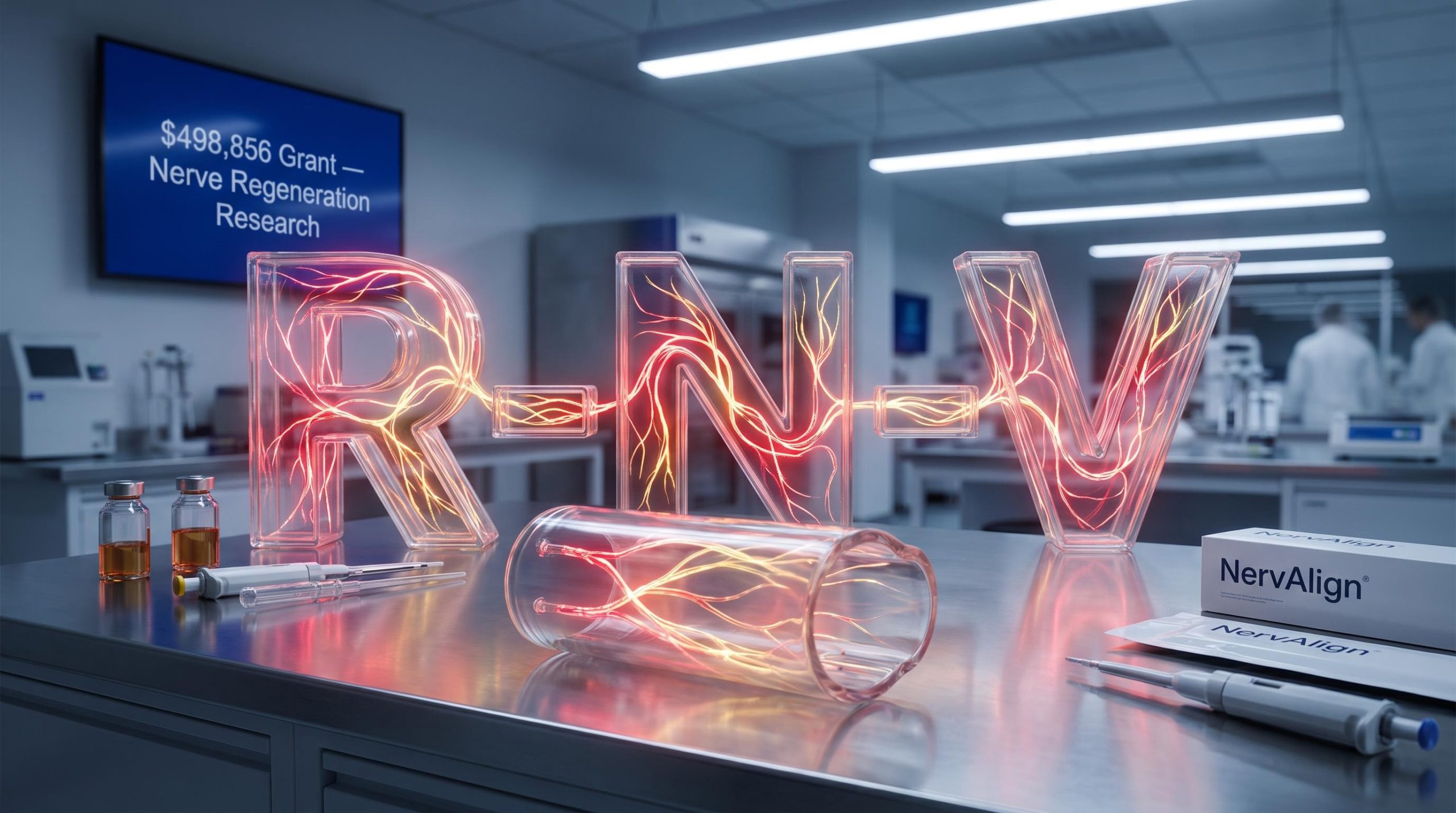
$499k grant secured for nerve regeneration research
ReNerve Limited, in partnership with the Royal Melbourne Institute of Technology (RMIT) and Associate Professor Shadi Houshyar, has been awarded a $498,856 grant from the Commonwealth of Australia through the Department of Education. The funding supports a ReNerve nerve regeneration project that uses patients’ own blood to accelerate nerve repair following prostate surgery.
The project, titled ‘Universal Platform for Tissue Regeneration and Healing: Addressing Nerve Injury’, received funding as part of Australia’s Economic Accelerator (AEA) Ignite Round 2 projects under the AEA Launch Program. Grant funding will be allocated between RMIT and ReNerve in accordance with the approved project budget.
For shareholders, the award represents access to collaborative research and potential future product development opportunities.
When big ASX news breaks, our subscribers know first
What the grant funds and where it fits
The partnership is focused on the development of a gel that is incorporated into a nerve cuff or wrap. According to the company, this gel could be used with additional tissue products such as ReNerve’s nerve conduits and nerve guide matrix.
ReNerve’s NervAlign products are designed not only to benefit patient recovery, but also as platforms for the delivery of cell therapies, enriched blood products and similar treatment products focused on accelerated nerve repair and recovery. The company notes the technology holds potential beyond prostate surgery.
The NervAlign Nerve Guide Matrix, a pipeline product designed to eliminate the secondary harvesting procedure required in current autograft surgery, has separately advanced to Stage 3 of a four-stage commercial production process ahead of FDA submission.
Chief Scientific Officer, Dr David Rhodes
“We are fortunate to be working with Associate Professor Houshyar on the next generation of nerve repair technologies and products. Being able to accelerate nerve regeneration would greatly benefit surgical outcomes as well as improving outcomes for patients.”
ReNerve’s product portfolio spans commercially available devices and pipeline candidates:
-
On market: NervAlign Nerve Cuff, Empliq Deep Dermal, and Empliq Amniotic tissue product ranges
-
In development: NervAlign Nerve Conduit Range, NervAlign Nerve Guide Matrix, and NervAlign Bionic Nerve
Why peripheral nerve repair matters
Peripheral nerve injury (PNI) refers to damage to the nerves that carry signals between the brain and spinal cord and the rest of the body. When these nerves are damaged during surgery, recovery can be slow and, in some cases, incomplete. Technologies that accelerate nerve regeneration aim to improve how quickly and how fully patients recover.
Prostate surgery, or prostatectomy, is a common context where nerve damage can occur. The nerves surrounding the prostate are delicate, and their disruption during surgery can affect patient outcomes. Accelerating regeneration in this setting could support improved surgical results.
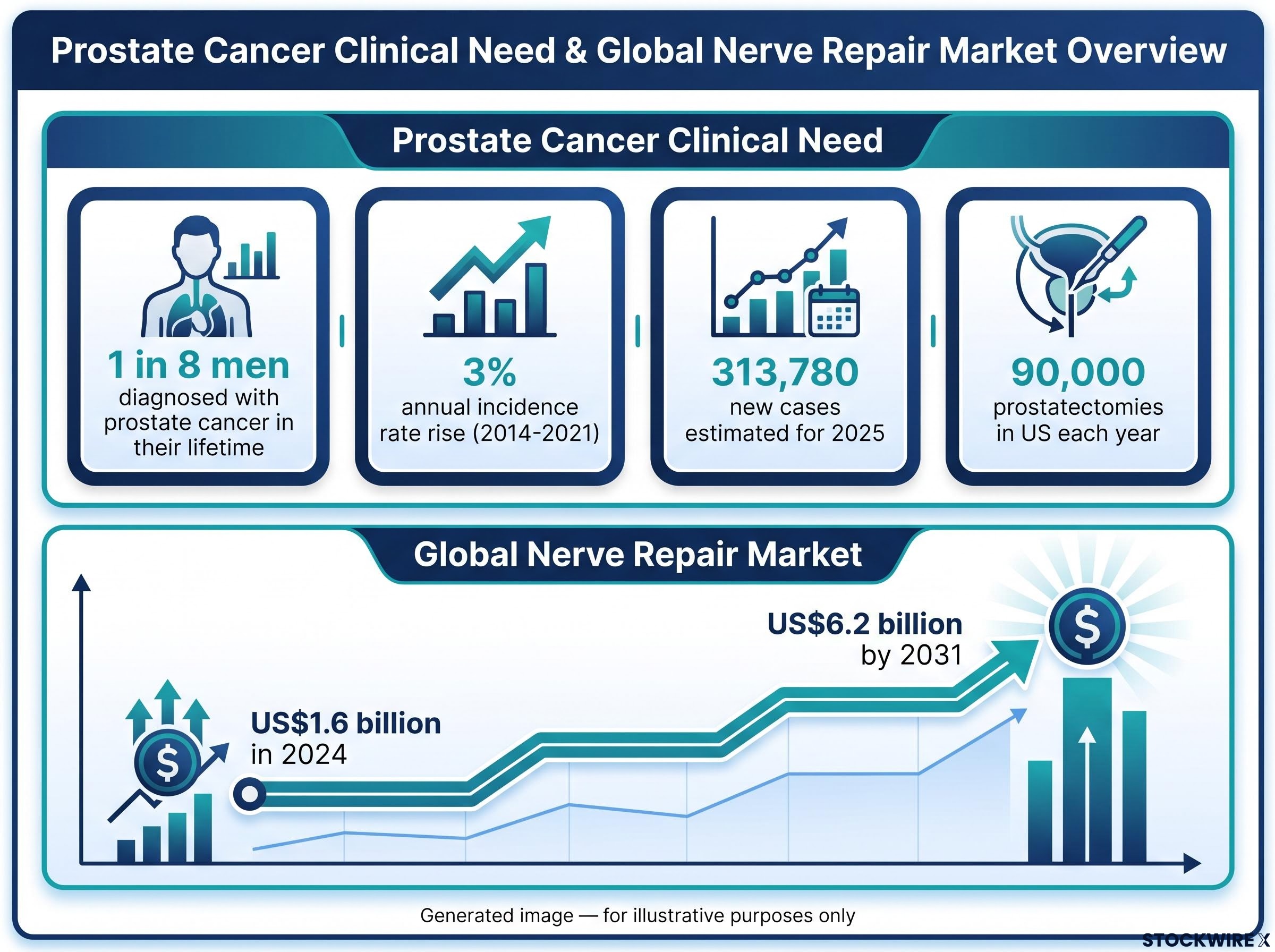
The clinical need is sizeable. According to figures cited in the announcement:
-
Approximately 1 in 8 men are diagnosed with prostate cancer in their lifetime
-
Incidence rates are rising by 3% annually as of 2014–2021, reversing previous declines
-
Roughly 313,780 new cases are estimated for 2025
-
Around 90,000 prostatectomies are undertaken in the US each year
A large and growing patient population underlines the potential addressable market for technologies targeting nerve repair after prostate surgery.
The investment case: platform potential and traction
The grant can be viewed as external validation of ReNerve’s platform strategy, providing R&D funding without diluting existing shareholders. It also positions the company alongside an academic research partner in RMIT.
The grant follows a separate non-dilutive funding event in which ReNerve received a $517,133 R&D Tax Incentive Refund from the ATO, reinforcing a pattern of securing external capital to fund development without drawing on shareholder equity.
To provide context, the company’s background material points to existing commercial traction. Since its 2022 product launch, ReNerve achieved 53% revenue growth in FY25, reaching $271k in sales for the year. These figures relate to prior commercial performance rather than the newly announced grant.
The company also references a clinical study of its FDA-cleared NervAlign Nerve Cuff. According to that study, patients treated with the device experienced post-surgical pain scores dropping from 7.1 to 0.4, compared with a drop from 7.1 to 3.3 without the device being used, described by the company as a statistically significant improvement.
ReNerve cites the global nerve repair market as valued at US$1.6 billion in 2024, with projections to reach $6.2 billion by 2031.
| Milestone / Metric | Detail | Investor Relevance |
|---|---|---|
| Grant amount | $498,856 | R&D funding |
| Partner | RMIT / A/Prof Houshyar | Academic R&D validation |
| FY25 revenue | $271k (+53%) | Commercial momentum |
| Market size 2031 | US$6.2bn | Large growth runway |
What happens next
The partnership is underway, and ReNerve has stated it will provide shareholders with ongoing updates as the project progresses.
Investors should note the early-stage nature of the work. The company has been clear that the project is currently at the research and development stage, and there can be no assurance that the technology will achieve its intended objectives, obtain regulatory approvals, or result in a commercial product.
On balance, the grant strengthens ReNerve’s pipeline and R&D capability, while pairing the company with an academic partner in the pursuit of next-generation nerve repair technologies.
Don’t Miss the Next Healthcare Breakthrough on ASX
Big News Blast delivers FREE breaking ASX healthcare news directly to your inbox within minutes of release, complete with in-depth analysis already done for you. Join 20,000+ investors who stay ahead of the market the moment announcements drop. Click the “Free Alerts” button at StockWire X to start receiving alerts today.