
RLS-2202 Phase 1a trial advances to Cohort 2
Patrys Limited (ASX: PAB) has advanced its RLS-2202 Phase 1a trial to Cohort 2, after the Safety Review Committee (SRC) completed its evaluation of first-cohort data in healthy volunteers. The study is designed to support a new intravenous delirium treatment option.
All four participants in Cohort 1 completed dosing and the protocol-defined safety observation period. Following review of the available safety, tolerability and pharmacokinetic data, the SRC concluded that RLS-2202 demonstrated an “acceptable safety and tolerability profile at the initial dose level” and recommended progression to the second cohort.
The Cohort 2 dose was determined in accordance with the study’s predefined dose-escalation design. The announcement does not disclose the dose itself.
Patrys said it remains on track to complete dosing in the Phase 1a trial in Q4 2026. Recruitment for Cohort 2 is expected to commence shortly.
Dr Samantha South, Chief Executive Officer
“Completing Cohort 1 is a key milestone for the RLS-2202 program. The Safety Review Committee has recommended advancing to Cohort 2…”
When big ASX news breaks, our subscribers know first
Why the bridging study matters
What a bridging study is
Quetiapine is an established oral drug with a well-established safety profile. RLS-2202, by contrast, is a new intravenous (IV) formulation.
IV delivery can produce a different exposure profile, meaning the way the drug appears in the bloodstream differs. Examples include a higher peak concentration and faster onset, with no first-pass metabolism (the processing of an oral drug by the body before it reaches the wider bloodstream).
The study aims to show how exposure to RLS-2202 compares with that of oral quetiapine. If it does, the existing oral safety and efficacy data can be used to support the IV formulation without repeating the full development program.
The study does not introduce a new active molecule.
Cohort 2 design
Cohort 2 uses a cross-over design to make this comparison:
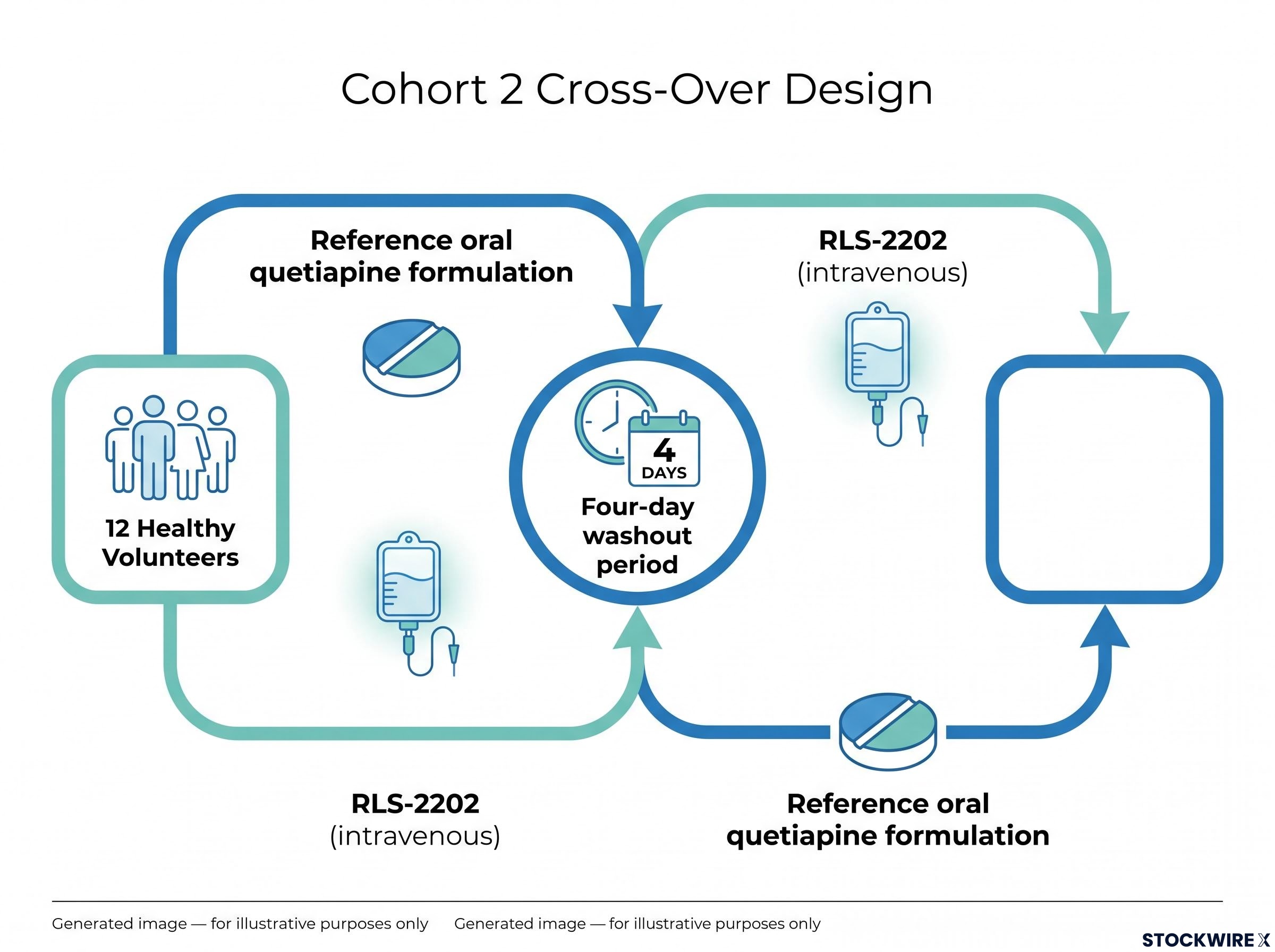
- 12 healthy volunteers
- Each receives both the reference oral quetiapine formulation and RLS-2202
- A four-day washout period separates the two doses
- The design is intended to reduce the influence of individual differences in metabolism on the interpretation of results
Recruitment for Cohort 2 is expected to commence shortly.
Investment significance
The pharmacokinetic and safety data are intended to support the bridging of the established oral quetiapine experience to the intravenous formulation. They are also intended to inform the design of the next clinical study and provide a foundation for future engagement with regulators, including the U.S. Food and Drug Administration.
Patrys has also formed a Clinical Advisory Committee that includes a Harvard-affiliated ICU specialist with FDA regulatory strategy experience, positioning the program for those US discussions.
Patrys said successful completion of the study “could materially streamline” the clinical development pathway. It also stated that a successful study has the “potential to materially reduce the development burden” associated with establishing a new intravenous treatment option for delirium.
Both statements are conditional on the study’s outcome, and the announcement does not state any regulatory result.
Delirium is a condition that can develop rapidly, is associated with serious consequences, and currently has limited options for rapid alleviation. The announcement does not disclose market size, pricing or trial results.
Cohort 2 timeline and next milestones
Patrys outlined the following key upcoming milestones for the RLS-2202 Phase 1a study:
| Timing | Milestone |
|---|---|
| October 2026 | GMP RLS-2202 for Cohort 2 dosing will be released and delivered to CMAX |
| Q4 2026 | Complete screening and enrolment of Cohort 2 participants |
| Q4 2026 | GLP validation of the bioanalytical assay in the range required for Cohort 2 analysis |
| Q4 2026 | Cohort 2 dosing expected to commence and be completed this quarter |
Patrys intends to provide further updates as key clinical milestones are achieved and data from the study become available.
Patrys describes itself as a clinical-stage company developing an injectable therapy for delirium alongside a differentiated deoxymab platform targeting immune-mediated inflammatory diseases.
Don’t Miss the Next Biotech Breakout
Join 20,000+ investors getting FREE breaking ASX news delivered to their inbox within minutes of release, complete with in-depth analysis. Click the “Free Alerts” button at Big News Blast to receive healthcare and biotech alerts the moment market-moving announcements break.