


Patrys builds international clinical firepower behind RLS-2202 delirium program
Patrys Limited (ASX: PAB) has established an international Clinical Advisory Committee (CAC) to guide the clinical development of RLS-2202, its injectable formulation of quetiapine for the treatment of delirium in acute-care settings. The formation of the CAC comes as the company’s Phase 1 program in healthy volunteers is already underway, with the committee representing the next deliberate step toward designing credible patient studies.
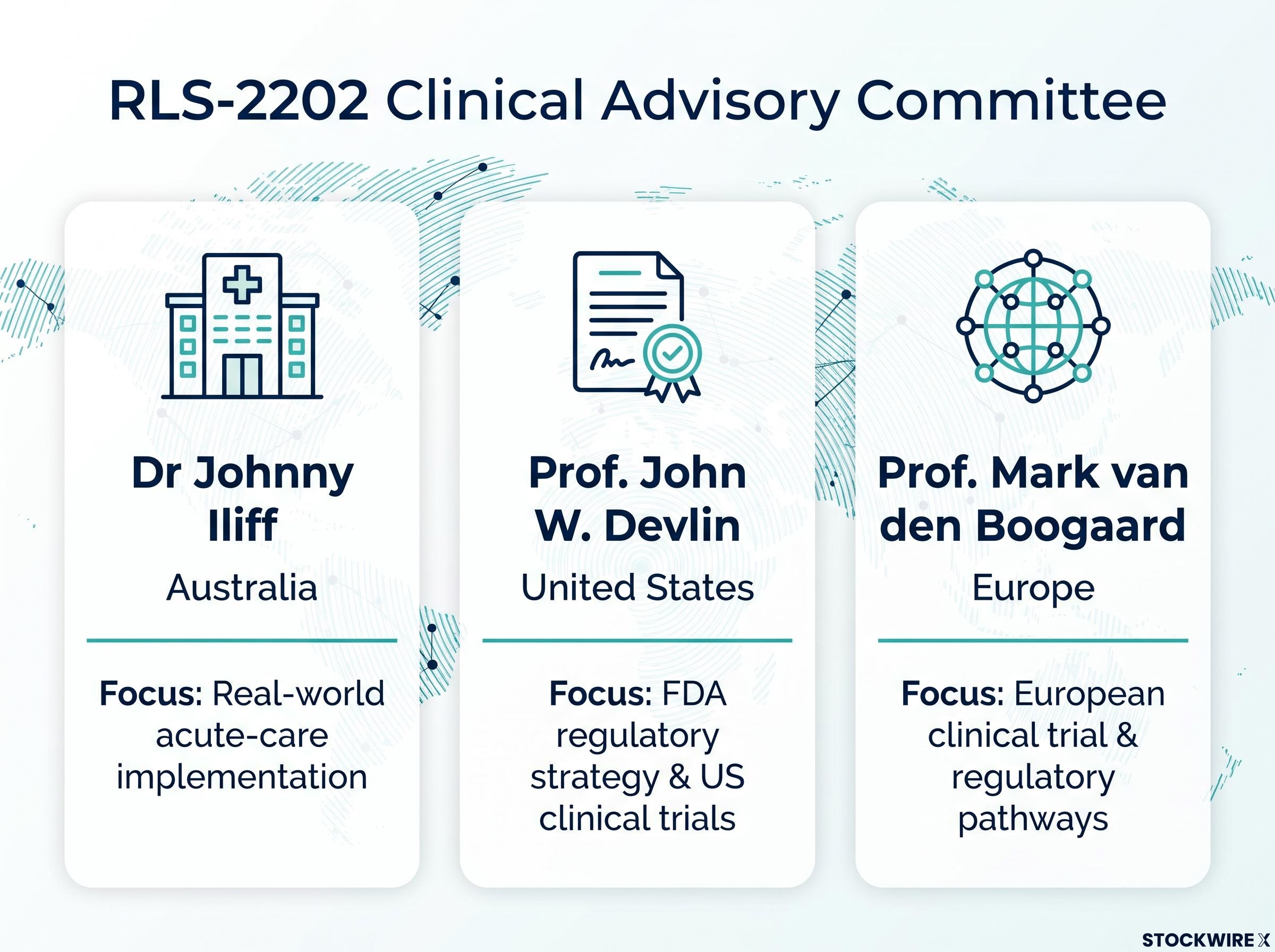
The CAC brings together senior clinicians and researchers from Australia, the United States and Europe. This international composition is intended to provide Patrys with perspectives across the clinical practice, trial design, and health-system environments relevant to its key target markets, including insight into FDA regulatory pathways and European clinical development considerations.
When big ASX news breaks, our subscribers know first
Meet the committee — three specialists shaping the RLS-2202 roadmap
Committee at a glance
| Member | Role on CAC | Institution | Country | Key Area of Expertise |
|---|---|---|---|---|
| Dr Johnny Iliff | Chair, Clinical Strategy Lead | Royal Perth Hospital / St John of God Murdoch Hospital | Australia | Acute and critical care, trauma, delirium prevention and management |
| Prof. John W. Devlin | Member | Northeastern University / Brigham and Women’s Hospital / Harvard Medical School | United States | Delirium research, antipsychotics in ICU, PADIS 2018 guidelines chair, NIDUS co-director |
| Prof. Mark van den Boogaard | Member | Radboudumc, Nijmegen | Netherlands (Europe) | ICU delirium prediction (E-PRE-DELIRIC model), PADIS guidelines, European Delirium Association |
What each member contributes to RLS-2202
- Dr Iliff: Ensures the development program is practical and implementable in real-world acute-care settings, and provides clinical input across Patrys’ broader pipeline.
- Prof. Devlin: Informs FDA regulatory strategy, US clinical trial and adoption pathways, and brings guideline authorship and large-scale implementation experience.
- Prof. van den Boogaard: Provides European clinical trial, regulatory, and delirium research network perspective for future EU market pathways.
Dr Samantha South, Chief Executive Officer
“We are delighted to welcome Dr Iliff, Professor Devlin and Professor van den Boogaard to our Clinical Advisory Committee. Their collective expertise will be instrumental as we advance RLS-2202 through clinical development, helping to ensure our trials are designed and executed to the highest scientific and clinical standards.
These appointments reflect Patrys’s continued focus on strengthening its clinical and academic leadership in critical care, delirium research and education. With our Phase 1 program now underway, their guidance will also be important as we look ahead to the design of subsequent clinical studies in patients with delirium.
Together, their expertise will deepen our engagement with the international ICU and delirium community and support the Company’s work to develop RLS-2202 as a potential treatment for delirium in acute-care settings.”
Why delirium in acute care is an underserved and commercially significant target
Delirium is an acute state of confusion that is common in critically ill and hospitalised patients. It represents a significant burden and challenge in acute and critical care.
Despite its prevalence and burden, existing treatment options remain limited. As Prof. Devlin noted in connection with joining the CAC:
Prof. John W. Devlin
“Despite the significant burden of delirium in critically ill patients, treatment options remain limited and there continues to be a need for well-designed clinical research in this area…”
RLS-2202 is an injectable formulation of quetiapine. The injectable route is particularly relevant in acute and ICU settings, where injectable administration is suited to the realities of acute-care settings.
RLS-2202 entered the Patrys pipeline through the Reliis acquisition completed in January 2026, which added injectable quetiapine to a company previously focused on its deoxymab antibody platform and marked a deliberate pivot toward lower-risk reformulation development.
What comes next for RLS-2202
With the Phase 1 program in healthy volunteers representing the current active stage of development, the CAC’s immediate mandate is to provide expert input into the design of subsequent clinical studies in patients with delirium. Key deliverables for the committee include guidance on:
HREC approval for Phase 1A was granted by Bellberry on 27 August 2026, clearing the primary ethics hurdle and confirming first participant dosing at CMAX in South Australia remains on track for the current quarter.
- Patient selection criteria
- Clinically meaningful endpoints
- Trial design and methodology
- Alignment with real-world clinical practice in acute-care settings
- Health system adoption considerations
The committee will also help connect Patrys with leading clinical centres and thought leaders to support later-stage development across Australia, the US and Europe.
For investors, a well-credentialed international CAC of this composition serves to reduce execution risk in a complex therapeutic area. By integrating expertise spanning FDA regulatory strategy, European clinical trial pathways, and real-world acute-care implementation, the committee is intended to position future RLS-2202 studies for credibility with regulators and clinical communities across Patrys’ key target jurisdictions.
Don’t Miss the Next Healthcare Breakthrough on ASX
Big News Blast delivers FREE breaking ASX healthcare news directly to your inbox within minutes of release, complete with in-depth analysis. Join 20,000+ investors already staying ahead of the market. Click the “Free Alerts” button at StockWire X to start receiving alerts the moment market-moving news breaks.