
LTR Pharma’s OROFLOW secures ethics approval, opening a US$8.1 billion gastrointestinal opportunity
LTR Pharma (ASX:LTP) has confirmed that the South Eastern Sydney Local Health District Human Research Ethics Committee (HREC) has approved an investigator-initiated clinical study evaluating OROFLOW® in patients with Oesophageal Motility Disorders (OMD).
The approval marks the first gastrointestinal application of the company’s proprietary intranasal platform to enter formal clinical evaluation. It is also the first formal clinical assessment of the platform outside erectile dysfunction (ED), broadening the technology beyond a single-indication focus.
The study will be independently led by Dr Peter Wu, Director of St George Motility Services at St George Hospital. It follows preliminary clinical observations by Dr Wu suggesting that intranasal PDE5 inhibitor therapy may improve swallowing function and reduce eating-related chest pain in patients with OMD.
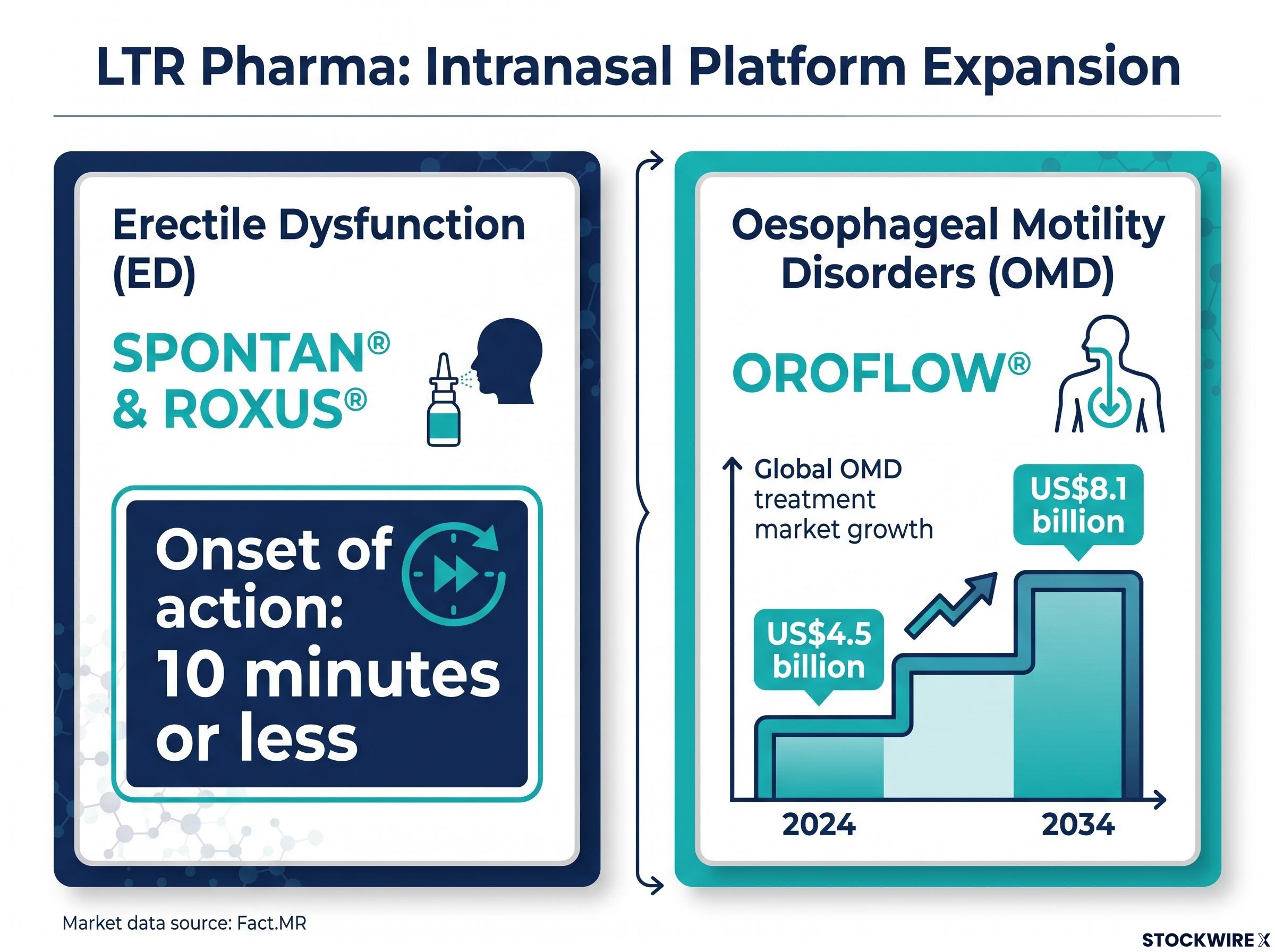
The commercial backdrop is meaningful. The global OMD treatment market was estimated at approximately US$4.5 billion in 2024 and is projected to reach US$8.1 billion by 2034, according to Fact.MR.
When big ASX news breaks, our subscribers know first
Why the OROFLOW study matters for the investment case
For investors, the strategic value lies in platform optionality. A successful study is expected to provide proof-of-concept data on the broad applicability of the intranasal platform, potentially supporting additional intranasal therapies beyond ED.
The same rapid-acting delivery technology underpins LTR Pharma’s two commercialised ED products, SPONTAN® and ROXUS®, fast-acting intranasal sprays designed to enable onset of action in 10 minutes or less. OROFLOW applies that delivery base to a new therapeutic area.
The ROXUS US commercial launch, structured through a binding term sheet with Shed Holdings targeting 150,000 prescription units in the first 12 months, illustrates the commercial scale the intranasal platform is already pursuing in parallel with the OROFLOW expansion.
OMD remains an area of significant unmet need. Many patients ultimately require invasive interventions, leaving them facing a difficult choice between living with debilitating symptoms and undergoing procedures such as surgery or repeated dilation.
The funding structure is notable for its independence. The study is funded by a research grant from LTR Pharma, administered through the South Eastern Sydney Local Health District. As an investigator-initiated study, it is designed, led and conducted independently by Dr Wu and his team, with no payments made to the investigators beyond their usual salaries.
Executive Chairman Lee Rodne
“OROFLOW represents an exciting opportunity to apply the same rapid-acting intranasal delivery technology underpinning SPONTAN and ROXUS to a completely new therapeutic area. The decision by a leading motility specialist to independently evaluate this approach reflects growing clinical interest in the broader potential of our platform. We are pleased to support research that could ultimately provide patients with a fast-acting, non-invasive alternative to existing treatment approaches.”
The thesis is straightforward: a single technology base offering multiple potential shots on goal.
Understanding Oesophageal Motility Disorders and how OROFLOW works
Oesophageal motility disorders are conditions characterised by abnormal movement and coordination of the oesophagus. This leads to impaired swallowing, known clinically as dysphagia, and painful oesophageal contractions. Subtypes include achalasia, oesophageal outflow obstruction, diffuse oesophageal spasm and hypercontractile oesophagus.
The science behind the approach centres on PDE5 inhibitors, a class of drugs that relax smooth muscle and reduce lower oesophageal sphincter pressure. This may render the oesophagus more distensible, allowing swallowed food to pass and empty more effectively. The anticipated clinical benefit is improved oesophageal emptying alongside a reduction in dysphagia and chest pain during eating.
As a non-invasive intranasal spray, OROFLOW may be particularly suited to patients with swallowing difficulties. It removes the need to swallow an oral tablet while offering a rapid route of administration.
SPONTAN Phase II interim data confirmed a median Tmax of 10 minutes across 27 subjects, compared with 60 minutes for oral vardenafil, establishing the pharmacokinetic foundation that OROFLOW’s study design now draws on for a new therapeutic area.
Current OMD interventions are typically invasive, including surgery, pneumatic dilation, and botulinum toxin injection.
Study design and what comes next
The PILOT study will be conducted in two stages, structured to build evidence progressively before advancing to patients.
-
Stage one assesses the time course of OROFLOW’s effect in healthy volunteers.
-
Stage two progresses to patients with OMD.
-
Investigators will evaluate effects on oesophageal contractility, bolus flow timing and bolus distension pressure.
The study population includes individuals scheduled to undergo Peroral Endoscopic Myotomy (POEM), drawn from those diagnosed with:
-
Achalasia
-
Oesophageal outflow obstruction
-
Diffuse oesophageal spasm
-
Oesophageal hypercontractility
The Company expects study initiation in the coming quarter and will provide updates on recruiting progress and data availability as milestones are achieved.
Dr Peter Wu
“Patients with achalasia and related motility disorders often face a difficult choice between living with debilitating symptoms and undergoing invasive procedures such as surgery or repeated dilation. In my practice, I have treated several achalasia patients with this intranasal approach and observed meaningful improvements in their ability to swallow, along with a reduction in chest pain during eating. These early observations are encouraging, but they need to be tested rigorously, which is the purpose of the PILOT study. If we can confirm a measurable effect on oesophageal function, a fast-acting and non-invasive treatment could change how these patients are managed, potentially reducing or delaying the need for surgery.”
For investors, the development provides a clear near-term milestone timeline to track. Study initiation in the coming quarter, recruitment progress, and the eventual release of data each represent catalysts that will test the broader potential of the intranasal platform.
Don’t Miss the Next Healthcare Breakout
Big News Blast, the FREE alert service from StockWire X, delivers breaking ASX healthcare news directly to your inbox within minutes of release, complete with in-depth analysis. Join 20,000+ subscribers already tracking the next market-moving announcement. Click the “Free Alerts” button to stay ahead of the market before the rest catch on.