
Immutep reports first survival data from EFTISARC-NEO in CTOS 2026 abstract
Immutep Limited (ASX: IMM; NASDAQ: IMMP) has announced the release of a Connective Tissue Oncology Society (CTOS) 2026 abstract reporting first survival data from EFTISARC-NEO, the investigator-initiated Phase II trial of eftilagimod alfa (efti) plus KEYTRUDA® (pembrolizumab) and radiotherapy as neoadjuvant treatment for resectable soft tissue sarcoma (STS).
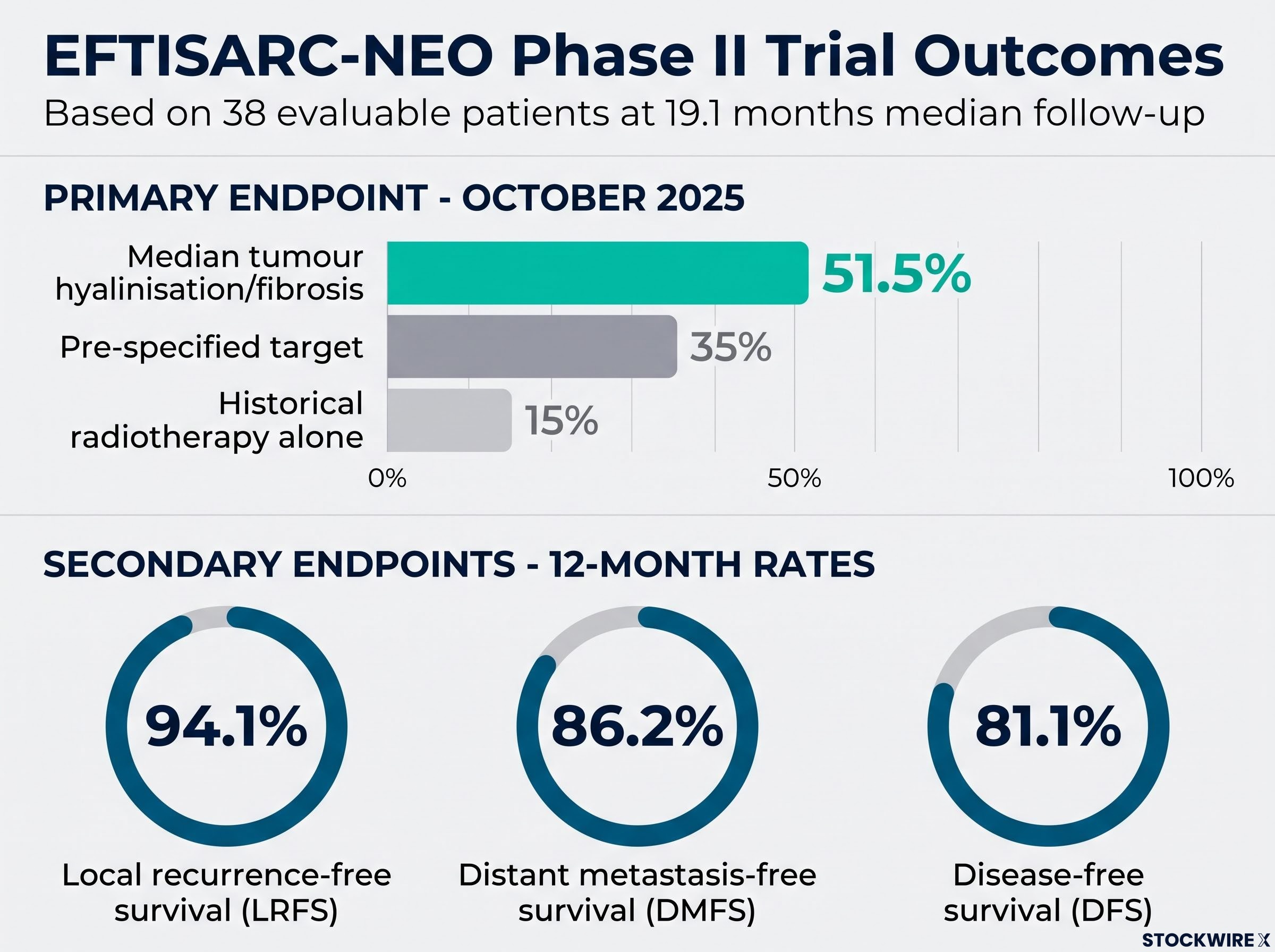
With a median follow-up of 19.1 months, the 12-month survival rates were reported in 38 evaluable patients, with a data cut-off of 30 April 2026. The survival outcomes are secondary endpoints of the trial.
The 12-month rates were:
- 81.1% disease-free survival (DFS)
- 94.1% local recurrence-free survival (LRFS)
- 86.2% distant metastasis-free survival (DMFS)
Further and new analyses will be presented in a poster discussion session on 19 November 2026 and will be the subject of a further announcement by the Company.
What the investigators concluded
The investigators concluded that efti plus pembrolizumab on top of standard radiotherapy as neoadjuvant therapy showed promising preliminary long-term outcomes warranting registrationally relevant trials in patients with STS.
No differences in DFS were observed across tumour grade, stage or histological subtype. The investigators also reported that high infiltration by tumour-infiltrating lymphocytes (TIL) and tumour hyalinisation/fibrosis after therapy may be associated with better DFS, but that longer follow-up is necessary.
Follow-up for DFS and overall survival is ongoing.
When big ASX news breaks, our subscribers know first
Building on a trial that already met its primary endpoint
The survival figures follow earlier results from the trial. The sequence reported by the company runs as follows:
- October 2025: EFTISARC-NEO met its primary endpoint, with a median tumour hyalinisation/fibrosis of 51.5% in 38 evaluable patients, well above the pre-specified target of 35% and approximately 15% historically observed with radiotherapy alone.
- October (ESMO Congress 2026): health-related quality of life data showed no significant deterioration during treatment and a statistically significant improvement following surgery.
- April 2026: the U.S. Food and Drug Administration (FDA) granted Orphan Drug Designation to efti for the treatment of STS.
How efti works
Efti is Immutep’s proprietary soluble LAG-3 protein and MHC Class II agonist. It activates antigen-presenting cells through the MHC Class II pathway, engaging both innate and adaptive immunity, including the priming of cytotoxic CD8+ T cells and the production of co-stimulatory signals and cytokines.
Neoadjuvant therapy is treatment given before surgery. Once a pathological response has been shown, survival measures such as DFS indicate how long patients remain free of disease after treatment.
The EFTISARC-NEO quality of life results add a patient-reported layer to these survival measures, with fatigue falling by up to 14.2 points on the QLQ-C30 scale after surgery.
Efti’s favourable safety profile enables combination with anti-PD-(L)1 therapy, radiotherapy and/or chemotherapy. It has received Fast Track designation from the FDA in first-line head and neck squamous cell carcinoma and first-line non-small cell lung cancer, and Orphan Drug Designation in soft tissue sarcoma.
Trial structure and Immutep’s role
EFTISARC-NEO is an investigator-initiated, open-label Phase II trial. Its key features are:
- Leadership: the Maria Skłodowska-Curie National Research Institute of Oncology in Warsaw, Poland.
- Funding and supply: primarily funded by a grant from the Polish Medical Research Agency, with Immutep supplying efti.
- Primary endpoint: pathological response, measured as the percentage of tumour hyalinisation/fibrosis at resection.
- Secondary endpoints: safety, DFS, LRFS, DMFS, overall survival, radiological response and health-related quality of life.
- Enrolment: 40 patients enrolled, with enrolment completed in January 2025 (ClinicalTrials.gov: NCT06128863).
What happens next for Immutep
- 18 to 21 November 2026: the CTOS 2026 Annual Meeting is held in Seoul, South Korea.
- 19 November 2026: a poster discussion session presents further and new EFTISARC-NEO analyses, which will be the subject of a further announcement by the Company.
- Following the presentation: the poster with updated data will be made available on the Posters & Publications page of Immutep’s website at www.immutep.com.
- Ongoing: follow-up for DFS and overall survival continues.
Want Alerts Like This on the Biotech Stocks You Follow?
StockWire X Market Intelligence scores every announcement in our coverage for how significant it’s likely to be for investors, and which way it points, then alerts you on the stocks you follow. The first 1,000 founding members lock in 50% off for life: A$247 a year instead of the standard A$495. Join the founding waitlist today.