
Genetic Signatures narrows FY2026 net loss 30% as restructure and new contracts reset the business
In its FY2026 Financial Results and Market Update presentation, released on 25 August 2026, Genetic Signatures detailed a full-year net loss of $14.0M, down 30% on the prior year (FY25: $20.1M). The molecular diagnostics company reported a net operating cash outflow of $7.8M, a 37% improvement, and ended the period with $22.1M in cash and term deposits at 30 June 2026 and no debt.
Revenue softened to $14.8M, down 7%, which management attributed to a competitive, price-sensitive market and a delayed Australian respiratory season.
The presentation framed FY2026 as a reset year, with a new CEO appointed, a comprehensive organisational review completed and the release of the company’s growth strategy. For investors, the narrative centres on cost discipline improving the loss trajectory while the balance sheet remains strong.
When big ASX news breaks, our subscribers know first
FY2026 financial results in detail
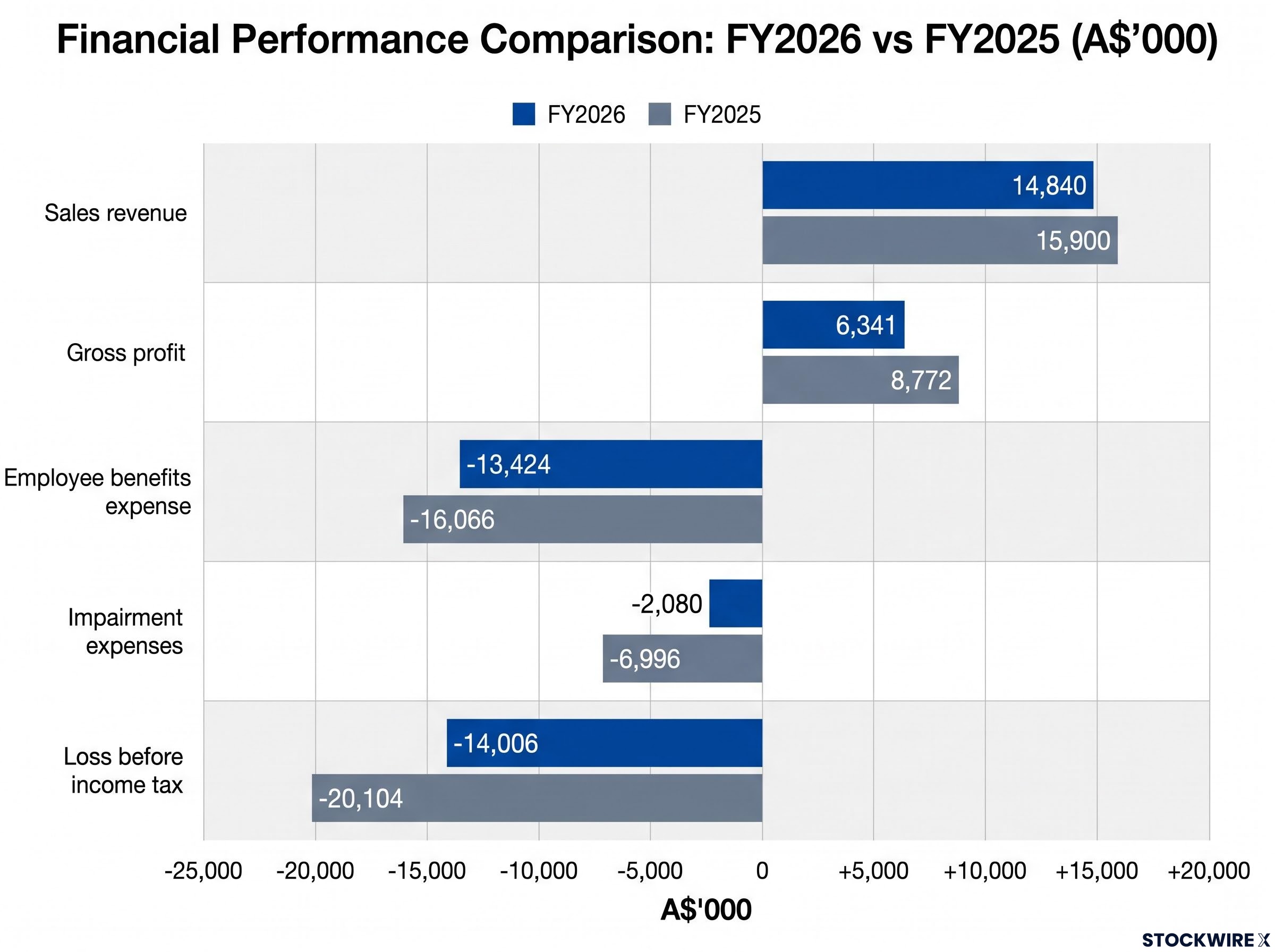
The results showed improving operational performance despite the lower revenue base. Gross profit fell to $6.3M from $8.8M, reflecting higher cost of materials, but reductions in employee costs and impairment expenses drove the narrowing of the overall loss.
| Metric | FY2026 (A$’000) | FY2025 (A$’000) |
|---|---|---|
| Sales revenue | 14,840 | 15,900 |
| Gross profit | 6,341 | 8,772 |
| Employee benefits expense | (13,424) | (16,066) |
| Impairment expenses | (2,080) | (6,996) |
| Loss before income tax | (14,006) | (20,104) |
Key takeaways from the results included:
-
Employee expenses reduced 16%, reflecting the early results of the FY2026 organisational restructure
-
Net operating cash outflow down 37% to $7.8M
-
Cash and term deposits of $22.1M at 30 June 2026, with no debt
The narrowing of losses was driven by cost control rather than revenue growth, which sets the context for the restructure detailed next.
The 1H FY26 results, reported in February 2026, showed revenue of $8.7M and a cash position of $29.9M, providing the baseline from which the full-year loss trajectory and cash drawdown reported here can be tracked across the financial year.
The organisational reset and $5M in annual savings
Management outlined an organisational restructuring completed in April 2026, following a line-by-line expenditure review. The company detailed expected annualised cost savings of $5M from FY2027 onwards, alongside new purchasing processes and controls anticipated to deliver further operational savings.
The presentation also noted the establishment of an AI policy and the beginning of AI-enablement across administrative and certain product development functions. The company also increased its cash runway to allow for the organisation to deliver on key strategic objectives.
The reset was structured around three pillars:
-
Reset organisational and cost structure
-
Secured long-term supply agreements
-
Reset product and instrument strategy, pausing development of customised automation equipment and commencing sourcing of off-the-shelf robotics
Notably, the $5M in savings is expected to land in FY2027, meaning the financial payoff sits ahead of the FY2026 numbers rather than within them.
New supply agreements anchor the revenue base
The company secured two long-term supply agreements during the period as evidence of commercial traction. A ten-year supply agreement was signed with Hvidovre Hospital, Denmark, with validation completed and commercial testing commenced in August 2026, which management described as demonstrating traction in the EMEA market.
The ten-year supply agreement with Hvidovre Hospital was secured through a competitive tender process, with the EasyScreen Pan-Enteric assay replacing fragmented multi-platform testing across 28,000 gastrointestinal samples in year one, growing at approximately 3% annually.
A long-term Australian supply agreement was also secured for the EasyScreen™ gastrointestinal and respiratory detection kits, featuring built-in annual growth.
Key contract highlight
The ten-year Hvidovre Hospital agreement, with commercial testing underway from August 2026, was positioned by management as opening new opportunities across Europe.
What syndromic molecular testing is, and why it matters
Syndromic multiplex PCR is a diagnostic approach that screens for multiple pathogens from a single sample. Genetic Signatures’ solutions screen up to 24 pathogens in a single automated test using patented 3base® technology.
Key benefits outlined in the presentation include:
-
Improved sensitivity, specificity and reliability compared to traditional methods
-
Support for antimicrobial stewardship through targeted, appropriate treatment
-
Increased pathogen coverage in a single test
-
Reduced patient burden, requiring only a single sample
-
Reduced labour, handling and errors through automated workflows
-
Faster results, reducing turnaround from days to a few hours
On market context, the presentation cited Mordor Intelligence data indicating growth in the syndromic multiplex diagnostic market is expected across all regions over 2026 to 2031, with the strongest growth anticipated across APAC markets. Drivers include a rising global population, the prevalence of infectious disease, and the transition from traditional testing methods.
Genetic Signatures’ EasyScreen™ products are accessible in over 30 countries, with CE-IVD, FDA, TGA or RUO status. The growing addressable market underpins the company’s growth strategy.
Growth strategy and FY2027 outlook
Management outlined a three-phase growth roadmap, moving from Stabilise to Optimise to Scale. The Stabilise phase, covering the restructure, product strategy and financial controls, was marked as completed, while re-entry to the US market was noted as “Not yet commenced.”
| Phase | Timeframe | Focus |
|---|---|---|
| Stabilise | Mar–Aug 2026 | Restructure, product strategy, secure AU business, financial controls (completed) |
| Optimise | Aug 2026–Mar 2027 | Finalise strategy, APAC market access, productivity |
| Scale | Mar 2027–Mar 2028 | APAC rollout, new product launches, EMEA/AU revenue growth (progressing); US re-entry not yet commenced |
The outlook set out six priorities for delivering on the strategy:
-
Grow revenue on the stabilised business through current and new customer relationships
-
Focus on profitability, with margin discipline a key objective for FY2027 and beyond
-
Outsource non-core product development to limit product risk
-
Continue disciplined, outcome-based capital deployment
-
Pursue new APAC and EMEA growth opportunities alongside Australian product extensions
-
Continue to focus on manufacturing, distribution and corporate partnerships
FY2026 was presented as a reset year, with narrowed losses, a stronger cost base, secured long-term contracts and a defined roadmap. With $5M in expected annualised savings and margin discipline positioned to support FY2027, the company framed itself as better placed to grow revenue on a stabilised business.
Ready to Explore Genetic Signatures’ Growth Strategy and Long-Term Contracts?
Genetic Signatures has completed its organisational reset, secured a ten-year supply agreement with Hvidovre Hospital and outlined a phased roadmap targeting APAC and EMEA expansion — all while narrowing its net loss by 30% to $14.0M in FY2026. With $5M in annualised savings expected from FY2027 and a debt-free balance sheet of $22.1M in cash, the company is positioned to shift from stabilisation to growth.
Investors seeking a deeper understanding of the EasyScreen™ product suite, commercial pipeline and strategic priorities can explore the Genetic Signatures investor and product centre for the latest information on the company’s molecular diagnostics platform and global market access across more than 30 countries.