

First patient completes 60-minute TRP-8803 infusion in Cohort 2
Entropy Neurodynamics (ASX: ENP) has dosed the first patient in Cohort 2 of its Phase 2 study of TRP-8803 (IV-infused psilocin) for Binge Eating Disorder (BED). The patient was dosed over 60 minutes on Monday 5 October and was safely discharged after all required post-treatment clinical assessments.
The infusion formally marks the commencement of dosing in Cohort 2. It follows the Cohort 1 results (refer ASX announcement of 14 September 2026).
During the infusion, the patient reported a maximum psychedelic intensity of 9/10 on the protocol-defined qualitative patient feedback measure of intensity of effect. According to the company, this is the first human evaluation within the study of the substantially shortened treatment model.
Cohort 2 is fully recruited, with all six required patients enrolled. Topline results are expected by the end of CY26.
When big ASX news breaks, our subscribers know first
Why a shorter infusion matters
140 minutes versus 60 minutes
Cohort 2 tests whether the TRP-8803 infusion can be reduced from 140 minutes to 60 minutes while retaining precise control over psychedelic onset, intensity and duration, together with positive clinical outcomes.
The loading dose is identical across both cohorts. The difference lies in the maintenance phase.
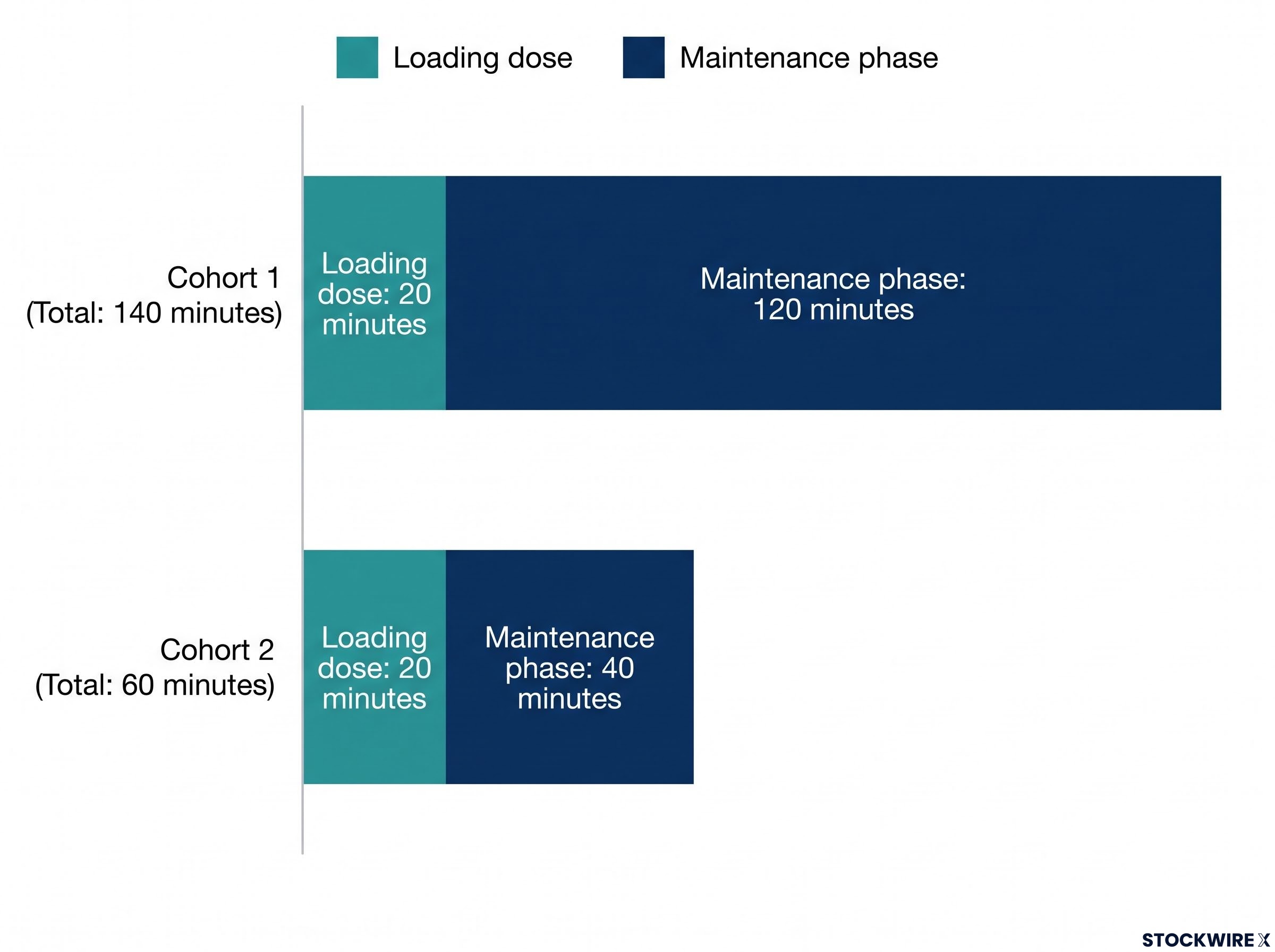
| Feature | Cohort 1 | Cohort 2 |
|---|---|---|
| Total infusion | **140 minutes** | **60 minutes** |
| Loading dose | **20 minutes** | **20 minutes** |
| Maintenance phase | **120 minutes** | **40 minutes** |
The company confirms overall TRP-8803 exposure is lower in Cohort 2, but says detailed conclusions on dose, exposure and clinical performance should await completion and analysis of the cohort.
Practicality and scalability
A shorter treatment window has the potential to reduce healthcare professional time and treatment-room requirements, and to increase patient throughput. The company says this could ultimately support a more practical and scalable treatment model within clinical practice.
For investors, treatment duration is a commercial lever. CEO Jason Carroll said treatment duration “…goes directly to one of the major challenges facing psychedelic medicine: whether these therapies can ultimately be delivered practically and at scale.”
How IV-infused psilocin differs from oral psilocybin
TRP-8803 is Entropy Neurodynamics’ proprietary formulation of IV-infused psilocin, the active metabolite of psilocybin. A metabolite is a substance the body produces when it breaks down a compound.
Oral psilocybin must first be absorbed and liver metabolised into psilocin before producing its psychedelic effects. TRP-8803 administers psilocin directly through a controlled IV infusion, which is designed to provide a more rapid onset and greater control over psychedelic intensity and duration.
Binge Eating Disorder is an eating disorder characterised by recurrent episodes in which a person consumes unusually large quantities of food while experiencing a sense of loss of control. Unlike bulimia nervosa, these episodes are not regularly followed by compensatory behaviours such as purging. Patients in Cohort 1 had treatment-resistant BED.
Control over duration is what could make a shorter session possible. That is the premise being tested in Cohort 2 of this precision-controlled approach.
Cohort 1 results at 12 weeks set the benchmark
Cohort 1 treated six treatment-resistant patients with two 140-minute infusions. The 12-week results form the reference point for Cohort 2.
The 12-week remission data showed the clinical gains holding in a population with a median BED duration of 15 years, which sets a demanding bar for any shorter regimen.
| Metric | Result |
|---|---|
| Response rate (clinically meaningful improvement in BED symptoms) | **100%** (all six patients) |
| Remission | **50%** |
| Reduction in weekly binge-eating episodes from baseline | **73%** |
| Patients with no binge-eating episodes across the 84-day follow-up | **three of six** |
| Quality of life improvement | **61%** |
- The improvements were accompanied by sustained reductions in anxiety and depression symptoms.
Jason Carroll, Chief Executive Officer
“…Cohort 2 asks an important next question – can we preserve the controlled psychedelic experience and positive clinical outcomes observed in Cohort 1 while reducing the infusion period to just 60 minutes.”
What investors should watch next
Caution on a single patient
The company states that no conclusion should be drawn from a single patient. Psychedelic intensity and clinical outcomes are different measures, so the 9/10 intensity reported by the first patient does not indicate clinical efficacy.
Whether the 60-minute regimen produces outcomes comparable with Cohort 1 will only be known after appropriate follow-up and analysis of the completed dataset. The company says it is too early to determine whether the 60-minute regimen would replace the 140-minute regimen.
Cohort 2 timeline and success markers
The study is intended to determine whether the shorter regimen can retain the characteristics and outcomes seen in Cohort 1. Of particular interest will be:
- Consistency of the psychedelic experience
- Safety and tolerability
- Improvement in BED symptoms and their durability
Dosing of the remaining participants will continue over the coming weeks, with topline results expected by the end of CY26.
The central question is whether TRP-8803 can preserve the controlled psychedelic experience and encouraging, durable clinical outcomes seen in Cohort 1 while reducing the infusion from 140 minutes to just 60 minutes.
Investors exploring what comes beyond BED can read our detailed coverage of the 72-patient basket trial, which covers the eight-indication design, the A$3.2 million budget and the Swinburne University agreement.
Ready to Explore the TRP-8803 60-Minute Infusion Study?
Entropy Neurodynamics has dosed the first patient in Cohort 2, testing whether TRP-8803 can cut infusion time from 140 minutes to 60 minutes. The result could shape a more practical and scalable treatment model for treatment-resistant Binge Eating Disorder.
Discover more about the TRP-8803 pipeline and the company’s clinical programs by visiting the Entropy Neurodynamics website. Topline Cohort 2 results are expected by the end of CY26.