


Durable results: all BED patients hold clinical gains at 12 weeks
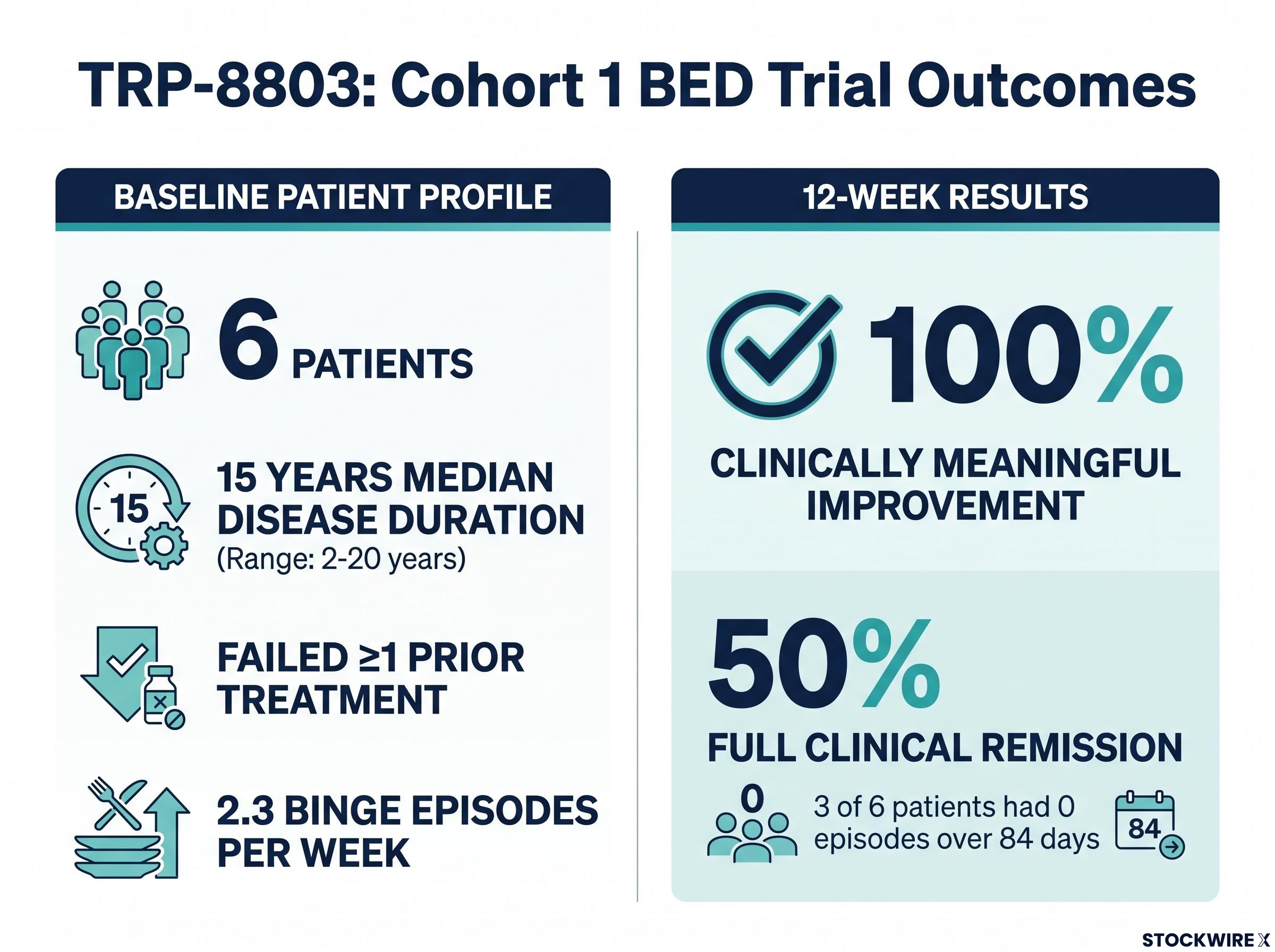
Entropy Neurodynamics Limited (ASX: ENP) has reported that all six patients in Cohort 1 of its Phase 2 trial of TRP-8803, an intravenous (IV)-infused psilocin formulation, maintained clinically meaningful improvement at the 12-week follow-up mark following completion of just two infusion sessions. Critically, this was a treatment-resistant population, not newly diagnosed patients, with a median Binge Eating Disorder (BED) duration of 15 years and a range of two to 20 years, and every patient had failed at least one prior BED treatment.
The headline durability figure sits alongside a 50% full clinical remission rate. Three of the six patients experienced zero binge-eating episodes across the entire 84-day follow-up period. Before entering the study, patients averaged 2.3 binge-eating episodes per week, a disease burden equivalent to approximately 28 episodes over the 12-week period. The combination of breadth (100% clinically meaningful improvement) and depth (50% remission) in a chronic, treatment-resistant group is the central clinical story from this data release.
When big ASX news breaks, our subscribers know first
4-week vs 12-week outcomes: how the response held
The table below presents the comparative outcomes at four weeks and 12 weeks across all measured endpoints.
| Outcome | 4-Week Result | 12-Week Result | Durability |
|---|---|---|---|
| Clinical remission | 50% | 50% | Maintained |
| Clinically meaningful improvement | 100% | 100% | Maintained |
| Weekly binge-eating episodes | 74% reduction | 73% reduction | Maintained |
| Anxiety | 58% reduction | 50% reduction | Sustained |
| Depression | 57% reduction | 42% reduction | Sustained |
| Life satisfaction | 63% improvement | 61% improvement | Maintained |
| Clinical Global Impression (CGI) | 33% improvement | 44% improvement | Improved |
The clinician-rated CGI score was the one measure that actually strengthened between four and 12 weeks, improving from 33% to 44%, a notable finding given that most subjective endpoints held relatively stable across the follow-up period.
What is IV-infused psilocin and why does the delivery method matter?
TRP-8803 differs from conventional oral psilocybin in both its chemistry and its delivery mechanism. The key distinctions for investors without a clinical background are straightforward:
- Psilocin is the active metabolite of psilocybin. TRP-8803 delivers it directly via IV infusion, bypassing the metabolic conversion step that oral psilocybin requires in the body.
- IV delivery allows clinicians to control the onset, depth, and duration of the psychedelic experience in real time, unlike a swallowed pill where dose delivery cannot be adjusted once ingested.
- Cohort 1 used two infusion sessions of 140 minutes each. Cohort 2 will test a shorter regimen of two sessions of 60 minutes each.
- Nine of the 12 treatment sessions reached maximum reported psychedelic intensity (10/10), with a mean peak intensity of 9.4/10 across all infusions.
The DSMB safety clearance that preceded Cohort 2 confirmed zero serious adverse events and zero discontinuations across all six Cohort 1 participants, and the independent board selected the 60-minute regimen specifically on the basis of that safety profile.
Treatment session duration matters commercially. Longer sessions consume clinical infrastructure and limit patient throughput, which is a known adoption barrier for psychedelic medicines. TRP-8803’s precision-controlled IV approach is specifically designed to address this constraint.
Independent preliminary EEG analysis of Cohort 1 identified large and reproducible changes in brain dynamics following TRP-8803 administration, including increased EEG complexity and substantial reductions in alpha activity across both treatment sessions, providing objective neurophysiological corroboration of the clinical response.
Regulatory tailwinds and what’s next for Entropy
The 12-week follow-up data carries an additional layer of relevance given the FDA’s July 2026 final guidance on psychedelic drug development, which specifically identifies Week 12 as an important efficacy assessment period for chronic psychiatric conditions such as Major Depressive Disorder (MDD) and Post-Traumatic Stress Disorder (PTSD). The company and the announcement are explicit that this represents regulatory alignment, not regulatory endorsement. Entropy’s Cohort 1 study is a small, open-label study and is not being presented as satisfying any FDA approval requirement.
CEO Jason Carroll addressed the significance of both the patient population and the durability outcome directly:
Jason Carroll, Chief Executive Officer
“…These were patients who had lived with Binge Eating Disorder for as long as 20 years and who had previously failed treatment. Before entering the study, patients averaged 2.3 binge-eating episodes every week. Following completion of just two TRP-8803 treatments, 50% of patients did not experience a single binge-eating episode during the entire 84-day follow-up period.”
Carroll also framed the company’s broader development thesis:
Jason Carroll, Chief Executive Officer
“…We are not seeking to develop another medicine that patients need to take every day. We are investigating whether a limited number of precision-controlled psychedelic treatments can produce a clinically meaningful benefit that persists long after dosing has finished.”
The next catalysts for the TRP-8803 programme are as follows:
- Cohort 2 BED topline results are expected in Q4 CY2026, evaluating a shorter 60-minute infusion regimen compared with the 140-minute sessions used in Cohort 1.
- Ongoing EEG and biomarker analysis to map brain dynamics to clinical outcomes and strengthen the mechanistic evidence base.
- Entropy’s broader 72-patient, eight-indication Australian clinical programme continues to progress.
- A proposed US Phase 2 MDD study in collaboration with the University of California, San Francisco (UCSF), announced 26 August 2026, represents the next major step into US pharmaceutical development.
The 72-patient basket trial received HREC approval to run all eight neuropsychiatric indications in parallel across nine cohorts, a capital-efficient structure estimated at A$3.2 million that positions TRP-8803 for simultaneous evidence generation across conditions well beyond BED.
The pipeline is deliberately multi-indication in design. BED is providing clinical validation of the TRP-8803 platform, while the proposed UCSF collaboration is the company’s intended entry point into the US market for MDD. Both threads are advancing concurrently, giving investors multiple near-term data catalysts to monitor.
The Cohort 1 12-week data represents the first meaningful evidence from a human, treatment-resistant population that TRP-8803’s core thesis holds: that a limited course of precision-controlled psychedelic treatment can produce clinical benefit that persists well beyond the dosing period. Larger, controlled studies will be required to characterise the optimal treatment regimen, retreatment intervals, and long-term durability. Entropy’s growing evidence base positions Cohort 2 results, expected in Q4 CY2026, as the programme’s next material clinical inflection point.
Ready to Track the Next TRP-8803 Data Catalyst?
Entropy Neurodynamics’ Phase 2 Cohort 1 results demonstrate that a 100% clinically meaningful improvement rate and 50% full remission were sustained across 84 days in a treatment-resistant BED population — following just two infusion sessions. With Cohort 2 topline results expected in Q4 CY2026 and a proposed US Phase 2 MDD study alongside UCSF now in motion, the programme’s near-term catalyst pipeline is substantial.
For the full pipeline overview, clinical data, and corporate updates, visit the Entropy Neurodynamics investor centre to stay ahead of the programme’s next material inflection point.