
Entropy secures HREC approval for world-first 72-patient basket study
Entropy Neurodynamics (ASX: ENP) has received Human Research Ethics Committee (HREC) approval to commence a Phase 1b/2a multi-indication basket study evaluating TRP-8803 (IV-infused psilocin) across eight major disorders in 72 patients. The Company has concurrently executed a new Clinical Trial Research Agreement (CTRA) with Swinburne University to conduct the trial.
Management has framed the milestone as the next phase in positioning TRP-8803 as a precision-controlled treatment platform for high-value disorders with large, undertreated patient populations. First patient dosing is expected during the current quarter, with dosing in one or more cohorts anticipated before the end of CY2026.
When big ASX news breaks, our subscribers know first
What the basket study covers
The approved study is an open-label Phase 1b/2a trial assessing the safety, tolerability and preliminary efficacy of TRP-8803. It is expected to enrol 72 participants across nine clinical cohorts of eight participants each.
The Treatment-Resistant Major Depressive Disorder (TRD) arm is split into two distinct cohorts: one comprising patients on stable antidepressant therapy (SSRI or other), and one comprising patients not receiving antidepressant treatment. This design allows the Company to assess safety and clinical activity across distinct TRD treatment settings.
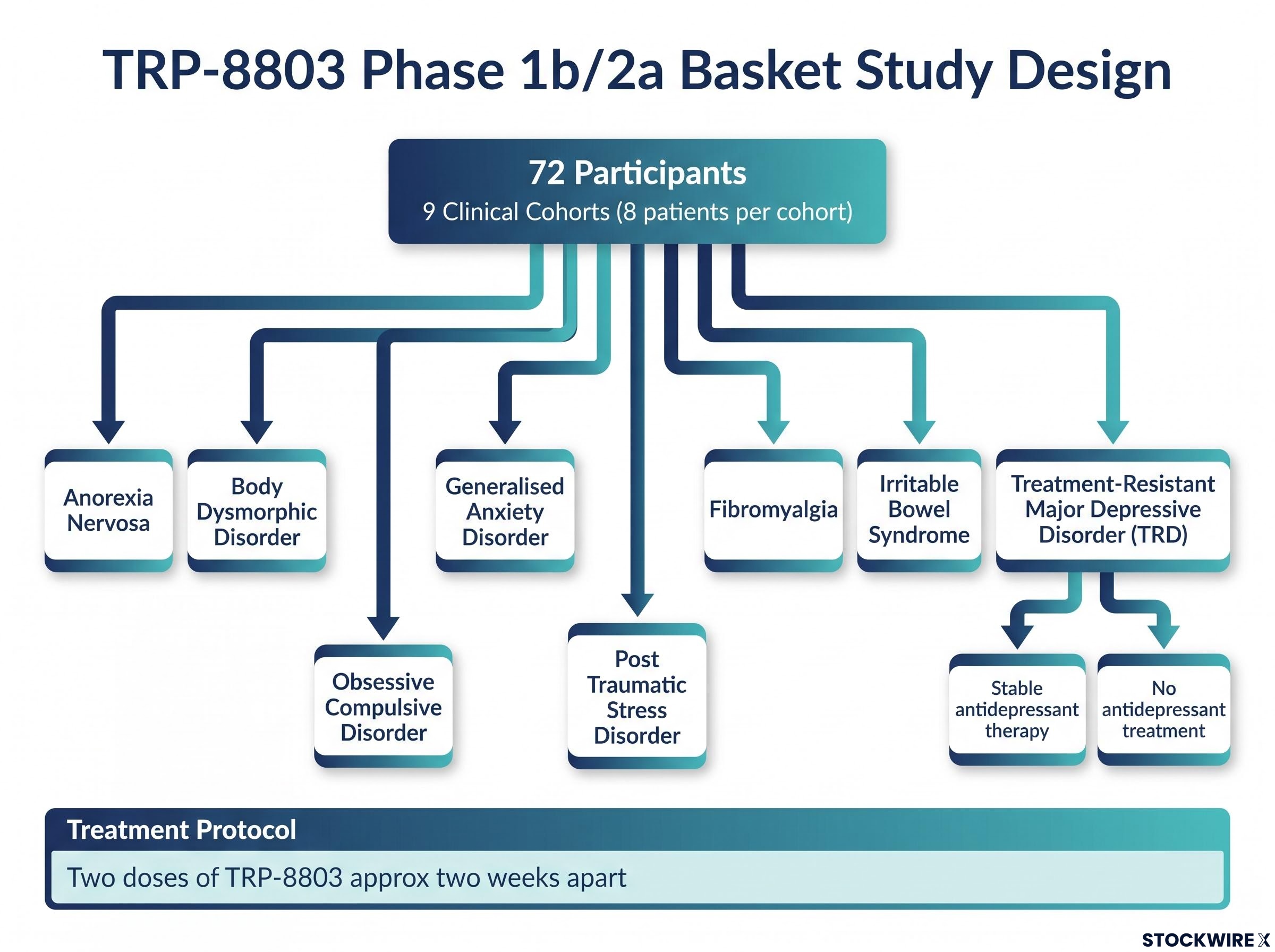
Participants will receive two doses of TRP-8803, administered approximately two weeks apart, alongside a structured psychedelic-assisted psychotherapy programme. The primary endpoint is safety, while secondary and exploratory endpoints will assess changes in anxiety, quality of life, disease-specific symptoms and broader patient-reported outcomes.
The protocol also incorporates advanced biomarker assessments, including MRI, functional MRI, electroencephalography (EEG), speech analysis and qualitative patient interviews, to further characterise the biological and clinical effects of the treatment across multiple indications.
| Indication |
|---|
| Anorexia Nervosa |
| Body Dysmorphic Disorder |
| Obsessive Compulsive Disorder |
| Generalised Anxiety Disorder |
| Post Traumatic Stress Disorder |
| Treatment-Resistant Major Depressive Disorder |
| Fibromyalgia |
| Irritable Bowel Syndrome |
Why a basket study — the strategic and capital-efficiency angle
The basket study marks a world-first initiative in neuropsychiatry, according to the Company, and an important strategic milestone in the development of TRP-8803. Rather than developing each indication in isolation, the design assesses the broader therapeutic potential of the proprietary intravenous psilocin platform across multiple disorders in parallel.
Capital efficiency sits at the centre of the rationale. The study is expected to cost approximately A$3.2 million, which does not include the Company’s pending R&D Tax Incentive refund opportunities. Running independent single-indication trials across every disorder would require substantially greater investment.
The design is also intended to reduce development risk. Because multiple opportunities are evaluated simultaneously, positive outcomes in one or more indications may create value even if some indications show limited response.
Underpinning the approach is a transdiagnostic thesis: many of the selected indications share common neurobiological mechanisms, including cognitive rigidity and altered brain network function, that may respond to precision-controlled psychedelic therapy.
CEO Jason Carroll
“Securing HREC approval and executing our expanded Clinical Trial Research Agreement with Swinburne University represents a significant milestone in the evolution of TRP-8803 from a promising lead asset into a scalable precision treatment platform capable of addressing multiple high-value neuropsychiatric disorders.”
“Following the highly encouraging clinical outcomes generated in treatment-resistant Binge Eating Disorder, we now can systematically evaluate TRP-8803 across eight additional disorders that share common underlying mechanisms. Rather than pursuing these indications sequentially, our world-first basket study enables us to evaluate them in parallel, significantly accelerating our understanding of where TRP-8803 has the greatest clinical and commercial potential.”
Building on strong Binge Eating Disorder results
The basket study builds on encouraging Phase 2 Binge Eating Disorder (BED) results (ASX announcement 7 July 2026). In the first patient cohort, the study achieved a 100% clinical response and 50% remission, alongside significant improvements in anxiety and depression.
These outcomes provide early clinical validation for the precision-controlled IV psilocin approach now being extended across eight further indications.
The basket study builds directly on Phase 2 BED results that showed a 100% clinical response rate and 50% complete remission across Cohort 1, with weekly binge episodes falling 74% from baseline and anxiety scores dropping 58% within four weeks of a single treatment session.
Understanding TRP-8803 and IV-infused psilocin
TRP-8803 is Entropy’s proprietary intravenously administered psilocin formulation. Psilocin is the active metabolite of psilocybin, the compound responsible for the therapeutic and psychoactive effects traditionally associated with psilocybin, and TRP-8803 is administered in conjunction with psychotherapy.
The formulation differs from oral psilocybin by delivering psilocin directly into the bloodstream, avoiding the need for gastrointestinal absorption and conversion. According to the Company, this delivery method offers several potential advantages:
-
Reduced pharmacokinetic variability and improved dosing precision
-
Ability to rapidly achieve and maintain target psilocin blood levels
-
Real-time control over treatment duration and intensity
-
Infusion can be paused or terminated if clinically required
-
Potentially shorter, more commercially feasible treatment duration
The transdiagnostic approach focuses on shared mechanisms across multiple disorders rather than treating each diagnosis in isolation. Entropy is investigating whether common processes, such as cognitive rigidity, inflexible beliefs and altered brain network function, may respond to TRP-8803 across different conditions. This differentiation forms a central part of the investment case relative to oral psychedelic competitors.
The Swinburne partnership expands clinical capacity
The concurrent CTRA with Swinburne University materially strengthens Entropy’s clinical development capability, building on the collaboration that has supported TRP-8803 to date. The expanded agreement provides access to additional clinical infrastructure to run multiple cohorts in parallel.
Key elements of the strengthened partnership include:
-
Greater dosing capacity through multiple dedicated treatment rooms
-
An expanded multidisciplinary team of investigators, psychiatrists, physicians, psychologists and psychedelic therapists
-
Enhanced research and operational support to help deliver multiple study cohorts in parallel
This enhanced capability is expected to improve patient throughput, support faster recruitment and dosing, and provide a scalable clinical research platform for future expansion of the Company’s development pipeline.
Next steps and what investors can watch for
Following HREC approval, the Company will complete the remaining regulatory and site governance requirements needed to commence the study, including Clinical Trial Notification (CTN) acknowledgement and site-specific governance approvals.
Patient recruitment will commence shortly, with first patient dosing expected during the current quarter. Subject to recruitment and operational timelines, the Company anticipates completing dosing in one or more indication cohorts before the end of CY2026. Management has described the period ahead as one of the most active and value-generating in the Company’s history.
Key milestones over the next 12 months include:
-
Recruitment and dosing progress
-
Cohort-level outcome data
-
Additional BED data
-
Biomarker analyses
-
Identification of lead indications
-
Validation of the broader transdiagnostic platform strategy
-
Potential partnering and development opportunities
The study is designed to generate a comprehensive clinical dataset for precision-controlled IV-infused psilocin, expanding the clinical evidence base while aiming to unlock development, commercial and partnering opportunities and further validate TRP-8803 as a scalable precision treatment platform.
For investors wanting to trace the step-by-step clinical progression that led to HREC approval for the basket study, our detailed coverage of the Cohort 1 BED dosing completion walks through how all six participants achieved a controlled and reproducible high-intensity psychedelic response, the timeline of DSMB review, and what the Cohort 2 enrolment status signalled about trial momentum heading into the second half of 2026.
Ready to Explore the World-First TRP-8803 Basket Study Opportunity?
Entropy Neurodynamics has secured HREC approval for a world-first, 72-patient basket study evaluating IV-infused psilocin across eight major neuropsychiatric disorders, building directly on a Phase 2 Binge Eating Disorder trial that achieved a 100% clinical response rate. At an estimated cost of A$3.2 million, the capital-efficient design positions TRP-8803 as a scalable precision treatment platform with multiple parallel pathways to clinical and commercial value.
Investors seeking a deeper understanding of the TRP-8803 pipeline, the transdiagnostic platform strategy and the broader development roadmap can explore the full Entropy Neurodynamics investor overview directly on the company’s website.