
Entropy Completes Cohort 1 Dosing in BED Trial With Consistent Patient Response

Entropy Neurodynamics hits key milestone in BED trial as all Cohort 1 patients complete dosing
Entropy Neurodynamics has announced the completion of dosing for all six participants in Cohort 1 of its Phase 2 trial evaluating TRP-8803 for Binge Eating Disorder. Each participant received two administrations of the IV-infused psilocin formulation 14 days apart, alongside supportive therapy. The trial targets 12 patients across two cohorts, with topline efficacy results for Cohort 1 expected in July 2026.
The announcement highlights a standout clinical observation: all Cohort 1 participants achieved a controlled and reproducible psychedelic response at high intensity. This consistency supports the company’s thesis that IV-infused psilocin may offer significant advantages over conventional oral psychedelic therapies. The trial is being conducted in collaboration with Swinburne University and is designed to evaluate the safety and feasibility of TRP-8803 whilst generating insights into treatment optimisation.
Management stated they are “very confident” the July data will highlight positive clinical outcomes for BED patients. Completing dosing without reported safety issues de-risks the next stage of the trial and positions the company for a near-term data catalyst.
When big ASX news breaks, our subscribers know first
Why IV-infused psilocin matters for psychedelic medicine
TRP-8803 is a proprietary IV-infused formulation of psilocin, which is the active metabolite of psilocybin. Whilst oral psilocybin has been studied extensively in psychedelic therapy research, IV delivery allows precise control over the onset, intensity, and duration of the psychedelic experience. This control is critical for integrating psychedelic-assisted therapy into real-world clinical settings where treatment efficiency and reproducibility are essential.
Entropy claims the following advantages for IV-infused psilocin compared to oral therapies:
- Rapid onset of the psychedelic state
- Predictable pharmacokinetics (the way the drug moves through the body)
- Precise control over treatment intensity and duration
- Rapid treatment reversibility if needed
- Potential for shorter, commercially viable treatment sessions
Shorter, more predictable treatment sessions could make psychedelic-assisted therapy scalable in real-world clinical settings, addressing a key commercialisation barrier for the sector. TRP-8803’s controlled duration may reduce this burden whilst maintaining therapeutic efficacy.
Cohort 1 outcomes support the TRP-8803 platform thesis
All Cohort 1 participants achieved a controlled and reproducible response at high intensity. CEO Jason Carroll stated this consistency further supports the differentiated profile of TRP-8803.
Jason Carroll, Chief Executive Officer
“The consistency observed across Cohort 1 further supports the differentiated profile of TRP-8803. Delivering a predictable and controllable psychedelic experience is an important step towards developing a therapy that can be integrated into real-world clinical settings, where treatment efficiency, reproducibility and scalability will be key drivers of commercial success.”
Reproducibility across all six patients strengthens the case that TRP-8803 can become a standardised treatment protocol. This is essential for regulatory approval, where variability in patient response can complicate efficacy assessments. It also matters for commercial partnerships, as pharmaceutical companies seek assets with clear, predictable clinical profiles that can support broad-label approvals.
What happens next for the BED trial
The Data Safety and Monitoring Board (DSMB) is scheduled to meet in the coming weeks to assess Cohort 1 safety data. This review must be completed before Cohort 2 dosing can commence. Recruitment momentum remains strong: 5 of the 6 participants required for Cohort 2 have already been enrolled, with the sixth in final interview.
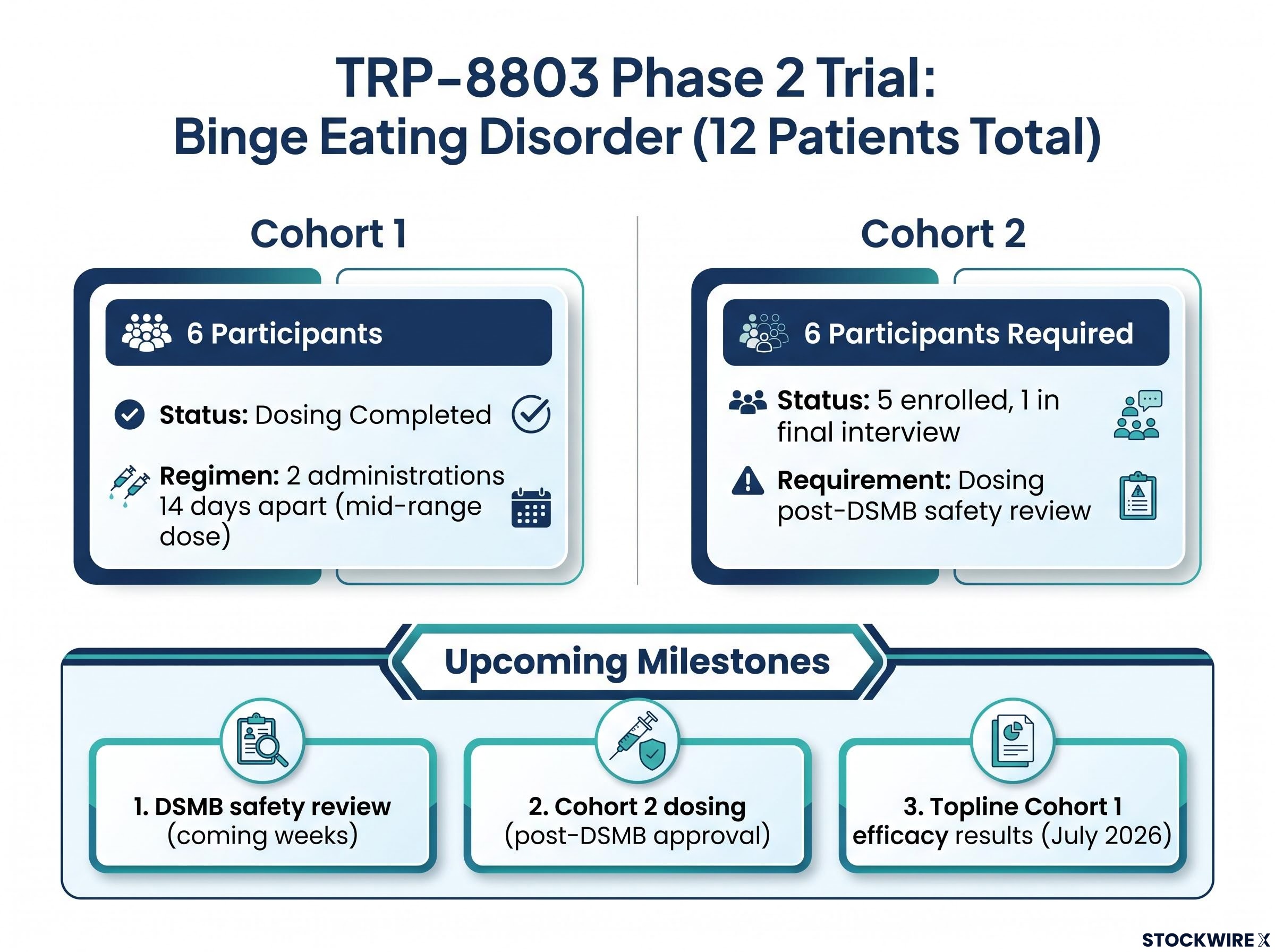
Cohort 1 received a mid-range therapeutic dose. The dosing regimen for Cohort 2 will be determined following review of Cohort 1 outcomes, allowing the company to optimise treatment intensity based on the efficacy and safety profile observed.
Key upcoming milestones include:
- DSMB safety review (coming weeks)
- Cohort 2 dosing commencement (post-DSMB approval)
- Topline Cohort 1 efficacy results (July 2026)
The July 2026 data readout represents the next major catalyst. Strong Cohort 2 enrolment reduces execution risk for the second phase of the trial, ensuring the company can move quickly following DSMB clearance.
Entropy’s broader pipeline and development strategy
Entropy has conducted Phase 2a trials using oral psilocybin for three indications: Binge Eating Disorder, Irritable Bowel Syndrome, and Fibromyalgia. Results from these earlier trials demonstrated clinical benefits and are informing TRP-8803 development. The BED trial using TRP-8803 is the lead programme, but positive results could support expansion into other indications where the company has already generated oral psilocybin data.
| Indication | Prior Development | Current Status |
|---|---|---|
| Binge Eating Disorder | Phase 2a (oral psilocybin) | Phase 2 (TRP-8803 IV psilocin) |
| Irritable Bowel Syndrome | Phase 2a (oral psilocybin) | Informing TRP-8803 development |
| Fibromyalgia | Phase 2a (oral psilocybin) | Informing TRP-8803 development |
This pipeline structure positions Entropy to leverage its oral psilocybin experience whilst advancing TRP-8803 as a next-generation platform. If TRP-8803 demonstrates consistent, controllable psychedelic responses in BED, the company may pursue additional trials in IBS or fibromyalgia using the IV-infused formulation.
The next major ASX story will hit our subscribers first
Investment outlook and upcoming catalysts
Cohort 1 completion is a de-risking event. All six participants achieved the intended psychedelic response without reported safety issues, validating the feasibility of the IV-infusion approach. The July 2026 topline data readout is the next major inflection point for the company.
Management stated they are “very confident” the topline results will highlight positive clinical outcomes for BED patients. If the data supports efficacy alongside the reproducibility already observed, TRP-8803 becomes a differentiated asset in the psychedelic therapy sector. This positions Entropy to pursue partnerships or further development with a clinical profile that addresses key commercialisation barriers: treatment duration, reproducibility, and scalability.
The combination of strong enrolment momentum (Cohort 2 nearly full), consistent Cohort 1 responses, and a near-term data readout creates a defined catalyst window. Investors with exposure to (ASX: ENP) should monitor the DSMB outcome and July efficacy results closely, as these events will determine the pathway for Cohort 2 and the broader TRP-8803 development strategy.
Want to Track Entropy’s Clinical Progress Through to the July Data Readout?
With Cohort 1 now complete and Cohort 2 recruitment nearly full, the next 18 months will define TRP-8803’s commercial potential. The DSMB review and July 2026 efficacy results represent critical validation points for the IV-infused psilocin platform.
Investors seeking detailed trial updates, regulatory milestones, and partnership developments can visit the Entropy Neurodynamics investor centre for comprehensive access to corporate announcements and strategic briefings. Stay informed as the company advances towards its pivotal data catalyst.