
New human data backs DMX-200’s CCR2 target in FSGS
New translational data presented at Kidney Week 2026 in Denver on 22 October 2026 links activation of the CCR2 pathway to poorer outcomes in focal segmental glomerulosclerosis (FSGS), according to a 23 October 2026 release from Dimerix Limited (ASX: DXB). The findings are described as supporting the mechanism of its Phase 3 investigational therapy, DMX-200.
The research was presented by Dr Sean Eddy of the University of Michigan and drew on the Nephrotic Syndrome Study Network (NEPTUNE) cohort, including 261 patients with FSGS. The study was funded by Dimerix, using data generated through NEPTUNE.
Dimerix states the data provide additional biological evidence for the mechanism behind its fully recruited ACTION3 Phase 3 trial. Clinical efficacy remains subject to the outcome of that study.
Dr Nina Webster, CEO & Managing Director, Dimerix
“These findings are significant because they provide independent human data linking activation of the CCR2 pathway to poorer outcomes in patients with FSGS…”
Headline findings
- CCR2 activity, an indicator of inflammation, was significantly elevated in kidney samples from FSGS patients compared with healthy controls.
- Higher CCR2 activity was associated with worsening kidney function.
- Elevated urinary MCP-1 levels were associated with poorer clinical outcomes.
- The outcomes are consistent with the Phase 2 trial, where DMX-200 reduced MCP-1 levels compared with increases in placebo-treated patients (ASX release 27 October 2020).
When big ASX news breaks, our subscribers know first
Why the CCR2 pathway matters in FSGS
FSGS is a rare, serious kidney disorder characterised by progressive scarring (sclerosis) in parts of the glomeruli, the kidney’s filtering units. The scarring leads to proteinuria, progressive loss of kidney function, and often end-stage renal disease.
MCP-1, also known as CCL2, is a key inflammatory signalling molecule that activates the CCR2 receptor. The pathway works in three broad steps:
- MCP-1 binds and activates the CCR2 receptor.
- Inflammatory cells are recruited into the kidney.
- Ongoing damage and fibrosis (scarring) follow.
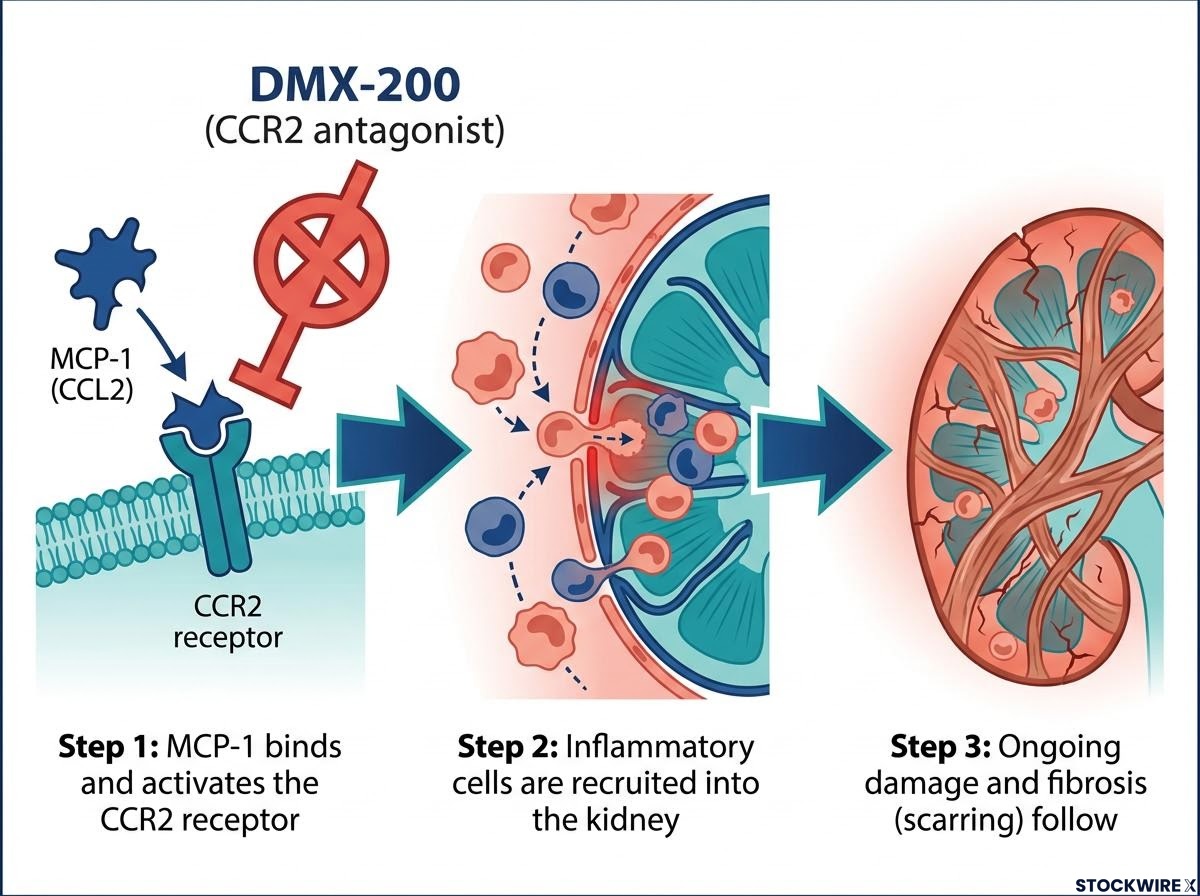
DMX-200 is a CCR2 antagonist administered to patients already receiving an angiotensin II type I receptor (AT1R) blocker.
The unmet need is outlined in the release. More than 40,000 people are estimated to be living with FSGS in the United States, and there are no therapies specifically approved for FSGS in the US. Even among patients who undergo kidney transplantation, disease recurrence occurs in up to 60% of cases.
Study findings and what they add to the investment case
The table below summarises the presentation’s key results as set out in the source materials.
| Finding | Evidence | Investor relevance |
|---|---|---|
| CCR2 transcriptional activity (TA) score elevated in FSGS and negatively correlated with eGFR | Score built from a 206-gene CCR2-associated network; correlation shown as R=-0.5, p<0.0001 | Supports CCR2 as a biologically relevant target |
| Urinary MCP-1/creatinine (high versus low) associated with a composite endpoint (40% loss of eGFR or end-stage renal disease) | Log rank p=0.04 | Links a urine biomarker to kidney outcomes |
| Alignment with Phase 2 MCP-1 data | DMX-200 reduced MCP-1 levels versus increases on placebo | Dimerix describes this as converging evidence |
Dimerix states the independent findings and its Phase 2 biomarker data provide converging evidence that DMX-200 targets a pathway associated with disease progression in FSGS. The findings may also provide supportive evidence for potential regulatory filings, subject to success in the ACTION3 Phase 3 trial.
The findings are the subject of a newly filed provisional patent application (number 2026904579). It is a filing only, and the release does not indicate a patent has been granted.
The researchers concluded that CCR2 activity may be monitored by urinary MCP-1, pointing to a possible non-invasive approach.
ACTION3 timeline and upcoming catalysts
ACTION3 is a pivotal, multi-centre, randomised, double-blind, placebo-controlled Phase 3 study. Key facts from the release:
- 333 patients randomised and dosed in the adult cohort.
- Recruitment completed across 219 sites in 21 countries.
- Final adult patient commenced treatment in March 2026.
- Final adult patient expected to complete dosing in March 2028.
- DMX-200 (120 mg capsule twice daily) versus placebo, in patients on a stable ARB dose.
Recruitment of paediatric patients aged 12-17 years continues as an independent cohort. The trial is designed to capture evidence of proteinuria and kidney function (eGFR slope), aimed at generating sufficient evidence to support marketing approval.
An external blinded review has confirmed greater than 90% statistical power for the proteinuria primary endpoint, and the FDA has indicated that percent reduction in proteinuria versus placebo is an appropriate basis for traditional approval.
Dimerix has also acquired DMX-652, a selective USP30 inhibitor now advancing into Phase 2 clinical development in acute kidney injury. The company says progress has the potential to diversify its clinical pipeline, though the release gives no timelines.
DMX-200 is protected by granted patents in various territories until 2032, with applications that may extend protection to 2042. It holds Orphan Drug Designation in the United States, Europe, UK and Japan.
The release describes the ACTION3 outcome as what is anticipated to be a major value-creating event if successful. The biomarker data add supportive biological context, but efficacy is yet to be demonstrated.
Dimerix has said its non-dilutive funding facility is sufficient to carry the company through the ACTION3 readout, which limits near-term funding pressure while the trial runs to March 2028.
Don’t Miss the Next Healthcare Breakout
Get FREE breaking ASX healthcare news delivered to your inbox within minutes of release, complete with in-depth analysis and the full announcement. Join 20,000+ subscribers already staying ahead of the market with Big News Blast. Click the “Free Alerts” button to receive alerts the moment market-moving news breaks.