

Dimerix reports first 100 patients complete ACTION3 double-blind treatment
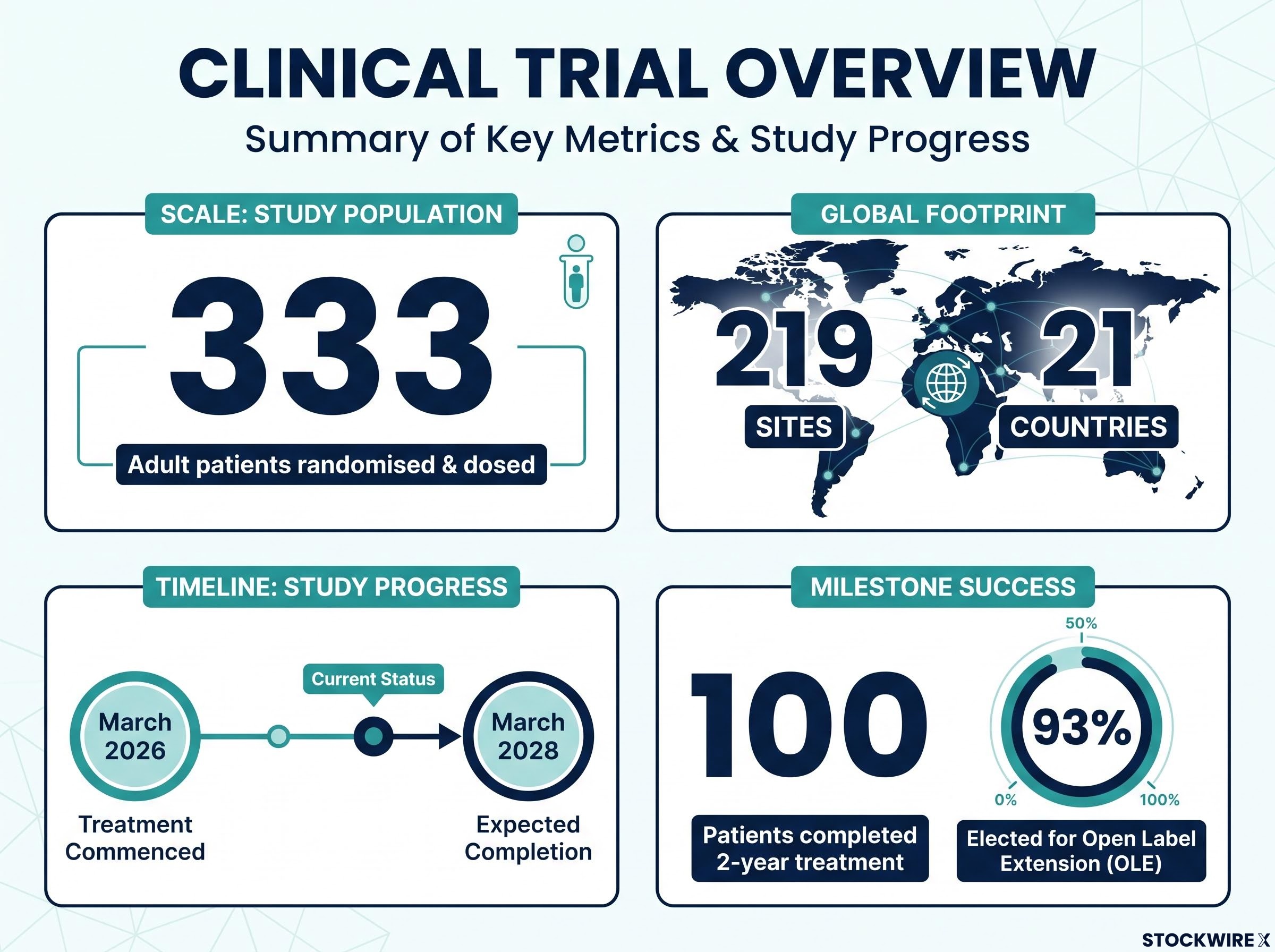
Dimerix (ASX: DXB) announced on 16 October 2026 that the first 100 patients have completed the full 2-year double-blind treatment period in its pivotal ACTION3 Phase 3 trial of DMX-200 in focal segmental glomerulosclerosis (FSGS). 93 of those 100 patients (93%) have elected to continue into the Open Label Extension (OLE) study.
The company describes the achievement as a significant operational milestone and an important clinical milestone. The announcement contains no efficacy data.
According to the company, as patients continue to complete the double-blind treatment period, the remaining execution risk associated with long-duration treatment adherence, participant retention and successful trial execution reduces. The company also noted the milestone is significant given the rarity of FSGS and the recruitment challenges associated with rare diseases.
Dr Nina Webster, CEO & Managing Director, Dimerix
“The completion of the first 100 patients represents another important milestone for the ACTION3 Phase 3 program. Having 100 patients now complete the 2-year double-blind treatment phase is not only an important clinical milestone, but also a significant operational achievement, for a global study of this size and duration…”
The ACTION3 trial remains ongoing, with patients continuing treatment and follow-up as planned.
Why the 93% OLE uptake matters
Patients who complete the trial can elect to continue into the OLE study. Uptake to date sits at 93%.
The first patient has now completed four continuous years in the DMX-200 program, two in the blinded trial and two in the optional extension, building a long-term safety record with direct regulatory relevance.
According to the company, the OLE study:
- provides access to DMX-200 treatment, regardless of whether the patient was on placebo or DMX-200 during the trial
- enables collection of additional long-term safety and clinical outcome data
- generates data that can be used to support future regulatory activities
When big ASX news breaks, our subscribers know first
ACTION3 at a glance: a fully recruited global study
The ACTION3 adult cohort is fully recruited. The final adult patient commenced treatment in March 2026, which the company says transitioned the study from recruitment into treatment and follow-up.
| Metric | Detail |
|---|---|
| Adult patients randomised and dosed | 333 |
| Recruitment footprint | 219 sites in 21 countries |
| Final adult patient commenced treatment | March 2026 |
| Final adult patient expected to complete dosing | March 2028 |
| Treatment arms | DMX-200 (120 mg capsule twice daily) or placebo, with patients on a stable angiotensin II receptor blocker (ARB) dose |
Recruitment of paediatric patients aged 12-17 years continues as an independent cohort within the ACTION3 program. The company says this cohort may support future expansion into adolescent indications in key territories.
The single Phase 3 trial is designed to capture evidence of proteinuria and kidney function (eGFR slope). It is aimed at generating sufficient evidence to support marketing approval.
Understanding FSGS and DMX-200
FSGS is a rare, serious kidney disorder. It involves progressive scarring in parts of the glomeruli, the kidney’s filtering units, which leads to proteinuria (excess protein in the urine), progressive loss of kidney function, and often end-stage renal disease.
The company cites the following unmet need:
- more than 40,000 people are estimated to be living with FSGS in the United States
- there are no therapies specifically approved for FSGS in the U.S.
- in progressive or treatment-resistant cases, the average time from diagnosis to end-stage kidney disease can be as short as five years
- disease recurrence occurs in up to 60% of kidney transplant cases
DMX-200 is a chemokine receptor (CCR2) antagonist administered to patients already receiving an angiotensin II type I receptor (AT1R) blocker. The company describes AT1R blockers as the standard of care treatment for hypertension and kidney disease.
DMX-200 is protected by granted patents in various territories until 2032. Patent applications submitted globally may extend protection to 2042, and Orphan Drug Designation has been granted in the United States, Europe, UK and Japan.
Potential catalysts: DMX-652 adds a second asset
Dimerix is advancing ACTION3 toward what it anticipates to be a major value-creating event if successful. The company has also strengthened its growth profile through the recent acquisition of DMX-652, which is advancing into Phase 2 clinical development for acute kidney injury (AKI).
Key points on DMX-652 from the announcement:
- a selective inhibitor of USP30, delivered as a small molecule oral once-daily capsule
- an open IND in the US, with a Phase 2 protocol that has received approval to proceed by the US Food and Drug Administration (FDA)
- sufficient pharmaceutical grade (GMP) drug product for the Phase 2 trial
- a current addressable patient population estimated at approximately 260,000 per annum across the United States, Germany, France, Italy, Spain and United Kingdom
Dimerix also notes a growing network of five commercial partners supporting global development and future market access.
The company states that progress and positive outcomes from the DMX-652 program have the potential to diversify its clinical pipeline and deliver multiple near- and medium-term catalysts for investors. The announcement does not disclose timelines for the DMX-652 Phase 2 trial.
The acquisition of DMX-652 from Mission Therapeutics carried a US$5 million upfront payment and up to US$287 million in milestones, with first Phase 2 dosing in cardiac surgery-associated AKI targeted for the first half of 2027.
Don’t Miss the Next Biotech Breakthrough
Join 20,000+ investors getting FREE breaking ASX news within minutes of release, complete with in-depth analysis already done. Click the “Free Alerts” button at Big News Blast to receive healthcare and biotech updates the moment market-moving announcements break.