
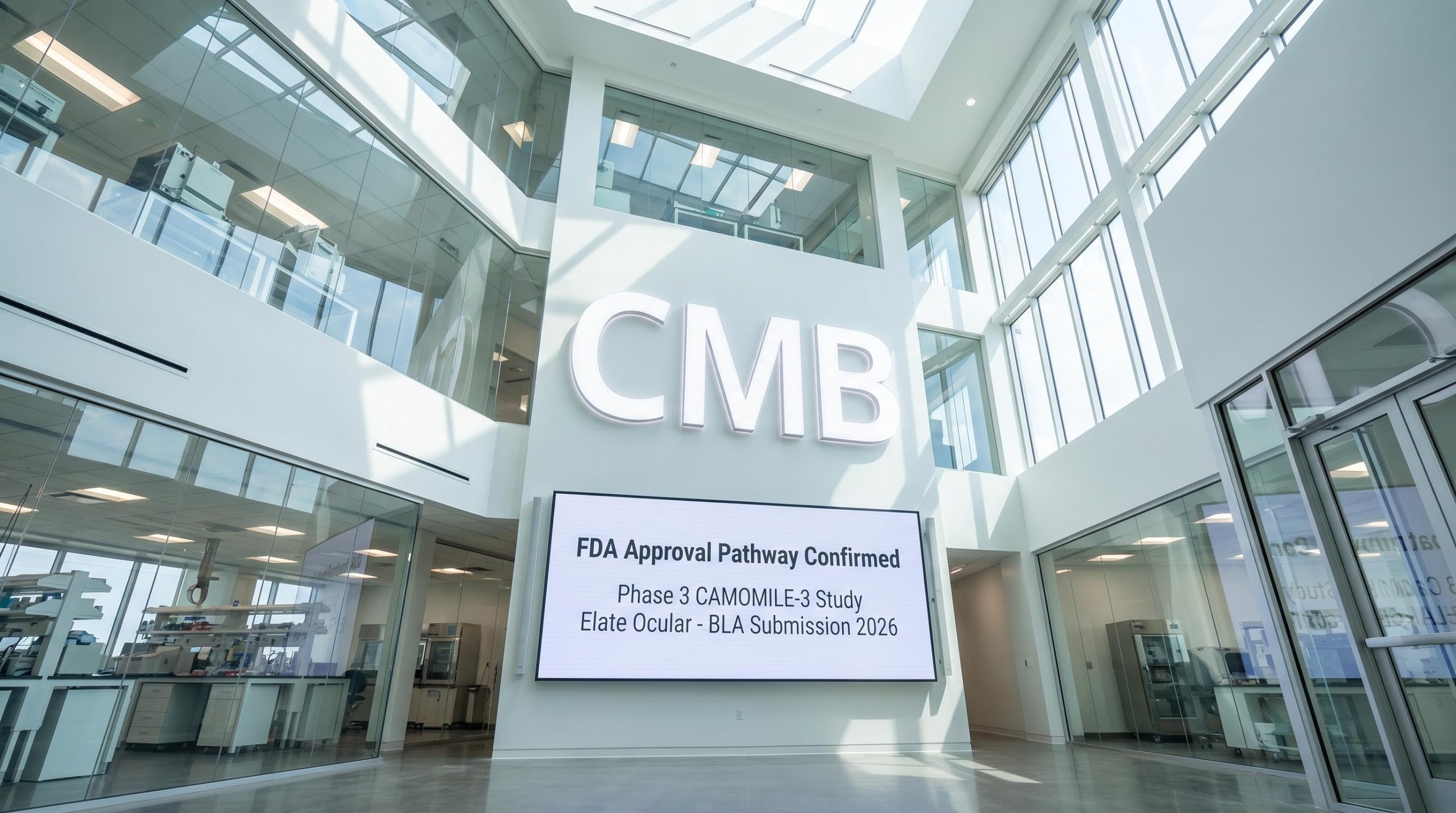
FDA greenlights single pivotal trial pathway for Elate Ocular
Cambium Bio (ASX: CMB) has received confirmation from the US Food and Drug Administration that a single adequate and well-controlled pivotal Phase 3 study, supported by confirmatory evidence, represents an acceptable pathway to support a Biologics License Application (BLA) for Elate Ocular in moderate-to-severe dry eye disease. The confirmation emerged from a Type D meeting held on 22 April 2026 with the FDA’s Center for Biologics Evaluation and Research, Office of Therapeutic Products.
The single-trial pathway replaces the historical requirement for two independent pivotal studies, aligning with updated FDA regulatory policy published 19 February 2026 in the New England Journal of Medicine by Dr Vinay Prasad and Dr Martin Makary. This policy shift establishes a single pivotal clinical trial plus confirmatory evidence as the FDA’s new default standard for marketing authorisation.
Dry eye disease affects tens of millions of people globally, with the moderate-to-severe segment presenting significant unmet medical need. The regulatory pathway confirmation de-risks the development programme by reducing capital requirements, accelerating enrolment timelines, and improving the probability of BLA success versus the legacy two-trial paradigm.
The Company holds Fast Track Designation for Elate Ocular, granted 4 December 2024, which enables rolling BLA submission and supplementation of the application as confirmatory evidence is generated during and after the pivotal Phase 3 study.
When big ASX news breaks, our subscribers know first
What a single pivotal trial means for biotech investors
A Biologics License Application is the regulatory submission package required by the FDA to authorise commercial sale of biological products in the United States. For decades, the FDA maintained an informal requirement for pharmaceutical sponsors to demonstrate statistical significance independently across two separate pivotal studies, creating a dual-study paradigm that doubled clinical development costs, timelines, and statistical risk.
The updated FDA policy permits sponsors to pursue a single adequate and well-controlled pivotal study as the principal evidence of effectiveness, supplemented by confirmatory evidence. Confirmatory evidence encompasses mechanistic or pharmacodynamic studies, animal model data, real-world evidence, and other supporting datasets that corroborate the pivotal trial findings without requiring a second identical clinical study.
For Cambium Bio, this means the n=400 randomised, double-masked, vehicle-controlled Phase 3 study (CAMOMILE-3) serves as the sole pivotal clinical evidence package. The nature and scope of confirmatory evidence will be determined in consultation with the FDA following Phase 3 readout, calibrated to the strength of the pivotal clinical data.
Fast Track Designation provides additional regulatory flexibility by allowing the BLA to be submitted and reviewed on a rolling basis. Rather than waiting for complete data compilation, the Company can submit components of the BLA as they are finalised, potentially accelerating the review timeline once pivotal data is available.
Three ways this accelerates Cambium Bio’s path to market
The single-trial pathway delivers three material benefits that directly address core biotech investment risks:
-
Lower capital requirement — A single-trial programme materially reduces clinical development costs versus running two concurrent pivotal studies. The specific capital saved will depend on final operational parameters, with the Company expected to provide further guidance as the pivotal study commences. Eliminating duplication of site initiation, patient recruitment infrastructure, and data collection across two parallel programmes represents a substantial reduction in non-productive development spending.
-
Faster enrolment and BLA submission — Consolidating clinical sites and patient recruitment into one programme removes competition for investigator sites and patient population that would occur with parallel trials. Two concurrent dry eye studies competing for the same moderate-to-severe patient cohort would fragment enrolment capacity and extend timelines. The unified approach is expected to accelerate enrolment, with First Patient In anticipated later in 2026.
-
Higher probability of regulatory success — Statistical risk is concentrated into one well-powered study rather than requiring independent success across two separate trials. Under the historical paradigm, a development programme must achieve statistical significance independently in both studies. Under the single-trial approach, the programme must demonstrate significance in one pivotal study supported by confirmatory evidence, improving the overall probability of generating a regulatory data package sufficient to support BLA approval.
Phase 3 study design confirmed
The FDA confirmed that the previously agreed Phase 3 study design remains acceptable to support the single-trial BLA pathway.
| Parameter | Detail |
|---|---|
| Study name | CAMOMILE-3 |
| Sample size | n=400 evaluable subjects |
| Design | Randomised, double-masked, vehicle-controlled |
| Treatment period | 9-week masked treatment |
| Co-primary endpoints | Corneal Fluorescein Staining Index (sign), VAS Eye Discomfort Score (symptom) |
The co-primary endpoint structure addresses both objective clinical signs (corneal staining measured via fluorescein dye) and patient-reported symptoms (eye discomfort scored on a visual analogue scale), meeting FDA expectations for dry eye disease efficacy assessment.
Confirmatory evidence and the road to BLA submission
The FDA confirmed that discussion of confirmatory evidence is most appropriate following Phase 3 readout, when the strength of the pivotal clinical data will inform the nature and quantity of confirmatory evidence required. This aligns with the FDA’s September 2023 guidance on demonstrating substantial evidence of effectiveness with one adequate and well-controlled clinical investigation.
Cambium Bio is evaluating a range of product-specific confirmatory evidence options to support Elate Ocular’s mechanism of action, including additional nonclinical characterisation studies. The specific confirmatory evidence package to be submitted as part of the BLA will be determined in consultation with the FDA following Phase 3 topline data, calibrated to the strength of the pivotal clinical results.
Potential confirmatory evidence types under consideration include mechanistic or pharmacodynamic evidence, evidence from relevant animal models, and real-world evidence. The mechanistic studies would aim to characterise how Elate Ocular’s proprietary human platelet lysate formulation repairs corneal epithelial damage and reduces inflammation in dry eye disease.
Fast Track Designation provides regulatory flexibility by allowing the BLA to be submitted and reviewed on a rolling basis, enabling the Company to supplement the application with confirmatory evidence generated during and after the Phase 3 open-label extension period. This removes the need to delay BLA submission until all confirmatory evidence is compiled, potentially accelerating the regulatory timeline from Phase 3 readout to approval decision.
CEO sets operational priorities
Karolis Rosickas, Chief Executive Officer, Cambium Bio
“This represents a substantial acceleration of our development plan, a meaningful reduction in the capital required to reach BLA submission, and an improvement in the overall probability of successfully bringing this therapy to patients in need. Dry eye disease affects tens of millions of people globally, and for the moderate-to-severe segment the treatment options remain limited. The Company’s operational focus is now unambiguous: to initiate the single pivotal Phase 3 study as soon as operationally feasible, with First Patient In expected later in 2026, and to drive the programme efficiently toward topline readout and BLA submission.”
The statement confirms management’s near-term operational priorities: site selection, ethics approvals, and regulatory clearances required to initiate patient screening and enrolment in the pivotal CAMOMILE-3 study during the second half of 2026.
Key milestones and what investors should watch
The single-trial pathway establishes a clear sequence of near-term catalysts for Cambium Bio shareholders:
- First Patient In for CAMOMILE-3 pivotal Phase 3 study: Expected later in 2026, marking formal commencement of the pivotal clinical programme
- Phase 3 topline data readout: Timing to be disclosed following study initiation, dependent on enrolment rate and 9-week treatment period completion
- Post-readout FDA engagement on confirmatory evidence requirements: Discussion with the Agency to determine nature and scope of supporting evidence calibrated to pivotal data strength
- Rolling BLA submission enabled by Fast Track Designation: Ability to submit BLA components as finalised rather than waiting for complete package compilation
- Potential approval timeline: Accelerated versus historical two-trial paradigm, contingent on pivotal data strength and confirmatory evidence adequacy
The pathway confirmation removes a major source of regulatory uncertainty and provides visibility on development milestones. Investors positioning ahead of clinical readouts now have clarity on the development pathway from Phase 3 initiation through BLA submission and potential approval.
The adequacy of the data to support BLA approval will be assessed as a review issue at the time of submission, meaning the FDA has not pre-committed to approval but has confirmed the regulatory framework is appropriate. Statistical significance on both co-primary endpoints in the pivotal study, supported by confirmatory evidence accepted by the Agency, would position Elate Ocular for potential commercialisation in the moderate-to-severe dry eye disease market.
Ready to Learn More About Cambium Bio’s Accelerated Development Pathway?
The single pivotal trial framework materially de-risks the Elate Ocular programme by reducing capital requirements, compressing timelines, and improving the probability of regulatory success. With First Patient In expected later in 2026, the Company is entering a catalyst-rich phase of clinical execution.
For detailed updates on the CAMOMILE-3 study and the pathway to BLA submission, visit the Cambium Bio investor centre. Investors can access real-time regulatory milestones, clinical trial progress, and commercial strategy updates as the programme advances toward potential market authorisation.