BCAL Diagnostics outlines early cancer detection strategy at Bioshares 2026
In its August 2026 investor presentation at the 20th Bioshares Biotech Summit, BCAL Diagnostics (ASX: BDX) detailed its early cancer detection strategy, built around blood-based tests spanning breast, pancreatic and ovarian cancer.
Management outlined a positioning underpinned by an established national referral infrastructure and funding to support FY2027 execution. The company detailed a share price of $0.08 in July 2026, 368M shares on issue, a market capitalisation of $28M, and cash of $1.6M at 30 June 2026, alongside commitments for funding of $4.9M.
The investment case was framed around a growing global market and an existing, scalable access pathway that can carry the portfolio into clinical use.
When big ASX news breaks, our subscribers know first
A portfolio built on the value of a negative result
At the centre of BCAL’s commercial thesis is the “rule out” concept. For most patients tested, management noted, the negative result is what changes their day, positioning the tests as a source of first line reassurance.
The presentation framed adoption around three commercial questions posed by management: what decision does the result change, how often is that decision repeated for the same patient, and who pays for it. A number that does not alter clinical action, the company argued, has limited commercial value regardless of its accuracy.
BCAL anchored this thinking in the prostate-specific antigen (PSA) test for prostate cancer, describing it as a model where most of the value sits in the negative result. A normal PSA lets a patient and doctor step back from further testing, while an abnormal result points to the next investigation rather than a diagnosis.
The company’s stated target is building that same first line reassurance for breast, pancreatic and ovarian cancer, which have no PSA equivalent today.
BCAL Diagnostics presentation
“For most of the people we test, the negative result is the one that changes their day. That is where we think the value is.”
Understanding sensitivity, specificity and negative predictive value
To explain its thesis, BCAL compared a diagnostic test to a security door: people with the condition pass through, while those without are stopped and ruled out.
Three concepts sit behind this. Sensitivity measures whether a test finds almost everyone who has the condition (“don’t miss it”). Specificity measures whether it correctly clears those who do not (“don’t falsely alarm”). Negative predictive value (NPV) answers whether a negative result can be trusted, the metric most closely tied to a “rule out” positioning.
Management emphasised that NPV matters most for its thesis. Testing higher-risk groups strengthens a positive result, while the negative result stays reliable. The health economic case, therefore, rests on NPV in the intended use population, not on sensitivity in isolation.
Published validation data across three tests
BCAL presented current validation data across its three available tests, retaining the caveat that certain figures remain in validation and require confirmation in the intended use population before any claim is made.
| Test | Sensitivity | Specificity | Study Population | Availability |
|---|---|---|---|---|
| BREASTEST plus™ | 90% | In validation | 613 Australian women with dense breast tissue | Available now |
| Avantect® Pancreatic | 82.6% | 97.5% | 259 cancers vs 1,186 controls | Available now |
| Avantect® Ovarian | 78.2% | 94.0% | 300+ patients incl. high risk | Available now |
The Avantect® tests are licensed from ClearNote Health under exclusive Australia and New Zealand distribution rights. Management highlighted that BCAL validates on its own current Australian cohorts, including the 613-women breast study, keeping the evidence close to how the tests will actually be used.
One platform, four rule-out applications
The company detailed a portfolio spanning four potential rule-out applications built on a single platform.
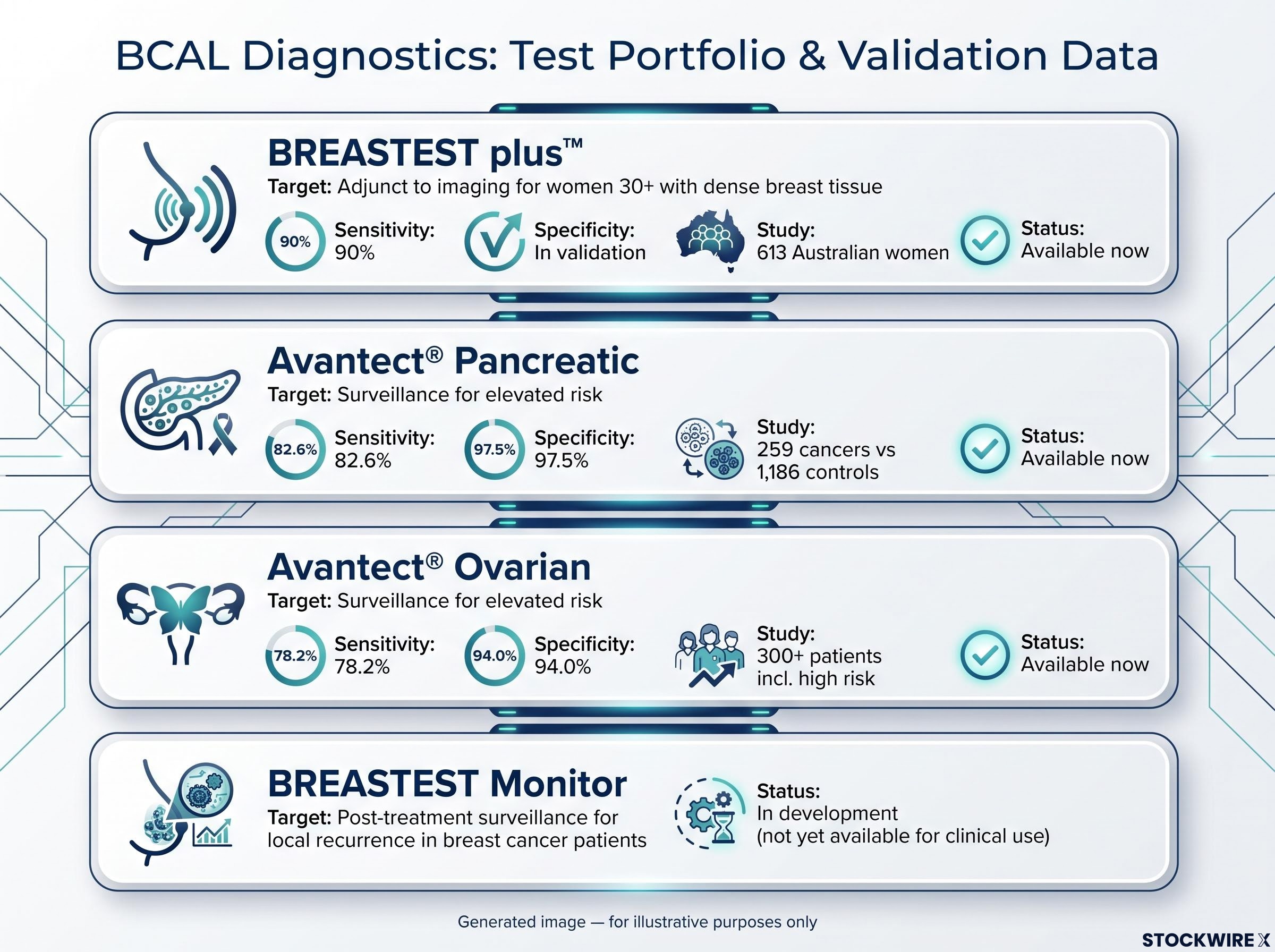
- BREASTEST plus™ — for women aged 30 and over with dense breast tissue, as an adjunct to imaging (available now).
- Avantect® Pancreatic — surveillance for individuals at elevated risk of pancreatic cancer (available now).
- Avantect® Ovarian — surveillance for individuals at elevated risk of ovarian cancer (available now).
- BREASTEST Monitor — post-treatment surveillance for local recurrence in breast cancer patients. This test is in development and is not yet available for clinical use.
On traction, the presentation noted 200+ BREASTEST plus™ tests sold since launch, supported by an Australian patent granted for its in-house lipidomic technology to 2043.
Infrastructure driving adoption
Management framed adoption around delivering tests through channels that already exist, summarised in the phrase “evidence gets a test approved, infrastructure gets it used.”
Referral forms sit within the Best Practice and Medical Director systems, used by around 97% of Australian GPs. The EarlyDetection.com.au telehealth platform, launched in January 2026 with Medmate, supports patient access, with blood collection through the Sonic Healthcare and Healius pathology networks.
BREASTEST plus™ is available at 96 Sonic sites across Sydney, Brisbane and Melbourne, processed at the NATA-accredited BCAL laboratory in Sydney, while Avantect® tests are processed at a CLIA-certified US lab. The EarlyDetection platform is also registered in New Zealand, meaning the same pathway can carry the portfolio into new markets without rebuilding it.
The FY2027 roadmap and catalysts
The company outlined a commercial pathway that is clinician-referred and patient-funded today, with revenue accruing while the evidence base builds. Management stressed that reimbursement outcomes are not assured and depend on assessment by the relevant funding authorities, and that nothing presented should be read as a forecast of a funding decision.
Next steps management detailed include:
- Growing referral volumes for Avantect® pancreatic and ovarian tests.
- Advancing BREASTEST Monitor development and a soft launch of the ClearNote Health MCED test.
- Advancing BREASTEST plus™ 2 validation with Sonic Healthcare USA and launch in the Australian market.
- Pursuing the MSAC reimbursement pathway, requiring evidence of clinical utility and cost-effectiveness.
For investors exploring what that reimbursement process involves in practice, our full explainer on the MSAC reimbursement submission details the target populations, the epigenomic profiling technology underpinning the application, and why a successful MBS listing would remove out-of-pocket cost barriers that currently limit adoption.
- Investigating partnerships to broaden distribution beyond Australia.
The company also noted a 10.2% strategic shareholding in Genetic Signatures, acquired for $1.39M, expanding its exposure to molecular diagnostics.
Why the investment case stands out
BCAL’s summary tied together an early cancer detection portfolio, a large and growing global market with incidence expected to rise to 4M new cases annually by 2040, and a scalable national access platform, with funding secured to support FY2027 execution.
Management reinforced its central framing: evidence gets a test approved, and infrastructure gets it used.
Don’t Miss the Next Healthcare Breakout
Big News Blast delivers FREE breaking ASX healthcare news straight to your inbox within minutes of release, complete with in-depth analysis. Join 20,000+ investors already getting the full picture the moment announcements drop. Click the “Free Alerts” button at StockWire X to start receiving alerts before the broader market catches on.