
BlinkLab Completes Nine-Site FDA Trial Network Ahead of Q1 2026 Launch
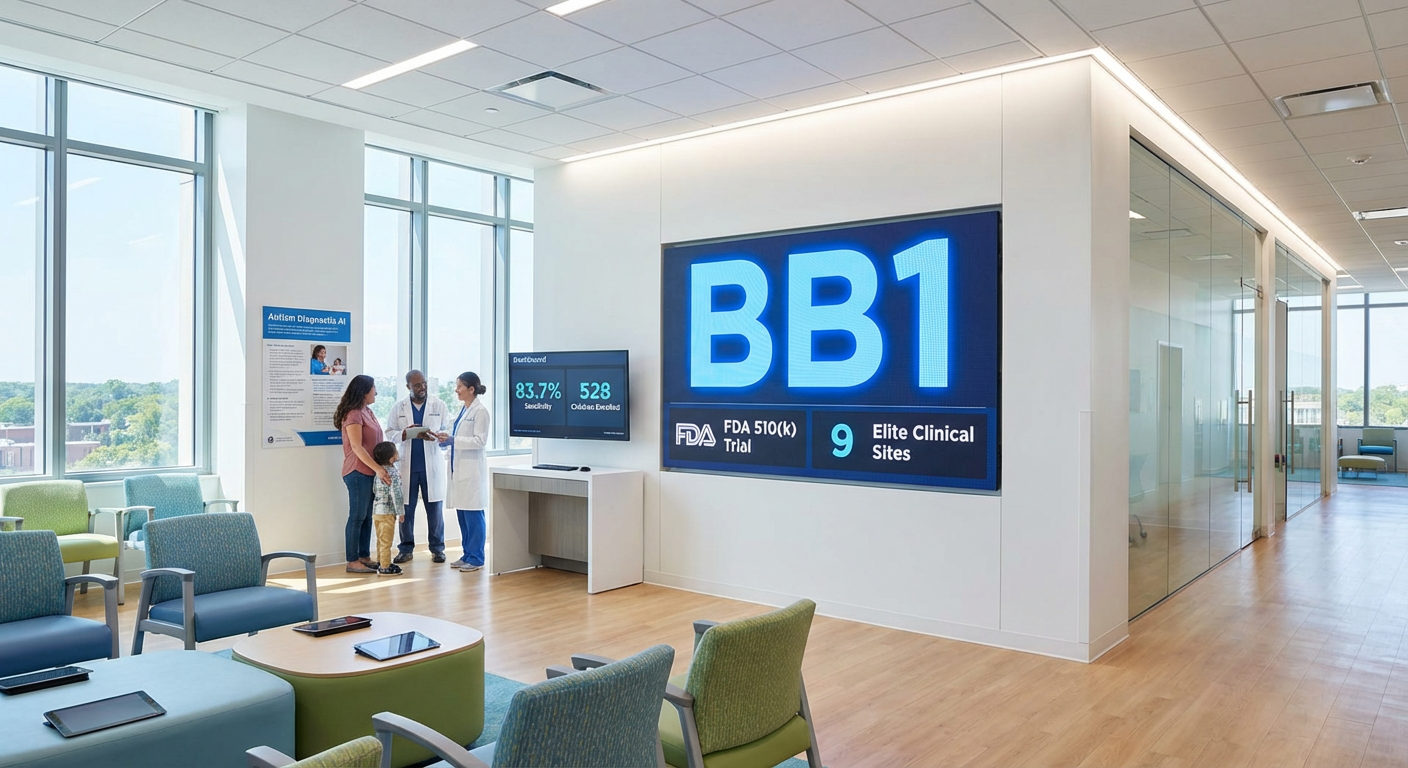
BlinkLab Limited (ASX: BB1) has onboarded Drexel University as the ninth clinical site for its pivotal FDA 510(k) trial, bringing the BlinkLab FDA trial network expansion to completion ahead of the study’s expected commencement in Q1 2026. The addition follows BlinkLab’s recently completed U.S. Pilot Study of 485 children, which demonstrated 83.7% sensitivity and 84.7% specificity, significantly exceeding the FDA’s agreed performance benchmark of >65% for both metrics.
BlinkLab expands FDA trial network to nine elite U.S. sites ahead of pivotal study launch
Drexel University’s onboarding marks a critical milestone in the BlinkLab FDA trial network expansion, completing the geographical and demographic coverage required for the pivotal trial. The study is set to enrol approximately 528 children aged 2-11 years across nine leading U.S. institutions, positioning the company to generate robust regulatory evidence for FDA 510(k) clearance of BlinkLab Dx 1, its AI-powered autism diagnostic aid.
The timing is significant. The trial is expected to commence in Q1 2026, meaning recruitment is now imminent. The completion of the pilot phase in October 2025, which delivered performance metrics nearly 20 percentage points above the FDA’s threshold, de-risks the pivotal study and confirms the technology’s readiness for scaled clinical deployment.
Dr Henk-Jan Boele, Co-founder and CEO
“I am very pleased to see an institution with such a longstanding track record of leadership in autism and neurodevelopmental research join BlinkLab for its FDA 510(k) diagnostic program. Institutions of this calibre are critical to giving our study the best chance at achieving the level of rigour required to demonstrate our technology at work, as well as maintaining the highest scientific and clinical standards.”
For investors, the BlinkLab FDA trial network expansion signals execution readiness for the company’s most material regulatory milestone. A fully enrolled network of elite institutions enables faster participant recruitment and strengthens the dataset that will support the FDA submission.
When big ASX news breaks, our subscribers know first
What is FDA 510(k) clearance and why does it matter for digital diagnostics?
The FDA 510(k) pathway is the regulatory route for medical devices to demonstrate substantial equivalence to an existing approved device. For digital diagnostics like BlinkLab Dx 1, this means proving that the technology performs at a clinically acceptable standard compared to established diagnostic methods.
A pivotal study is the final, large-scale clinical trial required before submission to the FDA. It provides the regulatory body with comprehensive evidence of safety, effectiveness, and performance across a representative patient population. Success in this phase is the gateway to market authorisation.
FDA 510(k) clearance would position BlinkLab Dx 1 as a first-of-its-kind, AI-powered diagnostic aid for autism in the U.S. market. Clearance unlocks access to reimbursement pathways, integration into clinical workflows, and scaled deployment across healthcare systems. It is the critical inflection point between clinical development and commercial viability.
The U.S. represents the world’s largest healthcare market. FDA clearance creates immediate commercial optionality and positions the company to address a significant unmet need in autism diagnosis.
Pilot study results de-risk the pivotal trial
The U.S. Pilot Study, completed in October 2025, enrolled 485 children and delivered sensitivity of 83.7% and specificity of 84.7%. Both metrics significantly exceeded the FDA-agreed benchmark of >65% sensitivity and >65% specificity, demonstrating the technology’s robustness in real-world clinical populations.
| Metric | BlinkLab Pilot Result | FDA Benchmark |
|---|---|---|
| Sensitivity | 83.7% | >65% |
| Specificity | 84.7% | >65% |
The pilot results de-risk the pivotal trial by confirming that BlinkLab Dx 1 can achieve clinically meaningful diagnostic accuracy when deployed across diverse clinical settings. The 18.7 percentage point margin above the FDA threshold for sensitivity, and the 19.7 percentage point margin for specificity, provide confidence that the pivotal study can replicate this performance and support regulatory clearance.
For investors, this is a critical validation point. The pilot phase was designed to stress-test the technology in real-world conditions, and the results indicate that BlinkLab is entering the pivotal trial with a proven platform rather than an unvalidated hypothesis.
Why Drexel University is a strategic addition
Drexel University’s involvement extends beyond its role as a clinical trial site. The institution’s A.J. Drexel Autism Institute is nationally recognised for its leadership in autism surveillance, diagnostic access, and evidence-based policy development. The Institute publishes the National Autism Indicators Report (NAIR), one of the most widely referenced datasets informing how autism is identified, diagnosed, and supported across U.S. healthcare and education systems.
These reports are routinely used by policymakers, public health authorities, and clinical leaders to shape national and state-level autism programmes. Drexel’s involvement in the pivotal trial positions BlinkLab within a network that influences not only clinical research but also policy frameworks and reimbursement pathways.
This matters for commercialisation. Regulatory clearance is a necessary condition for market entry, but adoption depends on clinical guidelines, payer acceptance, and integration into care pathways. Drexel’s institutional influence creates strategic pathways beyond clearance, into the structures that determine real-world implementation.
For investors, partnering with institutions that shape national autism policy accelerates the pathway from regulatory success to clinical adoption.
Elite clinical network positions BlinkLab for rapid enrollment and adoption
The BlinkLab FDA trial network expansion now includes nine leading U.S. institutions, each with a proven track record in autism research and clinical trial execution:
- Cincinnati Children’s Hospital
- Seattle Children’s Hospital
- University of Pennsylvania
- MU Thompson Center for Autism & Neurodevelopmental Disorders
- Southwest Autism Research & Resource Center
- University of Nebraska Medical Center
- Vanderbilt Kennedy Center
- Rush University Medical Center
- Drexel University
The network represents a geographically diverse and demographically representative sample of the U.S. population. This design strengthens the regulatory submission by ensuring the trial dataset reflects the real-world variability of autism presentation across different communities and clinical settings.
Beyond regulatory considerations, the network functions as a commercial asset. These institutions are future implementation partners. Their involvement in the trial creates early exposure to BlinkLab Dx 1, builds relationships with key opinion leaders (KOLs), and informs real-world clinical workflows. The collaborations are expected to support guideline development, payer engagement, and accelerated adoption upon FDA clearance.
For investors, the strategic value of this network extends beyond trial execution. These are not just research partners but potential customers, advocates, and integration sites for post-clearance deployment.
Addressing a critical unmet need in autism diagnosis
Autism diagnosis in the U.S. faces systemic challenges. Long waitlists, regional inequities, and delays in accessing specialist assessments create barriers to early intervention. Children in rural or underserved communities often wait months or years for a formal diagnosis, delaying access to therapies that are most effective during critical windows of brain development.
BlinkLab Dx 1 is positioned as a scalable solution to this problem. The AI-powered, smartphone-based platform can be deployed in clinics, community health centres, and primary care settings, bringing earlier and more objective autism assessments into environments where specialist expertise is limited.
If the pivotal trial succeeds and FDA clearance is achieved, BlinkLab Dx 1 would become a tool that reduces diagnostic bottlenecks, improves access to care, and supports earlier intervention. Earlier diagnosis improves clinical outcomes and unlocks access to intervention funding, creating both clinical value and commercial demand.
The autism diagnostic market is underserved and growing. Successful regulatory clearance positions BlinkLab to capture a segment of this market by addressing a documented gap in care delivery.
The next major ASX story will hit our subscribers first
What comes next for BlinkLab
The pivotal trial is expected to commence in Q1 2026, with enrolment of approximately 528 children across the nine-site network. The trial’s design and the pilot study’s de-risking results position the company to execute on its most material regulatory milestone.
Recent momentum supports this trajectory. BlinkLab has achieved peer-reviewed publication of its research and received an invitation to speak at a Simons Foundation Autism Research Initiative event, reinforcing its standing within the global neuroscientific research community.
2026 represents a pivotal year for the company. Trial execution, potential data readouts, and the pathway to FDA submission will determine whether BlinkLab can convert scientific promise into regulatory and commercial reality. The infrastructure is now in place. The next 12-18 months will test the company’s ability to deliver on that foundation.
For investors, the BlinkLab FDA trial network expansion completes the preparatory phase. The focus now shifts to trial execution and data generation, with regulatory submission and market entry as the defining outcomes.
Want the Next Healthcare Breakthrough in Your Inbox?
Join 20,000+ investors receiving FREE breaking ASX healthcare news within minutes of release, complete with in-depth analysis. Click the “Free Alerts” button at StockWire X to stay ahead on biotechnology, digital health, and medical device announcements the moment they hit the market.