

FDA accepts pre-IND meeting request — AdAlta’s ‘East to West’ strategy clears a critical checkpoint
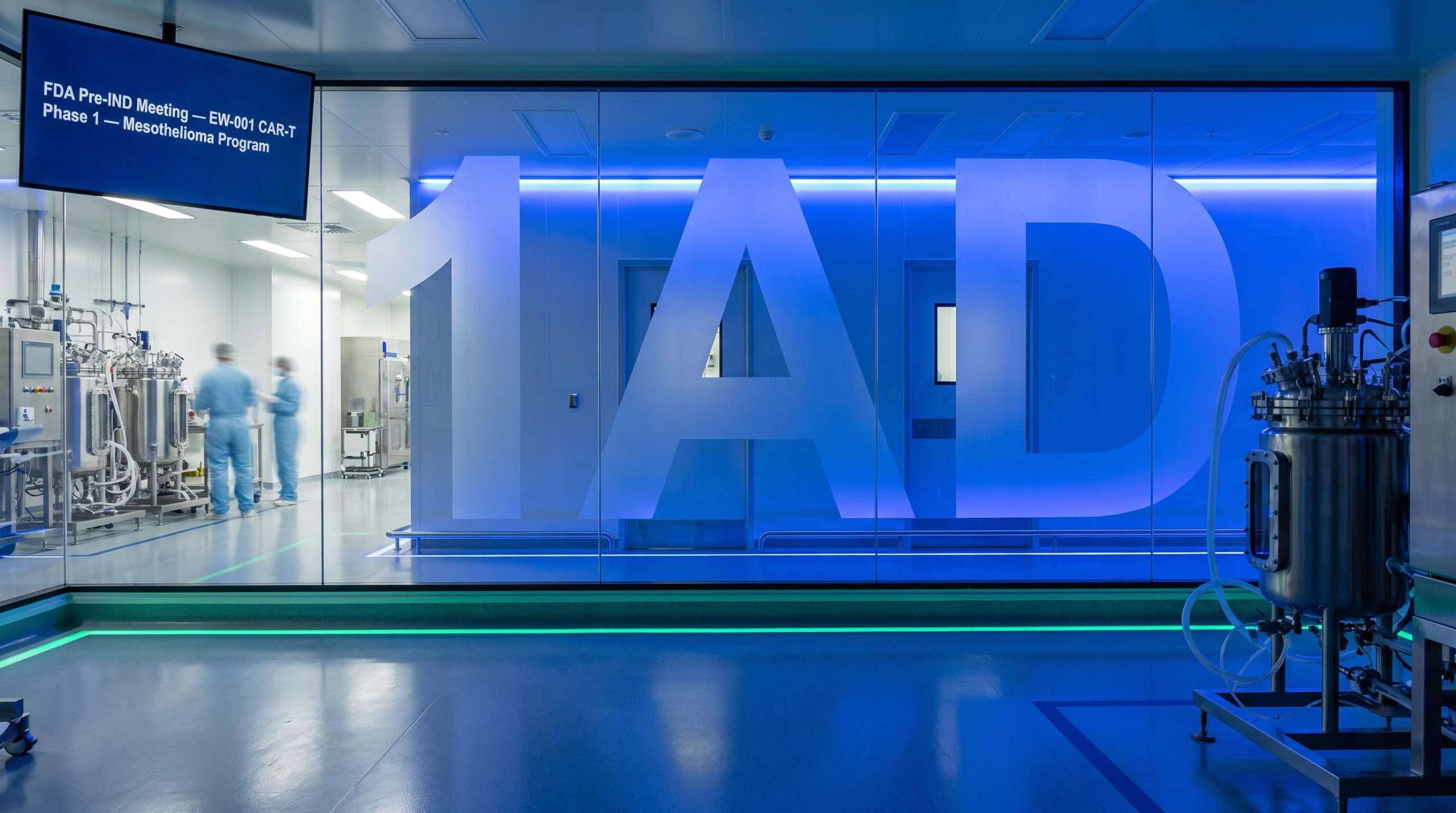
AdAlta Limited (ASX: 1AD) has received formal acceptance from the US Food and Drug Administration (FDA) of its request for a pre-IND meeting on EW-001, its lead CAR-T cell therapy targeting advanced mesothelioma. The meeting represents AdAlta’s first significant engagement with the FDA on EW-001 and is a key milestone for the second half of calendar 2026.
The virtual face-to-face meeting is scheduled for 3 November 2026 (US time) / 4 November 2026 (AEST). While the FDA’s agreement to meet is the headline, the more substantive investor story lies in what it took to reach this point: the convergence of hundreds of documents from co-development partner Shanghai Cell Therapy Group Co Ltd (“SHcell”), a draft Phase 1 clinical trial protocol, and a refined manufacturing strategy.
When big ASX news breaks, our subscribers know first
What it took to get here — three bodies of work in parallel
Before a pre-IND briefing document could be submitted, three separate and substantial work streams had to converge into a single, coherent plan. Each represented a meaningful undertaking in its own right.
-
Data from Shanghai. Hundreds of documents have been transferred from SHcell under the parties’ Development and Collaboration Agreement. These included detailed manufacturing methods, quality and release testing methods and results, laboratory and animal study reports, and patient-by-patient results from investigator-initiated trials conducted in China.
-
A clinical protocol for Australia. Extensive interaction with AdAlta’s clinical advisory board, drawn from Australia’s leading CAR-T and mesothelioma treatment centres, produced a draft Phase 1 clinical trial protocol. The protocol addresses patient selection, dosing, safety monitoring, and clinical outcomes to be measured.
-
Manufacturing for Melbourne. Technology transfer and process optimisation work with contract manufacturer Cell Therapies Pty Ltd (CTPL) is establishing how EW-001 will be manufactured in Australia to the standards the FDA expects.
The FDA is being asked to comment on a single, coherent plan in which the product made in Melbourne, the studies supporting it, and the trial proposed for Australian patients all line up. Specialist regulatory advisers Dark Horse Consulting Group, Inc (DHC) are supporting preparation of the briefing document and the meeting itself.
Dr Tim Oldham, CEO and Managing Director, AdAlta
“The FDA agreeing to meet us is the headline. What matters more is what it took to reach the point where we could request the meeting. Our team has worked through hundreds of documents from SHcell covering how EW-001 is made, how it is tested and how it has performed in patients in China. We have worked with some of Australia’s most experienced CAR-T and mesothelioma clinicians to turn that into a draft Phase 1 clinical trial protocol. And we have worked alongside Cell Therapies to finalise manufacturing technology transfer and optimisation plans. A pre-IND briefing document is only possible once all of those pieces exist and fit together, so this is a milestone for the whole program and for our partners, not just for our regulatory team…”
What is a pre-IND meeting and why does it matter for investors?
IND stands for “Investigational New Drug” — the application a company must have accepted by the FDA before it can begin clinical trials under FDA oversight in the United States. A pre-IND meeting is a formal, structured opportunity to present a development plan to FDA reviewers and receive feedback before committing to the most expensive parts of that plan.
This is not a procedural rubber stamp. It is the FDA engaging substantively with the company’s proposals. For investors, the significance sits across three areas:
- Early alignment with FDA expectations reduces the risk of delays and additional development costs if the agency later requires protocol changes or further studies.
- Any concerns raised at this stage can be addressed and incorporated into the formal IND submission, rather than stalling the program after it.
- FDA guidance will confirm which non-clinical studies conducted in China can be relied upon, and which additional studies remain required — potentially avoiding duplication of work already done.
The meeting is expected to provide input across three specific areas:
| Meeting Topic | What FDA Input Will Address |
|---|---|
| Manufacturing | Testing, comparability and release strategy for Australian-made EW-001; extent to which manufacturing improvements can be made before Phase 1 trials begin |
| Non-clinical studies | Which existing China data is acceptable; what additional laboratory and animal studies remain required |
| Phase 1 trial design | Patient population, starting dose, dose escalation scheme, and safety monitoring arrangements for a CAR-T therapy in advanced mesothelioma and other mesothelin-expressing solid tumours |
EW-001’s clinical case — why mesothelioma patients need a better option
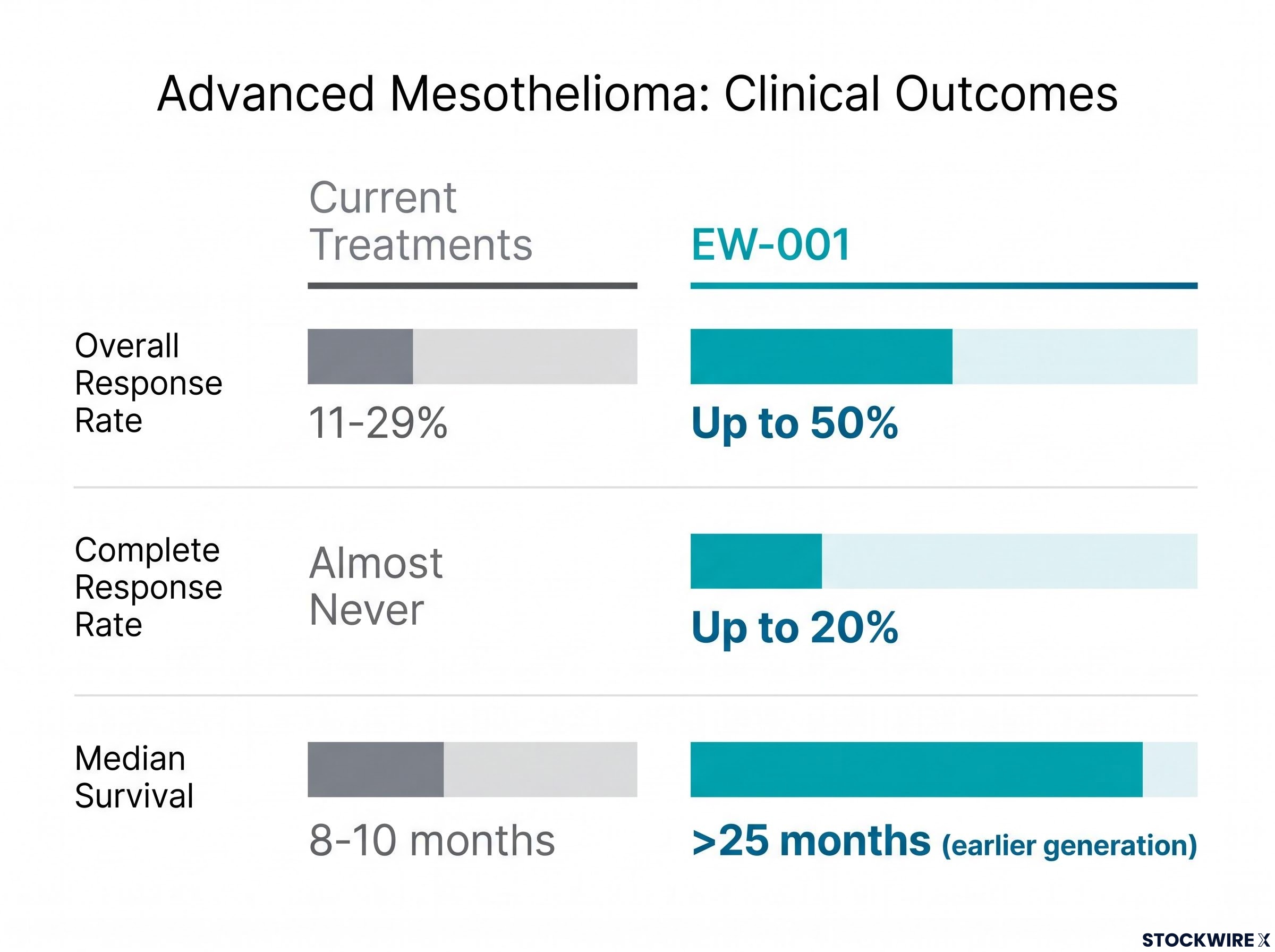
Mesothelioma is a rare but rapidly fatal cancer, typically linked to asbestos exposure. Once a patient has relapsed after initial therapy, second-line treatment options are severely limited and outcomes are considerably poorer. Current treatments typically deliver an Overall Response rate of 11–29% in second and subsequent line patients, with Complete Responses occurring almost never at that stage. Median survival for second-line patients is often only 8–10 months.
By contrast, EW-001 clinical studies conducted in relapsed or advanced mesothelioma patients (second line and later) in China have reported considerably different outcomes:
- Up to 50% Overall Response rate (tumour shrinkage)
- Up to 20% Complete Response rate (complete tumour clearance)
- Two patients achieving Complete Responses have reached two-year and one-year survival milestones respectively, with no evidence of cancer returning
- Median overall survival has not yet been reached in the current-generation manufacturing process; an earlier generation of EW-001 achieved more than 25 months median overall survival
The two-year cancer-free milestone achieved by EW-001’s first higher-dose patient represents an outcome with no documented precedent in second-line mesothelioma, where median survival under standard immunotherapy is approximately ten months.
EW-001 is also engineered with a dual mechanism: it targets the mesothelin protein expressed in many solid cancers, and it is designed to produce a checkpoint inhibitor to counter a key defensive mechanism used by cancers against CAR-T cells. EW-001 has not yet received regulatory approval for general commercial launch anywhere in the world.
What comes next — timeline and strategic read-through
The next concrete milestone is the pre-IND meeting scheduled for 3 November 2026 (US time) / 4 November 2026 (AEST). The FDA generally issues formal written minutes two to four weeks after the meeting. Following receipt of those minutes, AdAlta will assess the implications for its manufacturing, non-clinical, and clinical plans before updating the market as appropriate.
For shareholders, the significance reads across two dimensions:
-
De-risking the path to Phase 1. Early FDA alignment makes the eventual IND submission more robust. Any additional data requirements or protocol adjustments can be addressed while changes are still relatively inexpensive to make, rather than causing delays and added cost after a formal submission.
-
Proof of the ‘East to West’ model. Being in a position to hold this meeting demonstrates the strategy working in practice: data, know-how, and manufacturing capability moved from SHcell in China into a Western regulatory framework on a realistic timeframe and a modest budget. AdAlta intends to replicate this capability across its pipeline.
For investors exploring the commercial logic behind AdAlta’s regulatory strategy, our detailed coverage of the East to West commercialisation model walks through the unit economics, the comparable deal benchmarks, and the pitch CEO Dr Tim Oldham delivered to pharmaceutical executives at the CAR-TCR Summit in Boston in September 2026.
The broader market context adds weight to the program’s potential. The cellular immunotherapy market is projected to grow at a compound annual growth rate of 34%, reaching US$20.3 billion by 2028. Solid tumours account for 90% of all cancers yet remain underserved by current cellular immunotherapies — the exact segment EW-001 is designed to address.
Don’t Miss the Next Healthcare Breakthrough
Big News Blast delivers FREE breaking ASX healthcare news directly to your inbox within minutes of release, complete with in-depth analysis. Join 20,000+ investors already staying ahead of the market on biotech and healthcare developments. Click the “Free Alerts” button at StockWire X to start receiving alerts the moment market-moving news breaks.