Nvidia just displaced the largest share repurchase authorization in corporate history in a single board decision. On 28 September 2026, its directors approved an additional $150 billion in buyback capacity, pushing past the $110 billion program Apple approved in 2024 that had held the record.
The number that makes this credible rather than reckless is not the authorization itself. It is the $127 billion in trailing free cash flow the business generated over the past twelve months. This is a program sized to actual cash the company produces, not one propped up by borrowing.
The timing matters as much as the scale. The announcement landed against open questions about how long AI capital spending can keep climbing and intensifying competition in the chip market. What follows here is a framework you can apply to evaluate whether a buyback this large is a rational capital-allocation decision or an overconfident bet, using Nvidia as the real-world case study.
A $235 billion authorization built on cash, not confidence alone
The headline figure is arresting: $235 billion in total remaining repurchase capacity, the largest ever authorized by a US company in absolute terms.
That total is not one clean decision. The $150 billion approved on 28 September 2026 builds on an existing program, which had already been topped up by $80 billion back in May 2026. Nvidia expects to work through the full remaining amount by the end of fiscal year 2028.
The first thing to understand is what this authorization actually is, and what it is not. It gives management the capacity and flexibility to buy back stock. It does not lock the company into a fixed schedule or a guaranteed amount. Actual pace will depend on market conditions, the share price, and the company’s own capital needs as they emerge.
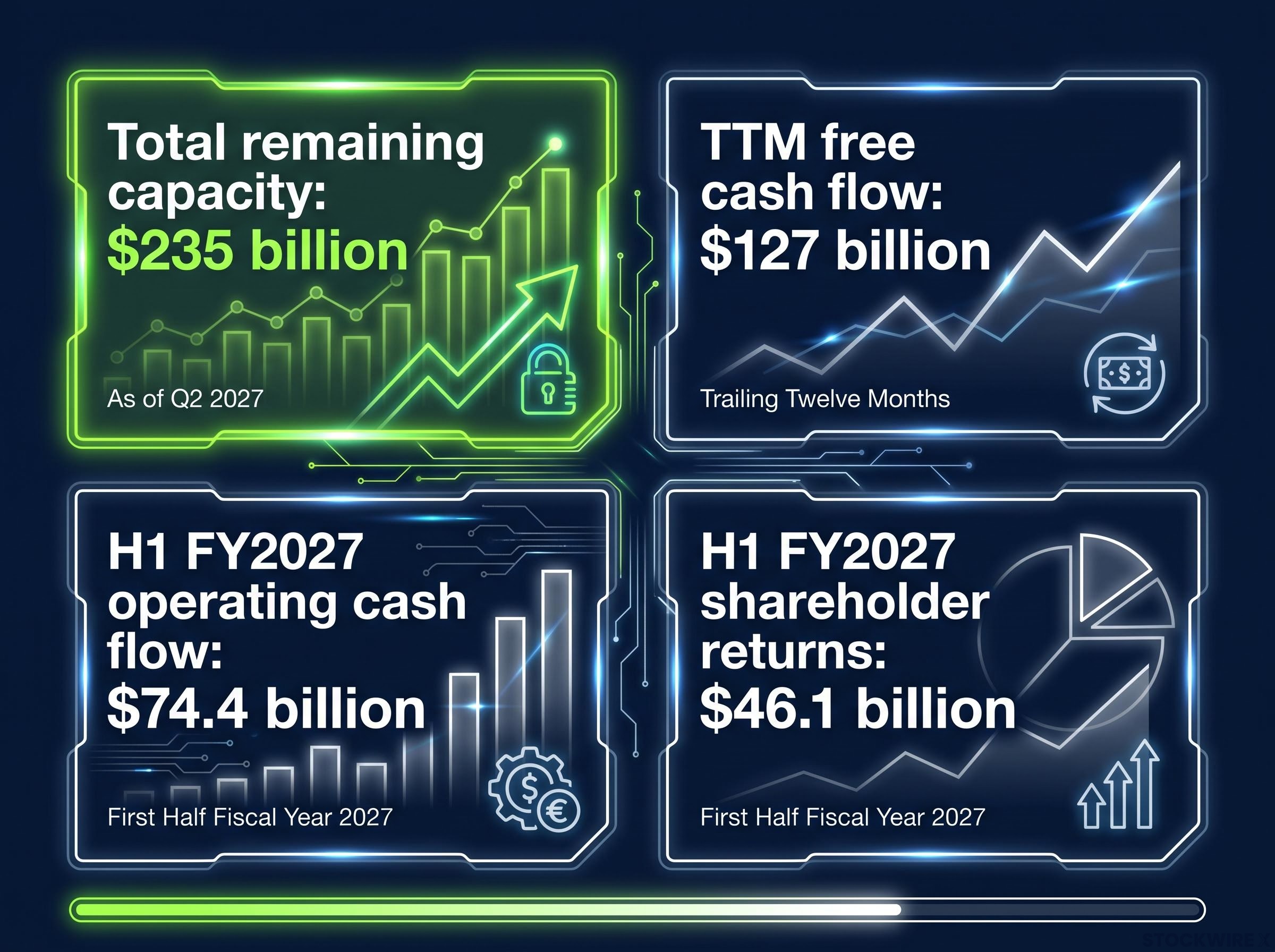
Here is where instinctive skepticism about the size starts to soften. Over the trailing twelve months, Nvidia generated $134 billion in operating cash flow and $127 billion in free cash flow. In the first half of fiscal year 2027 alone, operating cash flow reached $74.4 billion, and the company still returned $46.1 billion to shareholders.
| Metric | Figure | Context |
|---|---|---|
| Total remaining authorization | $235 billion | Largest ever by a US company |
| TTM free cash flow | $127 billion | The credibility anchor |
| H1 FY2027 operating cash flow | $74.4 billion | Six months of cash generation |
| H1 FY2027 shareholder returns | $46.1 billion | Returned alongside heavy AI spend |
| Authorization as % of market cap | ~4% | Per 24/7 Wall St estimate |
| Prior record | Apple $110 billion (2024) | The mark Nvidia surpassed |
That cash-flow context is exactly why the analyst reaction has been more measured than the headline might suggest.
Barron’s framing Relative to the cash Nvidia is generating, the buyback authorization is “not all that surprising.”
The gap between the headline number and the cash the business actually throws off is where the real story sits. A $235 billion program funded by a company producing $127 billion in annual free cash flow is a structurally different proposition than one funded by debt. That distinction is the first filter you should apply to any buyback, because a cash-funded program at this scale signals financial strength, while a debt-funded one of the same size would say something quite different about management’s appetite for risk.
When big ASX news breaks, our subscribers know first
How buybacks actually move the numbers, and where they fall short
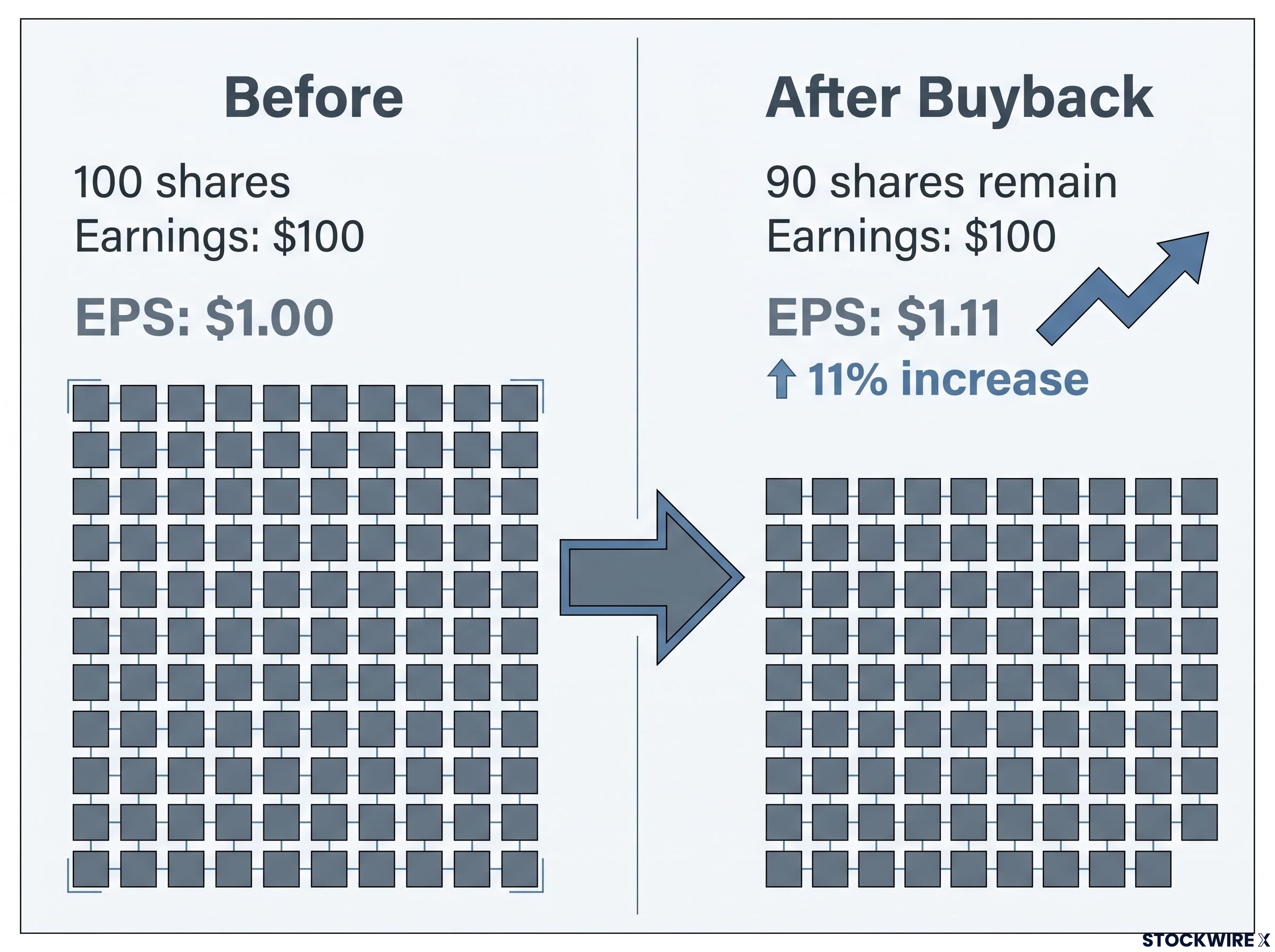
Buybacks lift earnings per share for a simple reason: fewer shares means each remaining one owns a larger slice of the same profit.
The arithmetic is worth walking through:
- Start with 100 shares outstanding and $100 in earnings, and EPS is $1.00.
- Buy back 10 shares so 90 remain, holding earnings at $100.
- EPS rises to roughly $1.11, an increase of about 11% with no growth in underlying profit at all.
That mechanical uplift is real, but whether it creates or destroys value depends entirely on price:
- Buying shares below their fair value transfers value to the shareholders who stay.
- Buying shares above fair value destroys value, because the company overpays and deploys capital that could have funded growth at an economic loss.
So the question is never simply whether repurchases are happening. It is what price is being paid relative to the company’s realistic long-term earnings power.
Beyond per-share arithmetic, a sustained buyback program can function as a technical price floor, with consistent corporate buying absorbing sell pressure at levels management has effectively signalled as attractive; the SK Hynix and Samsung programs in late 2026 illustrate how this mechanism operates in practice across different execution structures.
At Nvidia’s scale, the direct arithmetic is more modest than the size implies. UBS estimates, in commentary cited by Barron’s, that the buyback adds roughly 8 cents to its 2027 EPS forecast. Nvidia has two levers working at once, organic earnings growth and share count reduction, which compound for remaining shareholders, but the per-share engineering here is not dramatic.
That 8-cent figure tells you the near-term EPS effect is small. The investment case therefore rests on the long-term compounding of share count reduction and the signal it sends about management’s confidence in durable earnings, not on quick per-share engineering.
The stock-based compensation offset: why net share count is the real metric
Here is the complication the headline authorization hides. Nvidia, like most large technology firms, continuously issues new shares through stock-based compensation (SBC), the equity it hands employees as part of their pay.
Those new shares dilute existing holders. A buyback has to first neutralise that ongoing dilution before it produces any net reduction in shares outstanding. The UBS 8-cent estimate almost certainly bakes this offset into its modelling, which is part of why the number is modest.
The takeaway for you is practical. Track Nvidia’s diluted share count quarter over quarter in its filings, not the cumulative dollars authorized. If net share count is falling, the program is delivering. If SBC issuance keeps pace with repurchases, the authorization headline is doing more work than the buyback itself. Net share count trajectory and the ratio of SBC to buyback activity are the numbers that decide whether this program creates per-share value or merely maintains it.
What the Apple precedent tells you about execution over time
Announcement day is the easy part. The harder question is what happens across the years of execution that follow, and the clearest guide available is Apple.
The analyst community has reached for the comparison directly. Reuters framed Nvidia’s increase as eclipsing Apple’s $110 billion approval from 2024, and Barron’s described the program as echoing Apple’s playbook of using repurchases to support the stock as growth moderates and valuation multiples come under pressure.
Apple’s record over the past decade is the reason the parallel carries weight. It repeatedly authorized very large programs and executed them steadily, materially cutting its share count and supporting EPS growth even in stretches when revenue growth cooled. Its per-share earnings trajectory reflects operating performance and persistent share count reduction working together.
Apple’s $100 billion authorization, approved alongside its fiscal Q2 2026 earnings release, drew the same analytic questions about whether a large repurchase program signals confidence or deferred investment priority, and the market answered by selling the stock roughly 1.3% in extended trading despite simultaneous all-time records across revenue, iPhone sales, and EPS.
Four lessons carry over from that history:
- Authorization size matters far less than the actual pace and consistency of repurchases.
- Net share count reduction and EPS quality are the metrics that reveal whether a program is working, not the nominal dollars approved.
- A large buyback can add value when shares are reasonably priced, and risks looking like financial engineering when used mainly to prop up a stretched valuation.
- Investment capacity in research, ecosystem, and capital spending must stay fully funded, or the program undermines the growth that justifies it.
Not everyone thinks Nvidia has been aggressive enough.
Ben Reitzes, head of technology research at Melius Research “If I were Nvidia, I would even authorize more.”
That read, delivered to Barron’s, implies Nvidia’s cash-generation profile makes even a record authorization look conservative by Apple’s standards. The precedent is instructive less for the dollar amounts and more because it shows a disciplined repurchase program can act as a durable EPS support across business cycles, provided the underlying cash engine holds. The same condition applies to Nvidia, and the durability of the AI revenue cycle is the variable to watch.
The question that matters is not whether $235 billion was authorized in 2026. It is whether Nvidia executes consistent net share count reduction through fiscal year 2028 and beyond.
The investment case for the buyback: what has to go right, and what could go wrong
Capital-allocation frameworks judge a buyback as value-creating when three conditions hold:
- Shares are not materially overvalued relative to realistic growth and margin expectations.
- The company’s investment pipeline is fully funded, so nothing important is being starved.
- Repurchases are sized to free cash flow rather than financed with debt.
Against the available evidence, Nvidia looks reasonably placed on each. On price, David Bennett, a former Wall Street analyst speaking via Yahoo Finance, points out that management is buying back stock at a multiple cheaper than most S&P 500 companies. On funding capacity, the $74.4 billion in first-half operating cash flow returned alongside $46.1 billion to shareholders shows the company can fund AI expansion and buybacks at the same time. On financing, the program draws on cash, not borrowing.
David Bennett, former Wall Street analyst, via Yahoo Finance Nvidia “didn’t talk, it wrote a check.”
That is the confidence-signal argument in its most compressed form. When the market asked how long the AI boom could last, management answered with capital rather than commentary.
Three risks that could change the calculus before fiscal year 2028
The conditions that make the program work can erode, and three risks are worth monitoring rather than predicting.
The first is AI capital spending sustainability. Jacob Bourne, an analyst at Emarketer, notes plainly that “the AI buildout won’t continue at its current pace forever.” If capex growth slows faster than expected, the cash-flow trajectory underpinning a program this large could look aggressive in hindsight.
Hyperscaler capex absorption of operating cash flow has risen from 33-40% in 2022-2023 to an estimated 93-94% in 2026, a structural shift that sets the demand context for Nvidia’s data centre business and explains why the durability of the AI revenue cycle is the single variable that decides whether the buyback program ages well or poorly.
The second is competition. Reuters situates the buyback against “intensifying AI-chip competition” that has weighed on Nvidia’s performance relative to peers. In that environment, a fair debate exists over whether some of this capital might be better spent on research, new products, or acquisitions that deepen the company’s moat.
The third is geopolitical and export-control exposure. Restrictions on advanced chips can limit addressable markets and add volatility, raising the risk that the long-dated cash-flow forecasts supporting the authorization prove optimistic.
There is a built-in safeguard against all three. As 24/7 Wall St stresses, the authorization is non-binding, described as a standing bid under roughly 4% of the company’s market cap, with pace depending on market conditions, the stock price, and capital needs as they arise. If conditions deteriorate, Nvidia can slow or halt repurchases with no penalty. That flexibility is the program’s greatest strength and its central ambiguity: it signals intent and confidence, but it does not lock in the shareholder return.
The credibility of the whole program rests on one question the authorization cannot answer: whether Nvidia’s AI revenue engine produces the cash flows across fiscal years 2027 and 2028 that justify buying at today’s prices. Investors who hold that framing are far better placed to monitor real value creation than those fixated on the headline figure.
Past performance does not guarantee future results. Financial projections are subject to market conditions and various risk factors, and forward-looking statements are speculative and may change with market developments and company performance.
What a $235 billion authorization actually tells you, and what it does not
Three analytical layers stack up here. The program is credible because it is cash-funded, with $127 billion in trailing free cash flow behind it rather than debt. Its per-share impact is real but modest, with UBS estimating roughly 8 cents of EPS uplift, which means net share count, not authorization dollars, is the metric that matters. And its value depends on price paid, a funded investment pipeline, and the durability of AI-driven cash flows over the execution window.
Read together, the $235 billion figure is best understood as a signal of capacity, not a guarantee of returns. Its non-binding structure gives Nvidia optionality that both reassures and limits the commitment.
The execution pace against the 50% free cash flow target is where the program either validates or disappoints: UBS modelled that Nvidia must repurchase roughly $69 billion across three fiscal quarters to meet that commitment, making each quarter’s filing a meaningful data point rather than a formality.
Two things are worth tracking in the quarterly filings from here:
- The diluted share count trajectory, quarter over quarter, to confirm the buyback is producing net reduction rather than just offsetting dilution.
- The ratio of stock-based compensation issuance to buyback pace, which determines whether per-share value is being created or merely maintained.
The broader principle the Nvidia case illustrates is simple. The quality of a buyback is set by price paid, the sustainability of cash generation, and execution discipline, not by the size of the authorization headline. Apply that lens to any large buyback announcement, and you will be far better equipped to judge it.
This article is for informational purposes only and should not be considered financial advice. Investors should conduct their own research and consult with financial professionals before making investment decisions.