
UK government borrowing came in at £18.3 billion in August alone, a full £3.5 billion above what the Office for Budget Responsibility (OBR) had penciled in for the month. That single number tells the market the fiscal plan is already off course.
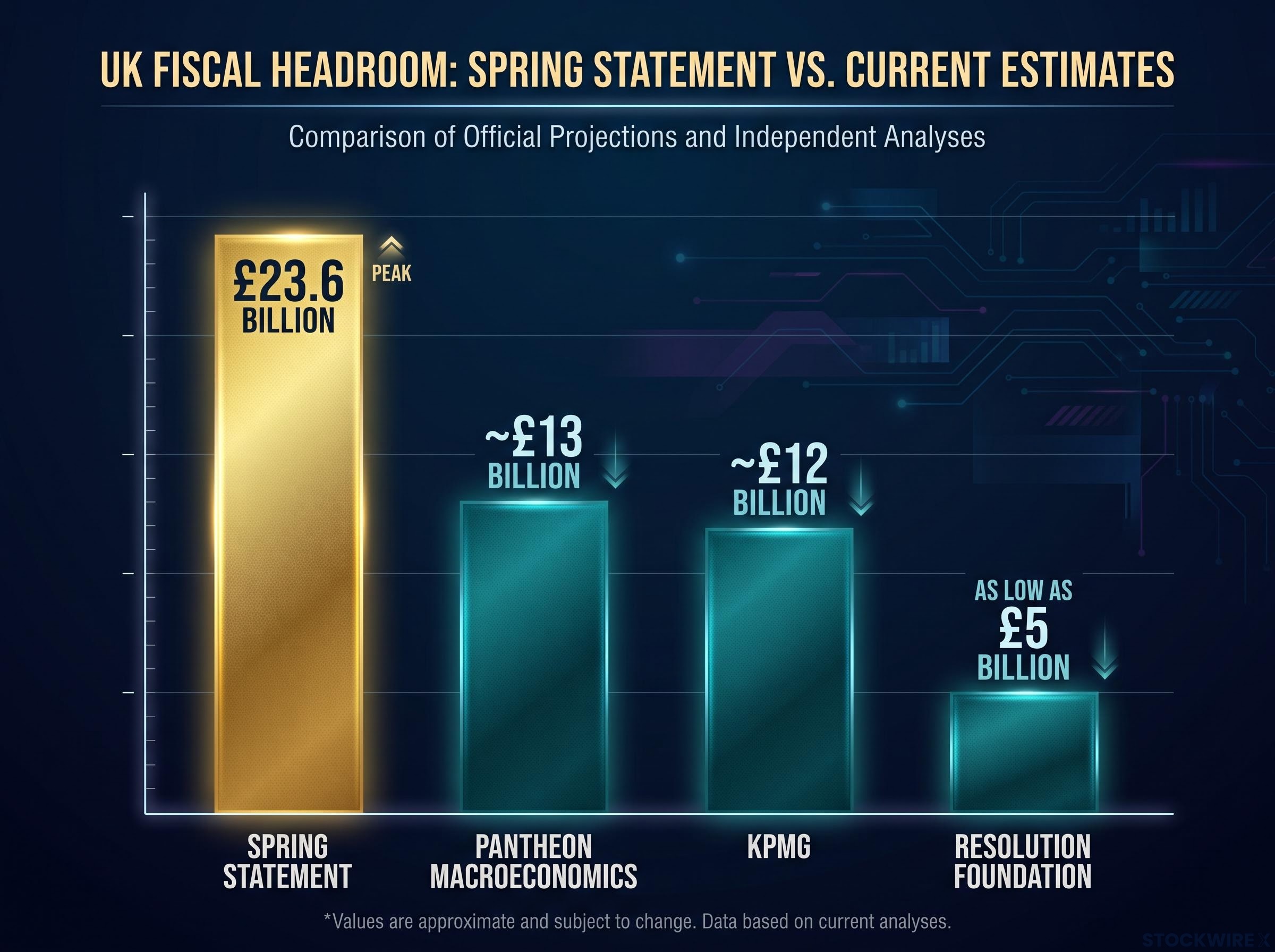
The fiscal headroom the Chancellor was leaning on has been cut roughly in half since the Spring Statement, from £23.6 billion to around £12 billion, and it was shrunk by forces the government does not control: higher gilt yields and rising debt servicing costs.
That matters far beyond the Treasury’s spreadsheets. When fiscal tightening becomes the near-certain response to a worsening budget, markets start to reprice how much work the Bank of England (BoE) will need to do on interest rates, and that repricing flows straight into the value of the pound.
Sitting in late September 2026, with the Autumn Budget six weeks away and the British Pound subdued below 1.3400 against the dollar, the question of whether the currency can fall further is no longer academic. What follows here traces the chain of logic from the borrowing figures to the currency price, and hands you a framework to judge whether the next leg lower in sterling is already priced in or still to come.
The fiscal position that changed everything
Start with the raw numbers, because the gap between forecast and reality is the whole argument.
August public sector net borrowing landed at £18.3 billion. On its own that figure is large, but the level is not the story. The story is the deviation:
- Borrowing was £2.9 billion higher than in August 2025.
- It came in £3.5 billion above the OBR’s own forecast for the month.
- Year-to-date net borrowing has now reached £77.3 billion, sitting £8.1 billion above the OBR’s forecast profile.
An overshoot in one month is a rounding error. An overshoot that compounds month after month is a trajectory, and that is what the cumulative figure exposes.
The ONS public sector finances bulletin for August 2026 confirms the £18.3 billion borrowing figure and documents the cumulative year-to-date deviation from OBR projections, providing the primary data series that underpins the fiscal deterioration case.
From one bad month to a structural overshoot
The year-to-date position is what turns this from a seasonal blip into a pattern. The OBR’s March 2026 Economic and Fiscal Outlook projected borrowing falling from 5.2% of GDP in FY 2024-25 to just 1.6% of GDP by 2030-31. That is a steep glide path, and the current run-rate makes it materially harder to hit.
The consequence shows up most sharply in the Chancellor’s fiscal headroom, the safety margin between projected borrowing and the government’s own fiscal rules. Higher debt servicing costs, driven by a gilt market sell-off that pushed yields higher, have cut that buffer roughly in half. Analyst estimates now cluster in a wide but consistently diminished range.
| Institution | Headroom Estimate | Key Driver |
|---|---|---|
| KPMG | ~£12 billion | Higher gilt yields and debt servicing costs |
| Pantheon Macroeconomics | ~£13 billion | Bond market sell-off lifting yields |
| Resolution Foundation | As low as £5 billion | Deteriorating fiscal position |
Here is what these figures mean for you if you hold sterling assets. The Chancellor’s room to manoeuvre on 28 October has been nearly halved by market forces the government did not choose, which means whatever plan arrives is being built on far weaker foundations than the one presented in spring. The size of the miss effectively sets the floor for how much consolidation is required, and that requirement shapes every major UK market variable heading into October.
When big ASX news breaks, our subscribers know first
How a tighter budget reprices the Bank of England
The connection between a borrowing overshoot and a weaker currency runs through the Bank of England. Follow the mechanism step by step, and the outcome becomes hard to argue with.
The logic is one of substitution. When a government tightens fiscally through tax rises and spending cuts, it cools domestic demand and inflation directly. That reduces the need for the central bank to do the same cooling work through higher interest rates. Fiscal tightening substitutes for monetary tightening.
Laid out as a chain, the transmission looks like this:
- Fiscal tightening (higher taxes, lower spending) reduces domestic demand and inflationary pressure.
- The BoE is less compelled to raise rates to achieve the same disinflation.
- As markets price out future hikes, the UK’s interest rate advantage over other economies narrows.
- A narrower rate advantage removes a key support for sterling, and the currency weakens.
The research here contains a genuine conflict worth naming directly. An earlier framing from Brown Brothers Harriman (BBH) referenced markets pricing roughly 100 basis points of BoE rate increases over the coming year. But more recent evidence suggests that dovish repricing may already be well advanced. At its September 2026 meeting, the Monetary Policy Committee held the Bank Rate at 3.75% on a 6-3 vote. A Reuters poll published on 14 September 2026 found economists unanimously expecting that hold, with most judging the next move more likely to be a cut than a hike.
The September 2026 MPC vote split of 6-3 to hold at 3.75% also carried a signal that markets absorbed immediately: the three hawkish dissenters pressing for a rise to 4.0% have maintained that position across multiple consecutive meetings, meaning the majority is just one defection away from losing its hold on the current rate path.
The International Monetary Fund (IMF) reinforces the direction of travel. It notes that fiscal consolidation of close to 1% of GDP in the prior year, with a further 0.5% of GDP projected for FY 2026/27, removes pressure on monetary policy to anchor inflation on its own. The more the budget does the work, the less the Bank has to.
That erosion shows up cleanly in the rate differential. Société Générale points out that UK policy rates currently sit about 125 basis points above those in the Eurozone, a gap that has supported sterling. As markets reassess how much tightening the BoE actually needs to deliver, that supportive differential compresses.
Rabobank analysts note that markets have overestimated the risk of BoE rate hikes. As tax rises and spending cuts are priced in, the repricing toward steady monetary policy, combined with a building fiscal risk premium, places downside pressure on the pound.
For a trader or investor, the implication is precise. The rate advantage supporting sterling is eroding not because the Bank has cut, but because the market is increasingly confident it will not need to hike. That confidence alone is enough to reduce the pound’s relative appeal, and it is the engine sitting underneath the GBP/USD chart.
What sterling traders need to know about the currency market
That mechanism becomes real the moment it shows up in price behaviour and analyst positioning.
On the GBP/USD screen, the pound is subdued below 1.3400. BBH’s Elias Haddad frames this level as a ceiling rather than a base, precisely because the downside risk from further dovish BoE repricing remains live. Unverified intraday data on 22 September 2026 placed the pair near 1.3363-1.3376, but treat those figures as directional context rather than precision.
The euro cross offers a complementary read on the same weakness, and several desks prefer it.
The cleaner signal for isolating domestic credibility risk from the global yield moves that drove UK and US 10-year yields on an almost identical arc through H1 2026 is the UK-Germany gilt spread, which separates the fiscal risk premium specific to Britain from the broader sovereign debt repricing playing out across major economies.
EUR/GBP as the cleaner expression of sterling weakness
EUR/GBP strips out US dollar volatility, leaving a purer read on sterling’s UK-specific pressures. That is why both Rabobank and TD Securities favour this cross as the vehicle for a bearish sterling view: the euro’s own drivers are comparatively stable in this period, so the movement reflects UK stress rather than dollar noise.
TD Securities is watching for a breakout above 0.86 in EUR/GBP. Rabobank forecasts the cross trending toward 0.87 on a three-month horizon. Société Générale goes further, warning that a poorly received austerity plan at the Autumn Budget could push EUR/GBP toward 0.88.
| Institution | GBP/USD View | EUR/GBP View | Key Condition |
|---|---|---|---|
| BBH | Capped below 1.3400 | N/A | Downside BoE repricing risk |
| Scotiabank | 1.3500-1.3600 | N/A | Fiscal risks do not escalate |
| TD Securities | N/A | Breakout above 0.86 | Fiscal risk premium builds |
| Rabobank | N/A | Toward 0.87 (3-month) | Repricing toward steady policy |
| Société Générale | N/A | Toward 0.88 | Budget seen as growth-damaging |
The spread of these targets is the signal. From Scotiabank’s stabilisation scenario around 1.3500-1.3600 to Société Générale’s stressed case implying EUR/GBP at 0.88, the range is unusually wide by recent standards. That tells you the Autumn Budget is functioning as a binary event for the currency, not a gradual drift. For anyone holding UK currency exposure through October, these levels define the practical risk envelope around the budget date.
The Autumn Budget as a binary event for the pound
If 28 October is the pivot, the arithmetic behind it explains why the outcomes fork so sharply.
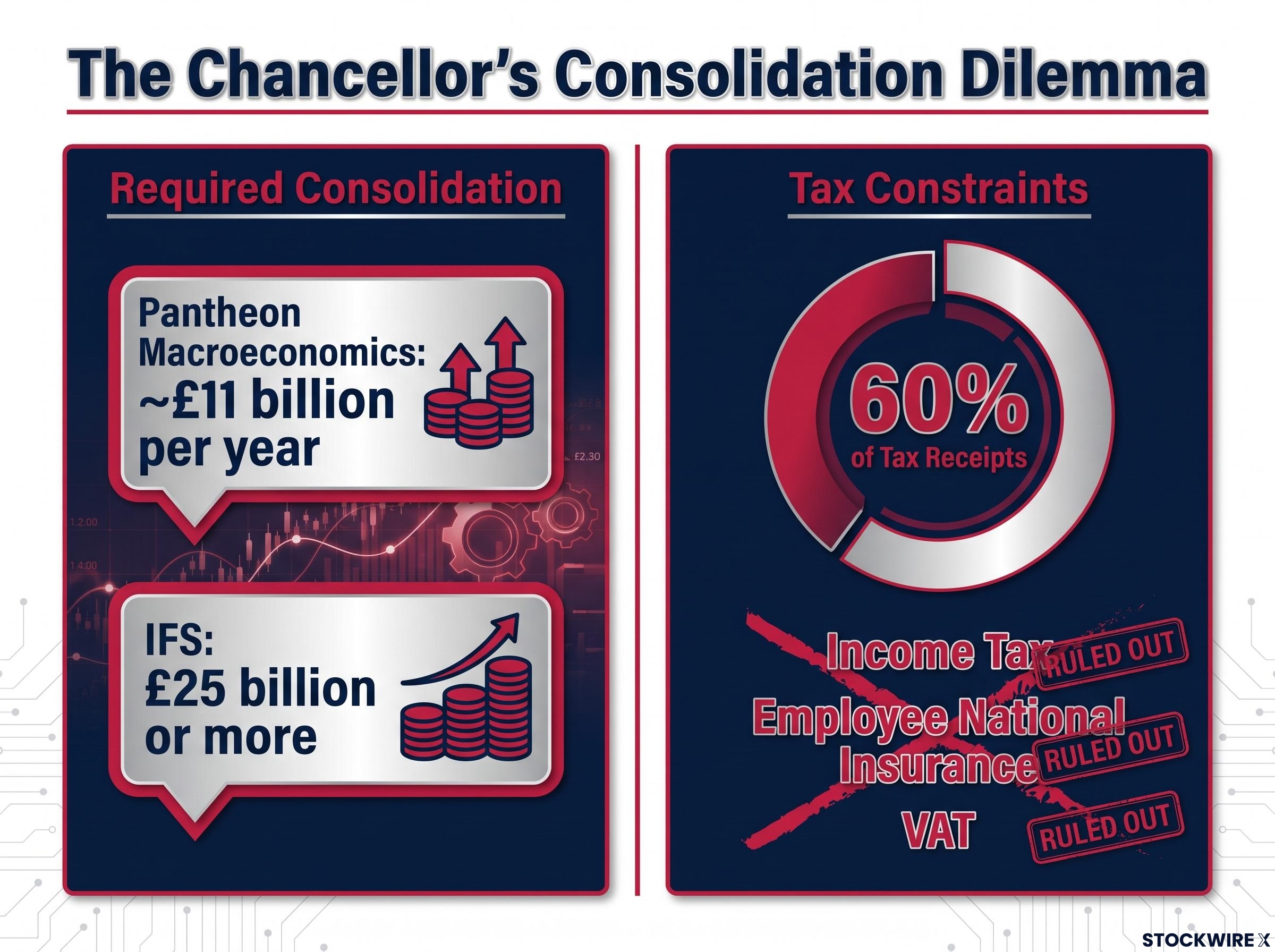
Pantheon Macroeconomics calculates that the Chancellor needs roughly £11 billion per year of consolidation, through tax rises or spending cuts, simply to restore headroom to its March levels. The Institute for Fiscal Studies (IFS) puts the number considerably higher.
The IFS suggests that £25 billion or more may be needed to meet broader spending ambitions while staying within the fiscal rules.
That gap is the tell. Even a fully credible budget may only partially close the problem, which means gilt market pressure and sterling weakness look more like durable features than one-off event risks.
The Chancellor is also boxed in on how to raise the money. Increases to the rates of income tax, employee National Insurance, and VAT have been ruled out, and those three account for close to 60% of tax receipts. That forces consolidation into narrower channels: threshold freezes, corporate taxes, wealth and property levies, or deeper spending restraint.
What a credible plan actually requires
In market terms, credible means a plan that stabilises the debt-to-GDP trajectory without front-loading contraction so severe that it further compresses BoE rate expectations. The structural challenge is stark: Scope Ratings projects UK general government debt reaching 114.8% of GDP by 2029.
There is a tension the Chancellor cannot easily escape. The measures most available, threshold freezes and taxes on companies and wealth, are less growth-damaging than blunt spending cuts, but they also offer less reassurance to gilt markets hunting for structural expenditure discipline. History offers a reference point: the 2010 austerity programme depressed the demand recovery and, in doing so, reduced the need for hawkish monetary policy.
That leaves two clean scenario forks for the pound:
- A credible, balanced plan that stabilises debt without triggering severe near-term contraction. Risk premia decline and sterling stabilises toward Scotiabank’s 1.3500-1.3600 range.
- An austerity plan seen as growth-damaging or insufficient. The fiscal risk premium builds and EUR/GBP tests 0.87-0.88.
For anyone with UK equity, gilt, or currency exposure, the announcement effectively defines the macro backdrop for the final quarter of 2026 and possibly the first quarter of 2027.
Past performance does not guarantee future results. Financial projections are subject to market conditions and various risk factors. These scenarios are speculative and subject to change based on market developments.
What the next six weeks mean for GBP/USD
Three pressure points now sit on the pound at once: fiscal headroom that has been nearly halved, a repricing of BoE expectations that has already advanced toward a hold-or-cut baseline, and a specific binary risk event on 28 October. The direction of sterling over the next six weeks depends on how those three interact.
Rather than chase a point forecast, watch three variables:
- The Autumn Budget’s headline consolidation number and its composition. A revenue-led plan reads differently to gilt markets than a spending-led one.
- Any shift in the MPC’s language on the rate path. A more explicit lean toward cuts would compress the rate differential further.
- The gilt market reaction, which functions as the real-time credibility barometer.
Of the three, the gilt market is the one to track most closely.
Long-end gilt yields carry a fiscal dimension that makes the Bank of England’s quantitative tightening decisions directly relevant to the Chancellor’s headroom: a 0.3-percentage-point rise in long-end borrowing costs is sufficient to erase the entire fiscal cushion, and the Bank’s reported move to scrap active sales of 20- and 30-year gilts partly reflects awareness that auction pressure was amplifying that risk.
In May 2026, political and fiscal turmoil pushed 10-year gilt yields to 5.17% and 30-year yields near 5.85%, levels comparable to the 2022 Truss-era crisis.
If 10-year yields rise sharply in the days after the budget, it signals that markets regard the consolidation as insufficient or growth-damaging. That is the most reliable leading indicator for the next leg lower in the pound.
The upside case is real but conditional. If the Chancellor delivers a plan that meets the arithmetic without signalling severe growth damage, Scotiabank’s 1.3500-1.3600 stabilisation range comes into view. The asymmetry in current positioning, though, still tilts toward further weakness, with the downside marked by EUR/GBP toward 0.87-0.88.
This article is for informational purposes only and should not be considered financial advice. Investors should conduct their own research and consult with financial professionals before making investment decisions.