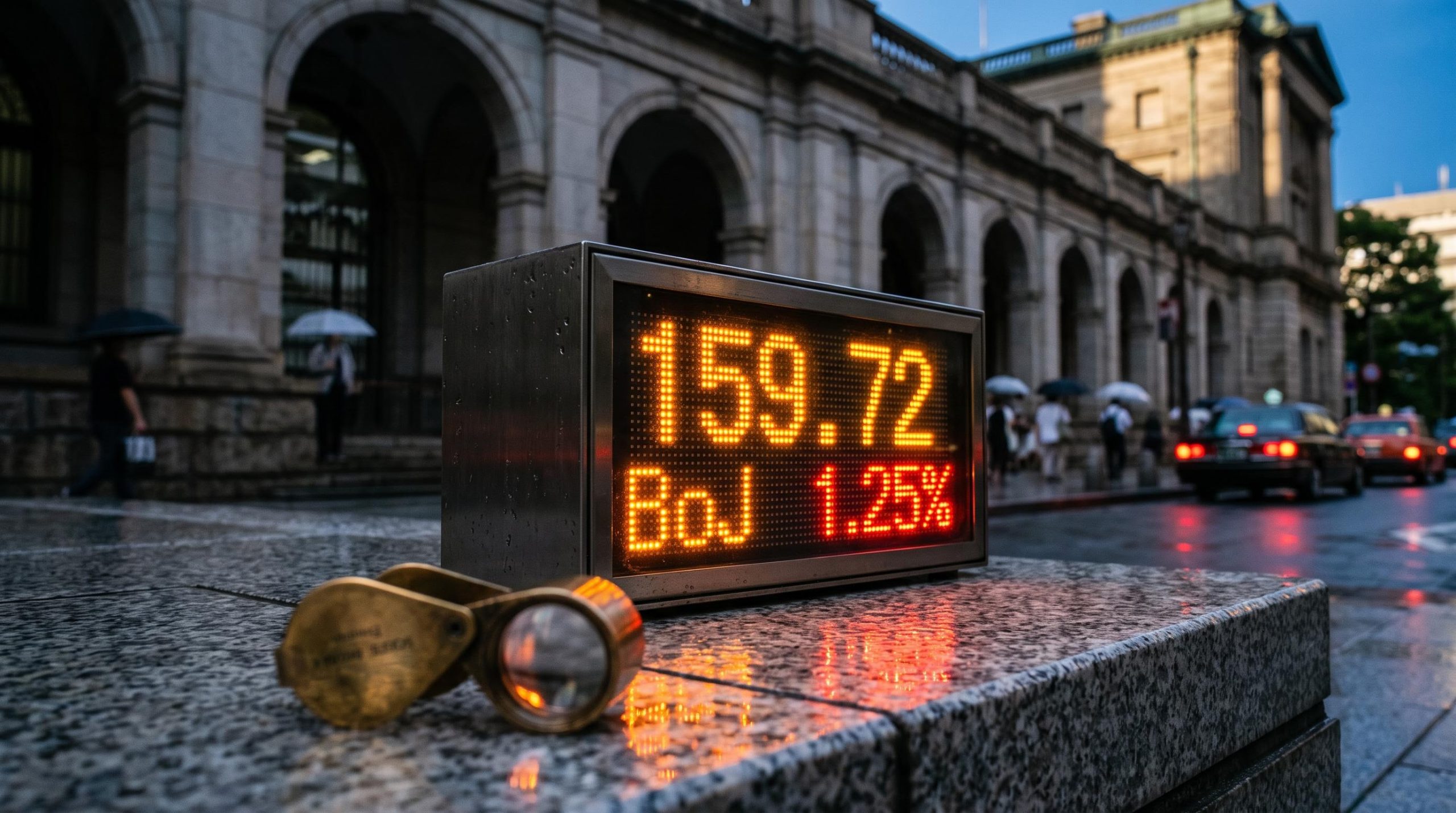
The yen sits at 159.72 to the US dollar, and the Bank of Japan’s policy rate is 1.25%. On Thursday, a board member who supports higher rates in principle argued that the BoJ should slow down. Economists still expect a BoJ rate hike in December regardless.
That gap is the story. Toichiro Asada spoke on 12 November 2026, five weeks before the 17-18 December policy meeting. His remarks mark out where the dovish edge of the nine-member board sits. A dove is a policymaker who leans towards lower rates or slower tightening.
Where that edge sits matters beyond Tokyo. It shapes how quickly Japan’s policy rate can climb from here, and that pace feeds directly into the currency that global carry traders, importers and multinational earners all price against.
This piece helps you judge two things. First, whether Asada’s caution changes the December outlook or only the pace after it. Second, what that difference means for the yen.
What Asada actually said, and what he left out
The headline reading was caution. Reuters, Bloomberg and FXStreet all carried the same core message on 12 November: further tightening should be gradual, because consumption is weak and higher rates could drag underlying inflation lower.
His exact wording tells a narrower story. Asada argued about speed and sequencing. He did not argue against normalisation itself, which is the BoJ’s gradual return from emergency-level stimulus to more conventional interest rates.
| Issue | Asada’s reported position |
|---|---|
| December hike | Neither endorsed nor ruled out; flagged the risk of weakening underlying inflation while consumption is weak |
| Pace | Future increases may need to be gradual and carefully timed |
| Lagged effects | Earlier hikes likely to show up with a lag of at least a year |
| Rate cut | Not considering proposing one |
| Yen | Declined to name a desirable dollar/yen level |
| Independence | Called central bank independence an important framework for price stability |
FXStreet’s Speechtracker scored the speech 4.2/10, slightly above his historical average of 3.7/10. The scale reads that as a mildly dovish tone, and a less dovish one than usual for Asada.
The consensus barely moved. Reuters reported that economists still expected a hike to 1.5% in December, followed by roughly quarterly moves.
Markets have tended to react less to the size of each move than to the forward guidance attached to it, as the September hike showed when a priced-in 25 basis point step left the debate on pace wide open.
The dovish end of the board is now arguing about what happens after December. Treat this speech as a signal about the 2027 path, not as a threat to the December decision.
When big ASX news breaks, our subscribers know first
Neutral rate, terminal rate and why 1.25% matters
Asada’s caution rests on one idea: the policy rate is now entering the “neutral zone”. To see why that changes every future meeting, you need the concept first.
What neutral means
The neutral rate is the interest rate that neither speeds up nor slows down the economy. Below it, policy stimulates borrowing and spending. Above it, policy restrains them.
No one can observe the neutral rate directly, so central banks estimate it. The BoJ’s staff estimate covers an unusually wide range.
The key number BoJ staff estimate Japan’s nominal neutral rate at roughly 1.1%-2.5%. The policy rate has sat at 1.25% since 24 September 2026.
Governor Kazuo Ueda has previously put neutral at no less than around 1%. The BoJ’s institutional view is that policy remains accommodative, meaning still supportive of growth, because real rates are negative. A real rate is the interest rate minus inflation.
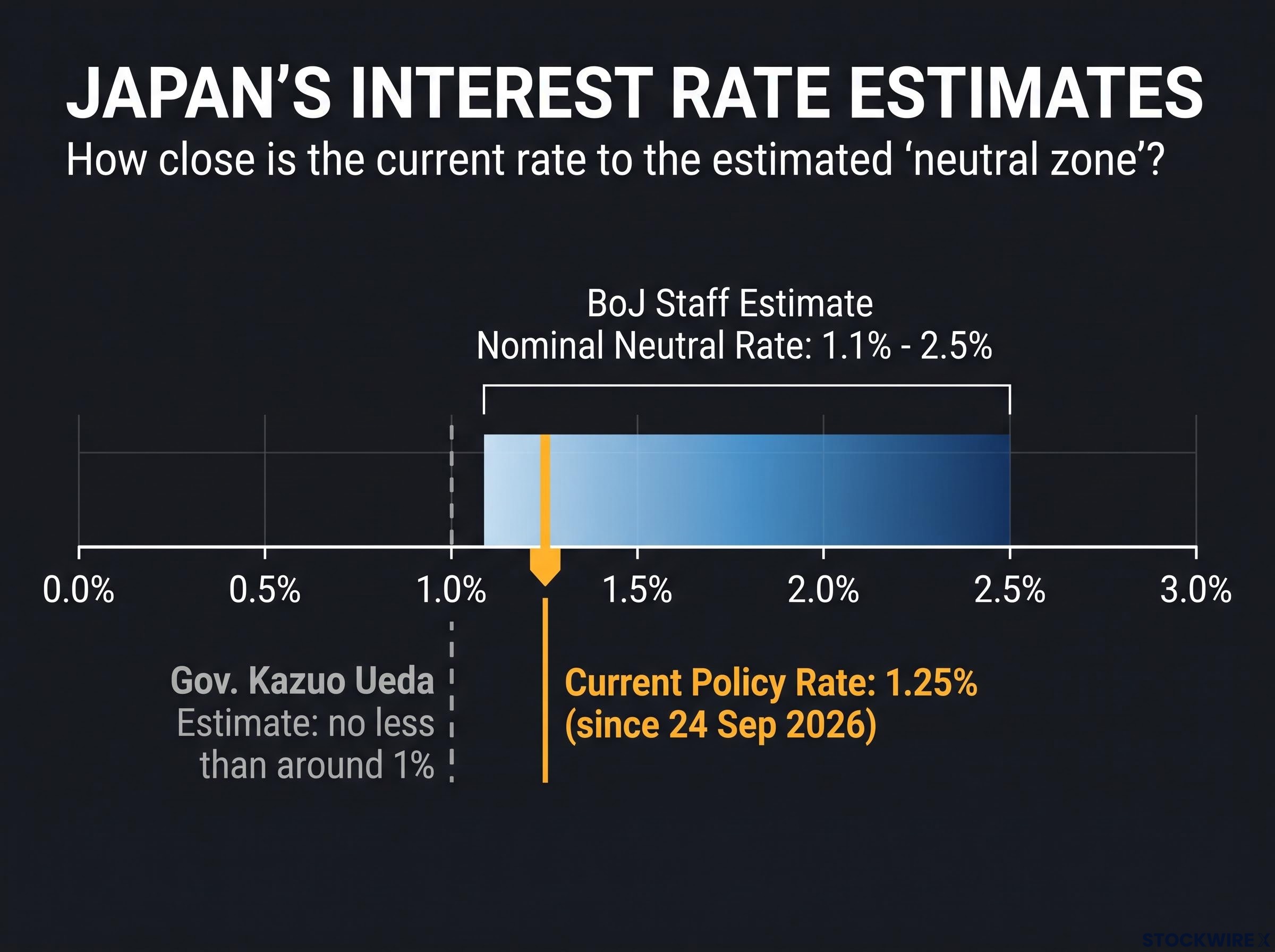
The current policy rate of 1.25% sits just above Governor Kazuo Ueda’s estimate of around 1%, and inside the staff estimate of 1.1% to 2.5%.
Asada reads the range differently. He sees neutral near its lower end, with some possibility that it sits only somewhat above today’s rate.
Why Asada will not name a terminal rate
The terminal rate is the peak a hiking cycle eventually reaches. Asada says he has no particular figure in mind and treats terminal and neutral as closely linked.
He also wants room to move rates up or down even after they reach a level consistent with the BoJ’s 2% inflation target. In his view, each meeting should weigh upside risks, downside risks and financial conditions afresh.
This is why the quarterly-pace assumption is the contested part. With the policy rate already at the bottom of a wide range, each further hike is a decision made under real uncertainty, not a mechanical step.
Dove versus hawk: the case for waiting and the case for hiking
If neutral is uncertain, the data has to settle the argument. The difficulty is that the same data supports both sides.
The gradualist case
Asada’s argument starts with households. September household consumption fell 6.8% year on year, the tenth straight decline and the largest since September 2020.
He adds the lag. Hikes from earlier in 2026 have not fully reached the economy yet. He also doubts that current inflation reflects strong domestic demand, so it could fade on its own.
His background fits this view. He is a former Chuo University economics professor who joined the board in April 2026, and Reuters and Bloomberg associate him with reflationist views and support for Abenomics. Reflationists favour stimulus to lift prices and growth. According to Morningstar, he opposed the September hike but backed the October hold.
The normalisation case
Hajime Takata made the opposing case at the 29-30 October meeting. The board held at 1.25% by an 8-1 vote, and Takata dissented in favour of about 1.5%.
His reasoning is that underlying inflation is near or above 2%, wages are strong and the yen is weak. On that view, waiting risks inflation expectations becoming entrenched.
The balance between hawks and doves is not fixed. With 2027 board appointments due to replace Takata and Tamura by mid-2027, the dovish edge Asada represents could carry more weight in later meetings.
| Indicator | Latest reading | Which camp it supports |
|---|---|---|
| Nationwide core CPI (Sep) | 2.1% y/y | Hawks |
| BoJ core-core measure (Sep) | 3.2% y/y | Hawks |
| Tokyo core CPI (Oct) | 2.6% y/y | Hawks |
| Nominal wages (Sep) | Up 4.6% to ¥311,409 | Hawks |
| Real wages (Sep) | Up 2.2%, ninth straight rise | Hawks |
| Household consumption (Sep) | Down 6.8% y/y | Doves |
Prices and pay favour the hawks. Spending is the doves’ strongest card, and it is a heavy one: real wages are rising, yet households are still cutting back.
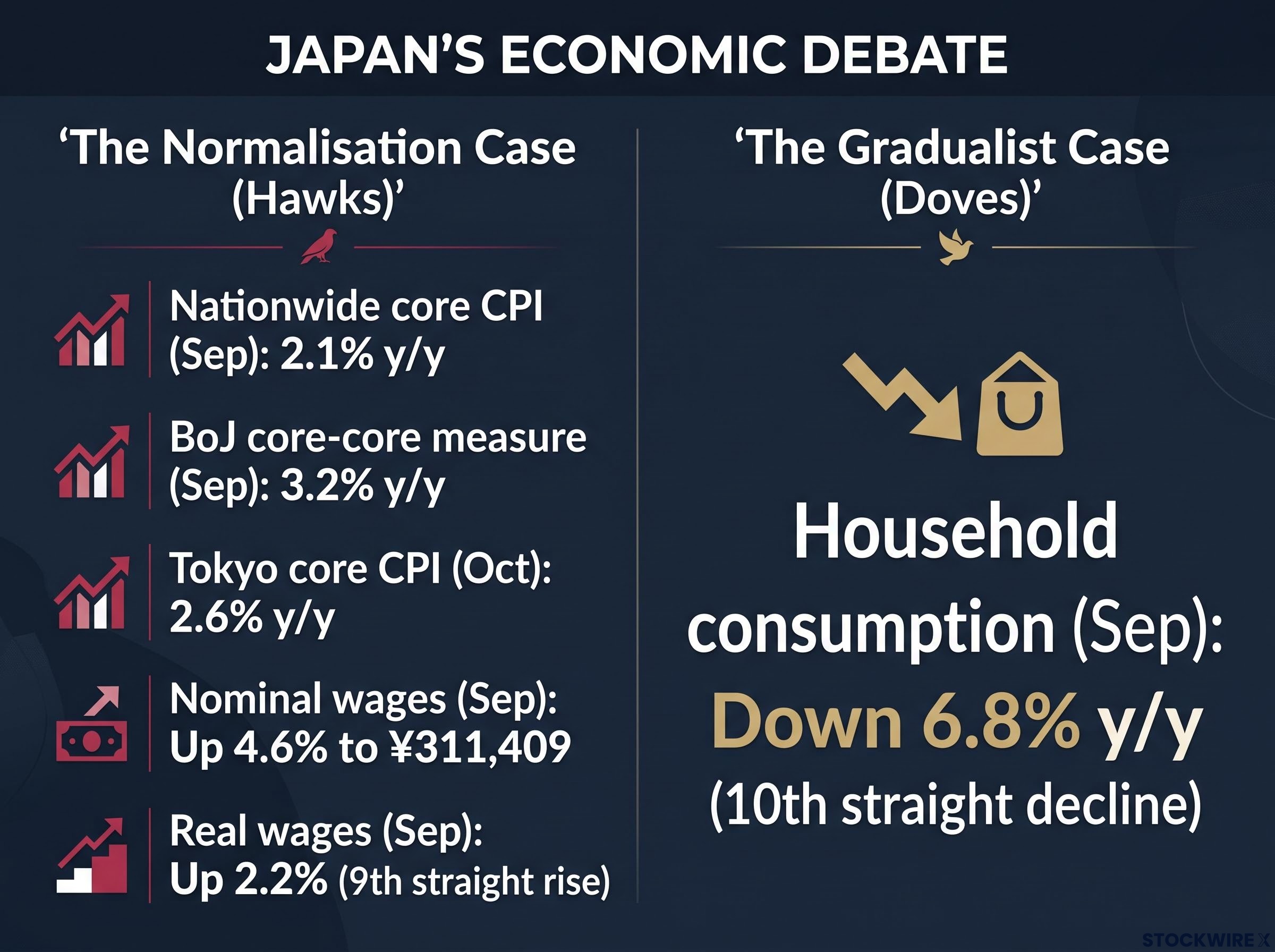
The normalisation case cites inflation up to 3.2% and nominal wages up 4.6%, while the gradualist case highlights a 6.8% drop in household consumption.
In the weeks before 17-18 December, expect the debate to turn on two things: consumption data, and whether wage gains are holding at smaller firms.
Why the yen stays near 160 despite hikes
The BoJ has raised rates repeatedly since early 2024, from -0.1% to 1.25%. Yet the yen is near ¥160 to the dollar, according to Reuters.
12 November 2026 USD/JPY at about 159.72, down 0.09%, at the time of FXStreet’s report.
Reuters linked the day’s yen weakness to rising US rate expectations. That is the first of five forces keeping the currency under pressure:
- Rate differentials. US rates remain far above Japan’s, so borrowing yen to buy higher-yielding assets still pays.
- Negative real rates. Inflation above target means nominal hikes have not delivered positive real returns, which leaves the yen little support from yield.
- Gradual normalisation. The climb to 1.25% is large by Japan’s history but low against other major economies.
- Fiscal and political concerns. Support for fiscal stimulus and reflationist appointments raise questions about how fast tightening can run.
- Carry trades and outflows. Japanese investors chase returns abroad, while foreign investors fund purchases in yen.
Asada added nothing on the currency side. His refusal to name a dollar/yen level is not an intervention signal; exchange-rate policy sits with the Ministry of Finance. Recent coverage reported intervention warnings, but no confirmed new operation.
A 25 basis point hike to 1.5% is unlikely to turn USD/JPY on its own if US expectations keep climbing. (A basis point is one hundredth of a percentage point.) For your currency exposure, the guidance on the follow-up pace matters more than the December decision itself.
For the yen outlook, the sequencing of BoJ timing, Fed pricing and official intervention matters more than any single rate move, which is why hikes alone have repeatedly failed to pull USD/JPY away from 160.
How Japan got to 1.25%: the policy path and its warnings
The scale of the shift explains the caution. The BoJ launched quantitative and qualitative easing (QQE), its large-scale asset purchase programme, in 2013. It cut rates below zero in January 2016 and introduced yield-curve control in September 2016, targeting the 10-year government bond yield. Both negative rates and yield-curve control ended in March 2024.
| Date | Decision | Size or vote |
|---|---|---|
| 19 March 2024 | Ended negative rates, target 0%-0.1% | From -0.1% |
| 31 July 2024 | Raised to 0.25% | 15-25 bp, depending on convention |
| 24 January 2025 | Raised to 0.5% | +25 bp |
| 19 December 2025 | Raised to 0.75% | +25 bp |
| 16 June 2026 | Raised to 1.0% | +25 bp |
| 24 September 2026 | Raised to 1.25% | +25 bp |
| 30 October 2026 | Held at 1.25% | 8-1, Takata for 1.5% |
The BoJ has tried this before and backed off twice:
- 2000: The BoJ exited zero rates into a fragile recovery and later reversed course.
- 2006-07: Hikes that followed the end of quantitative easing were undone after the global downturn hit.
Doves cite both episodes as proof that early tightening can fail when demand is not self-sustaining. Hawks reply that today is different: wages and prices now feed each other more clearly, and the policy rate is still low in real terms.
Both readings hold some truth. Asada’s caution is informed by past reversals, but the inflation and wage backdrop is stronger than in either earlier episode.
What to watch before 17-18 December, and how to read the outcome
The base case holds: a hike to 1.5% remains the economist consensus. What Asada changed is the conversation about pace afterwards. These are the signals to track:
- Household consumption. Another steep fall strengthens the case for a longer pause after December.
- Wage persistence. Watch whether pay gains are spreading to smaller firms.
- Core CPI. Readings that stay above 2% support the hawks.
- US rate expectations. These are the biggest swing factor for USD/JPY.
- Ministry of Finance rhetoric. Any escalation from verbal warnings matters for the yen.
Treat December as a probable step, and the 2027 pace as the open variable driving yen and rate-sensitive positioning.
Beyond December, the BoJ rate hike path is complicated by a planned food consumption tax cut in April 2027, which could mechanically pull headline CPI lower and blur the signals both camps rely on.
These statements are speculative and subject to change based on market developments. This article is for informational purposes only and should not be considered financial advice. Investors should conduct their own research and consult with financial professionals before making investment decisions.