Two ASX 200 stocks. Both down roughly 36% over the past year. Both sitting at or near 52-week lows right now. The similarity ends there.
Austal and PEXA Group arrived at the same destination by very different roads. One faces questions about whether a record order book can actually be turned into earnings. The other absorbed a regulatory shock that sliced directly into the fee revenue its entire business model depends on. For Australian equity investors, the distinction matters enormously, because the playbook for assessing each situation is completely different.
This piece works through both cases with the data now available, giving you a clear view of what is actually driving each decline, what analysts are focused on, and what specific milestones will determine whether these prices represent genuine value or a value trap.
Same chart shape, different stories underneath
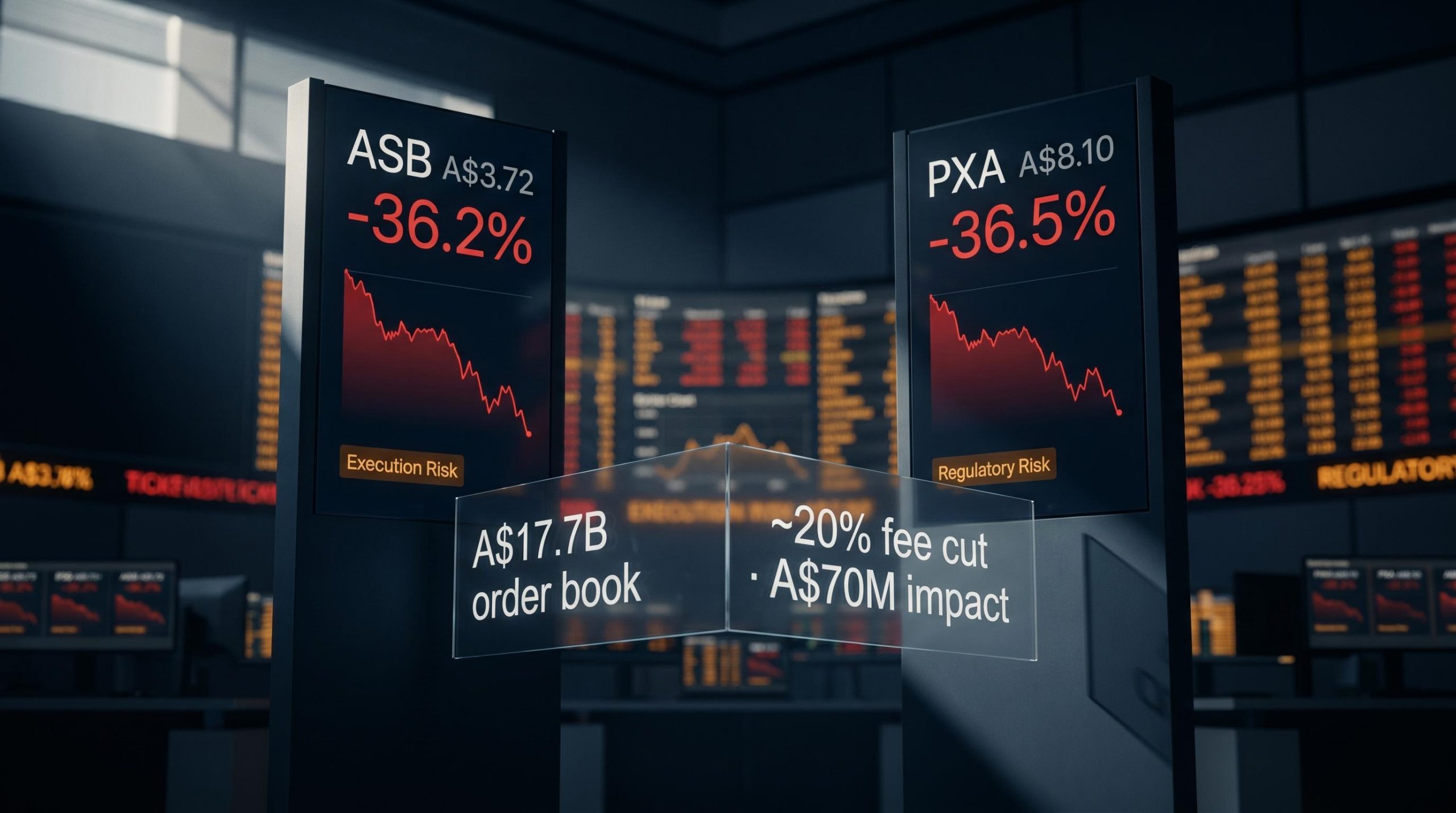
On the surface, the numbers are almost interchangeable. Austal (ASB) closed at A$3.72 on 10 July 2026, down 11.2% for the week and 36.2% over twelve months. PEXA Group (PXA) closed at A$8.10 the same day, down 5.2% for the week and 36.5% over twelve months. Both stocks hit or tested new 52-week lows in the same week.
That is where the parallel stops.
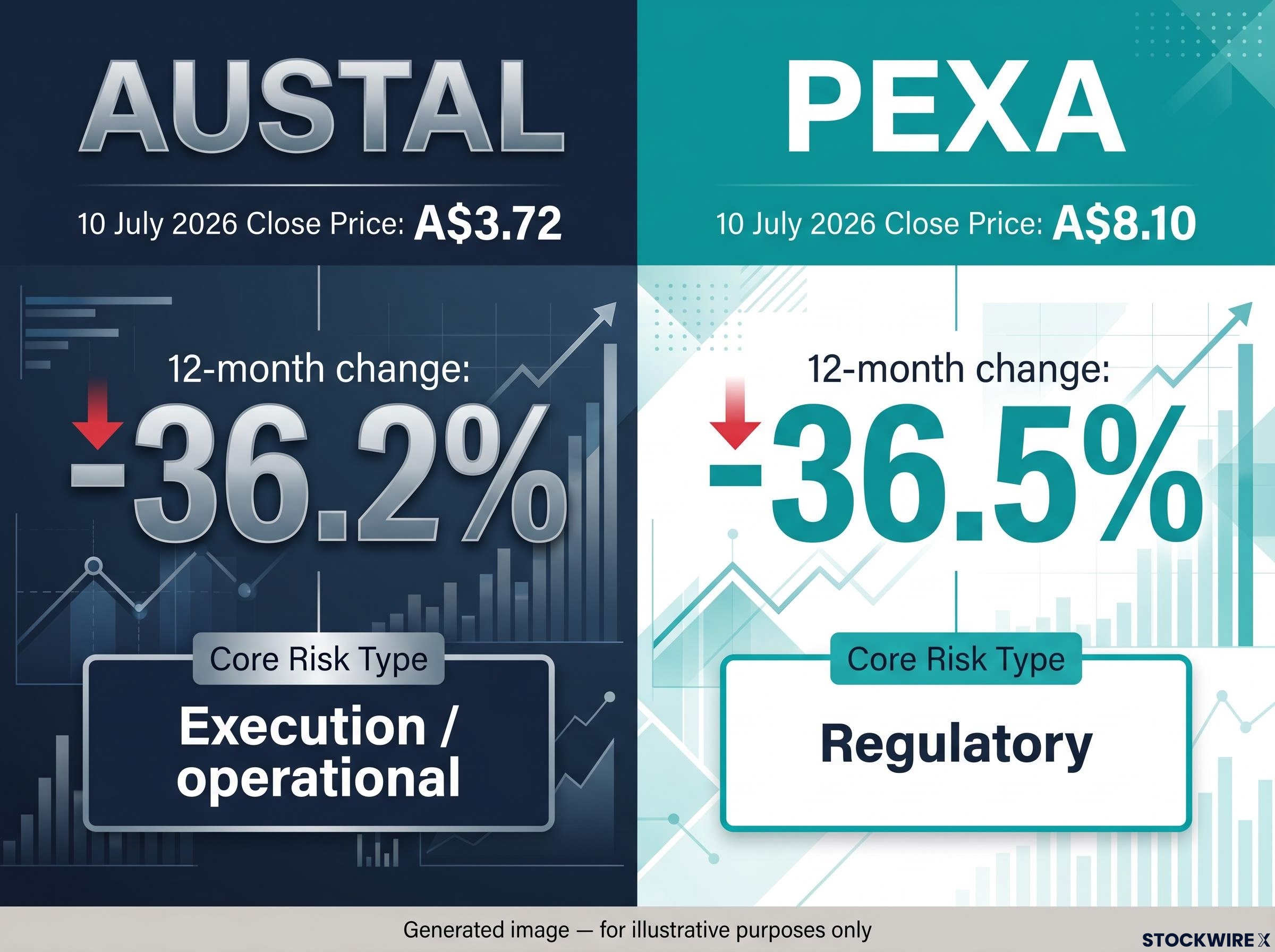
| Metric | Austal (ASB) | PEXA (PXA) |
|---|---|---|
| Close price (10 July 2026) | A$3.72 | A$8.10 |
| Weekly change | -11.2% | -5.2% |
| 12-month change | -36.2% | -36.5% |
| Key catalyst | Bell Potter target cut; prior accounting overstatement | IPART draft ruling on ELNO fees |
| Core risk type | Execution / operational | Regulatory |
The near-identical percentage declines could easily mislead you into treating these as equivalent situations. They are not. Austal’s problem is internal: can management deliver a massive order book at acceptable margins? PEXA’s problem is external: a government tribunal has proposed cutting its core fee revenue by roughly 20%. The forward-looking questions, the monitoring checklists, and the exit or entry criteria for each stock are entirely different.
When big ASX news breaks, our subscribers know first
Austal’s order book is not the problem, delivering it is
Start with what looks like strength. Austal’s reported order backlog stands at A$17.7 billion, a record, anchored by US naval programmes and defence contracts. That is genuine, confirmed revenue visibility stretching out for years. For a company trading at A$3.72, the top-line picture looks compelling.
Backlog analysis in defence contracting requires separating funded from unfunded obligations and tracking the book-to-bill ratio over successive periods; a record headline backlog number, as Austal’s A$17.7 billion figure illustrates, tells investors the revenue ceiling without confirming that contracts will convert to earnings at acceptable margins.
Now look at what sits underneath it.
Bell Potter cut its price target for Austal to A$4.10, down from A$6.30, a reduction of roughly 35% in a single revision. The broker pointed to the considerable operational challenges facing Austal as it takes on a growing portfolio of complex steel shipbuilding programmes in the United States while at the same time pressing ahead with facility expansion at its Henderson yards in Western Australia.
Bell Potter’s revised target of A$4.10, down from A$6.30, represents a roughly 35% cut, one of the sharpest single-revision downgrades the stock has received.
That reassessment did not arrive in a vacuum. In February 2026, Austal disclosed an accounting overstatement and cut its FY26 EBIT guidance to approximately A$110 million. The stock was trading near A$8.80-9.00 at the time; the current price of A$3.72 represents a drawdown of more than 50% from that peak. The February event structurally altered how the market interprets Austal’s disclosures and forward guidance.
The execution risks are specific and identifiable:
- Aluminium-to-steel transition: Austal built its reputation on aluminium vessels. Steel shipbuilding is a materially different discipline with different cost structures and skill requirements.
- Parallel facility ramp-up: Simultaneous capacity expansion at Henderson (WA) and US yards multiplies coordination risk.
- Cost overrun and delay exposure: Complex defence contracts carry explicit performance penalty provisions.
- Governance and reporting sensitivity: After the February 2026 accounting event, any further disclosure surprise will be priced harshly.
For you as an investor evaluating Austal at current prices, the order book tells you the revenue ceiling. It says nothing about where margins land. And after February’s governance event, the market will require demonstrated delivery before repricing the stock higher.
The fee cut that blindsided PEXA investors
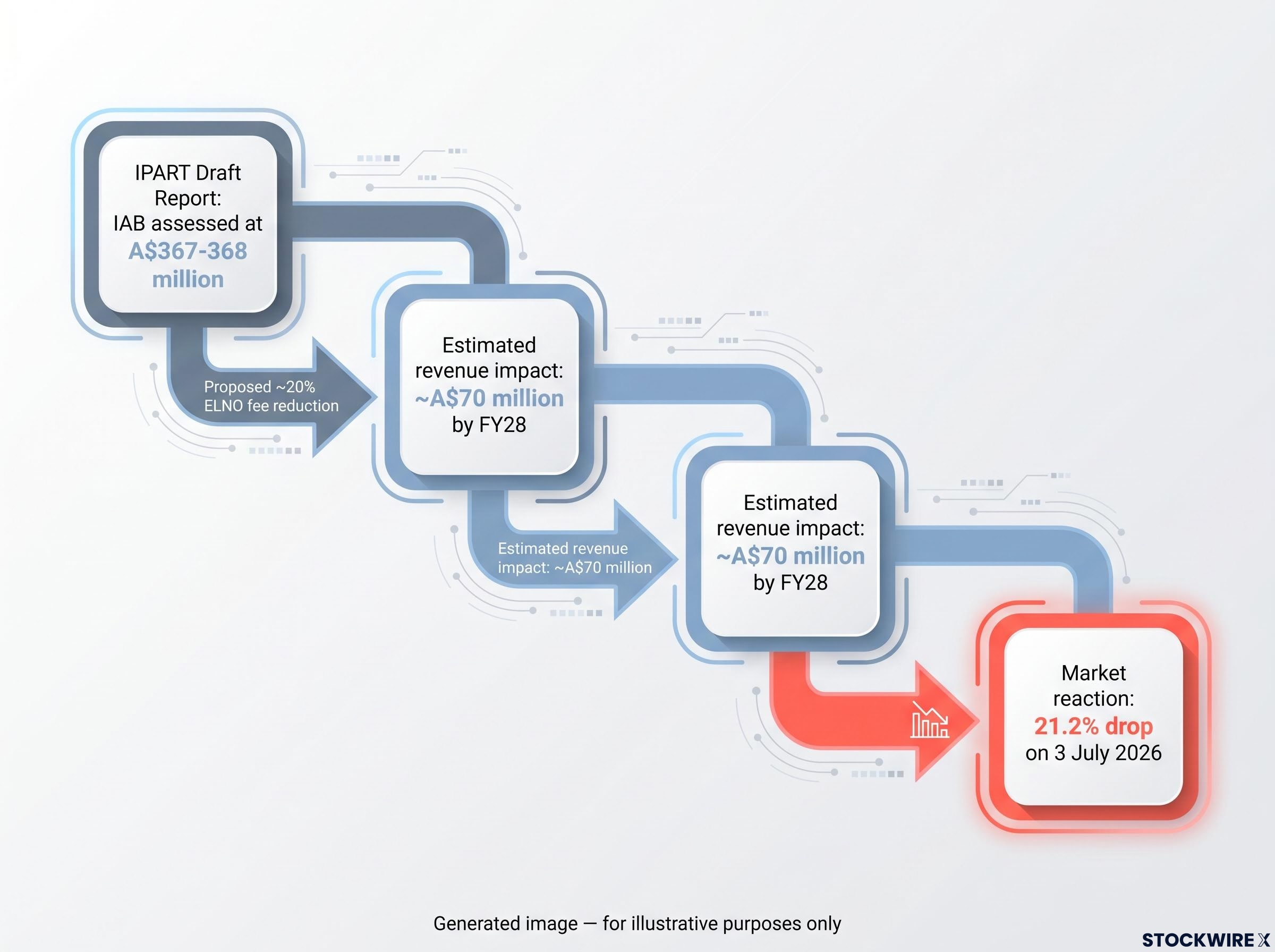
PEXA Group’s share price dropped 21.2% during the session on 3 July 2026, representing one of the most severe single-session sell-offs the company has experienced since listing.
A 21.2% single-day decline on 3 July 2026, triggered by IPART’s draft report, marked one of the sharpest one-day falls in PEXA’s time as a listed company.
The catalyst was a draft report from IPART (the Independent Pricing and Regulatory Tribunal), which put forward a reduction to regulated ELNO transfer fees of around 20%, a steeper outcome than the market had anticipated and one that IPART’s own modelling linked primarily to its assessment of a lower initial asset base than analysts had assumed. The estimated revenue impact: approximately A$70 million over the regulatory determination period to FY28.
Why did a sophisticated market not see this coming? The answer sits in a technical input called the initial asset base, or IAB. The IAB is the value IPART assigns to the regulated assets that underpin PEXA’s fee structure. A lower IAB produces a lower allowable revenue base, which directly drives the recommended fee reduction. IPART’s IAB assessment came in at approximately A$367-368 million, materially below many broker assumptions.
That gap between what analysts modelled and what IPART delivered is what produced the shock. Broker models had been calibrated to a softer outcome. The IAB is not a bureaucratic footnote; it is the engine of the entire pricing model. Until you understand why IPART landed where it did on asset valuation, you cannot assess whether management’s pushback has a credible chance of shifting the final determination.
The stock continued declining after the initial drop, reaching A$8.10 by 10 July 2026. PEXA management has publicly contested the draft through three channels:
- Arguing the IAB assumptions undervalue the asset base and should be revised upward
- Advocating for any fee reduction to be phased in over four years rather than implemented immediately
- Engaging in IPART’s formal consultation process ahead of a final determination
PEXA’s situation illustrates something important: quasi-monopoly positioning does not insulate a business from regulatory repricing. The technical details of a single regulatory submission moved this stock by more than 20% in a single session.
Policy-driven market risk can compress months of earnings repricing into a single session, as PEXA’s 21.2% decline on 3 July 2026 demonstrates; mapping regulatory exposure before a determination arrives, rather than reacting after the session closes, is the structural habit that separates investors who absorb the shock from those who anticipated it.
What the IPART process means from here, and how volume acts as a partial buffer
The draft report is not the final word. IPART’s process moves from draft to final determination after formal submissions, and there is a meaningful difference between the two stages.
Complete reversals of IPART draft positions are rare. That is worth stating plainly. But adjustments to timing, calibration, and phase-in arrangements are documented precedents in Australian regulatory history. On the phase-in question, PEXA management has made its preference clear: it wants any fee reduction spread across four years, rather than landing all at once.
- Formal submissions to IPART: PEXA and other stakeholders lodge responses to the draft, contesting specific inputs including the IAB methodology.
- Final determination release: IPART issues its ruling, which may adjust the draft’s terms on calibration, phasing, or both.
- Volume data in the interim period: Property transaction volumes during the regulatory period will partly determine PEXA’s actual earnings impact.
That third point matters more than it might first appear. PEXA’s fee revenue depends on both the per-transaction fee rate and the number of transactions processed. Higher Australian property transaction volumes can partially offset lower per-transaction fees. The net earnings impact of the IPART ruling will depend in part on property market conditions over the determination period, a variable outside PEXA’s control but one that works in both directions.
Australian property transaction volumes function as a partial natural hedge within PEXA’s earnings model; when volumes rise, higher transaction counts offset the revenue impact of lower per-transaction fees, linking PEXA’s financial performance to the same property market dynamics that influence A-REIT valuations and direct property investor activity.
International expansion as a longer-run lever
PEXA’s UK platform and broader international strategy represent the structural mechanism for reducing reliance on regulated Australian ELNO fees over time. The more material the international business becomes, the less sensitive PEXA’s total earnings profile is to any single IPART ruling. That diversification is not yet large enough to offset the current shock, but it changes the sensitivity calculation for investors looking beyond the next twelve months.
The final determination is the event that matters for PEXA investors, not the draft. Whether management wins any ground on the IAB or the phase-in schedule will determine whether current prices turn out to be an overreaction or a fair new baseline.
How to read a 52-week low: a framework for distinguishing signal from noise
A stock hitting its 52-week low is not automatically a buy signal or a sell signal. It is an invitation to ask a specific question: what caused the decline, and has the underlying risk been fully priced?
The distinction between a genuine discount and a value trap is one of the most consequential judgments in ASX equity investing, and value trap recognition depends less on the percentage drawdown itself than on whether the underlying earnings impairment is temporary or structural.
Austal and PEXA illustrate the two most common risk types you will encounter at annual lows, and they require different frameworks:
- Execution risk (Austal): The revenue is known and contracted, but margins are uncertain. Resolution is internal: the company either delivers on its programmes at acceptable profitability or it does not. You are watching management performance, cost control, and disclosure quality. The timeline depends on delivery milestones, and the risk compounds if governance concerns resurface.
- Regulatory risk (PEXA): The earnings base is being repriced by a third party outside management’s control. Resolution follows a defined regulatory timeline. Partial offsets (volume, international growth) are possible but do not eliminate the core exposure. You are watching for the final determination and for any signals on phase-in terms.
In both cases, specific, dateable events precipitated the decline. Austal’s accounting overstatement in February 2026 and PEXA’s IPART draft on 3 July 2026 are identifiable catalysts, not sentiment-driven selling or market-wide drawdowns.
The forward milestones worth tracking are equally specific:
- Austal watchpoints: Delivery performance at Henderson (WA) and US facilities over the next couple of reporting periods; margin realisation on steel vessel contracts; any further guidance revisions or disclosure surprises.
- PEXA watchpoints: The IPART final determination and whether any ground is gained on the IAB or phase-in schedule; the trajectory of UK and international business contribution to total earnings.
The investor who can name the specific risk driving a stock’s annual low, identify who or what resolves it, and set a monitoring schedule around those resolution events is better positioned than one who simply reads the number as a valuation signal.
What each stock needs to prove, and when
Austal at A$3.72 trades roughly 10% below Bell Potter’s revised target of A$4.10. That narrow gap tells you the market is not expecting a swift recovery; it is expecting proof. The conditions are specific: successful execution across the steel shipbuilding programmes, clean margin realisation over the next two reporting periods, and no further governance or accounting surprises. Until those conditions are met, the record A$17.7 billion order book remains a revenue ceiling, not an earnings floor.
PEXA at A$8.10 faces a different test entirely. The IPART final determination is the defining near-term catalyst. A ruling that softens the draft’s terms, whether on the IAB methodology or the phase-in schedule, would create room for a re-rating. A ruling that largely confirms the draft locks in a lower earnings base for the regulatory period. Alongside that, the trajectory of UK and international revenue will determine whether PEXA can grow its way toward reduced dependence on the regulated Australian fee structure.
IPART’s draft report on ELNO service fees sets out the full methodology behind the proposed revenue reduction, including the IAB valuation inputs that produced an asset base figure materially below broker assumptions and directly drove the recommended fee cut.
The proof points for each stock:
- Austal: Margin delivery on steel contracts; clean reporting across the next two periods; no further governance events
- PEXA: A softer final IPART determination than the draft; meaningful progress on international earnings contribution; supportive Australian property transaction volumes
Neither stock is a straightforward recovery bet. Both require specific milestones to resolve before price recovery has a credible foundation. The 36% drawdown is a statistical coincidence. The investor frameworks for each stock should be entirely distinct.
This article is for informational purposes only and should not be considered financial advice. Investors should conduct their own research and consult with financial professionals before making investment decisions.