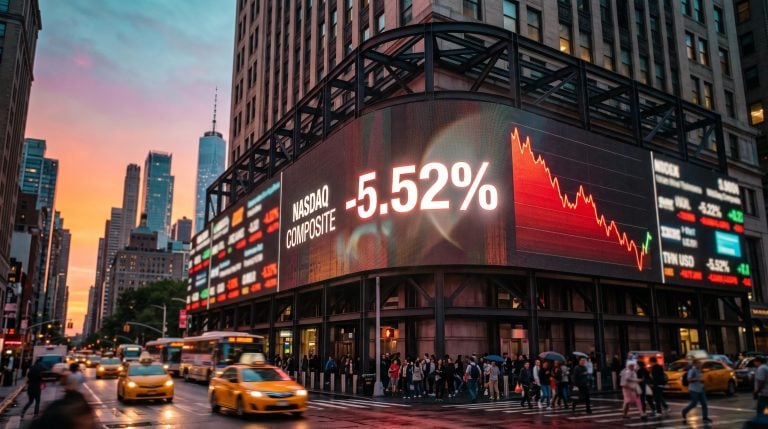
Last year, something happened that a safe-haven currency is not supposed to do. During the April 2025 trade-policy shock, US Treasury yields rose and the dollar fell at the same time, which fed fears of dollar debasement. This month the dollar is behaving like a refuge again, with the US Dollar Index (DXY) at 102.24, up 0.53% on 11 November 2026, according to EXANTE.
So which episode tells you the truth about the dollar?
Rabobank’s FX Strategy team has taken a clear side. In commentary relayed by FXStreet on 11 November 2026, the bank argued that last year’s debasement fears look overstated. It pointed to easing worries about political interference at the Federal Reserve and renewed safe-haven buying.
That matters if you hold US assets, earn returns in dollars, or are weighing how much non-US exposure to carry. The answer shapes both your currency risk and your bond risk.
The useful skill here is telling apart three ideas that often get lumped together: debasement, safe-haven status and reserve status. Once you can separate them, you can see which warning signs would actually change the picture.
Why was debasement the story in 2025, and what changed this year?
Start with the vocabulary. Dollar debasement means the gradual loss of a currency’s purchasing power and credibility over time. It is a slow process, not a single event.
That is different from safe-haven status, which describes how investors behave in a crisis: they rush into dollars and US Treasuries. It is also different from reserve-currency status, which measures how much of the world’s official central bank reserves sit in dollars.
April 2025 made the debasement fear credible because it broke the usual crisis pattern. The International Monetary Fund (IMF), in its 2025 External Sector Report, found that US yields and spreads over other major economies widened while the dollar depreciated.
The IMF’s reading The combination suggested weaker demand for Treasuries, possibly reflecting concern about US fiscal policy, policy uncertainty or portfolio diversification.
Compare the three patterns side by side:
- Normal risk-off behaviour: Treasury prices rise (so yields fall) and the dollar strengthens.
- April 2025 behaviour: Treasury yields rose and the dollar fell, the pairing usually seen when investors doubt a country’s fiscal or policy credibility.
- November 2026 behaviour: Equity stress and geopolitical risk sent buyers back into Treasuries, with the 10-year yield at 4.84% on 5 November, which Reuters reported was near its lowest since 9 September, while the dollar held or strengthened.
Rabobank leans heavily on the third pattern. In its view, the rush into dollars when the Gulf war began cut against the idea, popular last year, that the currency had forfeited some of its refuge appeal.
Your reading of the November pattern improves once you grasp dollar funding mechanics: in a crisis, margin calls force leveraged investors to raise dollar cash, which can lift the currency independently of any view on US credibility.
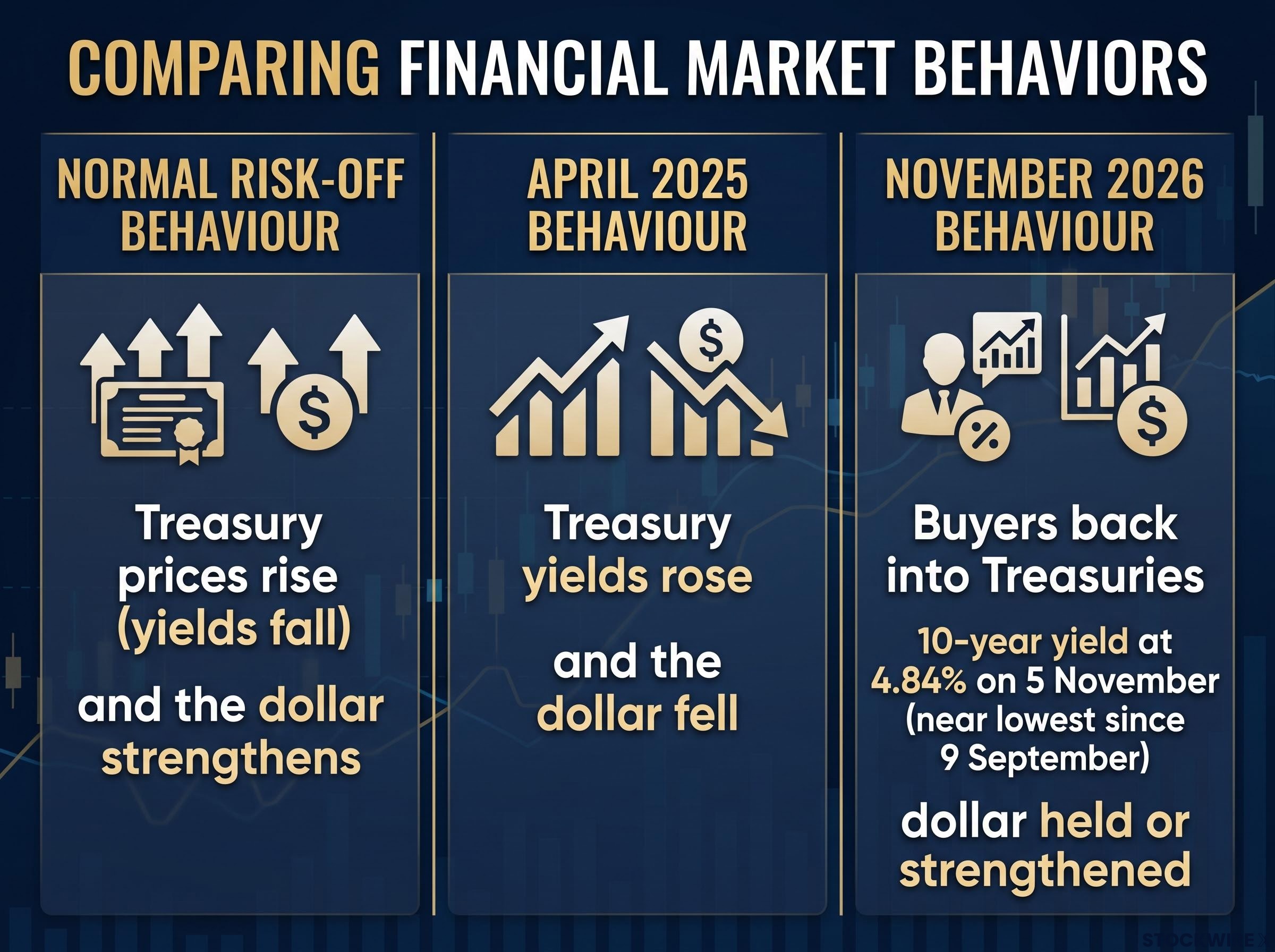
In November 2026, buyers backed into Treasuries with the 10-year yield at 4.84% on 5 November, nearing its lowest since 9 September.
The thesis has shifted from “broken” to “bruised.”
For you, the sensible read is to treat April 2025 as a stress test result, not a verdict. One anomalous episode deserves attention, but a single failure does not prove a permanent break, especially when the next crisis produced the old behaviour.
When big ASX news breaks, our subscribers know first
What is the “exorbitant privilege,” and how does it erode?
To judge whether the dollar is being debased, you need to understand the advantage at stake. Economists call it the exorbitant privilege: the ability of the US to borrow in its own currency at relatively low yields, because the rest of the world needs dollars.
How the privilege works
The world uses dollars for reserves, trade, collateral and safe assets. That steady demand makes it cheaper for Washington to fund itself. The chain runs like this:
- Reserve demand: Central banks hold dollars and Treasuries as their main store of reserves.
- Transaction demand: Trade, commodities and cross-border finance are largely settled in dollars.
- Safe-asset demand: Investors have traditionally bought dollars and Treasuries during crises.
- Cheaper US financing: That foreign buying supports Treasury prices and holds yields down.
- External balance benefit: The US can run larger external deficits because its liabilities are in its own currency.
The scale is large. The Federal Reserve estimates foreign investors held about $9 trillion, roughly 32% of marketable Treasuries, in Q1 2025. That is the demand keeping your US borrowing costs, and potentially your mortgage rates, lower than they might otherwise be.
How it can erode
Each link in that chain can weaken. The evidence suggests erosion is gradual rather than sudden, but it is visible.
| Channel | What it means | Current evidence |
|---|---|---|
| Falling reserve share | Central banks hold fewer dollars relative to other assets | About 72% in 2001, 58% in 2024 (Fed staff), 56.32% in 2025 Q2 (IMF COFER) |
| Higher term premium | Investors demand extra yield for fiscal, inflation or political risk | Rabobank sees signs in shifting yield spreads and Treasury market stress |
| Hedging | More investors hedge dollar exposure, shrinking the advantage of unhedged dollar assets | Qualitative; part of the diversification debate |
| Gold substitution | Central banks buy gold instead of another currency | Gold became the second-largest reserve asset by market value in 2024 (IMF) |
| Loss of crisis symmetry | Investors sell dollars and Treasuries together in a global shock | Occurred in early April 2025 |
Even so, the euro holds only 21.13% of reserves against the dollar’s 56.32%, according to the IMF. Erosion at the margin is already in the data, but no rival operates at the dollar’s scale. The question for you is pace, not existence.
Separating Treasury safe-haven risk from outright de-dollarisation risk matters in practice, since conflating them can leave a portfolio under-hedged on Treasury volatility while over-hedged against a displacement scenario that remains unlikely near term.
Reading the signals: Fed credibility, yield spreads and Treasury stress
If the privilege rests on trust, the institution that most shapes that trust is the Federal Reserve. Here the evidence cuts both ways.
Fed credibility after the midterms
A currency is only as credible as the central bank managing it. If investors suspect interest rates are being set for political reasons, they demand more compensation to hold that currency’s bonds.
Democratic control of the Senate after the November 2026 midterms strengthened checks on President Trump’s ability to place allies on the Fed Board. Reuters described Senate control over appointments on 4 November as a major guardrail. Trump’s room is also limited because three of the seven governors on the Board, chaired by Kevin Warsh, were appointed by President Biden.
Rabobank argues that greater credibility lets the dollar better capitalise on strong US growth. Yet the issue is eased, not settled. A president can remove a governor only “for cause,” generally understood as more serious than a policy disagreement, but future vacancies could reopen the appointment fight.
A June Supreme Court ruling gave Federal Reserve independence a legal backstop, requiring documented evidence, a chance to respond and a deadline before any governor can be removed, though the underlying for-cause question remains open in lower courts.
Spreads and Treasury stress
A yield spread is the gap between two bond yields, here the 10-year yields of different countries. Using IMF Global Markets Monitor figures for 10 November 2026, the picture looks like this:
| Market | 10-year yield | Spread vs US (derived, approximate) |
|---|---|---|
| United States | ~4.8% | n/a |
| Germany | ~3.2% | US higher by ~1.6 pp |
| United Kingdom | ~5.1% | US lower by ~0.3 pp |
| Japan | ~2.7% | US higher by ~2.1 pp |
It is tempting to read a high US yield as proof of strong demand for dollars. The UK comparison shows why that fails: gilts yield more than Treasuries, yet nobody would call sterling the stronger currency.
Treat spreads as a gauge of whether investors want extra compensation for US-specific risk, not as a strength score. If the US premium over Germany and Japan widens while the dollar weakens, you are looking at the April 2025 warning sign again.
Does the deficit still threaten the dollar, and is this debasement or a cycle?
Fed credibility and crisis behaviour have improved. The budget arithmetic has not, and Rabobank itself flags the large deficit as a medium-term risk for the dollar.
The deficit arithmetic
The Congressional Budget Office (CBO), Washington’s non-partisan budget scorekeeper, provides the core numbers:
- FY2026 deficit: $2.0 trillion, or 6.2% of GDP, $217 billion (12%) larger than FY2025 (CBO, 9 November 2026), above the $1.9 trillion it forecast in February.
- Net interest: about $1.14 trillion in FY2026.
- Debt held by the public: about 100-101% of GDP in 2026, projected to reach 120% by 2036 (CBO, February 2026).
- Higher-rate scenario: 133.1% of GDP by 2036 if rates run 150 basis points above baseline (CBO, October 2026).
- Treasury borrowing: projected at $618 billion for October-December 2026 and $800 billion for January-March 2027.
This creates a feedback loop. Higher yields raise interest costs, which widen the deficit, which requires more borrowing, which can push yields higher still. CBO’s higher-rate scenario shows how quickly that loop compounds.
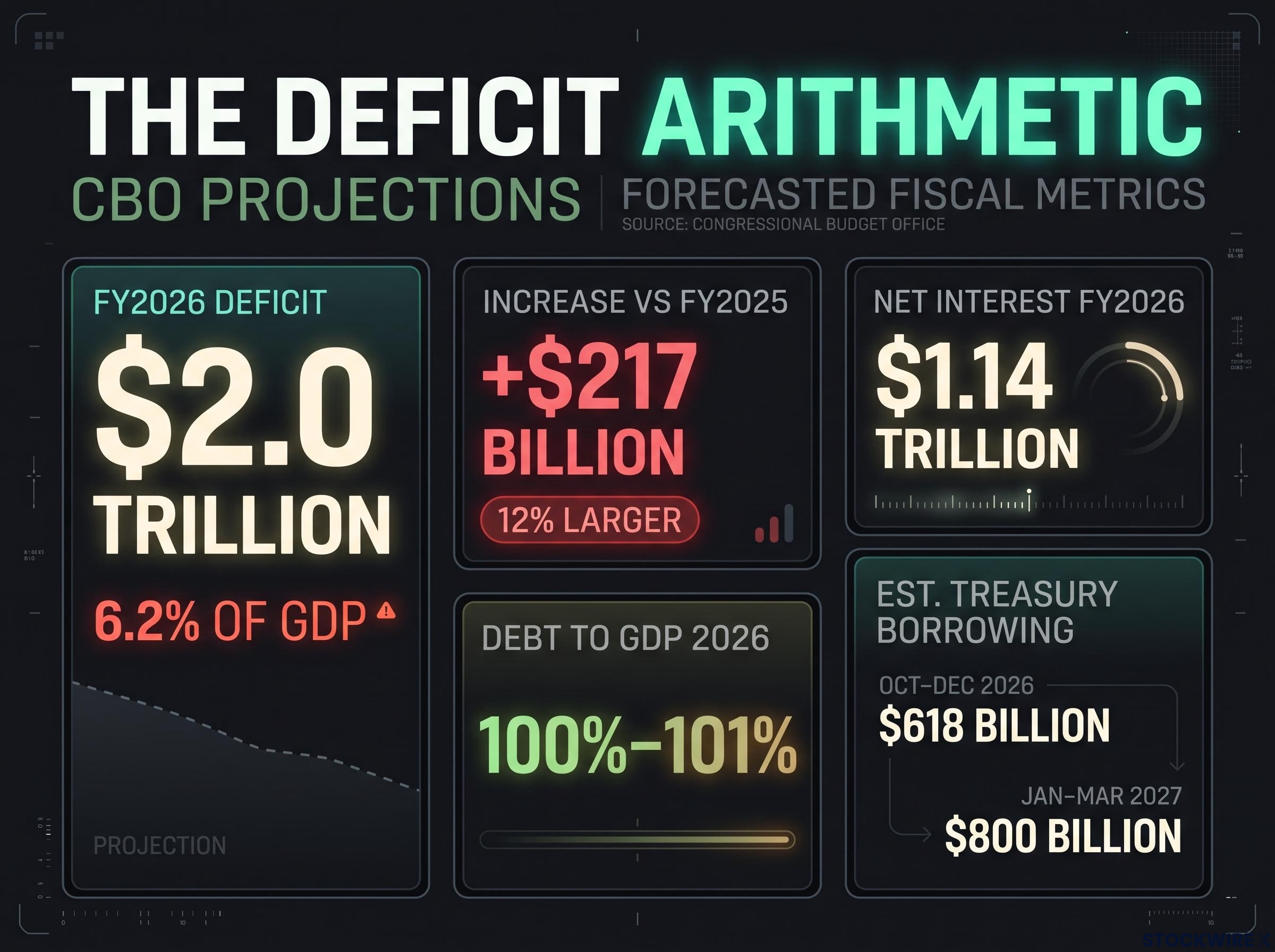
The FY2026 deficit is projected at $2.0 trillion (6.2% of GDP), which is $217 billion (12%) larger than FY2025, with $1.14 trillion in net interest.
Projections like these are speculative and subject to change based on economic conditions and policy decisions.
Rabobank adds a twist. In commentary on 4 November, it argued that greater fiscal prudence could initially lower yields and weigh on the dollar, but strengthen its credibility and safe-haven standing over time.
Cyclical dip or structural drift?
The disagreement among institutions is about speed and interpretation, not about whether diversification is happening.
| Source | Position | Key reasoning |
|---|---|---|
| Rabobank (Nov 2026) | Intermediate: 2025 fears overstated | Eased Fed fears and crisis demand, but deficits remain a risk |
| ING (Feb 2026) | Mostly cyclical | Decline tied to cyclical factors and shifting US policy expectations |
| IMF (2025 External Sector Report) | Structural signals present | Abnormal 2025 safe-asset behaviour and rising central bank gold holdings |
The strongest challenge to Rabobank’s view deserves its own space.
The counterargument A currency does not need to lose its reserve crown to be debased. Gradual loss of purchasing power, a higher term premium and persistent fiscal risk can all coexist with reserve leadership.
History supports the gradual path. Sterling’s reserve share slid from about 81% in 1945 to 11% by 1970, and in September 2022 Britain’s gilt crisis drove bond yields up while sterling fell to near $1.03, showing how fiscal doubts can hit a country’s bonds and currency together.
“Overstated” does not mean “gone.” The deficit is the variable most likely to reopen the debasement debate, so it belongs on your watch list for any dollar allocation decision.
Three signals that would settle the debate for dollar holders
Rabobank’s case is strongest as a rebuttal to the idea that 2025 marked an irreversible collapse in dollar credibility. It is weaker as a dismissal of long-term fiscal and institutional risk, and the bank does not claim otherwise.
Three signals will tell you which way the evidence is moving:
- The next shock: Do the dollar and Treasuries rally together, or repeat the April 2025 split?
- Fed appointments: Watch new vacancies and how closely the Senate scrutinises Warsh.
- Deficits and auctions: Treasury’s advisers have warned the funding gap will widen over FY2027-29, which tests demand for new debt.
The real question is not whether the dollar is finished. It is what evidence would change your mind, and whether you are watching for it.
For readers wanting to track the second signal closely, our deep-dive into Warsh and Fed independence examines the pressure campaign on his predecessor as a baseline for judging his conduct.
This article is for informational purposes only and should not be considered financial advice. Investors should conduct their own research and consult with financial professionals before making investment decisions.