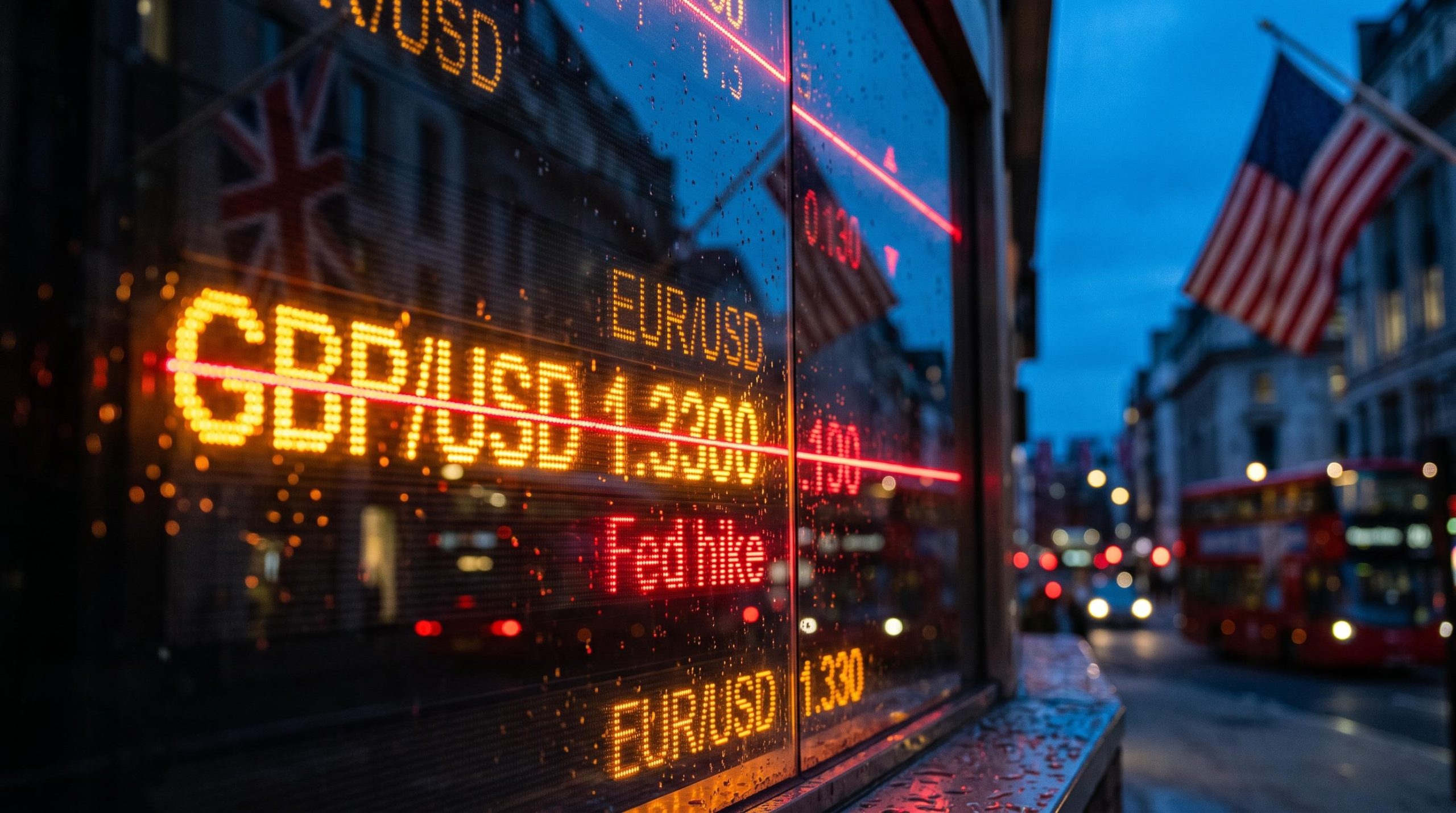
The pound slipped for a second straight session on Wednesday, yet GBP/USD held above 1.3300 even after a hotter US inflation print and a hawkish Federal Reserve voice pushed the dollar higher. The pair briefly reached about 1.3355 intraday before falling back toward its lowest level in a week and a half.
Yesterday’s October US consumer price index (CPI), the government’s main inflation gauge, showed prices up 0.4% for the month and 0.3% on a core basis, which excludes food and energy. Markets now treat a December Fed rate hike as close to certain.
Sterling has not given way, though. The current GBP/USD forecast depends on whether 1.3300 holds. Here is how to judge that line and the three forces that will decide it.
Why did one CPI print lift the dollar, and why is sterling still above 1.3300?
Both readings beat consensus. Persistence is the bigger surprise: core CPI has now printed 0.3% for a third straight month, so underlying price pressure is not fading.
Monthly core readings carry outsized weight in Fed rate decisions because the committee treats persistence in underlying prices as the clearest signal of whether tightening has further to run, which is why a third straight 0.3% print drew such attention.
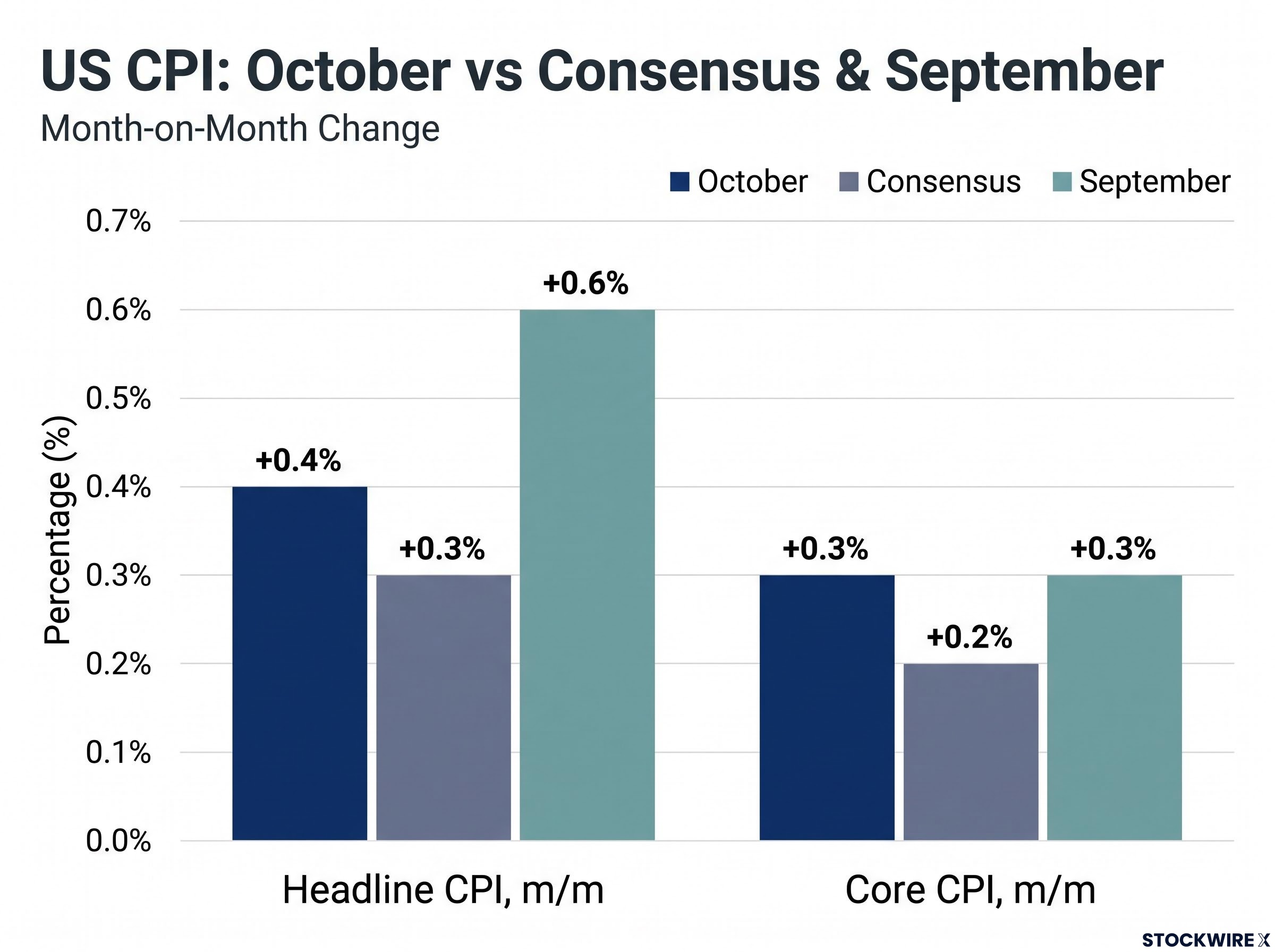
October’s US consumer price index beat consensus, with core CPI printing at +0.3% for the third consecutive month.
| Measure | October | Consensus | September |
|---|---|---|---|
| Headline CPI, m/m | +0.4% | +0.3% | +0.6% |
| Core CPI, m/m | +0.3% | +0.2% | +0.3% |
Only month-on-month figures were published. Year-on-year data were withheld after last year’s government shutdown, although the official reason has not been confirmed.
The pricing shift was abrupt. Odds of a December hike jumped from about 70% before the release to roughly 91% in Reuters-linked reporting, with another report putting them near 100%. GBP/USD fell about 0.7% on 10 November.
Fed Governor Christopher Waller added fuel. He backs at least a 25bp hike at the 8-9 December meeting of the Federal Open Market Committee (FOMC), the Fed’s rate-setting body. He had also said a 50bp move should be considered if core CPI reached about 0.3%, and October met that threshold.
Markets are not following him all the way. A 50bp hike is priced at only about 10%, and Goldman Sachs chief US economist David Mericle expects most voters to prefer a gradual pace.
The hike is now the base case. That means the dollar’s lift largely reflects an expectation that is already priced, so further gains need a fresh surprise.
How hot CPI travels from rates to the dollar
- Inflation runs hot: markets raise their expected path for the Fed’s policy rate.
- Yields climb: higher expected rates push up Treasury yields.
- The gap widens: the US yield advantage over other economies grows.
- The dollar strengthens: investors move money toward the higher-yielding currency.
There is one caveat. Data quality after the shutdown makes it harder to tell genuine acceleration from measurement noise.
What is holding GBP/USD up, and how are the dollar, gold, Bitcoin, AUD/USD and USD/JPY reacting?
The dollar has gained against every major currency over the past seven days, according to FXStreet’s heat map. It rose most against the Canadian and Australian dollars and least against the yen.
| Currency | USD change |
|---|---|
| EUR | 0.39% |
| GBP | 0.68% |
| JPY | 0.10% |
| CAD | 1.47% |
| AUD | 1.34% |
| NZD | 0.25% |
| CHF | 0.88% |
Two forces are limiting sterling’s losses. Bank of England (BoE) Deputy Governor Clare Lombardelli said on Tuesday that more rate rises are likely, citing high energy prices and a resilient UK economy. Reports that the BoE lifted Bank Rate from 3.75% to 4.00% on 5 November have not been independently confirmed.
A fully priced 25bp move explains sterling’s muted reaction to the Bank’s decision, and the Bank’s own projection of inflation near 5% by mid-2027 keeps the question of further tightening open.
The second force is hope of a US-Iran breakthrough, which would reduce demand for the dollar as a safe haven. The dollar index sits around 102.30, a figure that has also not been independently confirmed.
- Gold: about US$4,050-US$4,060, recovering after losing more than 2.5% on Tuesday, with Fed hike bets capping gains.
- Bitcoin: about US$73,700-US$73,800 after a low of US$72,727, with spot exchange-traded fund (ETF) outflows of US$95 million on Tuesday, the fourth straight day of outflows.
- AUD/USD: about 0.6875-0.6900, bouncing from a seven-month low as hawkish FOMC comments cement December pricing.
- USD/JPY: about 158.82-158.86, held below 159.00 as the risk of Japanese intervention supports the yen.
Gold and Bitcoin: the yield squeeze
Higher yields raise the opportunity cost of holding gold, which pays no income, and a stronger dollar makes gold dearer for foreign buyers. Bitcoin reacts the same way but with more leverage behind it.
Leverage warning K33 Research puts perpetual-futures open interest at about 353,000 BTC, the 99th percentile of the past two years, and warns of sharp moves as leverage builds.
If you hold any of these assets, the pattern shows that rate expectations, not safe-haven demand, are driving this episode. Watch Fed pricing before geopolitical headlines.
Where does GBP/USD go next: key levels, scenarios and what the banks expect
1.3300 is the line that matters. Only a clear close beneath it would suggest the pound’s recent rally has lost its drive.
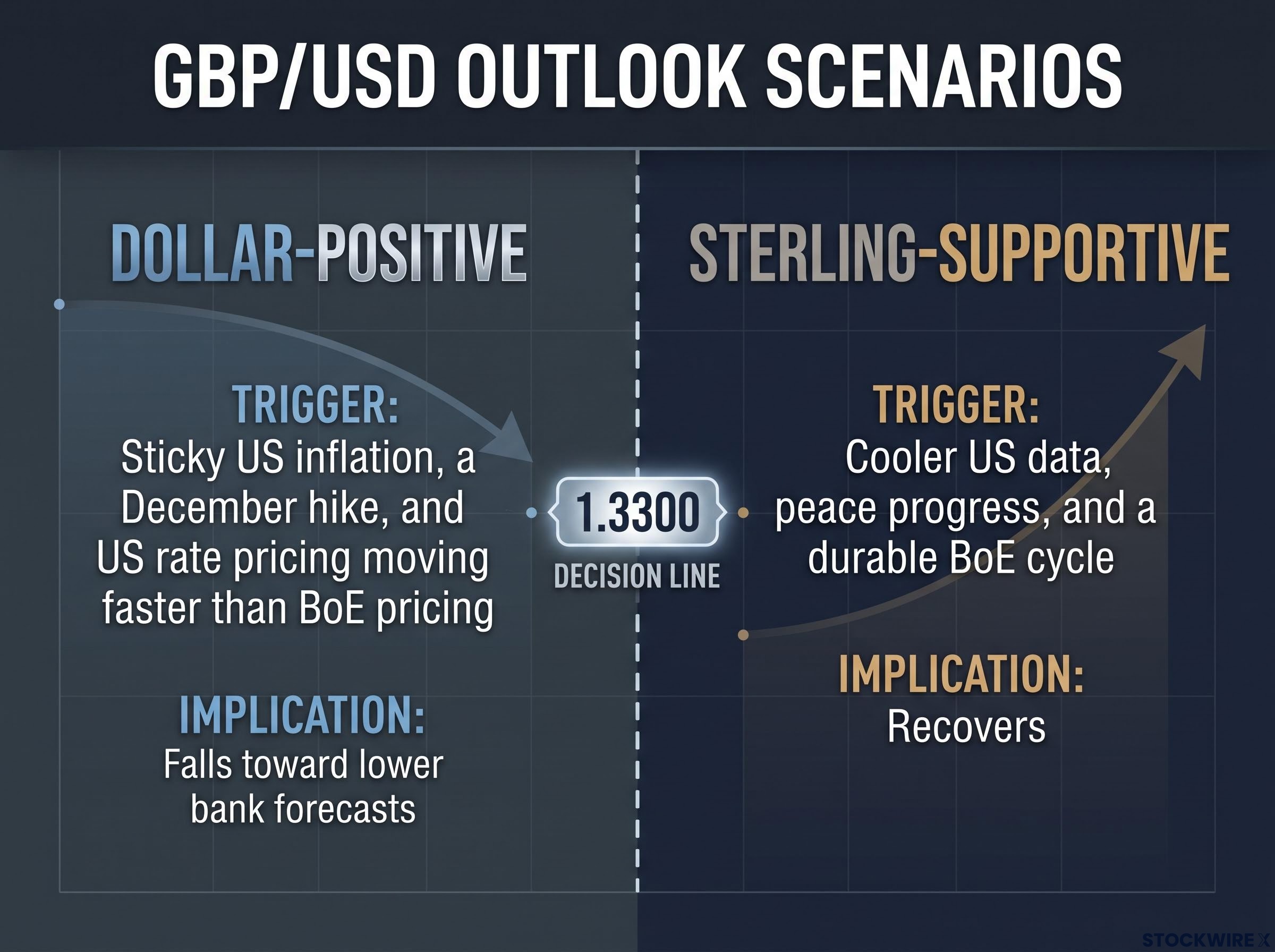
The future outlook for the pair hinges on the 1.3300 level, dependent on US inflation, Federal Reserve hikes, and Bank of England pricing.
| Scenario | Trigger | GBP/USD implication |
|---|---|---|
| Dollar-positive | Sticky US inflation, a December hike, and US rate pricing moving faster than BoE pricing | Falls toward lower bank forecasts |
| Sterling-supportive | Cooler US data, peace progress, and a durable BoE cycle | Recovers |
Bank views are thin, and none of the following could be independently verified:
- Rabobank (unverified): about 1.31 at three and six months, and 1.30 at 12 months.
- MUFG (unverified): expects modest sterling strength but considers pricing for two further BoE hikes excessive.
- ING (unverified): sees correction risk in the dollar rally.
No current views were found for Commerzbank or Westpac. Past performance does not guarantee future results, and projections are subject to market conditions and various risk factors.
What would change the picture
Iran has tabled a proposal and Qatar says mediation continues, but tanker attacks persist and no final agreement exists. Brent crude sits near US$92.55, reportedly down about a third since mid-October, although that figure is unverified. A deal could strip away both the safe-haven bid and part of the US yield advantage.
A breakdown in talks or further attacks could set off another dollar surge. Two other risks sit in the background: USD/JPY near 159, and diesel, freight and fertiliser costs that are slow to follow oil lower and could keep US inflation elevated into 2027.
1.3300 is your decision line. If it holds, the pound’s offsets are working; if it breaks, the Fed repricing has overpowered them.
Three signals that decide whether 1.3300 holds into the December Fed meeting
The US rate differential is the most immediate driver, so US inflation data and Fed pricing come first. BoE signals come second: further hawkish comments keep sterling’s counterweight in place. US-Iran talks come third, because they can either drain or revive safe-haven demand for the dollar.
Track all three against one line. A decisive break below 1.3300 before 8-9 December would tell you the dollar case has won. A hold would mean the balance still favours patience.
This article is for informational purposes only and should not be considered financial advice. Investors should conduct their own research and consult with financial professionals before making investment decisions.