Key Takeaways
- Cameras that only record do not stop theft: only about 5% of the more than 25,000 tools stolen in Queensland in 2024-25 were returned, so footage rarely recovers the loss.
- Genuine security needs three parts: real-time detection, a trained person judging live footage and a response that can reach the site, which is what separates remote video monitoring from passive CCTV.
- ADT Guard monitored sites grew from 301 to 1,029 across FY26, and police-assisted arrests climbed from more than 50 in April 2026 to 100 by November 2026.
- Australian organic growth reached 12.5% in FY26, up from about 8% in FY25, with management naming ADT Guard as a key driver, while group revenue hit $203.7M (up 16.5%).
- The ADT UK acquisition, targeted for completion in 1H 2027 and funded by a 4-year Unitranche facility and vendor shares, sets up an ADT Guard rollout to UK customers within 6 to 12 months of completion.
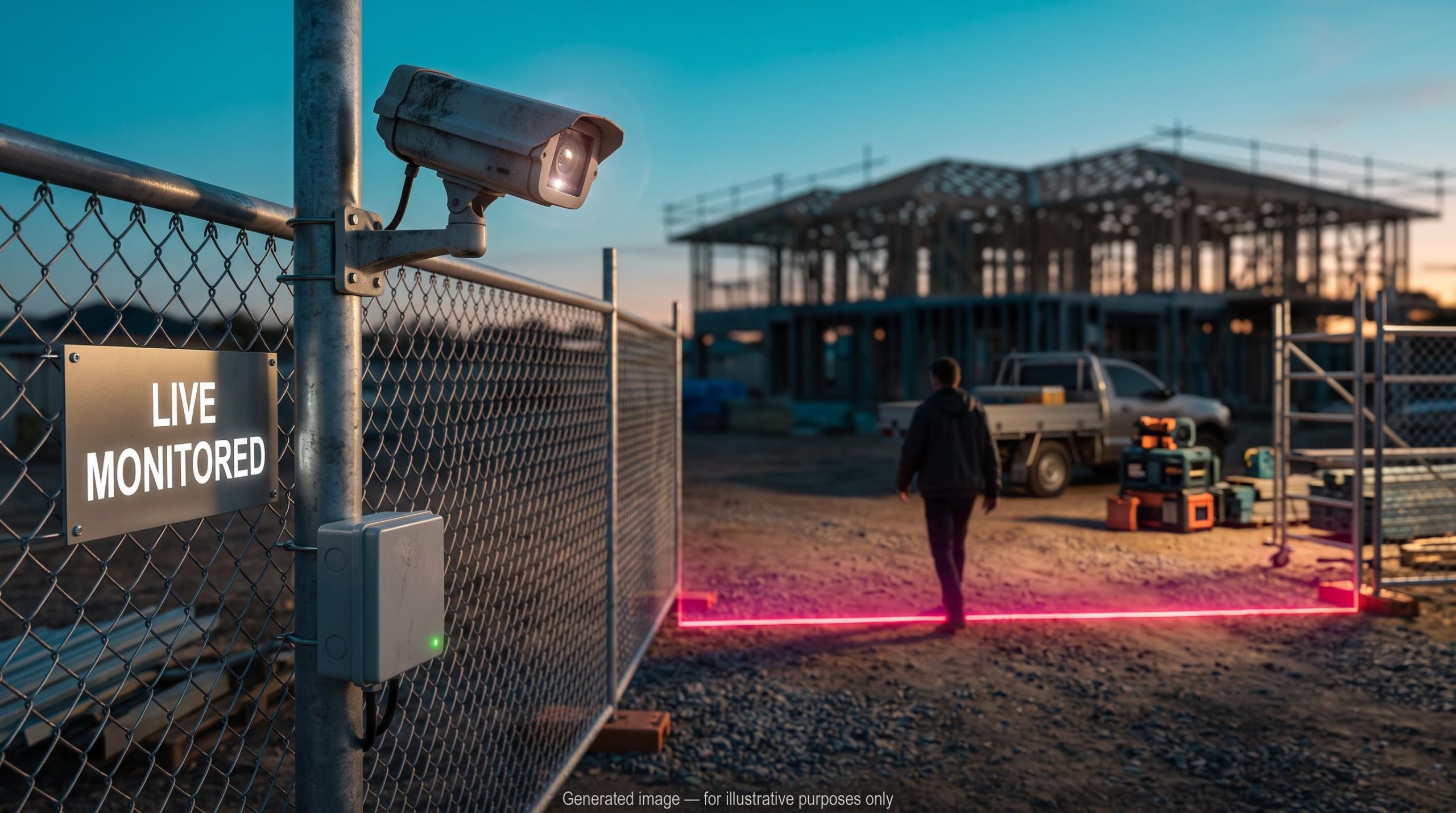
It is 2am and the cameras on your site are working perfectly. They are recording every frame of someone cutting the fence, loading a ute and driving off. Nobody sees it until the morning, when the footage is reviewed and the tools are already gone.
That gap is why remote video monitoring matters. CCTV on its own records what happens. It is not security monitoring, because nobody is watching and nobody can act while the incident is unfolding.
The difference matters if you manage or own a site and pay for security. It also matters if you invest in security companies and want to tell a passive camera product from an active service.
This article shows you how to tell a system that records from one that intervenes, and gives you the questions that expose the difference.
Why recording is not the same as security
Think of a construction site after the crew has gone home, or a self-storage facility with a locked gate and no staff overnight. Both usually have cameras. Both are still exposed, because a camera that only records does nothing until a person reviews the footage.
What the gap costs
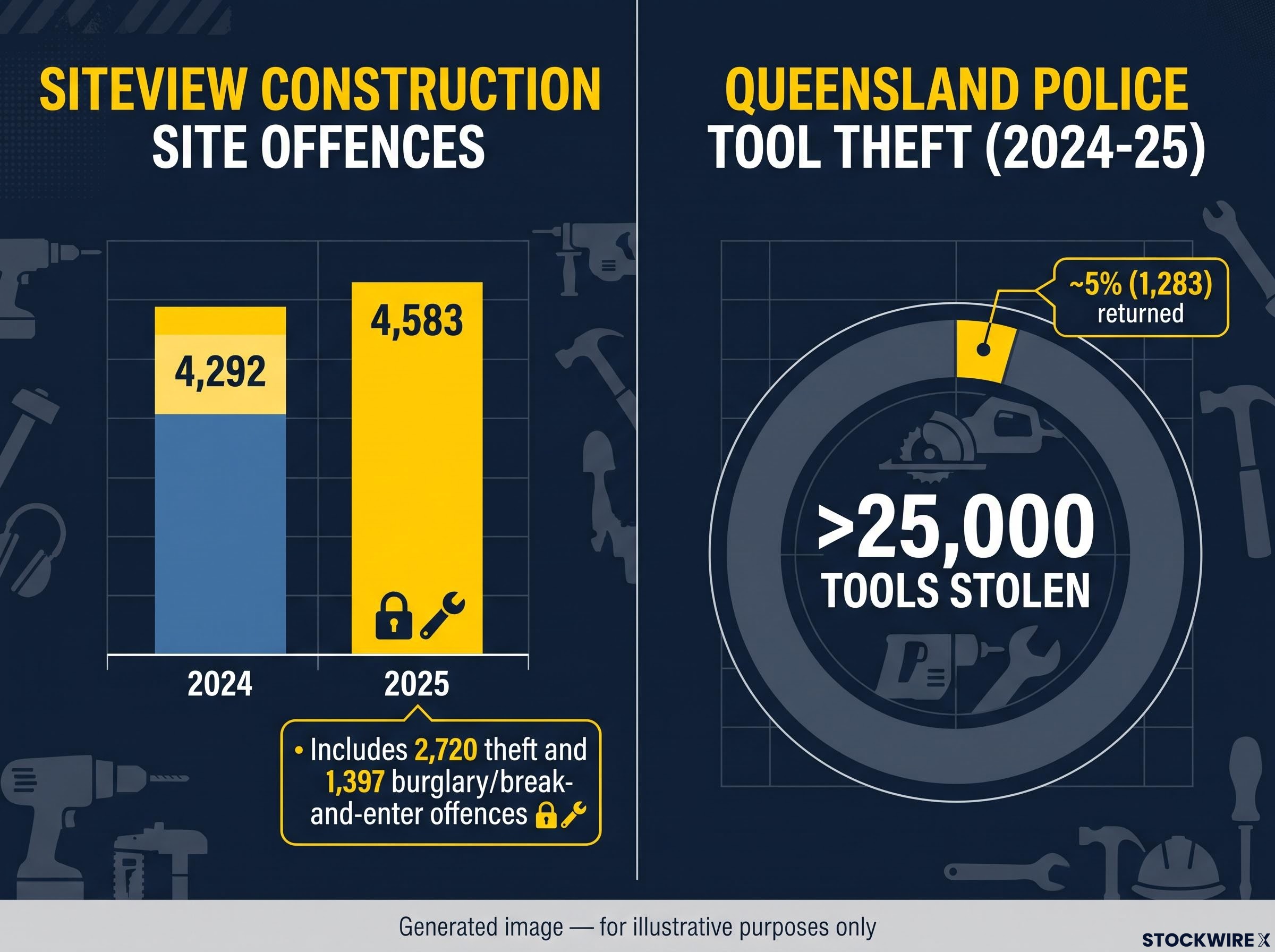
The losses are real and rising. SiteView reported 4,583 selected offences at Australian construction sites in 2025, up from 4,292 in 2024. That total included 2,720 theft offences and 1,397 burglary and break-and-enter offences.
The SiteView construction theft analysis draws on Australian Bureau of Statistics and Crime Statistics Agency Victoria data, so you can trace the offence counts back to public datasets before you rely on them when budgeting for site security.
Queensland’s recovery rate Queensland Police data shows more than 25,000 tools were stolen in 2024-25. Only 1,283 were returned to their owners, about 5%.
When big ASX news breaks, our subscribers know first
How remote video monitoring works, step by step
On an operator’s screen, a quiet site sits dark until a figure steps across a marked line near the fence. What happens next is a sequence. Here is how ADT Guard runs it:
- Cameras on site feed an installed Edge AI device, a small on-site computer that analyses video locally.
- The device filters camera activity and sends only relevant events and footage to a monitoring room.
- When a person crosses an armed virtual boundary, an automated audio warning can sound on site.
- A human operator assesses the live footage and can speak directly to the person on site.
- The operator decides whether to call police, who attend and may make an arrest.
The filtering step is what makes the rest work. Wind, animals and harmless movement are screened out before they reach a person, so the operator’s attention goes to genuine events.
Camera-only CCTV, by contrast, captures and stores, and depends on someone noticing later.
The TMA video monitoring definition frames the category as proactive, event-driven surveillance combining live feeds, analytics and remote guarding, which is the standard you can hold any provider to when they say they monitor.
The technology does the sorting, but a person makes the call at every step that matters. Whatever you are buying or assessing, ask where that human judgement sits, because it is what separates a verified event from a motion notification.
What deterrence looks like when nobody is arrested
Arrests are the outcome people notice. They are not the whole story.
A police-assisted arrest, as Intelligent Monitoring Group (ASX: IMB) counts it, means police made the arrest after an ADT Guard operator assessed live footage and called them. Several outcomes sit outside that count:
- Intruders who leave after hearing the audio warning
- Police escorts of trespassers off site
Managing Director Dennison Hambling gave an example on the February 2026 half-year results call.
Two visits, two deterrences Two people scouted a property at about 12:30am and were deterred. They returned roughly 90 minutes later to try another perimeter and were deterred again, and police then checked the property for the rest of the night.
Nothing was stolen and nobody was arrested, yet the site was protected twice. The company also stated that many of its arrest incidents ended with minimal or no damage to the customer’s property.
Typical ADT Guard sites are construction sites and storage facilities, where theft and entry into hazardous areas are the common risks. For you, the takeaway is simple: the arrest count is the visible tip, and a service that deters before anything happens delivers value that never shows up in a headline figure.
Five questions for site managers, four for investors
You can now test any security set-up, or any security company, with a short list.
For site managers
- Is anyone watching live after hours? Recording alone means nobody is.
- Can someone speak to an intruder on site? Two-way audio lets an operator warn a person off.
- How quickly can police be called? A live operator can call while the incident is under way.
- Are false alarms filtered before they reach a person? Filtering keeps attention on genuine events.
- Is the service measured by incidents stopped? Outcomes matter more than stored footage.
ADT Guard is built to answer yes to each: live operators, on-site audio, direct police calls, Edge AI filtering and reported arrest outcomes.
For investors
- Is the company moving customers from passive products to active services? IMB built ADT Guard on its existing monitoring base.
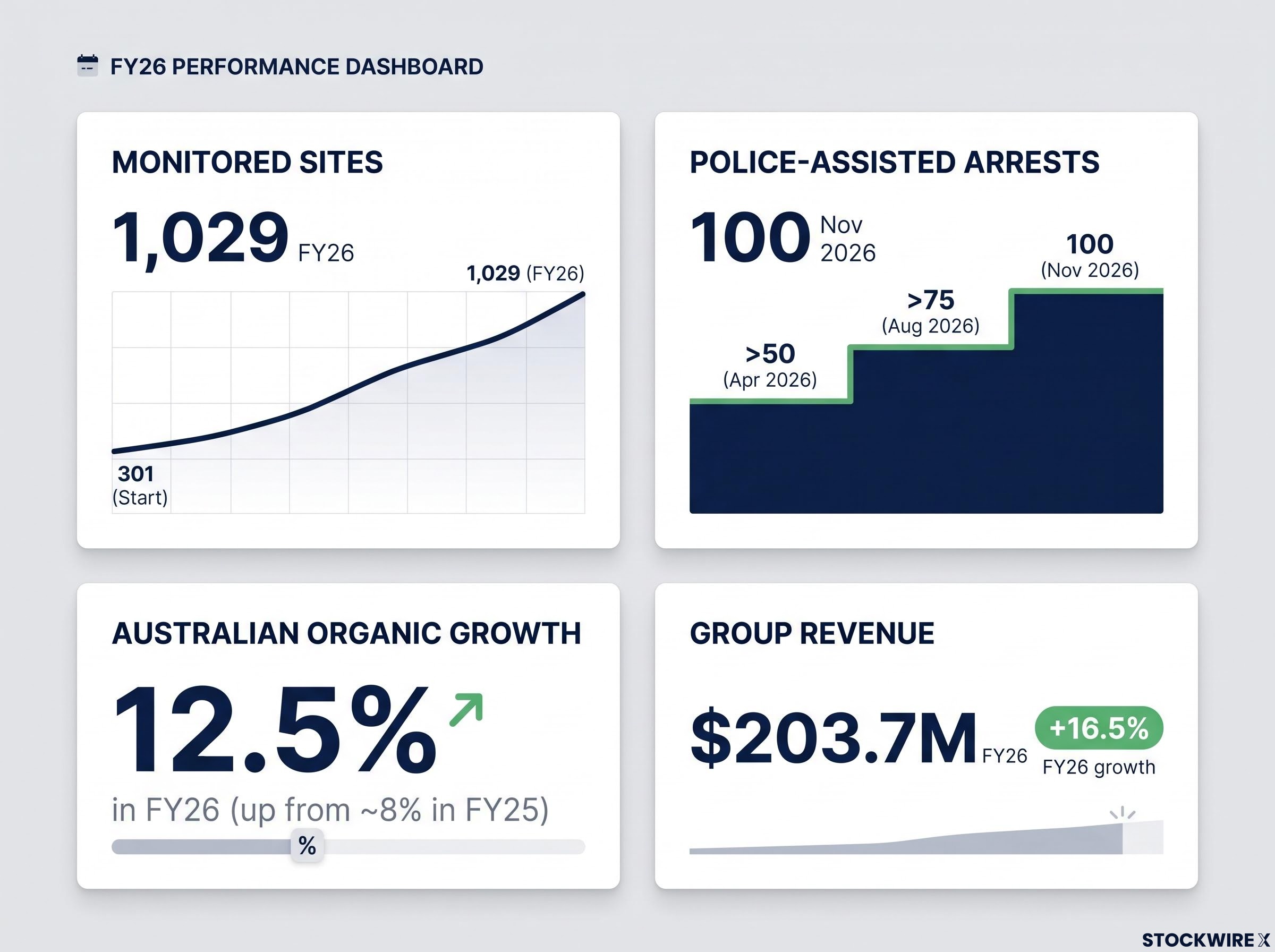
- Does it report an outcome metric, not only customer numbers? IMB reports police-assisted arrests: more than 50 at Q3 FY26 (April 2026), more than 75 at the FY26 results (26 August 2026) and 100, as the company confirmed in November 2026.
- Is the active service base growing? Monitored sites rose from 301 to 1,029 across FY26, the year to 30 June 2026.
- Is the new service lifting organic growth? Australian organic growth reached 12.5% in FY26, up from about 8% in FY25, with management naming ADT Guard as a key driver.
Used together, the two lists let you separate a company that sells hardware from one delivering a measurable outcome. The same lens works on any security business you follow.
Intelligent Monitoring Group: building remote video monitoring on its monitoring base
IMB is a Perth-based security and monitoring group whose businesses include ADT Security. The company said remote video monitoring would become a growth engine. The figures show that plan in delivery.
It added capability through the acquisitions of Western Advance in September 2025 and B.N.P. Securities in October 2025. According to the FY26 Annual Report, these broadened its commercial security reach and created more opportunities to deploy ADT Guard.
The scale already reached is the clearest signal. The company states ADT Guard launched in January 2025, gained sales traction from around June 2025 and saw arrests accelerate through 2026, reaching 100 from just over 1,000 sites roughly 18 months after launch.
| Metric |
Figure |
Period or date |
Source |
| ADT Guard monitored sites |
301 to 1,029 |
FY26 |
FY26 Results Presentation |
| Police-assisted arrests |
100 |
November 2026 |
Company-confirmed |
| Australian organic growth |
12.5% |
FY26 |
FY26 results material |
| Group revenue |
$203.7M (up 16.5%) |
FY26 |
FY26 Results Presentation, 26 August 2026 |
| Commercial pipeline |
$72.4M |
Q4 FY26 |
Chair’s Business Update |
Each milestone is specific and dated, so you can check progress in every quarterly update against what the company said it would do. As ADT Guard extends across IMB’s commercial base and, the company plans, into the United Kingdom, its model of stopping incidents rather than recording them is set to reach far more sites.