A stock you hold goes into a trading halt. Two days later it reopens down 12% after announcing a $5 million raise, and the easy explanation is that the market has overreacted.
Usually it has not. That fall is three separate forces stacked on top of each other, and each one tells you something different about the company and about your choices.
An ASX capital raising is routine, especially among miners, biotechs and small-cap growth companies that spend cash before they earn it. Real money is at stake for you. Your ownership can be diluted, you may be offered shares at a discount, and the decisions come with deadlines.
Here is how to separate the forces behind the fall and see how placements, share purchase plans and entitlement offers treat you differently. You will also learn the simple sum that shows whether a discounted offer is worth taking, and what to check while the stock is halted.
Why do share prices fall when a company raises capital?
The drop on resumption feels like one event. It is easier to judge once you split it into its three parts.
Mechanical dilution
When a company issues new shares and you do not buy any, you own a smaller slice. Your claim on earnings, dividends, votes and any future takeover payout is spread across more shares. Nothing about the business has to change for this to happen.
Your stake shrinks further when share dilution compounds across several years of issuance, because each new raise or equity grant reduces your claim on a base that was already smaller, so you need higher absolute returns just to break even.
The discount effect
New shares are nearly always priced below the last trade. Commonly cited discounts run from 5% to 20%, although that is a rule of thumb rather than a current ASX-wide average. Because new investors pay less, the post-raise price tends to settle near a weighted average of the old price and the cheaper issue price.
What the announcement signals
The announcement itself is information. It tells the market something about the company’s finances, and the market reprices on it.
The signal varies most of the three. The same raise can read as growth funding or as a cash emergency. Investors may conclude that:
- cheaper debt or operating cash has run out;
- the company needs money urgently;
- the balance sheet is weaker than they believed;
- directors see the current price as a good moment to issue equity; or
- sophisticated investors demanded a discount before committing.
The signal can also work in the company’s favour. A heavily oversubscribed raise, where demand far exceeds the shares on offer, suggests strong investor appetite. A raise can also add value when the money funds a high-return project or removes the risk of insolvency.
So “why did it drop?” is the wrong question for that 12% fall. The useful question is which driver dominated: a mechanical adjustment you can expect, or a warning about the company’s finances.
When big ASX news breaks, our subscribers know first
How placements, SPPs and entitlement offers actually work
Once you know why prices fall, the next thing to read in the announcement is the structure. Each structure trades off speed, cost, certainty and retail access in a different way.
Placements
In a placement, a broker lines up institutions and sophisticated investors to buy newly issued shares, typically while the stock is in a trading halt. It typically takes one to two days. An ordinary halt can last up to two trading days, and ASX allows up to four in exceptional cases for large accelerated pro-rata raises.
Trading halts are prospective tools: they stop further trading while an announcement is prepared, but they do not unwind trades made earlier while information was uneven, which is why you gain most from acting during the halt window rather than after it.
Placements are fast, cheap and certain, but retail holders are usually excluded and diluted. Listing Rule 7.1 caps issues without shareholder approval at 15% of capital over a rolling 12 months. Rule 7.1A adds another 10% for companies valued at $300 million or less and outside the S&P/ASX 300; the money raised must be cash, and the price cannot fall below 75% of the 15-day volume-weighted average price (VWAP). VWAP is the average price across a period, weighted by the number of shares traded.
Share purchase plans
A share purchase plan (SPP) lets existing holders buy new shares, usually at the placement price and with no brokerage. ASIC Instrument 2019/547 caps your purchases at $30,000 per 12 months. Popular SPPs are often scaled back, so you may receive fewer shares than you applied for.
Some SPPs use a VWAP formula or the lower of two prices. If the market price falls below the offer price while the SPP is open, the plan loses its appeal. Most SPPs are not pro rata, which means your entitlement does not depend on how many shares you already hold.
Entitlement offers
An entitlement offer gives every eligible holder the right to buy new shares in proportion to their holding. Non-renounceable entitlements lapse with no compensation if you do not take them up. Renounceable rights can be sold, and they trade briefly on ASX under a separate code.
Accelerated versions move institutions first: an ANREO is non-renounceable and an AREO is renounceable. Shortfall bookbuilds sell any unclaimed shares to other investors. In 2024, among deals above $50 million, standalone placements made up 33%, placement plus SPP 32% and placement plus entitlement 23%, according to Herbert Smith Freehills Kramer.
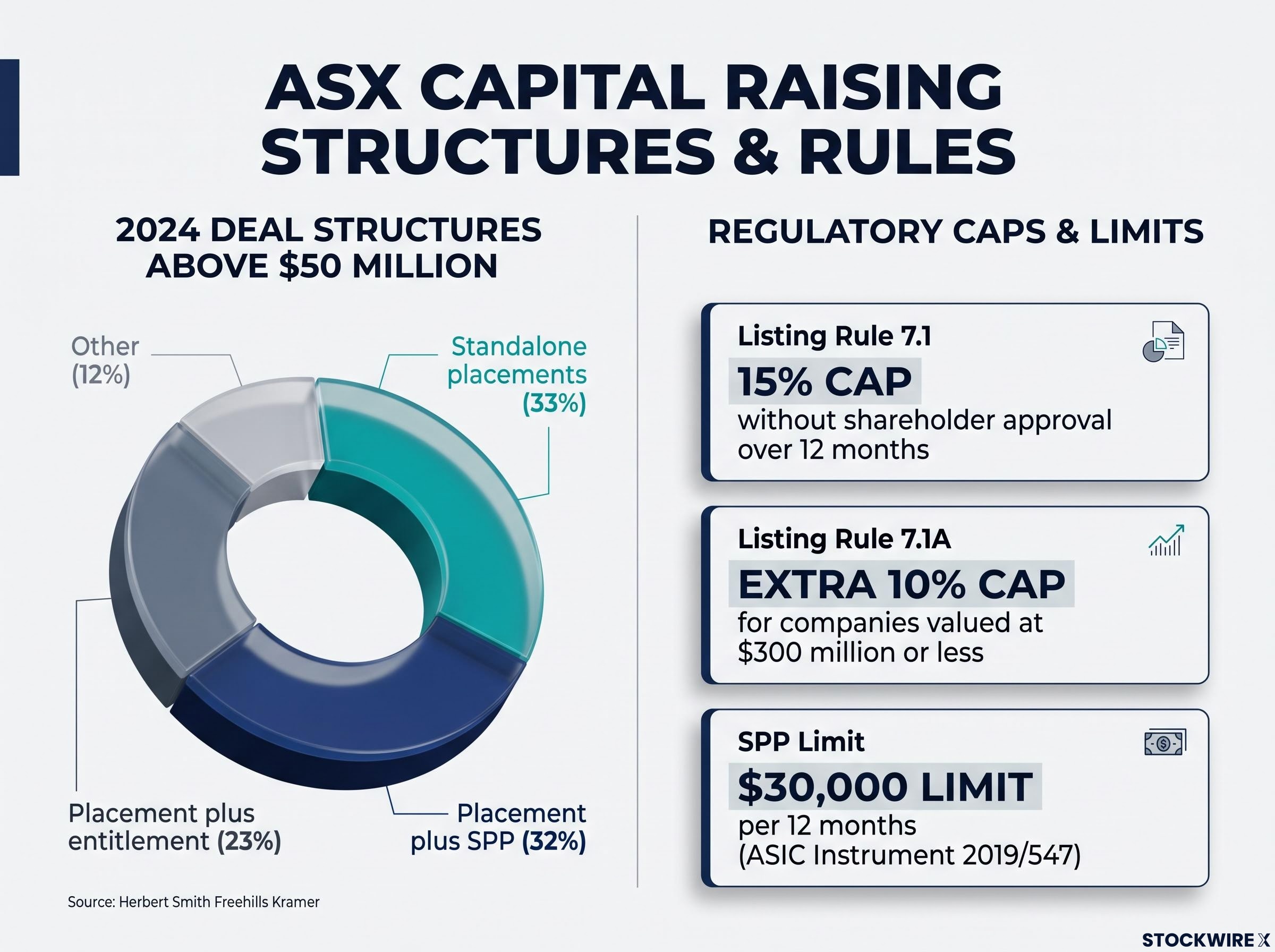
In 2024, standalone placements and placement plus SPP structures dominated ASX deals above $50 million, making up 33% and 32% respectively.
| Structure | Who participates | Main advantage | Main retail concern |
|---|---|---|---|
| Institutional placement | Institutional and sophisticated investors | Fast, cheap, certain | Retail excluded and diluted |
| Placement plus SPP | Institutions plus eligible holders | Some retail access | Non-pro rata, $30,000 cap, scale-backs |
| Pro-rata entitlement | Eligible holders by holding size | You can maintain ownership | Capital required; some holders ineligible |
| Non-renounceable entitlement | Holders who subscribe | Simpler and cheaper | No compensation if not taken up |
| ANREO | Institutions first, retail later | Faster, earlier certainty | Retail gets access after institutions |
| AREO | Institutions first; rights saleable | Non-participants can sell rights | Timing, complexity, shortfall risk |
| Shortfall bookbuild | Other investors take unclaimed shares | Improves certainty | Non-participants may not benefit |
Only a pro-rata entitlement gives you a formal way to keep your percentage. That protection costs you capital, and the price can move against you during the offer period.
How to calculate TERP and judge whether the discount is real
If you are offered an entitlement, the headline discount to the last close is not the right yardstick. The theoretical ex-rights price (TERP) is a better one. TERP is the price the shares should trade at once the new shares are added, based purely on arithmetic.
TERP = (N × P₀ + M × P_offer) / (N + M) N is existing shares, P₀ is the pre-raise price, M is new shares and P_offer is the offer price.
Here is how to run it on a 1-for-4 offer at $0.80 when shares last traded at $1.00:
- Value the existing shares: 4 × $1.00 = $4.00.
- Value the new shares: 1 × $0.80 = $0.80.
- Divide by total shares: $4.80 ÷ 5 = $0.96 TERP.
- Compare the offer with TERP: $0.80 is 16.7% below $0.96.
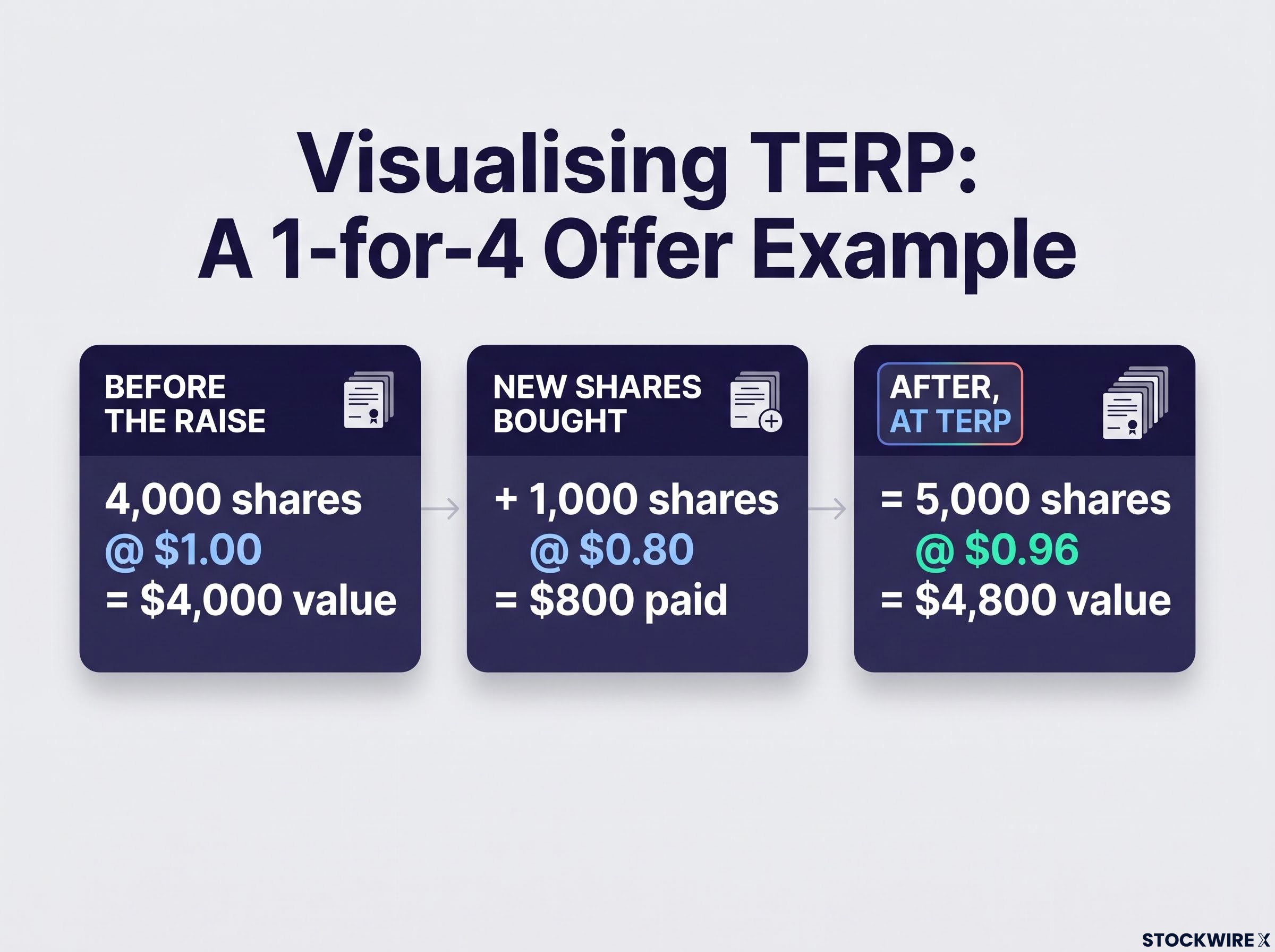
For a 1-for-4 offer at $0.80, a $4,000 pre-raise value and $800 paid for new shares results in a $4,800 value at TERP.
| Position | Shares | Price | Value |
|---|---|---|---|
| Before the raise | 4,000 | $1.00 | $4,000 |
| New shares bought | 1,000 | $0.80 | $800 paid |
| After, at TERP | 5,000 | $0.96 | $4,800 |
Your $4,800 holding is simply your $4,000 plus the $800 you paid. Taking up the offer protected your position rather than creating a windfall. Had you let the rights lapse, your 4,000 shares would be worth $3,840 at TERP. That gap between TERP and the offer price is where a right’s value comes from.
Real offers show the same split between headline and true discount. Peak Rare Earths priced its May 2025 offer at $0.10 against a pre-offer close of $0.12 and a TERP of $0.116, a 14.2% discount to TERP. For comparison, ASIC’s 2020 data showed average discounts to last close of 16.1% for placements and 27.2% for entitlement offers. Those were COVID-era figures, not a current average.
Treat TERP as a benchmark, not a forecast. Your discount only counts if the shares still trade near TERP when they are allotted, so the same offer can be a bargain or a loss depending on what the market does next.
What recent ASX raisings show about discounts and structure
Recent deals show how much discounts vary from one raise to the next.
| Company and date | Structure and size | Discount and pricing | Key takeaway |
|---|---|---|---|
| Goodman Group, Feb 2025 | About $4.0B placement (about 6.2% of securities) plus SPP up to $400M | $33.50 vs $35.98 close: 6.9% discount | Large-cap, thin discount |
| ALS Limited, May 2025 | Placement plus SPP targeting $40M | $16.70: 5.3% to last close, 5.7% to five-day VWAP | Benchmark changes the headline |
| Syrah Resources, Aug 2025 | About $20M placement plus underwritten 1-for-5.42 ANREO of about $50M | TERP described as theoretical | Ineligible holders warned of dilution |
| Peak Rare Earths, May 2025 | 1-for-4.7 non-renounceable offer, about $7.5M | $0.10 vs TERP $0.116: 14.2% | Small-cap using a pro-rata route |
Goodman Group issued billions at a single-digit discount. ALS Limited shows that the same raise produces different discount figures depending on the benchmark. Syrah Resources and Peak Rare Earths gave existing holders a pro-rata route, with Syrah pairing it with a placement. Ashurst’s FY25 review notes that combining a placement with an SPP or accelerated rights issue can reduce dilution.
Discount depth tends to reflect:
- the size and urgency of the raise;
- liquidity and market capitalisation;
- whether the raise is underwritten;
- the strength of institutional demand;
- the benchmark used (last close, VWAP or TERP).
There is a gap in the data. No reliable exchange-wide average for price moves on resumption exists for 2025-26 raisings, and the resumption move for most of these deals was not found.
That makes your own judgement more important. A 5% discount on a large profitable company and a 20% discount on a speculative micro-cap are not the same deal, so always read the discount alongside risk and liquidity.
Not every raise is a one-off event: some small-cap issuers use equity lines of credit that let them sell shares at a discount to VWAP over time, so a $5 million draw can require noticeably more shares than the headline figure suggests.
What to check during a trading halt, and the risks of taking up an offer
A halt usually gives you up to two trading days. That is long enough to run a structured check if you start with the quickest screens.
A checklist to run while the stock is halted
- Size versus market cap: a raise near 5% of the company’s value is soaked up with little fuss, whereas one at 30% or above hangs over the stock for much longer.
- Discount depth: a steeper discount usually points to a weaker open, and can suggest the broker struggled to place the shares.
- Use of funds: money aimed at growth projects or acquisitions is generally welcomed more warmly than money for working capital or paying down debt.
- Price comparison: discount to last close, five-day VWAP, 15-day VWAP and TERP.
- Structure and eligibility: placement, SPP, entitlement, AREO or ANREO, and whether you qualify.
- Scale-backs, underwriting and shortfall: who takes unclaimed shares and on what terms.
- Control effects: whether an underwriter or cornerstone investor could materially increase its stake.
- Runway: months of cash left after the raise.
- TERP sensitivity: your outcome if shares trade 10%, 20% or 30% below TERP.
- Future dilution and tax: options, convertibles, likely follow-on raises and the offer’s tax section.
- Timing: the difference between first resumption and the date the new shares become tradeable.
Risks of taking up a discounted offer
Passing the checklist does not make the offer safe:
- Price below offer: if you take up the $0.80 offer and shares trade at $0.70 before allotment, a 5,000-share holding is worth $3,500.
- Scale-backs: you may receive fewer shares than you applied for.
- Shortfall uncertainty: the bookbuild price may land below TERP or the offer price.
- Underwriting limits: underwriters guarantee the amount raised, subject to their terms, not the share price afterwards.
- Illiquidity: a deep discount may simply compensate for risk.
- Tax: treatment differs depending on whether entitlements are exercised, sold or lapse, so read the offer’s tax section and seek professional advice.
The discount is only the entry price; the quality and size of the use of funds decide whether a raising creates or destroys value.
This article is for informational purposes only and should not be considered financial advice. Investors should conduct their own research and consult with financial professionals before making investment decisions.
Making a calm call when the next halt notice arrives
You now have a way to read the fall rather than react to it. Dilution and the discount are arithmetic you can calculate. Signalling is the part that needs your judgement, and the structure decides whether you get a seat at the table.
The habits are simple. Identify the structure first, compare the offer price with TERP rather than the last close, read the use of funds line by line and test how many months of runway the money actually buys.
The best time to set your limits is before the next halt notice arrives. Decide what raise size, discount and use of funds would lead you to participate, sell your rights or step aside. Then the two-day halt becomes a checklist exercise instead of a scramble.