
Virgin Australia reaffirms 1HFY27 outlook as demand stays strong
Virgin Australia has reaffirmed that its 1HFY27 underlying EBIT will be broadly in line with 1HFY26, in a 9 November 2026 trading and outlook update ahead of its participation in the UBS conference in Sydney. The airline’s guidance is held despite a high fuel and operating cost environment.
The Group cites strong customer demand, particularly for event-related travel, along with disciplined capacity management and benefits from its Transformation Program. Fuel costs are consistent with previous guidance.
When big ASX news breaks, our subscribers know first
Fuel and cost picture for 1HFY27 and 2HFY27
Fuel hedging
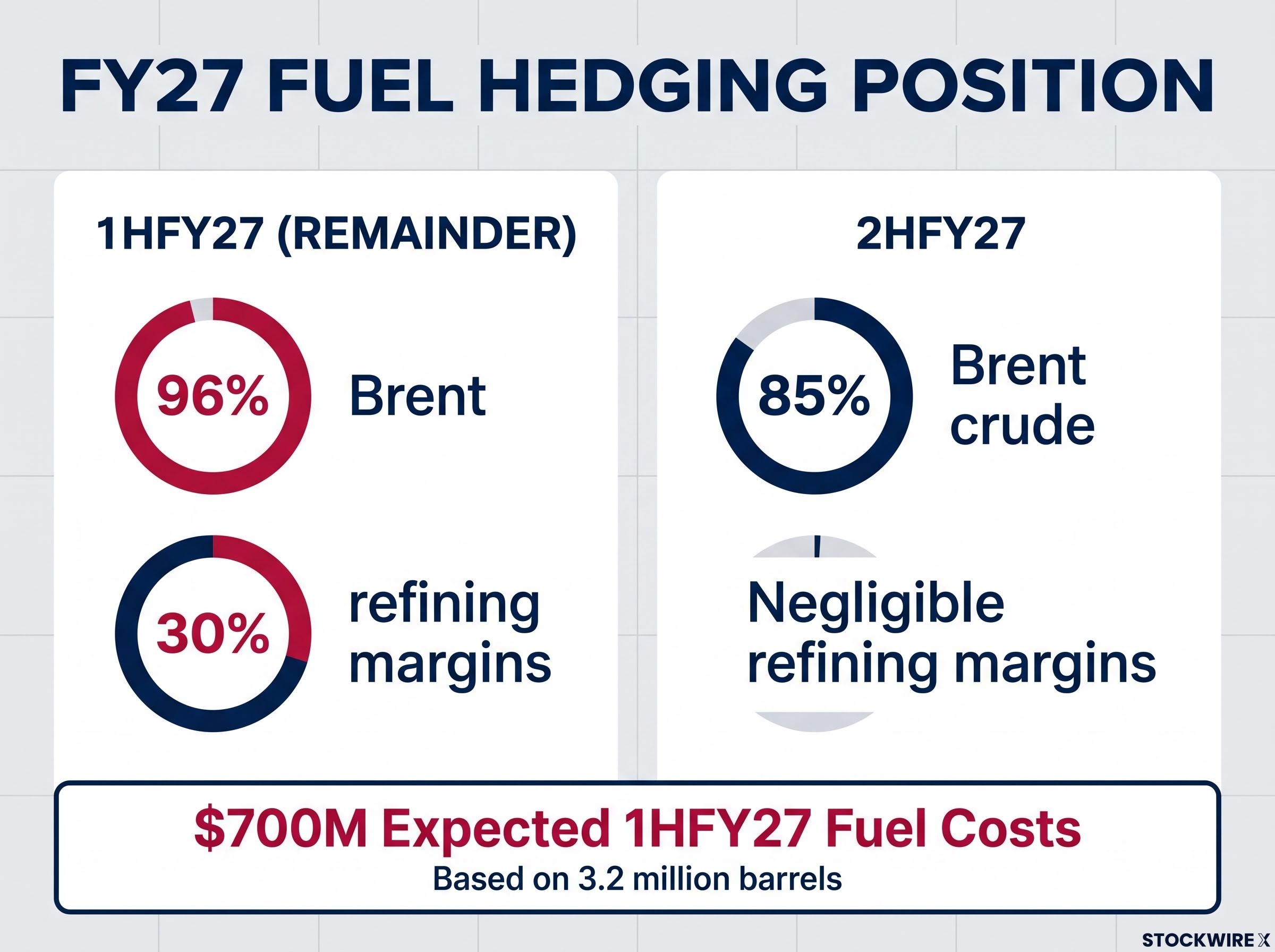
Fuel costs are expected to be approximately $700M for 1HFY27, consistent with previous guidance, with hedging partly mitigating ongoing fuel price volatility. The figure is based on the forward curve as of 5 November 2026 and 3.2 million barrels of oil.
Current hedging levels are:
- 1HFY27 (remainder): 96% for Brent and 30% for refining margins
- 2HFY27: 85% for Brent crude, with full participation to lower prices, and negligible amounts of refining margin hedging
The hedging strategy remains unchanged. Hedging levels are higher in the near term to manage fuel price volatility, while other operational levers, including fare and capacity adjustments, are being implemented to be effective in the long term.
Based on the forward fuel curve and the reduced levels of hedging, fuel costs are expected to be higher in 2HFY27 than in 1HFY27, despite reduced capacity.
Operating costs
Other operating costs are in line with expectations. Benefits from the Transformation Program and lower maintenance costs are expected to partly offset headwinds in airports and labour costs.
CASK (ex fuel) growth for 1HFY27 is expected to remain less than RASK growth, compared to the previous corresponding period. CASK is cost per available seat kilometre, while RASK is revenue per available seat kilometre.
Capacity, airfares and Velocity
Domestic demand remains resilient, with revenue performance supported by disciplined capacity management. Considering the high fuel and operating cost environment, Virgin Australia has adjusted capacity and airfares.
| Metric | Period | Guidance |
|---|---|---|
| Domestic capacity (ASK, versus previous corresponding period) | 1QFY27 | Reduced 1% |
| Domestic capacity (ASK, versus previous corresponding period) | 2QFY27 | Expected to reduce 4% |
| Domestic capacity (ASK, versus previous corresponding period) | 3QFY27 | Expected to reduce 4% |
| Domestic capacity (ASK, versus previous corresponding period) | 1HFY27 | Consistent with previous guidance of a 3% reduction |
| RASK growth (versus previous corresponding period) | 1HFY27 | 6-8%, consistent with prior guidance |
ASK refers to Available Seat Kilometres, a measure of airline capacity.
Velocity
Velocity’s FY27 outlook is unchanged, with underlying EBIT expected to be broadly flat compared with FY26. The company says Velocity continues to perform strongly, supported by member engagement and its growing financial services partner network.
Velocity remains focused on sustainable earnings growth, targeting low double-digit underlying EBIT growth in FY28 and FY29.
Fleet renewal, capex and balance sheet
Virgin Australia continues to progress its fleet renewal and investment programme to improve efficiency, reliability and the guest experience. Fleet developments include:
- Delivery of FY27’s new aircraft orders has already been completed: five Boeing 737-8 MAX aircraft and two Embraer E190-E2 aircraft
- Acquisition of four previously leased Boeing 737-800 aircraft, increasing the proportion of owned aircraft in the fleet to approximately 39%
The efficiency gains from the newer 737-8 MAX jets also show up in emissions intensity, where the airline’s 2026 Impact Report records a 6.3% cut against its FY24 baseline, though it concedes new aircraft alone will not meet its regulatory obligations.
The Group continues to expect FY27 capital expenditure of approximately $900 million to $1.0 billion, consistent with previous guidance.
Virgin Australia describes its balance sheet as strong and says it continues to manage its capital commitments within its capital allocation framework. It expects leverage to remain towards the lower end of its target range of 1-2 times net debt to EBITDA throughout FY27.
What happens next for Virgin Australia
The announcement points to the following forward milestones:
- Boeing 737-10: following certification by the Federal Aviation Administration in the United States, the current delivery schedule provides for the first aircraft in June 2028, with further deliveries scheduled for FY29.
- Velocity: targeting low double-digit underlying EBIT growth in FY28 and FY29.
- Leverage: expected to remain towards the lower end of the 1-2 times target range throughout FY27.
Don’t Miss the Next Airline and Travel Stock Mover
Join 20,000+ investors getting FREE breaking ASX news within minutes of release, complete with in-depth analysis. Click the “Free Alerts” button at Big News Blast to get market-moving updates from the consumer and transport sectors in your inbox the moment news breaks.