
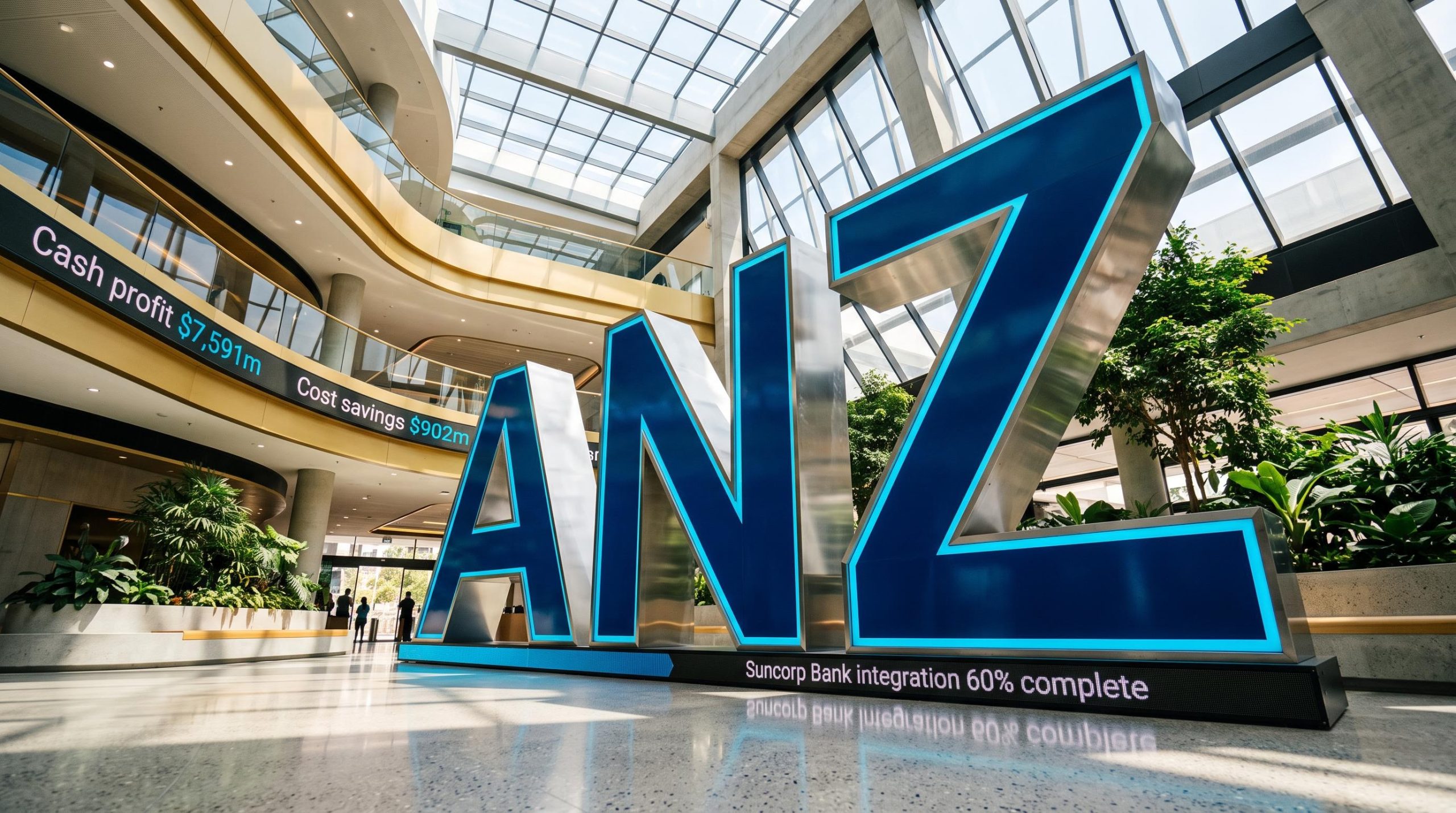
ANZ FY26 results presentation: cash profit lifts to $7,591m
In its FY26 results presentation, ANZ Group Holdings detailed cash profit of $7,591m for the year ended 30 September 2026, up 31% on $5,787m in FY25. Management also set out a like-for-like comparison.
Excluding $1,109m of FY25 significant items, cash profit rose 10%. No items were classified as significant in FY26.
Headline metrics, compared with FY25 excluding significant items, included:
- Return on tangible equity of 11.56% versus 10.47% (+109bps)
- Cost-to-income ratio of 49.26% versus 53.42% (-416bps)
- Level 2 CET1 ratio of 11.99% versus 12.03%
- Revenue/Avg RWA of 4.83% versus 4.75%
- Dividend per share of 166 cents, unchanged on FY25
The final dividend is 83 cents per share, partially franked at 80% (FY25 final: 70%). The interim dividend was franked at 75% (FY25: 70%), and the full-year dividend payout ratio is approximately 66% on a Cash NPAT basis.
The table below sets out the profit and revenue lines. FY25 revenue and expenses are shown excluding significant items.
| Measure ($m) | FY25 | FY26 | Change |
|---|---|---|---|
| Statutory profit | 5,891 | 7,270 | +23% |
| Cash profit | 5,787 | 7,591 | +31% |
| Revenue (FY25 excl. significant items) | 22,184 | 22,479 | +1% |
| Expenses (FY25 excl. significant items) | 11,849 | 11,074 | -7% |
| Profit before provisions | 10,335 | 11,405 | +10% |
When big ASX news breaks, our subscribers know first
Cost savings and Suncorp Bank integration track ahead of plan
Management outlined gross cost savings of $902m in FY26, ahead of the estimated $875m announced at 1H26 and the $800m indicated at FY25. The savings split into $392m in 1H26 and $510m in 2H26.
The program announced in September 2025 to reduce roles by approximately 3,500 is now complete. Expenses fell to $11,074m, and FY27 total expenses are expected to remain flat to the pro forma FY26 cost base of $11.26 billion.
Progress against the five immediate priorities:
- Leadership and culture: new values launched: Put customers first, Deliver with excellence, Own the outcome, Work as one.
- Suncorp Bank integration: 60% of activities completed at end-September 2026, with an expectation of 85% by end-March 2027 and migration of customers to ANZ by June 2027. Cost synergies of approximately $108m have been achieved to date, against an estimated $500m per annum full run-rate from FY29. Approximately $565m of the estimated $745m integration costs has been spent.
- Single customer front-end: 45% complete, with an expectation of 80% by end-March 2027 and delivery to all Retail and SME customers by September 2027.
- Simplification: the $902m in savings and the completed role reductions.
- Non-financial risk: on track to deliver the activities in the Root Cause Remediation Plan, with the second and third independent assurance reports by Promontory released.
The completion percentages are based on work packages, which vary in size and complexity and remain subject to change.
Chief executive Nuno Matos has framed the end state as one brand for customers, with the integration sitting inside the first phase of the ANZ 2030 strategy and a second growth phase contingent on 2027 delivery.
AI as an enabler
The presentation described an expected AI-enabled interaction range of more than 90% across overall contact centre volumes at platform completion. It also cited 2x software engineering capacity related to Single Customer Front End deliverables in FY26. The Enterprise AI Control Plane is being implemented progressively.
Balance sheet, credit quality and capital position
The Level 2 CET1 ratio measures the highest-quality capital a bank holds relative to its risk weighted assets. It matters to shareholders because it indicates the buffer available to absorb losses, and ANZ reported 11.99%. On a Basel Harmonised basis, the ratio was 17.9%.
Key balance sheet and credit measures:
- Customer deposits of $670b (+6%) and net loans and advances of $811b (+4%), both excluding Markets
- Collective provision balance of $4.53b, $2.1b above the base case scenario
- Individual provision loss rate of 5bps in 2H26, against a long run loss rate of 11bps
- Average LCR of 132% and NSFR of 116%, against a regulatory minimum of 100%
- Term funding issuance of $40b in FY26
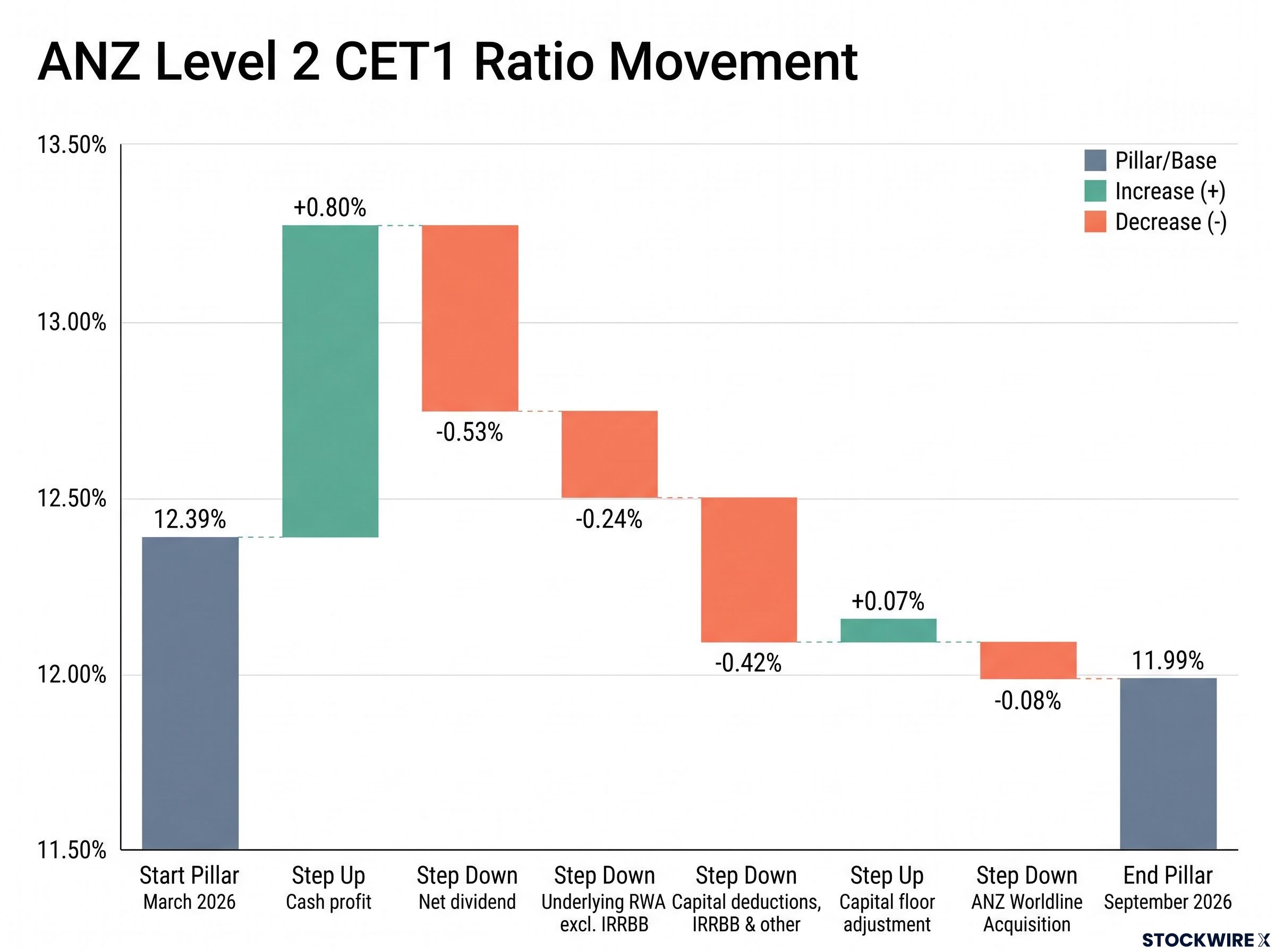
The CET1 ratio moved from 12.39% at March 2026 to 11.99% at September 2026. Contributors included cash profit (+0.80), net dividend (-0.53), underlying RWA excluding IRRBB (-0.24), capital deductions, IRRBB and other (-0.42), the capital floor adjustment (+0.07) and the ANZ Worldline Acquisition (-0.08). ANZBGL senior debt is rated AA- by S&P.
The ANZ New Zealand result tells a different story from the group, with profit falling to NZ$2.53b as a NZ$125m court provision and higher costs outweighed flat income.
Targets and what ANZ says comes next
Management targets, which are forward-looking, include lifting return on tangible equity towards 12% by FY28 and towards 13% by FY30. They also include a cost-to-income ratio in the mid-40s percent by FY28, sustained through to FY30, and estimated Suncorp Bank synergies of $500m with full run-rate synergies realised in FY29.
For FY27, management’s stated focus is sustaining revenue momentum, maintaining cost discipline, and efficient funding and capital allocation. On margins, a 4bps net interest margin benefit from the replicating portfolio is expected over the next 12 months, and 1H27 NIM excluding Markets is expected to remain broadly stable half on half.
Stated upcoming milestones:
- Suncorp Bank integration is expected to reach 85% by end-March 2027.
- The single customer front-end is expected to reach 80% by end-March 2027.
- A safe and secure migration of Suncorp Bank customers to ANZ is targeted by June 2027.
- The single customer front-end is to be delivered to all Retail and SME customers by September 2027.
- APRA expects its credit risk capital proposals to be implemented from 1 April 2027.
- Outstanding AT1 securities are to be grandfathered as Tier 2 from January 2027 until their first scheduled call date.
- Remaining Suncorp integration spend of approximately $165m is expected throughout FY27, with a small residual in FY28.
Stay Ahead on Banking and Finance News
Get FREE breaking ASX finance news delivered to your inbox within minutes of release, complete with in-depth analysis and the full announcement. Join 20,000+ investors already receiving real-time alerts from Big News Blast. Click the “Free Alerts” button to see market-moving news the moment it breaks.