A reading of 6% sounds like a pass-or-fail test for India’s central bank. It is not that simple. India’s October consumer price index (CPI) is not due until 12 November 2026, yet the forecasts sit almost exactly on the line, and the India inflation outlook depends less on which side of it the print lands than on what is driving it.
A Reuters poll of economists puts the median forecast at 5.93%. DBS Group Research goes slightly higher, at 6.0%.
That line matters because of what happened last month. On 7 October, the Reserve Bank of India (RBI) raised its repo rate, the rate at which it lends to commercial banks, by 25 basis points (bps) to 5.50%. A basis point is one hundredth of a percentage point. It was the RBI’s first hike since February 2023.
The RBI aims for 4% inflation and treats anything from 2% to 6% as tolerable. A reading at the top of that band will shape whether a second hike follows in December.
Here is how to separate the temporary drivers from the lasting ones, and why that split matters for the December rate debate and for how markets are already pricing it.
Why does DBS expect India’s October CPI to hit 6.0%?
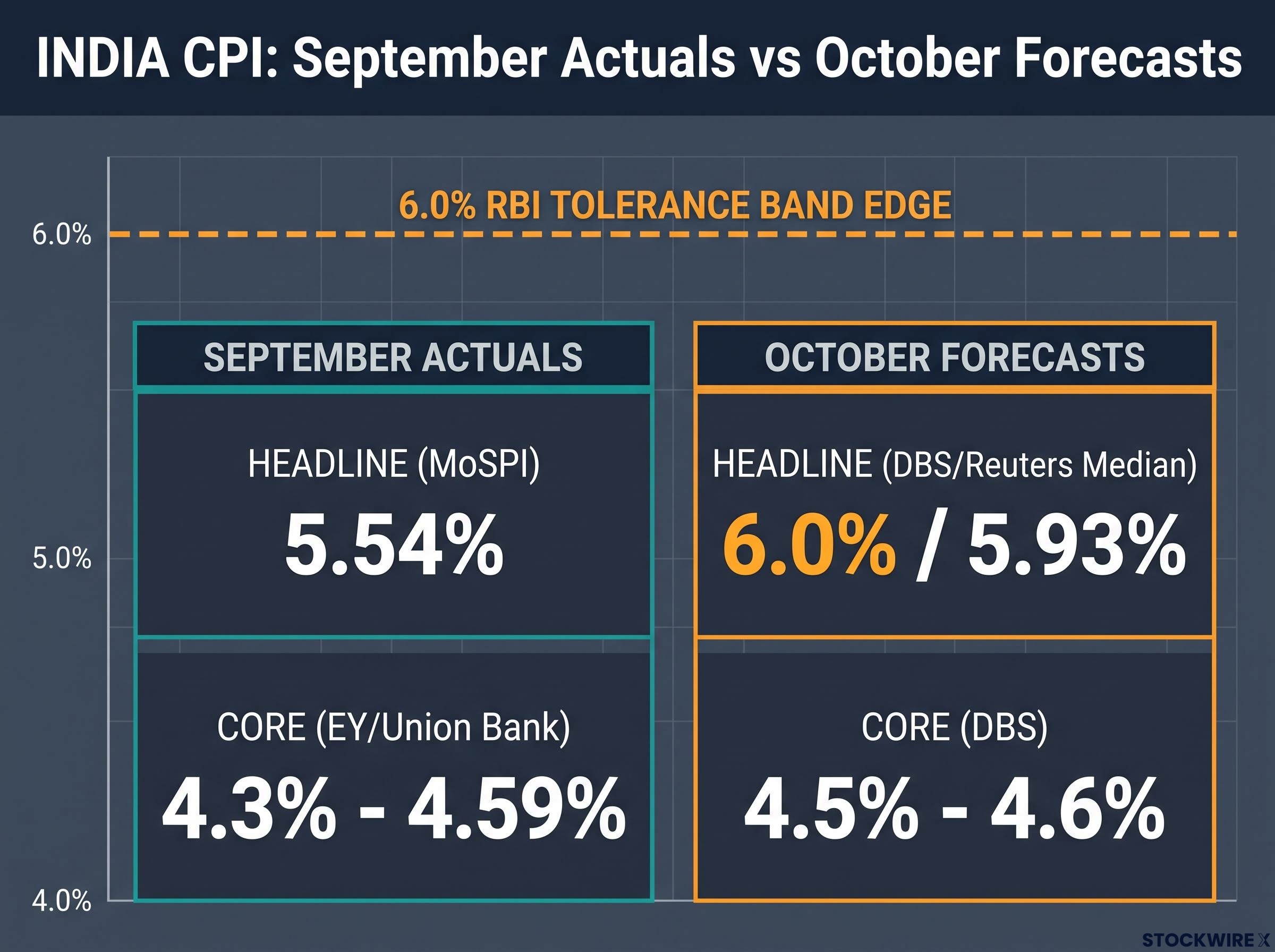
The forecasters largely agree. DBS expects headline CPI to rise to 6.0% year on year in October, with core inflation, which strips out volatile food and fuel prices, climbing to 4.5%-4.6%.
That would extend a sharp climb. Official September CPI from the Ministry of Statistics and Programme Implementation (MoSPI) came in at 5.54%, up from 4.82% in August, with rural inflation at 6.08% and urban at 4.88%.
DBS is not an outlier. The Reuters poll of 36 economists produced a median of 5.93%, and nearly half expected a reading at or above 6%.
The spread is where the confidence thins. Forecasts run from 5.50% to 6.60%, a gap of more than a full percentage point on a single monthly figure.
| Measure | Headline CPI | Core CPI |
|---|---|---|
| September actual (MoSPI) | 5.54% | 4.3%-4.6% (private estimates) |
| October Reuters median | 5.93% | About 4.45% |
| October DBS forecast | 6.0% | 4.5%-4.6% |
| October Reuters range | 5.50%-6.60% | Not available |
Core adds another layer of uncertainty. MoSPI publishes no official core series, so every core figure is a private estimate. EY put September core at 4.3%, while Union Bank of India estimated 4.59%.
DBS points to frequent-interval data showing month-on-month price pressure intensifying in cereals, edible oils and vegetables. A reading this close to the band edge means the headline alone will not settle policy. What you should watch is core and whether the pressure persists, not whether the number starts with a 5 or a 6.
When big ASX news breaks, our subscribers know first
How food, base effects, fuel and services fit together
The visible signal is food. To judge whether it matters for policy, you need to see how each driver moves the index.
Food and base effects
Cereals, edible oils and vegetables carry heavy weights in India’s CPI basket. When their prices rise together, headline inflation jumps quickly. According to Crisil, food inflation rose to 7.7% in September from 6.0% in August.
Many of these spikes follow the monsoon and the harvest, which makes them cyclical: they tend to fade when supply recovers.
Roughly 90% of India’s food inflation is supply-side in origin, which limits what rate hikes can do directly, though surging household inflation expectations create a credibility risk the RBI cannot ignore.
Base effects amplify the move. A base effect occurs when the year-earlier comparison month had unusually low prices, so even modest monthly gains produce a large year-on-year rate. EY attributed part of September’s rise to exactly this.
Core, fuel and offsets
Services move more slowly. Their prices respond with a lag to wages, rents, transport and demand, so firmer services inflation suggests pressure is spreading beyond the grocery bill.
DBS also cites a fading indirect-tax base effect. Earlier changes to indirect taxes, such as consumption taxes, held measured prices down. As those months drop out of the comparison, core inflation rises even without any new tax change.
Two forces work in the other direction, though neither offers quick relief. Softer precious-metal prices pull down the clothing and personal-effects components. Retail fuel prices adjust to crude with a lag, so oil costs feed into transport, logistics and inputs later rather than immediately.
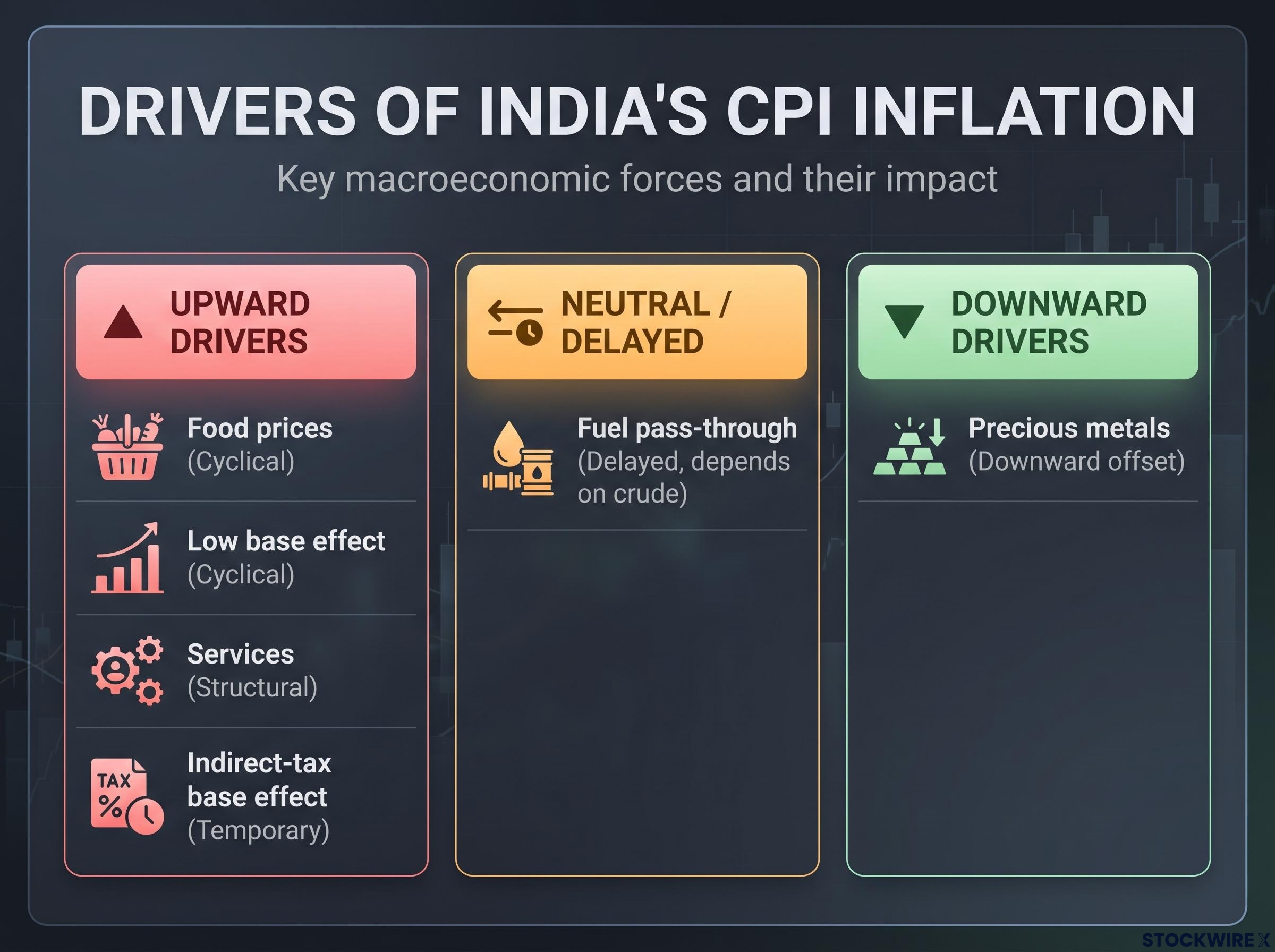
| Driver | Effect on CPI | Direction | Likely duration |
|---|---|---|---|
| Food prices | Heavy weights lift headline fast | Upward | Cyclical |
| Low base | Inflates year-on-year rate | Upward | Cyclical |
| Services | Lagged pressure on core | Upward | More structural |
| Indirect-tax base effect | Raises measured core | Upward | Temporary, mechanical |
| Fuel pass-through | Feeds transport and inputs later | Delayed upward | Depends on crude |
| Precious metals | Lowers clothing and personal effects | Downward | Partial offset |
One statistic shifts the reading. The share of CPI items with inflation above 4% rose from 20% in March to 37% in August. That tells you the pressure is broader than a vegetable shock, and broad pressure is what central banks act on.
Will the RBI hike again in December, and what are the markets pricing?
Breadth is what splits the forecasters. When it moved in October, the RBI changed its stance from “neutral” to “calibrated tightening”, and it projects FY27 inflation of 5.2%, with 6.0% in Q3 and 5.7% in Q4, alongside growth of 7.1%.
The shift to a calibrated tightening stance was passed by a 4:2 split on the Monetary Policy Committee, and Governor Malhotra ruled out near-term rate cuts, which is why the rupee barely reacted to the hike itself.
DBS expects a second consecutive 25-bp hike in December and a total cycle of 75 bps once a February 2027 move is included. Others share the hawkish lean, but the conviction varies.
| Institution | December call | Key reasoning |
|---|---|---|
| DBS | 25-bp hike | Food, low base, services, core pressure |
| HSBC | 25-bp hike to 5.75% | Reinforce policy credibility |
| Goldman Sachs | Hike, with up to three more moves | Sees RBI hawkishness as durable |
| Nomura | 25-bp hike to 5.75% | Only a limited recalibration |
| ICRA | Hike appears likely | Food, crude, uneven monsoon |
ICRA‘s Aditi Nayar sees another December move as likely, and Barclays expects two further hikes on broadening inflation. Nomura also pencils in December, but frames it very differently.
Nomura’s counterpoint Markets had priced in close to 125 bps of hikes, a level Nomura judged excessive for what it sees as a limited recalibration rather than a full tightening cycle.
History explains why the hawks are not dismissed. In August 2022, with inflation above the band, the RBI raised rates by 50 bps to 5.40%, then to 5.90% in September.
How oil rewired the market pricing
Then oil fell. Brent crude dropped from about $118 a barrel near the end of October to about $94 yesterday, 5 November.
Overnight index swap (OIS) rates, which reflect where traders expect the RBI’s policy rate to average over a set period, fell sharply the same day. The 1-year rate dropped 10 bps to 6.4050%, the 2-year 9 bps to 6.4175% and the 5-year 8 bps to 6.5275%.
Oil matters this much because India imports most of its crude. The merchandise trade deficit widened to US$30.21 billion in September, and DBS expects the October goods deficit to exceed US$30 billion. Cheaper oil narrows that gap, supports the rupee, lifts government bonds and eases input costs for equities.
OIS rates fell while CPI forecasts held firm, which shows the market betting the breach is temporary. That gap between sell-side hawks and market pricing means you should treat December as open, not settled.
What could keep inflation higher, or let the RBI hold?
The risks cut both ways, and the balance could shift before December.
Developments that would tilt the call towards a hike:
- A deficient or uneven monsoon, or El Niño, keeping food prices high (flagged by the RBI and ICRA)
- Brent returning to $100 or more, which Goldman warns would create a larger growth and inflation problem
- Rupee weakness, raising the cost of oil, metals and imported inputs
- Core inflation continuing to broaden beyond the private estimates
Developments that would support a pause:
- The RBI’s framework, which weighs the outlook and persistence, so one reading at 6% does not automatically trigger a move
- A food shock that proves temporary as supply recovers
- The growth drag from higher rates, a wide trade deficit and energy costs, set against the RBI’s 7.1% growth projection
- Forecast uncertainty, with a 5.50%-6.60% range and only private core estimates
Union Bank adds a complication. It expects up to 50 bps more tightening by the end of FY27, but argues part of the pressure reflects defence of the currency rather than purely domestic inflation.
The 12 October rupee-defence package, including a 20% FERR cash requirement and a lower limit on unhedged derivatives, tightened liquidity on top of the rate hike and shows how seriously the currency is being treated.
That matters for how you read any December move. A hike aimed at the rupee says something different about inflation than one aimed at core prices, so weigh core momentum, oil and the currency together rather than leaning on the headline alone.
Reading the 12 November print and the December decision
The headline near 6% is largely a food and base-effect story. Whether the RBI treats it as temporary depends on core inflation and how widely price pressure has spread.
Three variables will tell you which way December leans:
- The official October print on 12 November, alongside private core estimates, to see whether core moves towards 4.5% or beyond.
- Brent relative to $100, the threshold Goldman flags for a larger inflation problem.
- Rupee and trade deficit data, which show whether tightening is about prices or the currency.
If core firms and oil rebounds, the hawkish camp gains ground. If core stalls and crude stays near $94, the market’s gentler pricing looks more defensible.
Past performance does not guarantee future results. Financial projections are subject to market conditions and various risk factors.
This article is for informational purposes only and should not be considered financial advice. Investors should conduct their own research and consult with financial professionals before making investment decisions.