
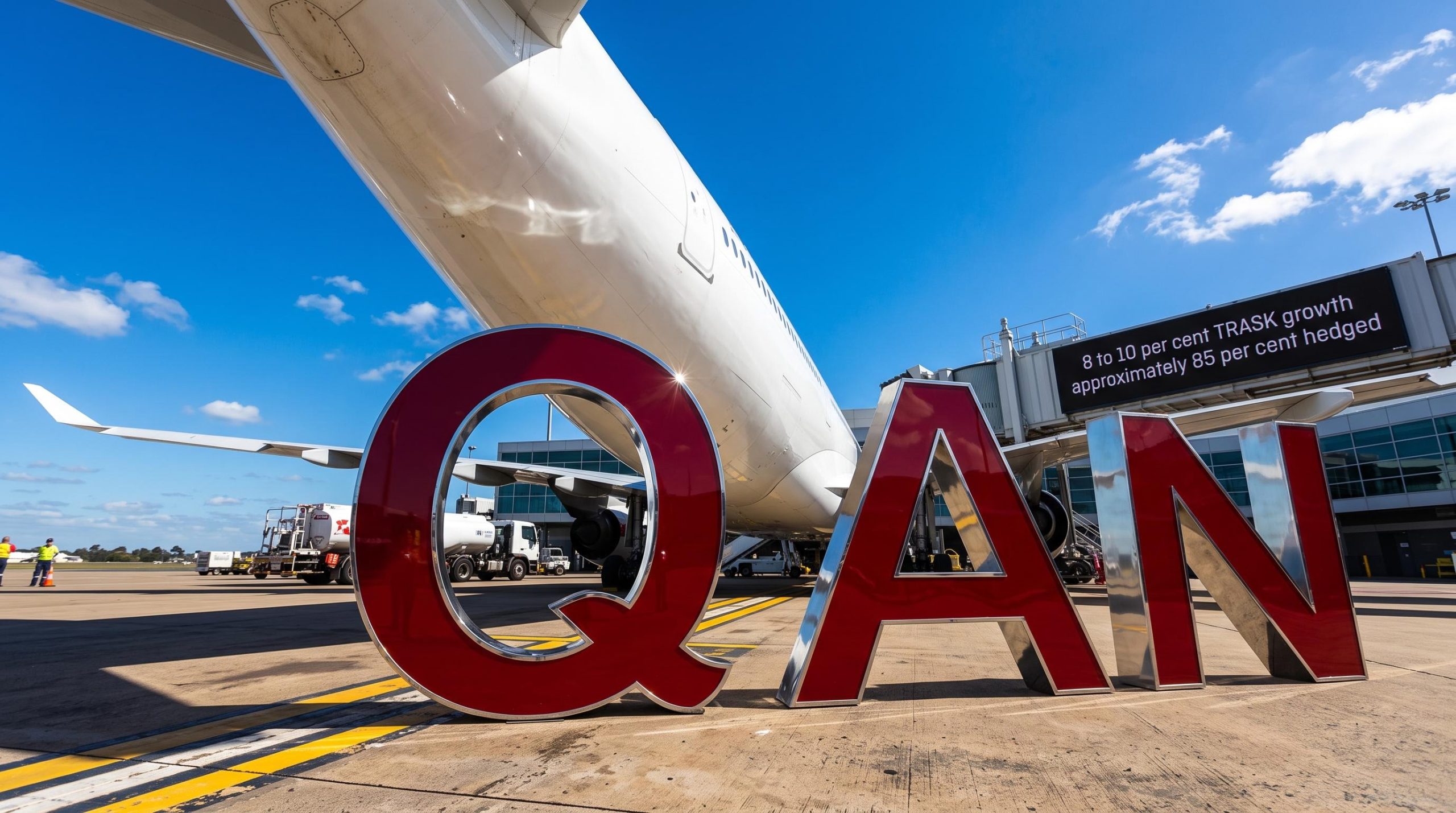
Qantas reaffirms trading outlook as 1H27 fuel bill expected to hit $3.75 billion
In its market update of 6 November 2026, Qantas Airways said trading conditions remain in line with the outlook provided at its FY26 results in August, despite elevated fuel prices. The Qantas market update puts the Group’s expected 1H27 fuel cost at approximately $3.75 billion.
Guidance is largely unchanged while the fuel bill is higher. The Group said it has and will continue to adjust fares and capacity in response to higher fuel costs.
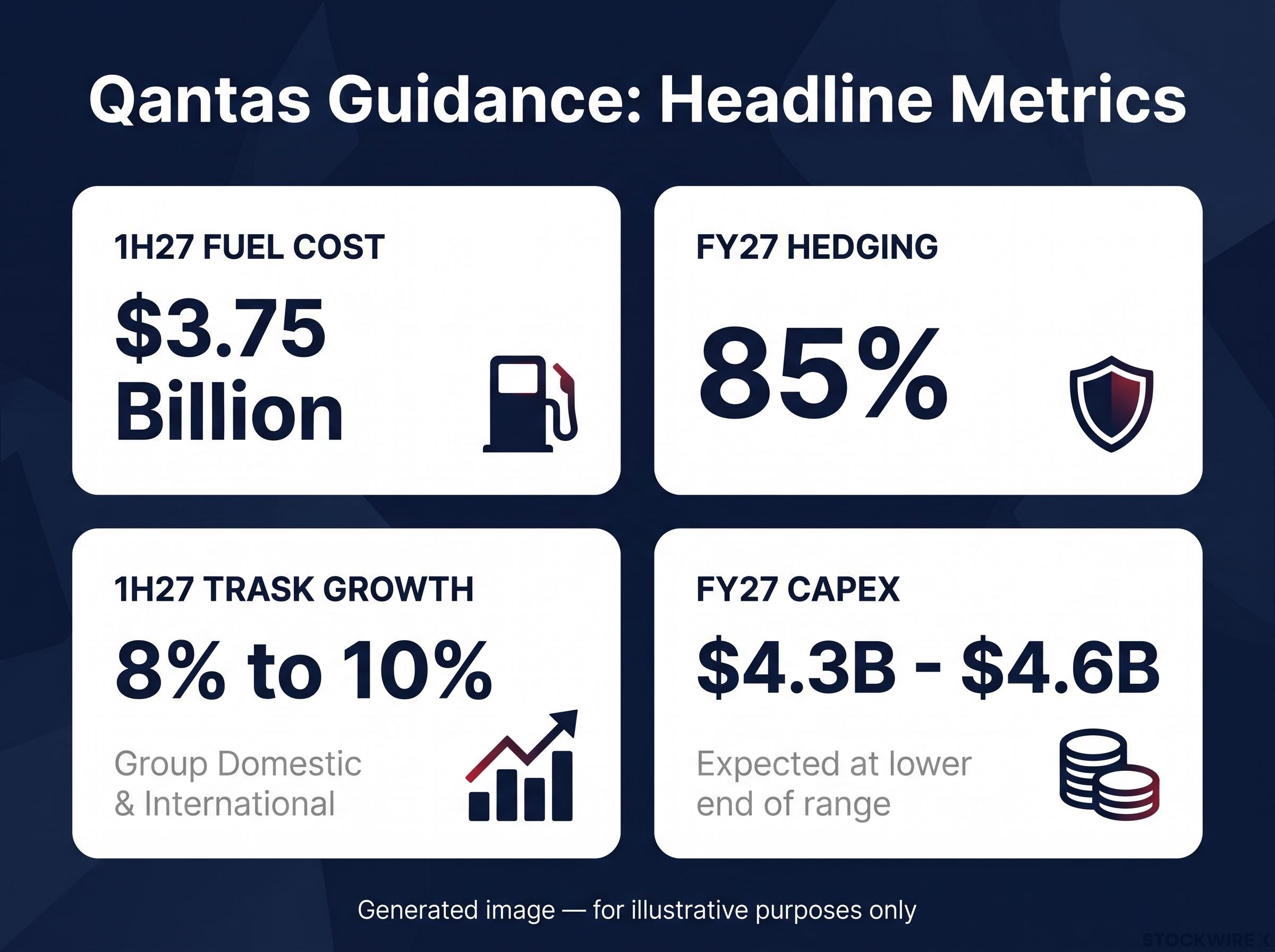
Four headline points stand out:
- Fuel: 1H27 fuel cost now expected to be approximately $3.75 billion
- Hedging: approximately 85 per cent hedged for FY27
- TRASK: Group Domestic and Group International each expected to grow 8 to 10 per cent in 1H27
- Capex: FY27 net capital expenditure now expected at the lower end of the $4.3 billion to $4.6 billion range
When big ASX news breaks, our subscribers know first
Demand holds firm across key segments
The Group said demand remains resilient as customers continue to prioritise travel. By segment:
- International: demand across Qantas and Jetstar remains strong, supported by customers redirecting travel away from the Middle East
- Domestic leisure: demand remains strong
- Non-resources corporate and government: travel remains stable and is being closely monitored
Fuel costs and hedging: how Qantas is managing the pressure
The fuel outlook
Based on forward curves, fuel prices are expected to remain elevated through FY27. Qantas fuel costs for 1H27 are now expected to be approximately $3.75 billion.
That figure is based on forecast consumption of approximately 16.2 million barrels in 1H27 (including SAF purchased). It assumes market jet fuel prices of approximately A$223 per barrel, excluding hedging, into-plane costs, SAF and carbon credit costs.
Hedging position
The Group has continued to extend hedging and is approximately 85 per cent hedged for FY27. The hedging is predominantly in Brent crude oil, with significant participation in lower fuel prices.
Education: what is TRASK and why does it matter?
TRASK is total unit revenue, calculated as total revenue divided by available seat kilometres (ASKs). An ASK is one seat flown one kilometre, so TRASK shows how much revenue each unit of capacity earns.
Investors watch the measure because it shows how revenue per unit of capacity is moving as costs change. The Group expects Group Domestic and Group International TRASK to each grow 8 to 10 per cent in 1H27 compared with the prior corresponding period.
Guidance, capacity and capital discipline
The 8 to 10 per cent 1H27 TRASK growth expectation is unchanged from the guidance provided at the FY26 results. The prior corresponding period for Group International includes Jetstar Asia.
FY27 net capital expenditure is now expected to be at the lower end of the previously guided range of $4.3 billion to $4.6 billion. Qantas Loyalty remains on track to deliver Underlying EBIT growth of 5 to 7 per cent in FY27, and all other guidance provided at the FY26 results remains unchanged.
The capacity table below shows the Group’s capacity versus the prior corresponding period.
| Segment | 1Q27 | 2Q27 | 1H27 | 3Q27 |
|---|---|---|---|---|
| Group Domestic | (1%) | (5%) | (3%) | (4%) |
| Qantas Domestic | (1%) | (5%) | (3%) | (5%) |
| Jetstar Domestic | (1%) | (4%) | (3%) | (3%) |
| Group International | +2% | +2% | +2% | +1% |
| Qantas International | +4% | +3% | +3% | +1% |
| Jetstar International | (2%) | +2% | 0% | 0% |
| Group | 1% | 0% | 0% | (1%) |
The contrast is clear for 1H27. Group Domestic capacity is down (3%) while Group International is up 2%, leaving Group capacity at 0%. Jetstar International includes Jetstar Asia in the prior corresponding period.
For readers wanting to see which routes were trimmed and which gained seats, our detailed coverage of the Qantas schedule changes covers the European additions, the Bengaluru suspension and the Trans-Tasman reductions behind the domestic and international split.
What happens next for Qantas
- 1H27 results release, February 2027: The Qantas Group will provide guidance on 2H27 TRASK. The Group noted that 2H27 TRASK will reflect the cycling of fare and capacity actions taken in the prior corresponding period.
Get Airline and Consumer News Before the Market Moves
Get FREE breaking ASX news delivered to your inbox within minutes of release, with in-depth analysis already done. Join 20,000+ investors using Big News Blast to stay ahead of the market. Click the “Free Alerts” button to start receiving alerts the moment market-moving news breaks.