
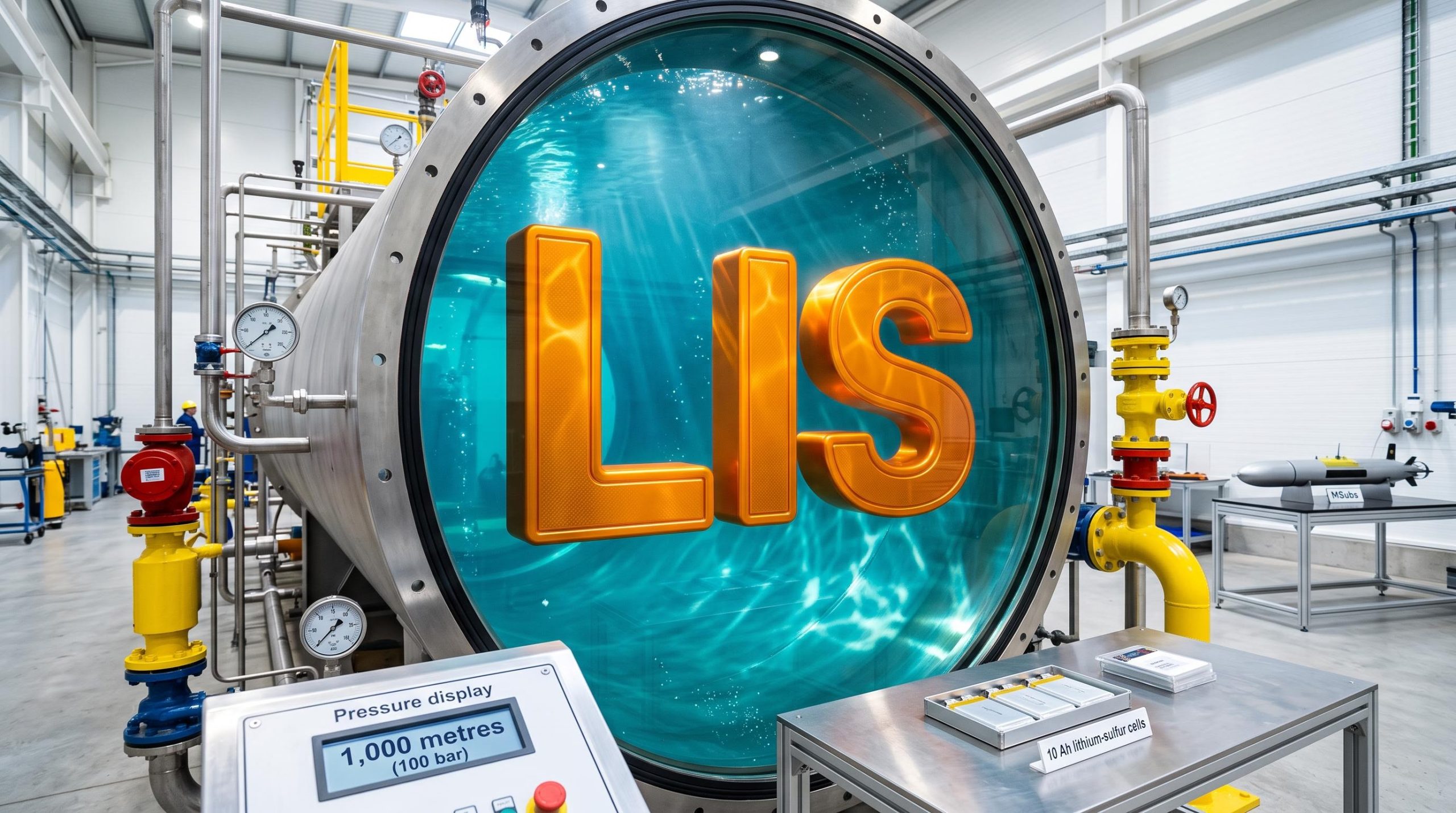
Li-S Energy cells clear 1,000 metre pressure test in MSubs UUV trial
Li-S Energy (ASX: LIS) has announced that its 10 Ah lithium-sulfur cells completed repeated pressure cycles equivalent to a depth of 1,000 metres (100 bar). The testing was run under the Company’s collaboration with UK undersea systems specialist MSubs Limited, announced in December 2025, and targets the Uncrewed Underwater Vehicle (UUV) market.
The Company described the result as “a breakthrough for Li-S Energy and the first of its kind for the Company’s cells.” The test report has been delivered to and accepted by MSubs, which has expressed its satisfaction with the outcome and its intention to continue the assessment with Li-S Energy.
For investors, pressure testing was the first key phase of the assessment process, and the cells have passed it.
Dr Steve Rowlands, Chief Technology Officer, Li-S Energy
“…Our cells did not just survive it, they kept delivering propulsion current through repeated dives and came back to the ‘surface’ undamaged, with no change in mass and a textbook recovery to open-circuit voltage…”
What the testing showed
The testing was conducted in an MSubs pressure vessel, commissioned at the Company’s Battery Testing Centre in Geelong during the June 2026 quarter. Li-S Energy’s 10 Ah lithium-sulfur pouch cells, produced on its 2 MWh automated production line in Geelong, were tested at different states of charge, both with and without the discharge current each cell would deliver for the main propulsion of the extra-large UUV (XLUUV).
Each test cycled the cells from surface pressure to the equivalent of 1,000 metres depth and back, simulating an extreme “porpoising” manoeuvre in which the vehicle dives to operating depth, resurfaces and repeats. Pressure and cell voltage were monitored throughout, and the cells were inspected and weighed before and after testing.
Reported results included:
- No visible mechanical damage, swelling or leakage following testing
- No mass loss recorded
- Cell voltage stable through every pressure cycle, with no abnormal behaviour
- Open-circuit voltage stable for 24 hours and beyond after testing
- The discharged cell recovered to its equilibrium voltage once discharge stopped
| Test parameter | Result |
|---|---|
| Cell type | 10 Ah lithium-sulfur pouch cells |
| Simulated depth | 1,000 metres (100 bar) |
| Pressure profiles completed | All cells completed their assigned profiles |
| Mechanical damage, swelling or leakage | None visible |
| Mass loss | None recorded |
| Cell voltage during pressure cycles | Stable, no abnormal behaviour |
| Open-circuit voltage after testing | Stable for 24 hours and beyond |
| Discharged cell after discharge stopped | Recovered to equilibrium voltage |
When big ASX news breaks, our subscribers know first
Why MSubs and the UUV market matter
Who MSubs is
MSubs is headquartered in Plymouth in the United Kingdom. It designs and builds crewed and uncrewed underwater vehicles for the UK Ministry of Defence, the US Navy and US Special Operations Command.
Its platforms include XV Excalibur, the Project CETUS XLUUV handed over to the Royal Navy in December 2025. The collaboration is directed at evaluating Li-S Energy’s lithium-sulfur technology for large-scale propulsion battery systems in MSubs’ extra-large UUV platforms.
Rob Shaw, Engineering Director, MSubs
“Pressure tolerance was a major gate in our feasibility assessment, and Li-S Energy’s cells have passed it convincingly…”
Why pressure tolerance decides UUV battery choice
Deep-diving vehicles must keep their batteries working under very high pressure. Many designs respond by adding heavy pressure containment or buoyancy foam, which adds weight and bulk.
According to Dr Rowlands, the result removes a key risk for using the cells in water-filled UUVs at ambient pressure. The Company says the result supports these advantages for UUVs:
- Around twice the energy density of lithium-ion
- Lower weight
- Near-neutral buoyancy without the need for heavy pressure containment or extensive buoyancy foam
- Ability to operate at representative subsea temperatures
A growing market
Navies in Australia, the United Kingdom and the United States are all fielding extra-large UUVs. Australia alone committed A$1.7 billion to its Ghost Shark programme in 2025.
The same requirements apply to commercial UUVs for subsea inspection, offshore energy and seabed survey. The Company states that success with MSubs positions Li-S Energy for the whole sector, not just one platform, in what it describes as a multi-billion dollar market.
The work to date is an assessment, and the announcement does not describe any contract, order or revenue.
What happens next for Li-S Energy and MSubs
Li-S Energy and MSubs have agreed the next steps in the assessment process:
- Pressure vessel testing at greater simulated depths.
- Charging as well as discharging at depth.
- Testing across the thermal operating profiles of subsea vehicles.
- Subject to the outcome of those tests, a targeted trial of a Li-S Energy battery pack during an actual dive mission on an XLUUV in open water.
- Market updates as the qualification process progresses, in accordance with the Company’s continuous disclosure obligations.
The result is a de-risking milestone in an ongoing qualification process, with further testing still to come.
Li-S Energy is an Australian developer of ultra-lightweight lithium-sulfur cells offering more than twice the energy density of conventional lithium-ion, targeting aviation, drones, defence and aerospace applications.
Get Battery Tech News Before the Market Moves
Join 20,000+ investors receiving FREE breaking ASX news within minutes of release, complete with in-depth analysis and the full announcement. Click the “Free Alerts” button at Big News Blast to get real-time alerts on the next defence and technology mover the moment news breaks.