A Bank of England rate hike sounds like good news for sterling. When the move is almost fully priced, though, the currency has usually reacted already, and the next leg of any GBP/USD forecast depends on how the committee votes and what it says next.
On Monday, 2 November 2026, sterling held modest gains against the dollar after pulling back from two-week highs. The pair traded around 1.3420 in one session reference, after peaking just below 1.3450, while Reuters cited a level of $1.3387. These figures are best read as intraday snapshots, not a single settled price.
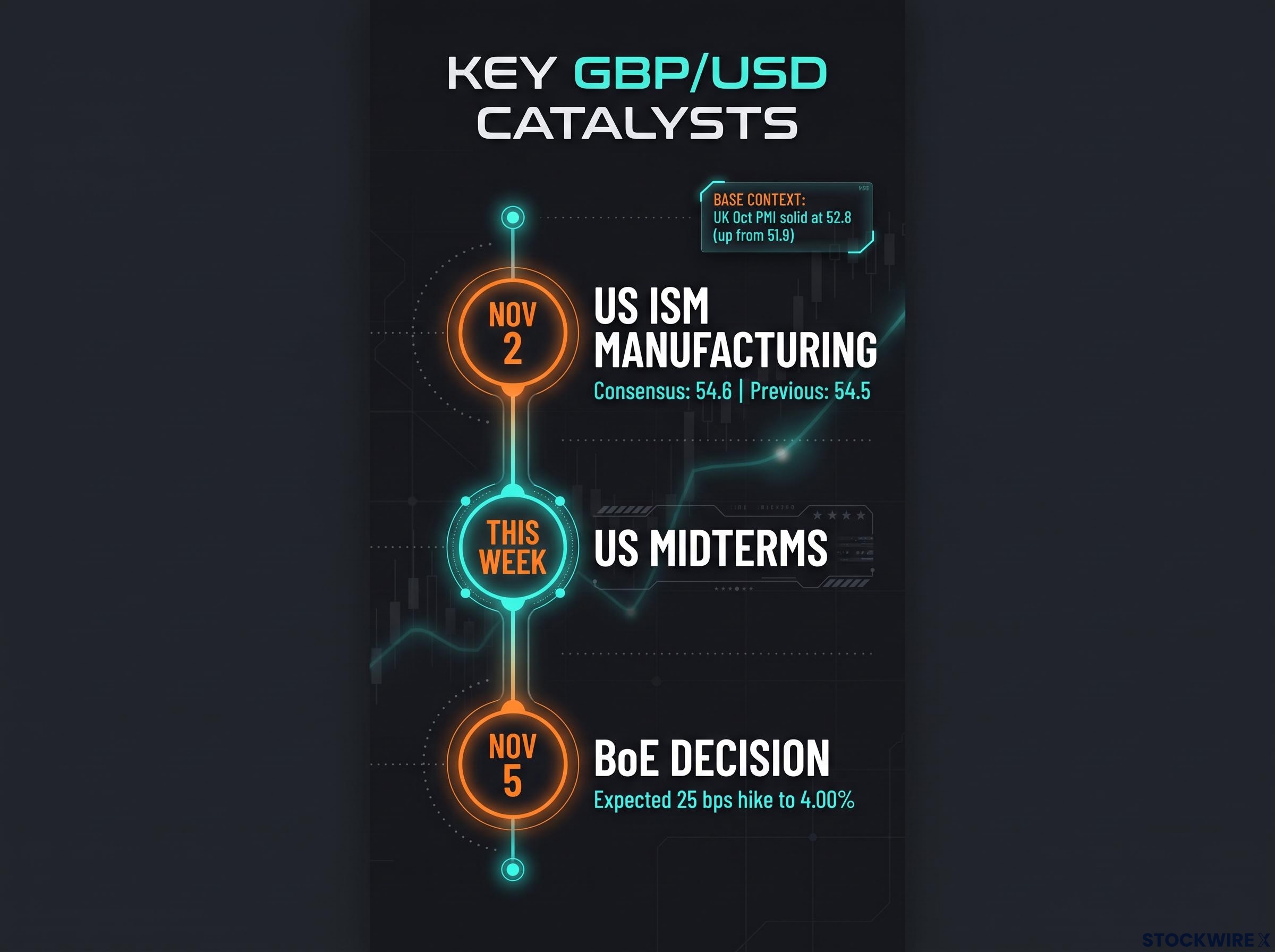
The UK side looks firm. October’s final manufacturing purchasing managers’ index (PMI) came in at 52.8, a five-month high, and markets expect a 25 basis point hike to 4.00% on Thursday 5 November. A basis point is one hundredth of a percentage point.
The dollar side is less settled. It sits between US midterm uncertainty and today’s ISM Manufacturing release.
Here is which forces on each side of the pair carry the most weight this week, and how you can read PMI releases yourself.
Why is sterling holding gains before the Bank of England decision?
The factory data gave sterling a solid base. The final S&P Global UK manufacturing PMI rose to 52.8 in October from 51.9 in September. It matched both consensus and the flash estimate, and it showed the strongest output growth in more than two years.
Danske Bank read the improvement as leaning hawkish for the Bank of England (BoE). A hawkish signal points towards higher interest rates. The bank added a caveat: supply-chain distortions make the signal less clean than the headline suggests.
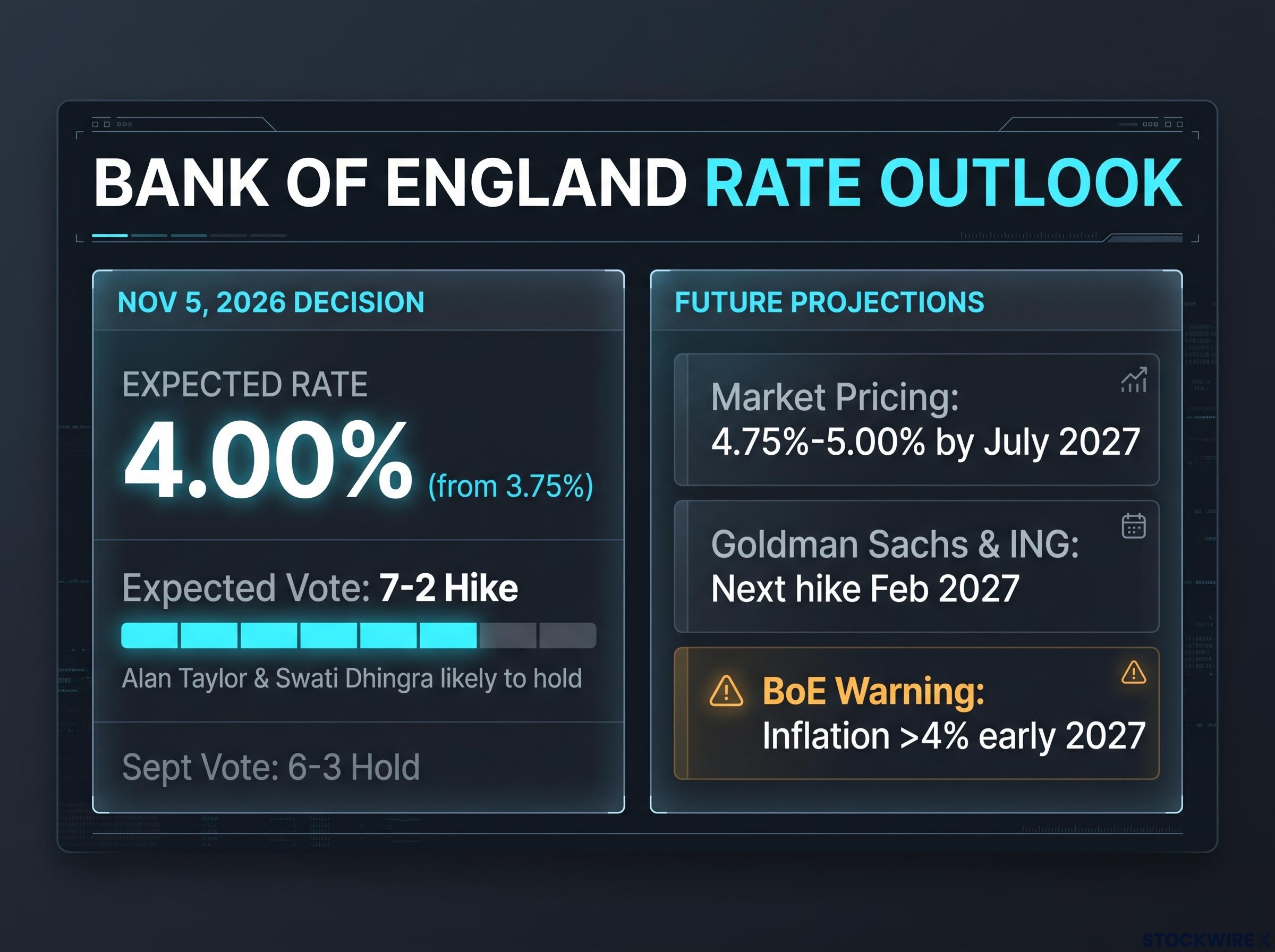
That data fed a near-consensus view. Economists polled by Reuters expect Bank Rate to rise from 3.75% to 4.00%, and money markets had almost fully priced the move.
That is the problem for anyone expecting a big sterling rally on Thursday.
| Item | Detail |
|---|---|
| UK manufacturing PMI | 52.8 (Oct) vs 51.9 (Sep) |
| Expected Bank Rate | 4.00% (from 3.75%) |
| Expected vote split | 7-2 in favour of a hike |
| Decision date | Thursday 5 November 2026 |
| Potential next move | February 2027 (Goldman Sachs, ING) |
What the vote split could signal
The expected split is 7-2, with Alan Taylor and Swati Dhingra seen as the most likely members to vote for no change. That would mark a sharp shift from September, when the Monetary Policy Committee (MPC) voted 6-3 to hold.
A clean 7-2 vote with firm guidance would support the market’s view of more hikes ahead. A larger dovish bloc would suggest a committee reluctant to go further. Because the hike itself is priced, a one-off signal could weigh on sterling even with a rate rise. You should watch the vote count and the wording, not the rate.
The case for and against more hikes
Markets have priced at least three further hikes by July 2027, which would take Bank Rate towards 4.75%-5.00%. Goldman Sachs called pricing of more than 100 bp of tightening over the following year excessive, citing contained wage pressures and a likely winter slowdown in consumer spending. Goldman and ING both expect another increase in February.
The BoE has warned that inflation could rise above 4% early in 2027. Governor Andrew Bailey argued that policymakers cannot wait for conclusive evidence of second-round effects, where higher inflation feeds into wages and business pricing.
The Bank’s revised inflation peak forecast, lifted from around 3.2% to somewhat over 4% in just two months, explains why the committee cannot wait for conclusive evidence of second-round effects before acting.
- For further tightening: a temporary energy shock must not become persistent through wages, services prices and inflation expectations.
- Against further tightening: energy inflation is an imported supply shock, and higher rates cannot lower energy prices. They could instead weaken demand, jobs and already sluggish growth.
When big ASX news breaks, our subscribers know first
What is the dollar side of the pair telling you?
While sterling has data supporting it, the dollar’s direction is conditional. It was somewhat soft on Monday, pressured by election uncertainty and a mild risk-on tone as oil eased. Risk-on means investors are more willing to buy riskier assets, which tends to reduce demand for the dollar as a safe haven.
Two events could change that direction. The first is the Institute for Supply Management (ISM) Manufacturing PMI, due at 10:00 a.m. ET (15:00 UK time) today. Consensus sits near 54.6, against 54.5 previously.
The actual result was not available at the time of writing, so no comparison with consensus is made here.
The headline may matter less than the details. Traders watch the prices paid and employment components because they shape expectations for the Federal Reserve. Pre-release calendars cited prices paid near 77.2-78 and employment around 53 against 52.7 prior, but these previews have not been independently confirmed.
The second event is the midterms. Polymarket odds as of 2 November show a lopsided House and a less certain Senate.
| Chamber | Democratic control | Republican control |
|---|---|---|
| House | 94%-95% | 6% |
| Senate | 72%-73% | 28%-29% |
Analysts at MUFG argue that Democratic control would reduce the scope for further fiscal stimulus, meaning extra government spending or tax cuts.
MUFG on the midterms A heavy Republican defeat could dampen dollar strength, but MUFG does not see it as a decisive factor on its own.
The possible outcomes and their likely dollar effects are:
- Democratic sweep: probably dollar-negative, through lower expectations of fiscal expansion.
- Republican Senate, Democratic House: less negative, since some Republican influence over fiscal policy remains.
- Gridlock: could lower Treasury yields, though funding or debt-ceiling disputes might trigger a temporary safe-haven rebound in the dollar.
The House result is largely expected. The Senate is the variable that could still surprise the dollar, and that uncertainty explains why the dollar’s reaction has been restrained rather than clearly bearish.
Options pricing offers a useful cross-check on the midterms, with the VIX near 16 suggesting traders see ordinary event risk, while deficit financing, tariffs and yields look like the larger risks whichever party wins.
How do you read a PMI above or below 50 as a currency signal?
Both sides of the pair have now been shaped by a PMI. On screen it looks like a single number such as 52.8. The mechanics behind it tell you how much weight it deserves.
The basic rule
A PMI is a survey-based diffusion index. Companies report whether conditions improved, worsened or stayed the same, and the answers are combined into one score. A reading of 50 means no change, above 50 signals expansion and below 50 signals contraction.
The UK index from S&P Global surveys senior executives. The ISM index surveys US manufacturing supply executives.
The currency channel runs like this: a stronger-than-expected reading suggests firmer growth, which can raise the odds of tighter policy and support the currency. Weak readings work the other way. PMIs feed into the expected policy differential, meaning the gap between where two central banks are expected to set rates. They are not standalone currency forecasts.
The surprise matters more than the level. The UK’s 52.8 was a strong number, but it matched consensus, so it delivered little surprise. An ISM above consensus would generally support the dollar, while a downside surprise would tend to lower Treasury yields.
| Reading | What it signals | Typical currency read | Caveat |
|---|---|---|---|
| Above 50, beats consensus | Expansion, firmer than expected | Supportive | May already be priced |
| Above 50, matches consensus | Expansion as expected | Limited reaction | Sub-indices can shift the read |
| Below 50, misses consensus | Contraction, weaker than expected | Negative | High prices may still prompt hawkish reaction |
Where the signal breaks down
Danske Bank’s warning about UK supply-chain distortions shows that even a clear reading needs a second look. The main limitations are:
- Breadth, not size: a diffusion index shows how widespread growth is, not how large it is.
- Supply shocks distort the signal: delivery delays can inflate readings without stronger demand.
- Flash versus final: the UK final matched its flash, but revisions do happen.
- Manufacturing is not the whole economy: the larger UK services sector may tell a different story.
- The FX link is conditional: pricing, other central banks, politics and risk appetite can all override it.
- Relative performance matters: a strong UK PMI can still be sterling-negative if the US surprises more.
- Sub-indices can change the story: a strong headline with falling employment is less supportive of rate hikes.
Three questions cover most of this for any release you see: how far is it from 50, how far is it from consensus, and what do the sub-indices say about inflation and jobs?
Professional investors often apply a four-step framework to each release: note the composite direction, separate manufacturing from services, check new orders and prices, then cross-reference one hard-data input before updating any view.
What could move the GBP/USD forecast from here?
Armed with that framework, you can map the week as a sequence. The catalysts arrive in order, and each can change the read on the next one.
| Catalyst | Date | Scenario | Likely GBP/USD effect |
|---|---|---|---|
| ISM Manufacturing | 2 November | Stronger prices paid or employment | Lower, as US yields and dollar rise |
| ISM Manufacturing | 2 November | Weak result | Higher |
| US midterms | This week | Democratic sweep | Higher, though MUFG expects a modest effect |
| BoE decision | 5 November | Hike with one-off signal or dovish vote | Lower despite the hike |
| BoE decision | 5 November | Hike with firm guidance on further moves | Supportive |
The Senate odds of 72%-73% leave room for a market-moving surprise. On the UK side, Goldman’s view that pricing is excessive raises the risk of disappointment if the MPC signals a single move.
Three slower-moving forces sit behind those events:
- Oil: lower prices reduce inflation pressure and weaken the case for more hikes. A renewed spike would raise the risk of persistent UK inflation.
- Growth: further hikes could weaken UK consumption and investment, which is why some economists expect limited follow-through after November.
- Positioning: with the hike nearly fully priced, sterling’s reaction is more likely to follow the vote, guidance and projected path than the decision.
No single input decides this pair alone. The week amounts to a contest between the BoE’s guidance and US data and politics, and the scenarios above are possibilities rather than predictions.
These statements are speculative and subject to change based on market developments and economic data.
Reading the week ahead without chasing the headline
The UK data and a priced-in hike give sterling a firm floor. The real uncertainty sits with the dollar leg and with what the MPC says on Thursday.
As events land, three checks will tell you more than any headline. First, look past the ISM headline to prices paid and employment. Second, watch whether markets reprice the Senate odds, since the House result is already expected. Third, read the MPC vote split and any hint about February, because a 7-2 vote with open guidance tells a different story from a split that leans dovish.
Taken together, those three signals will show whether the pair’s recent range holds or breaks.
This article is for informational purposes only and should not be considered financial advice. Investors should conduct their own research and consult with financial professionals before making investment decisions.