
The European Central Bank (ECB) held rates on 29 October 2026, and the vote was unanimous. Yet within a day, UOB economist Lee Sue Ann was forecasting an ECB rate hike in December, and market pricing put the odds of a 17 December move at roughly two in three.
So what does a “hold” mean when the people holding spent part of the meeting debating whether to raise rates?
The answer starts with inflation. Headline inflation reached 3.8% in September, its highest level since September 2023, while government bond yields climbed and borrowing costs tightened across the euro area. December is a live decision, not a settled outcome. All information here is current as of 31 October 2026.
Here is how to judge whether December delivers a final hike or a skipped one, which data releases will settle it, and what each outcome means for savers, bond holders, equity investors and borrowers.
Why did a unanimous hold read as a hawkish pause?
On paper, nothing moved. The ECB left the deposit facility rate at 2.50%, the main refinancing rate at 2.65% and the marginal lending rate at 2.90%. The deposit facility rate is the interest the ECB pays banks on overnight deposits, and it is the rate that most directly steers euro-area borrowing costs.
The deposit facility rate reprices the overnight cost of money for every bank in the system, which is why currency and bond markets treat it as the true policy signal rather than the main refinancing or marginal lending rates.
The details told a more hawkish story. Five factors pushed markets towards the view that the ECB had paused rather than stopped:
- The Council debated a hike. President Christine Lagarde confirmed a rise was discussed, which kept December alive.
- Inflation is rising. Headline inflation, measured by the Harmonised Index of Consumer Prices (HICP), jumped to 3.8% in September from 3.2% in August, while core inflation (which strips out energy and food) edged up to 2.5%.
- Energy could prove persistent. Deutsche Bank and UBS both flagged another hike as possible to stop energy inflation from becoming entrenched.
- Growth is holding up. Eurostat’s flash estimate showed Q3 GDP up 0.4% on the quarter and 1.3% on the year. That was slower than Q2’s 0.6% but above the consensus cited by CNBC.
- The cycle was not declared over. BBVA Research called it “a pause with a clear direction”, and ING argued that only a sharp deterioration in the growth outlook would probably prevent a December hike.
Then UOB added its voice. On 30 October, Lee Sue Ann argued that the hawkish tone of the hold backed the bank’s established expectation that any last tightening step was always more probable in December than in October.
Markets went further. Reuters reported about a two-in-three chance of a December hike, while LSEG pricing implied almost three further hikes over the next year. That gap matters to you: the debate is no longer only about whether December happens but about how far tightening runs. Treat the two-in-three probability as a live signal, not a certainty.
The opposing reading
The ECB’s own explanation pulls in the other direction. It cited tighter financing conditions, broadly stable underlying inflation and the absence of new wage-driven price pressure as reasons to hold.
Lagarde on second-round effects Lagarde said the ECB was not yet seeing additional second-round effects beyond those already in its projections (CNBC, 29 October 2026).
On this reading, bond markets were already doing the ECB’s work. The ECB’s statement supports that view only conditionally, which is why both interpretations remain credible.
When big ASX news breaks, our subscribers know first
Can tighter bond markets do the ECB’s job for it?
Most people assume the policy rate is the only lever that matters. It is not. What households and firms actually pay depends heavily on bond yields, and those moved sharply even while the ECB sat still.
A sovereign yield is the annual return investors demand to lend to a government. When it rises, banks price mortgages and business loans off that higher benchmark. Borrowing gets dearer, spending and investment slow, and inflation eventually cools. In effect, higher yields can tighten conditions in a way that partly substitutes for a rate hike.
The ECB said average 10-year sovereign yields sat about 35 basis points above the assumptions in its September staff projections. A basis point is one hundredth of a percentage point, so that is a 0.35 percentage point rise in benchmark borrowing costs.
| Measure | Level | Source/date |
|---|---|---|
| German 10-year Bund | About 3.34%-3.38% | MarketWatch; Yahoo Finance, 29 October 2026 |
| French 10-year OAT | About 4.83%-4.94% | MarketWatch; Admirals, 29 October 2026 |
| OAT-Bund spread | About 155 bp (one intraday measure) | Admirals, 29 October 2026 |
| French fiscal-risk episode | French 10-year yield briefly above 5% | Yahoo Finance; Admirals, week of 19 October 2026 |
The ranges reflect timing. MarketWatch captured levels after the decision, while Admirals reported intraday readings earlier the same day.
Three channels are now feeding into euro-area conditions:
- Energy shock: pushes headline inflation up directly, and becomes persistent if workers demand compensation and firms pass on costs.
- Bond yields: raise borrowing costs for mortgages, companies and governments, which weighs on demand.
- French political risk: fiscal uncertainty widens the gap between French and German yields, which can tighten conditions well beyond France.
That leaves the ECB with a genuine trade-off. It can hike to lean against the inflation shock, or accept that market-driven tightening will restrain demand on its own. ING’s view is that tighter conditions explain the October hold but do not remove the need for a December hike.
If you hold bonds, carry a mortgage or own French assets, you are already feeling part of this tightening. That is exactly why the ECB could afford to wait in October, and why its next move is still open.
What data between now and 17 December could change the call?
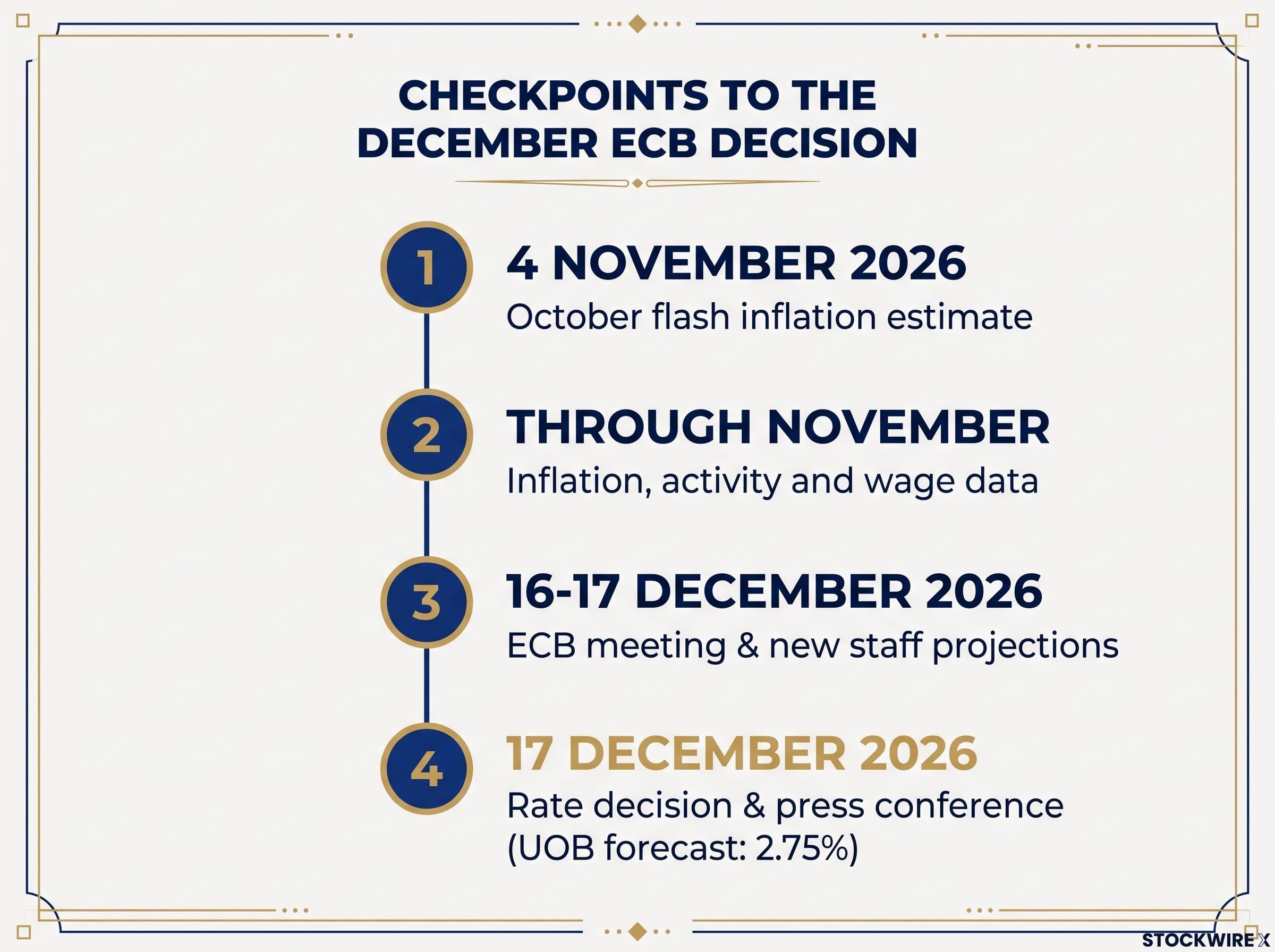
The debate becomes manageable once you pin it to dates. Four checkpoints stand between now and the decision:
- 4 November 2026: euro-area flash inflation estimate for October.
- Through November: further inflation, activity and wage data.
- 16-17 December 2026: ECB meeting, with new staff projections.
- 17 December 2026: rate decision and press conference.
The exact release timing of the December projections has not been confirmed.
The December projection round is the definitive checkpoint, because a second consecutive upward revision to the ECB’s inflation forecasts would signal that the temporary energy-shock thesis is under material strain.
| Indicator | Latest figure | Source/date | Why it matters |
|---|---|---|---|
| Headline HICP | 3.8% y/y (September) | Eurostat, 16 October 2026 | Sets the headline pressure |
| Core HICP | 2.5% (September) | ECB, 17 October 2026 | Shows whether energy is broadening |
| Compensation per employee | 3.3% y/y (Q2), from 3.6% in Q1 | ECB, 29 October 2026 | Key test for second-round effects |
| ECB wage tracker | 2.5%-2.8% rest of 2026; 2.6% early 2027 | ECB, 29 October 2026 | Points to gradual wage easing |
| Q3 GDP (flash) | +0.4% q/q; France -0.1% | Eurostat, 30 October 2026; Bloomberg | Gauges room to tighten |
A hike becomes more likely if core and services inflation broaden, wages re-accelerate and activity stays resilient. It becomes less likely if activity slumps or energy prices fall. UOB’s own condition is explicit: absent a significant drop in energy prices or a sharp activity slump, risks favour one last hike before a lengthy pause.
The ECB Survey of Professional Forecasters (SPF), published on 30 October, shows how professionals see the path:
| Measure | 2026 | 2027 | 2028 |
|---|---|---|---|
| Headline HICP | 3.0% | 2.6% | 2.0% |
| Core HICP | 2.4% | 2.5% | 2.2% |
| GDP growth | 1.0% | 1.3% | 1.3% |
For your monitoring, core inflation and wages matter more than the headline number. Lagarde has named second-round effects as the main risk, and none are yet visible. A wage surprise in November would shift the odds faster than another energy-driven headline print.
What would a 2.75% deposit rate and a long pause mean for investors?
UOB’s central scenario is a 25 basis point hike on 17 December to 2.75%, followed by an extended pause. That is one forecast, not a guarantee, and the arguments cut both ways.
The case for and against
Against a December hike:
- Activity is slowing, and France contracted 0.1% in Q3.
- The energy effect could reverse and lower headline inflation without further tightening.
- No wage-price spiral is visible, with compensation growth easing.
Against a prolonged pause:
- Headline inflation of 3.8% risks unsettling expectations.
- Core inflation sits above the 2% target, with the SPF seeing 2.5% in 2027.
- A final hike could reinforce the ECB’s credibility while growth is weak but not collapsing.
Precedent suggests that a final hike is usually followed by a stretch of restrictive policy until inflation clearly returns towards target, rather than a quick cut. Past performance does not guarantee future results, and financial projections are subject to market conditions and various risk factors.
Who feels it, and how
| Group | Likely implication |
|---|---|
| Savers | Deposit returns stay far better than in the negative-rate era, and a long pause makes income predictable. |
| Bond investors | A final hike may pressure short and medium duration first; a pause improves carry. French bonds carry more fiscal and political risk than Bunds. |
| Equity investors | Property, utilities and leveraged firms face valuation pressure; banks may gain from margins; exporters and defensives may prove resilient. |
| Mortgage borrowers | Variable-rate and refinancing borrowers face higher costs; fixed-rate borrowers are mainly affected on refinancing. |
No recent Goldman Sachs or Commerzbank December forecasts have been identified to test UOB’s view against.
Whether you save or borrow, a pause at 2.75% offers income and payment certainty, but not a quick return to the low rates of earlier years. Plan around a plateau.
Investors exploring how a pause pairs with ongoing QT should read our deep-dive into ECB monetary policy tools, which explains why a hold with run-off remains restrictive for the euro.
A conditional hike, a plateau to plan for: how to read the next six weeks
The weight of evidence points to October as a hawkish pause, with a December hike conditional rather than guaranteed.
UOB’s 2.75% terminal forecast fits the inflation risks and the roughly two-in-three market probability. The main counterweight is that higher bond yields may already be tightening conditions enough to make a further move unnecessary.
Your checkpoints are clear: the 4 November flash inflation estimate, November wage and activity data, then the 17 December decision. Core inflation and wages will tell you which way it breaks.
This article is for informational purposes only and should not be considered financial advice. Investors should conduct their own research and consult with financial professionals before making investment decisions.
—