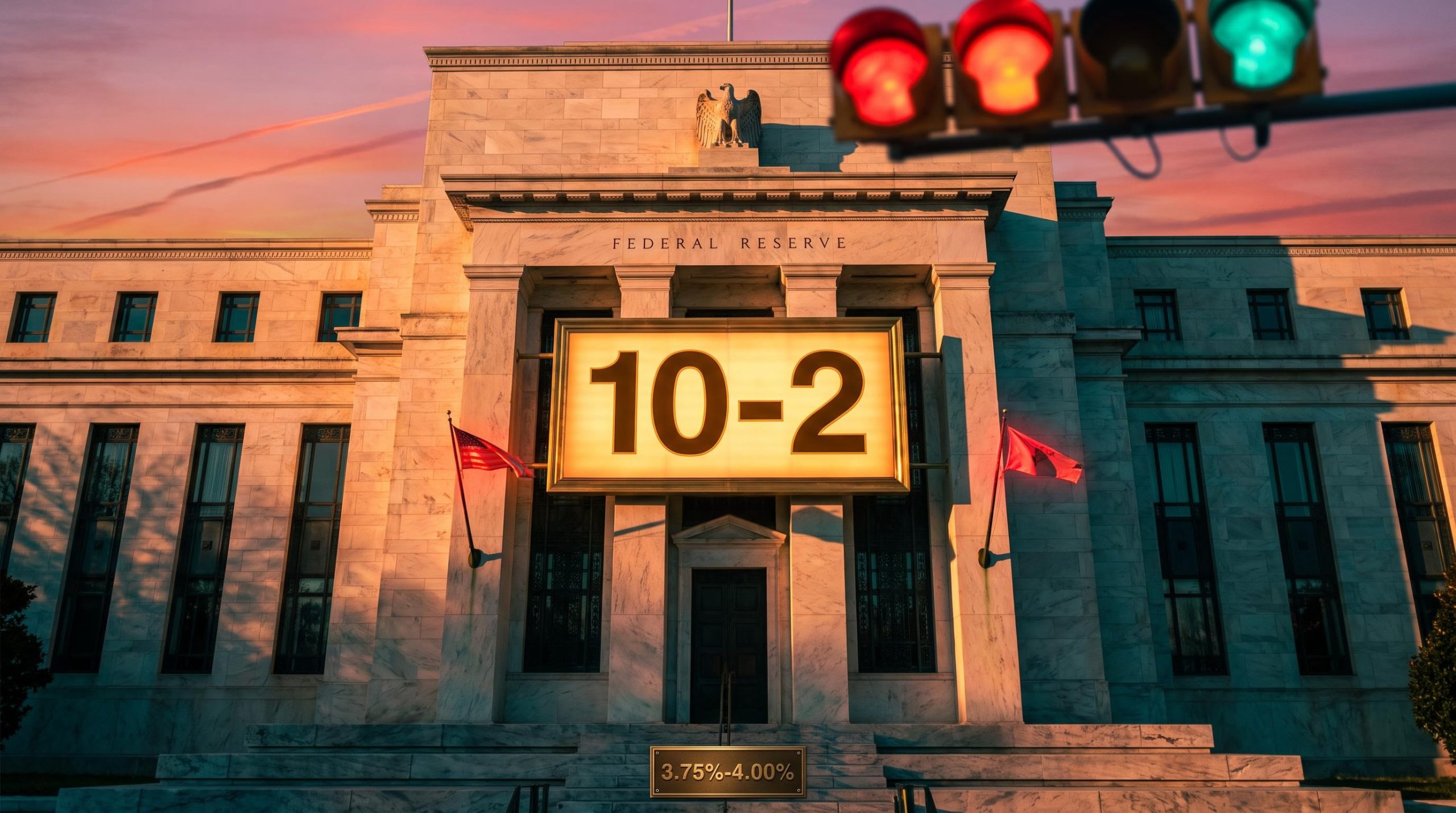
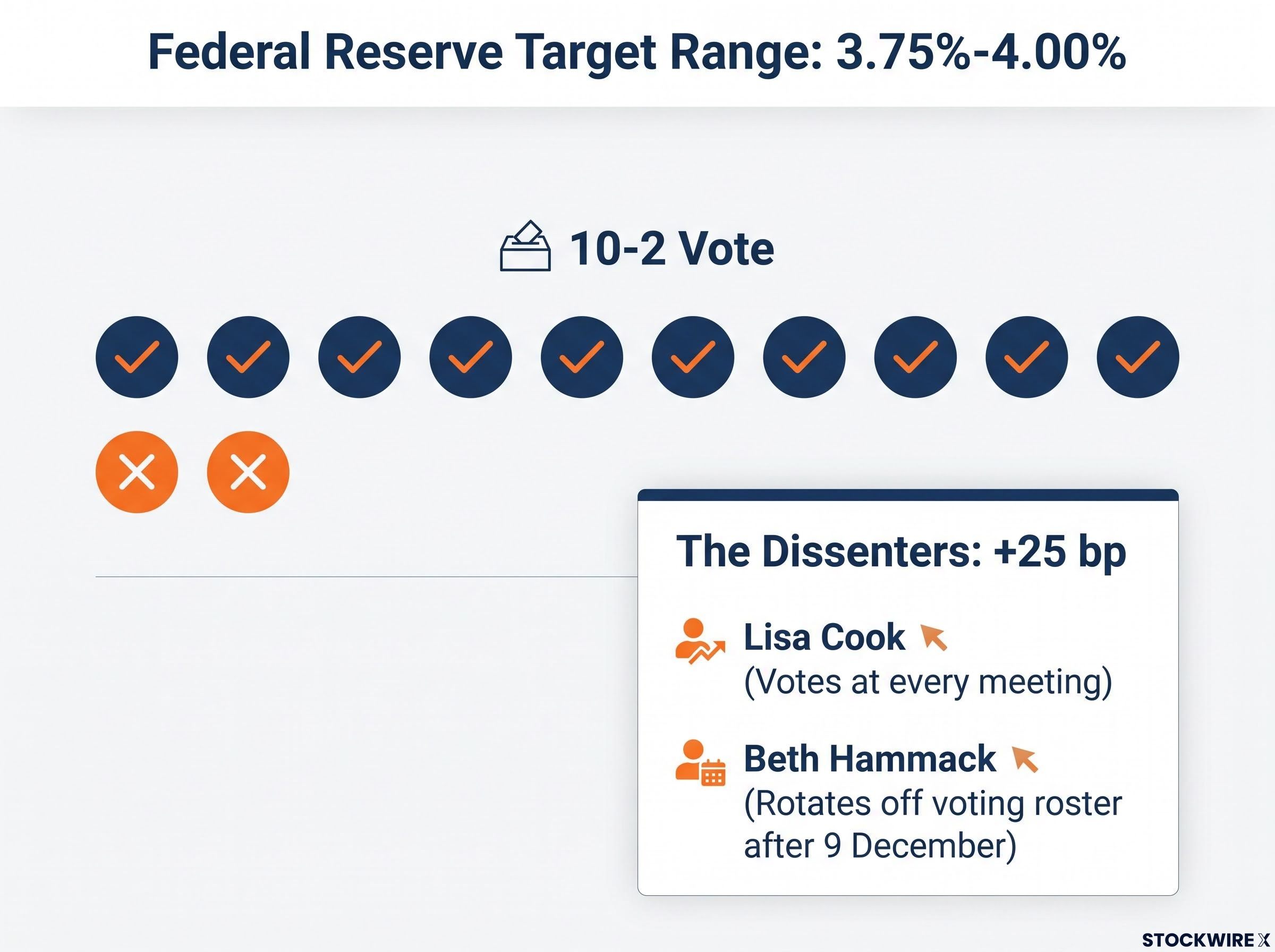
The Federal Reserve held its benchmark rate at 3.75%-4.00% on Wednesday, but the 10-2 vote carried a warning. Governor Lisa Cook and Cleveland Fed President Beth Hammack both dissented in favour of a 25 basis point hike, keeping a hike alive at the Fed December rate decision.
The next meeting runs 8-9 December 2026. Between now and then, the bond market, the borrowing behind the AI build-out and a possible Anthropic listing may shape the outcome as much as the next jobs report.
That matters for anyone holding bonds, rate-sensitive stocks or AI exposure. If credit tightens on its own, the Fed may have less work to do. If it does not, a hike looks increasingly likely.
Here is what the dissents, the data and the credit market stress points tell you about where the Fed goes next.
What the 10-2 split and Warsh’s press conference actually signalled
The dissents
The decision: Federal funds target range held at 3.75%-4.00%, vote 10-2, both dissenters seeking +25 bp
Hammack’s dissent was expected. Cook’s was not. Danielle DiMartino Booth of QI Research had anticipated three regional dissents, from Hammack, Dallas Fed President Lorie Logan and Minneapolis Fed President Neel Kashkari, and she read Cook’s vote as a surprise given her dovish academic record.
The difference matters because of who gets to keep voting. Hammack, Logan and Kashkari rotate off the voting roster after 9 December. Cook, as a governor, votes at every meeting.
The Board itself now contains a voice for tightening. That means a December hold would need a clear justification rather than being the default.
Warsh’s communication style
The statement upgraded economic activity from “solid” to “strong” and said inflation “remains elevated.” Chair Kevin Warsh then declined to offer conventional forward guidance, saying he generally opposes it outside of crises.
He also would not describe financial conditions as tight. DiMartino Booth argued that credit markets had already done some tightening on the Fed’s behalf, and that admitting so would have implied no December hike.
The market’s read was split:
- Hawkish: CNBC and Schwab described a divided, inflation-focused Fed, and Business Insider reported December hike odds of around 82% (a figure not independently confirmed).
- Patient: The statement’s language about “accumulating more information” leaves room for a hike, a hold or later easing.
- Credit-sensitive: Spreads may already be doing part of the tightening.
The hold was not a pause. It preserved an option.
The Fed rate hike outlook was already split before the meeting, with 16 of 18 officials penciling in another increase this year while futures traders leaned towards an October pause, and the 10-2 vote now shows that gap reaching inside the committee.
When big ASX news breaks, our subscribers know first
Weak hiring, softer inflation breadth: the case against a hike
The inflation numbers support the hawks. August personal consumption expenditures (PCE) inflation ran at 3.4% year on year, according to Schwab. PCE is the Fed’s preferred inflation gauge. CNBC reported September expectations of 3.7% headline and about 3.1% core.
Then the labour market data cuts the other way. September payrolls rose just 29,000, according to the Bureau of Labor Statistics (BLS), with unemployment at 4.2%.
At Jackson Hole, Warsh pointed to inflation breadth: the share of price inputs rising 3% or more, with anything above 50% signalling inflation that is spreading.
Breadth check: Bloomberg’s Anna Wong estimates breadth at 38% on a six-month moving average, below the 50% warning line
Even low jobless claims are disputed. Franklin Templeton reads them as weak hiring rather than mass layoffs. DiMartino Booth argues that only about 1 in 4 unemployed Americans collect benefits, so claims understate the weakness.
| Indicator | Latest reading | Supports |
|---|---|---|
| August PCE (y/y) | 3.4% | Hike |
| September payrolls | +29,000 | Hold |
| Three-month payroll average | About 51,000 (unverified) | Hold |
| Hourly earnings (y/y) | 3%, slowest since May 2021 (unverified) | Hold |
| Initial claims, week to 17 October | 194,000 | Contested |
| Inflation breadth | 38% | Hold |
If breadth is falling and hiring is this thin, a hike is a bet that inflation is stickier than the Fed’s own breadth gauge suggests. Weigh that when you see December hike odds quoted.
Could AI debt and an Anthropic IPO tighten credit before the Fed does?
The supply pipeline
Anthropic filed its Form S-1 on 26 October. An S-1 is the registration document a company files with US regulators before selling shares to the public. Anthropic has proposed a Nasdaq listing under ANT, and the Wall Street Journal reportedly said it is targeting the week of 16 November. The filing describes about $417 billion of future compute obligations, according to CNBC, while the size, share count and price remain undisclosed.
DiMartino Booth has referred to a roughly $100 billion deal. That figure is her estimate, not a disclosed number.
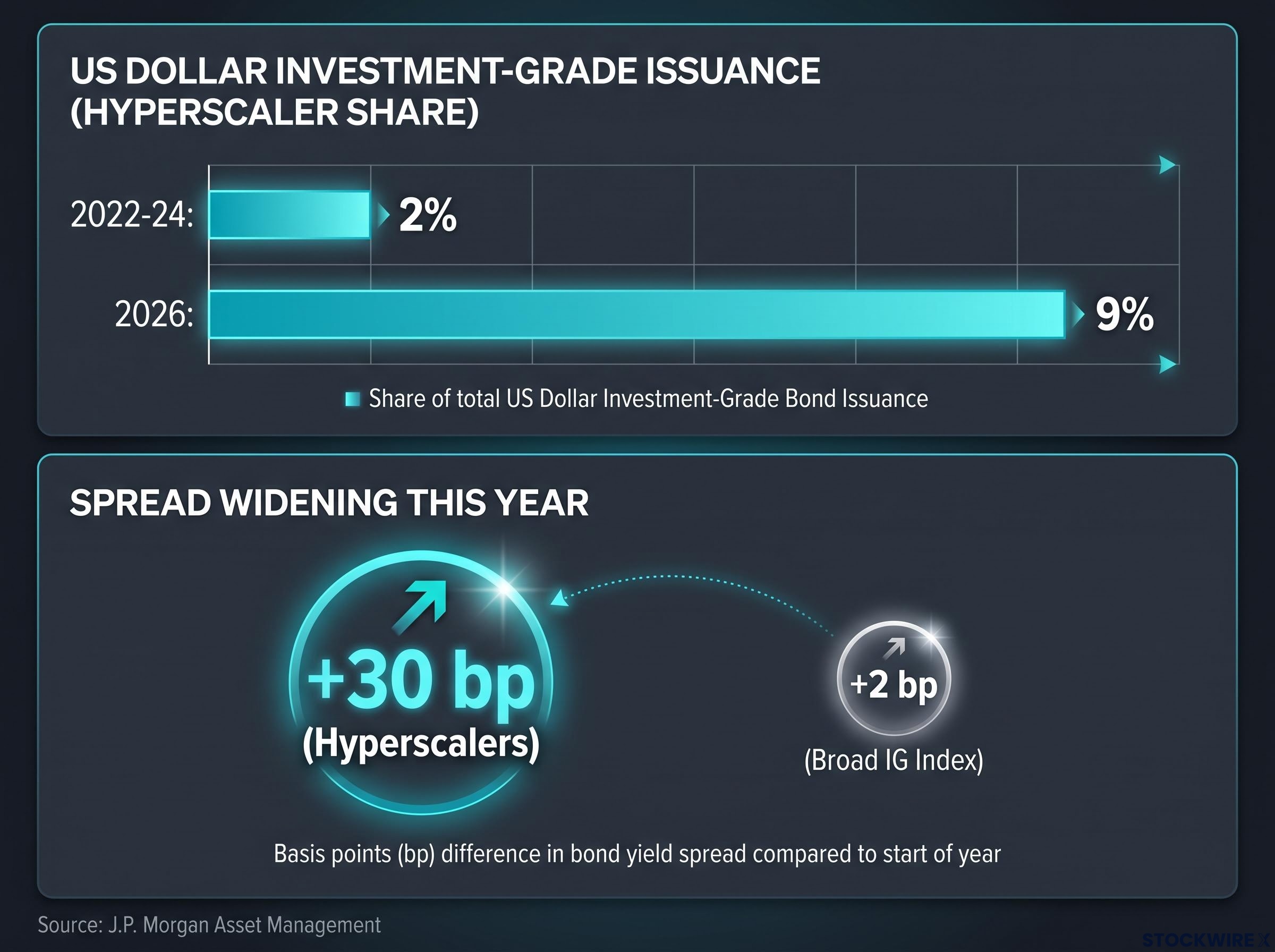
The bond side is larger. J.P. Morgan Asset Management counts about $219 billion of hyperscaler investment-grade issuance so far this year, with about $300 billion more expected. Investment-grade bonds are debt rated as relatively low-risk, and hyperscalers are the giant cloud-computing companies. These firms account for an estimated 9% of US dollar investment-grade issuance in 2026, up from about 2% in 2022-24. Vanguard puts the hyperscaler figure at $132 billion, a gap that reflects different definitions of what counts.
Spread gap: Hyperscaler spreads have widened about 30 bp this year, versus about 2 bp for the broad investment-grade index (J.P. Morgan)
A spread is the extra yield investors demand over government bonds, so widening means borrowing has become costlier.
AI bond market issuance is already distorting investment-grade pricing, with some double-A rated hyperscaler bonds trading at triple-B-equivalent spreads because of supply pressure rather than any change in default risk.
How supply reaches the Fed
- Yields and spreads: Heavy issuance can lift borrowing costs without a rate change.
- Crowding out: A large IPO alongside bond deals could absorb investors’ appetite for risk.
- Refinancing risk: Wider spreads raise debt costs on long-dated AI projects.
- Year-end liquidity: Big supply meeting thinner dealer balance sheets could cause sudden spread jumps.
Some claims need caution. The IMF’s 13 October Global Financial Stability Report warned that weaker AI investment could trigger a correction in AI-related assets. However, framing AI as an inflationary demand shock remains unverified. DiMartino Booth’s claim that AI plus defence spending accounts for over 100% of GDP growth is not supported by later research.
Wider spreads act like a rate hike you did not vote for. Watching credit and the issuance calendar tells you whether the Fed’s December job is getting easier or harder.
Hike, hold or cut: what a 2018-style pivot would need
| Option | Case for | Counterargument |
|---|---|---|
| Hike | PCE above 3%, two dissents, high reported odds | Payrolls only +29,000 |
| Hold | Observe delayed effects of the September increase and wider spreads | Dissents make a hold look loose |
| Cut | Credit event, disorderly liquidity or AI correction | None evident as of 29 October |
DiMartino Booth’s thesis leans on 2018. That year the junk bond market shut for about 40 days, stocks fell sharply on Christmas Eve, and Powell pivoted on 4 January 2019. The comparison is useful, but the two periods are not the same:
- Similar: Credit tightening can do the work of rate hikes.
- Different: The stress is concentrated in AI infrastructure, and hyperscaler balance sheets are stronger.
- Different: Spreads are widening, but markets have not shut.
- Different: Hiring is weak, but there are no mass layoffs.
Goldman Sachs’ Jan Hatzius reportedly still expects a final December hike (unverified). Warsh’s new schedule, with one 2027 strategy meeting with no rate vote and two in 2028, will leave fewer meetings at which rates can change. That raises the stakes of each decision.
A pivot needs credit to break, not just wobble. Treat a hike as the base case until spreads, issuance or hiring data say otherwise.
What the hold settles, and what November data must answer
The October hold kept the Fed’s options open. A December hike remains the most likely outcome, but credit and liquidity conditions could still change that.
Strategists have argued that investors who want to shorten bond duration into T-bills and tilt equities towards quality large caps reduce exposure to a hike shock, a posture that remains relevant while December stays live.
Three things to watch before 8-9 December:
- Anthropic’s pricing and demand in the week of 16 November
- Hyperscaler spreads and issuance volumes
- The next payrolls and inflation breadth readings
The 3 November midterms add a political variable that could sharpen scrutiny of AI spending.
Past performance does not guarantee future results. Financial projections are subject to market conditions and various risk factors. Forward-looking statements are speculative and subject to change based on market developments.
This article is for informational purposes only and should not be considered financial advice. Investors should conduct their own research and consult with financial professionals before making investment decisions.