
TegenEOS and PRP deliver positive tendon repair data in preclinical study
Tetratherix Limited (ASX:TTX) has completed its ten-week preclinical validation study of TegenEOS as a carrier for platelet-rich plasma (PRP) in tendon repair. At six weeks, injuries treated with TegenEOS + PRP showed organised new blood vessels, less inflammation and less scar-like tissue than injuries treated with PRP alone.
The results extend TegenEOS beyond bone graft delivery to the delivery of biologics such as PRP for soft tissue repair. More than 30 million tendon and ligament injuries occur worldwide each year, and the global PRP market was estimated at more than US$700 million in 2026.
The study opens a second application for the same product, which management says is a conversation it can now take to orthopaedic partners with data in hand.
When big ASX news breaks, our subscribers know first
The PRP delivery problem TegenEOS targets
Why PRP disperses and why it matters
Tendons heal slowly and often poorly because they have little blood supply and few cells. The tissue that forms is largely scar, which is weaker than the tendon it replaces.
PRP is a concentrate of a patient’s own platelets, prepared by spinning a small blood sample in a centrifuge. Platelets carry growth factors that signal the body to grow new blood vessels, bring in repair cells and rebuild tissue.
The weakness is delivery. Injected PRP is a liquid and disperses from the injury site within hours, long before healing is under way.
How TegenEOS works
TegenEOS is the company’s bone graft carrier, formulated from its proprietary Tetramatrix™ platform technology. In this study it was used under development code TP280 as a carrier for PRP.
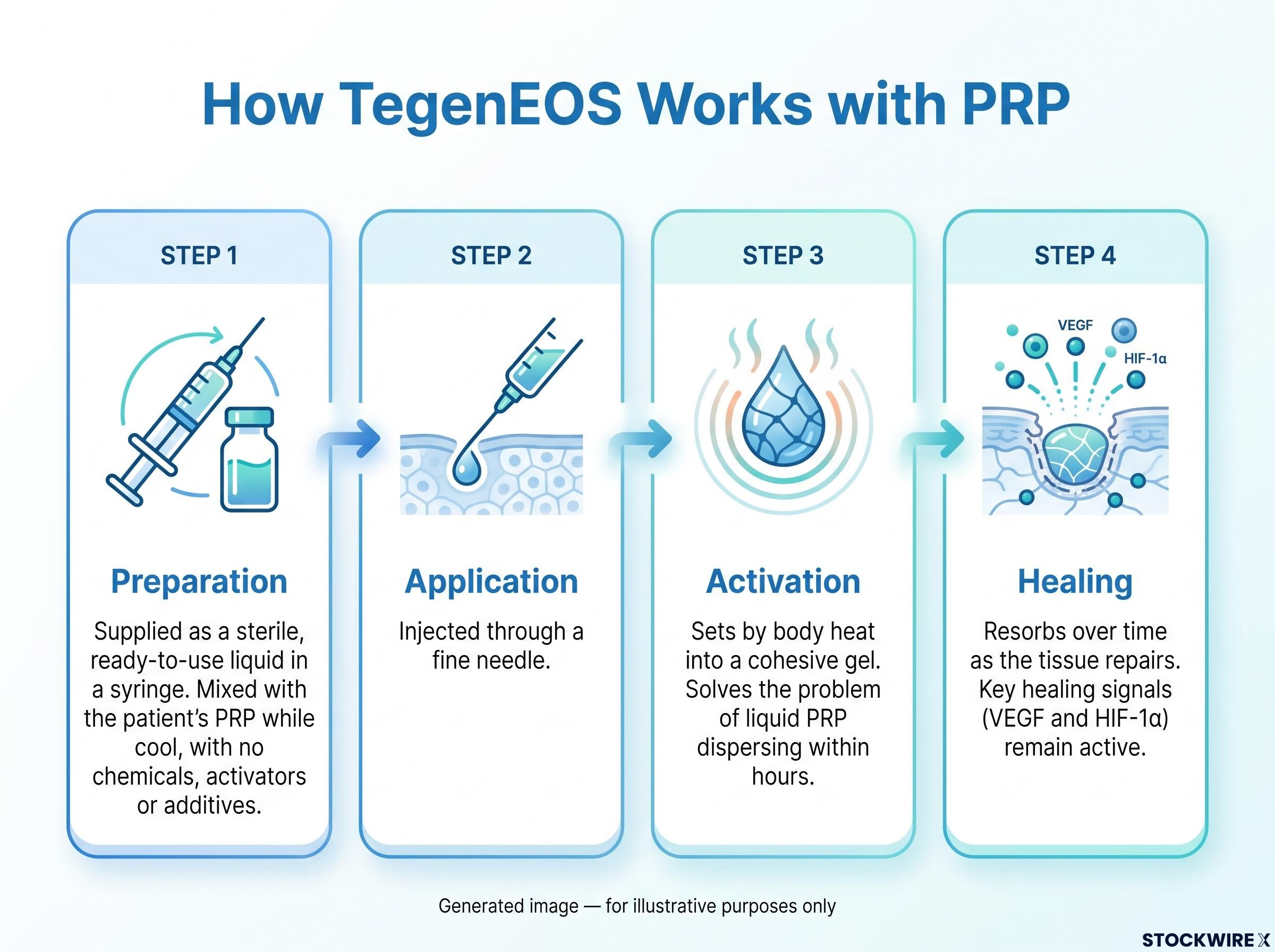
- Supplied as a sterile, ready-to-use liquid in a syringe
- Mixed with the patient’s PRP while cool, with no chemicals, activators or additives
- Injected through a fine needle, then set by the patient’s own body heat into a cohesive gel
- Resorbs over time as the tissue repairs
In laboratory testing, the gel released the PRP’s proteins over a longer period than PRP alone, while key healing signals (VEGF and HIF-1α) remained active after mixing.
What the study found
The study ran in two stages. In the laboratory, TTX confirmed that TegenEOS mixes evenly with PRP, stays injectable through a fine needle and sets at body temperature.
In the animal stage, a defect was created in the patellar tendon, below the kneecap, an injury that does not heal on its own in this model. Animals were treated in four groups (untreated, TegenEOS alone, PRP alone, and TegenEOS + PRP), included males and females, and were followed to six and ten weeks.
| Group | Six weeks | Ten weeks | Notes |
|---|---|---|---|
| Untreated | Defect still showed a gap | Traces of old bleeding | Confirms the injury does not heal on its own |
| PRP alone | Broad band of inflamed, scar-like tissue | n/a | n/a |
| TegenEOS + PRP | Repair crossed by organised new blood vessels, with less inflammation | Narrowest and most regularly aligned of the groups examined; blood vessels still present | Tissue was rebuilding rather than scarring |
On safety, no section containing TegenEOS, with or without PRP, showed the features of a foreign body reaction (giant cells, granuloma or a fibrous capsule) at either time point. Body weight and organ weights were comparable across all groups.
Dr Ali Fathi, Founder and CTO of TTX
“PRP has never had a biology problem. It has a delivery problem…”
The company said that in this preclinical model, keeping PRP at the injury made a difference, which supports further development of TegenEOS as a carrier for PRP.
Commercial opportunity and next steps for TTX
Consistent with its platform-to-product model, TegenEOS is intended for commercialisation through partnership. TTX generates the proof-of-concept and pilot data, while the partner owns regulatory approval, reimbursement and market planning.
The company outlined several advantages:
- Works with the patient’s own PRP, prepared exactly as it is today
- Requires no additional equipment or hospital infrastructure
- Sets by temperature alone, so nothing is added to the PRP
- Derived from a single platform chemistry already manufactured across TTX products, with biocompatibility testing already completed for the underlying technology to support its US FDA submissions
That shared chemistry is already generating revenue, with commercial Tetramatrix polymer shipments to the US now under way and manufacturing scaled from pilot to commercial-grade production.
Because TegenEOS is injected through a fine needle and sets with body heat alone, TegenEOS + PRP can be given in an outpatient clinic, without an operating theatre or additional equipment. This has the potential to lower the cost of treatment for patients and healthcare systems.
TegenEOS continues to progress toward its US FDA 510(k) approval as a bone graft carrier. Using it to deliver PRP is a different intended use and will require its own regulatory pathway.
What happens next for TegenEOS
The company outlined three next steps, with no dates given:
- An equine study is being prepared to confirm the results in a larger animal model.
- A dedicated PRP development plan will define the regulatory pathway for PRP use, with multiple catalysts in the near future.
- TegenEOS continues to progress toward US FDA 510(k) approval as a bone graft carrier.
The results are preclinical only, and the PRP application remains at the development planning stage.
Don’t Miss the Next Healthcare Breakout
Get FREE breaking ASX healthcare news delivered to your inbox within minutes of release, complete with in-depth analysis. Join 20,000+ investors already getting ahead of the market. Click the “Free Alerts” button at Big News Blast to receive alerts the moment market-moving news breaks.