WTI December futures settled at $102.78 a barrel on Wednesday, up $2.88, according to DTN, on a day when the Federal Reserve’s rate decision barely registered in crude. The settlement figure has not been independently confirmed, but the direction of the session is clear: WTI crude oil prices took their cues from Iran, the Strait of Hormuz and US inventories, not from Washington’s central bank.
That is a notable split. The Fed held rates on 28 October 2026 with two officials pushing for a hike, a hawkish signal that would normally weigh on oil demand expectations. Crude did not flinch.
The reason sits in the physical market. Traders are pricing blockades, tanker routes and barrels in storage rather than borrowing costs, and Thursday’s GDP print plus the reaction to Fed Chair Warsh’s remarks are still to filter through.
Here is what drove the price today, what could move it before and after the 3 November midterms, and which dated events deserve your attention next.
Why did oil shrug off a Fed hold while Iran headlines moved the market?
How the session unfolded
Trading began Wednesday slightly below $100, and WTI rose through most of the day as intraday momentum recovered from close to oversold territory, according to FXStreet’s chart read. Near-oversold means prices had fallen fast enough that sellers looked exhausted. One of the largest advances came straight after the weekly inventory data.
Just ahead of the Fed announcement, one five-minute candle wiped out over half of that gain from the data release. DTN put the intraday high at $103.55, FXStreet had WTI trading near $102 after the decision, and no verified session low was published.
The Fed itself held its target range at 3.75%-4.00% in a 10-2 vote, with Governors Lisa Cook and Beth Hammack dissenting in favour of a 25 basis point hike. The statement said “inflation remains elevated” and upgraded economic activity to “strong”. FXStreet judged the hold largely priced in. Warsh’s press conference at 18:30 GMT was his first public comment since the quiet period began on 17 October.
The Federal Reserve statement confirmed the 10-2 vote to hold the target range at 3.75%-4.00%, with Governors Lisa Cook and Beth Hammack dissenting in favour of a 25 basis point increase.
The lesson for you: a rate decision that matches expectations carries little new information for oil, so watching Fed days alone is a poor way to read crude right now.
What the EIA data said
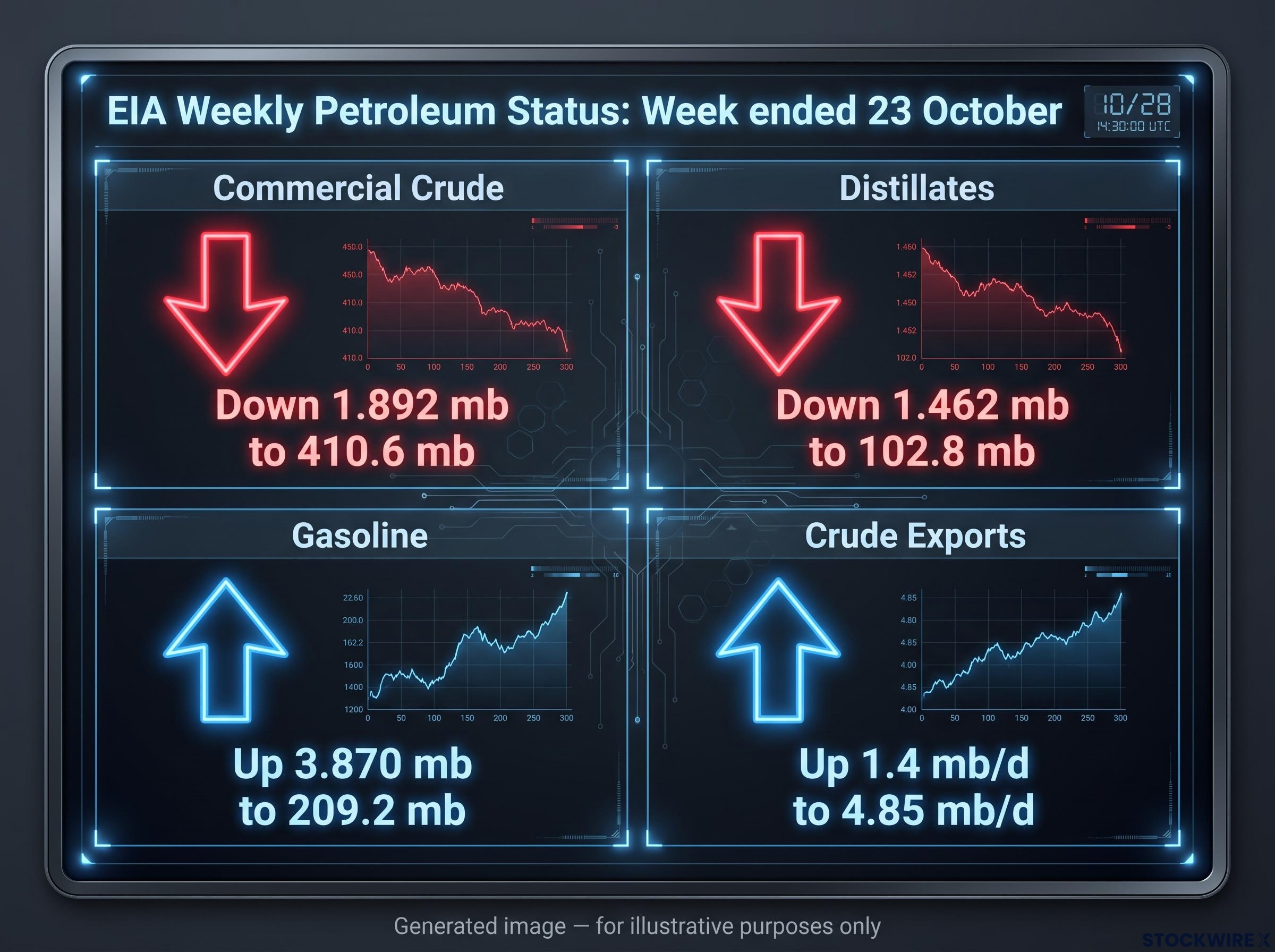
The Energy Information Administration (EIA) report for the week ended 23 October did the heavier lifting.
| Item | Result | Market read |
|---|---|---|
| Commercial crude | Down 1.892 mb to 410.6 mb | Supportive |
| Distillates | Down 1.462 mb to 102.8 mb | Supportive |
| Gasoline | Up 3.870 mb to 209.2 mb (about 0.9 mb expected) | Restraining |
| Refinery utilisation | 92.8% | Restraining |
| Crude exports | Up 1.4 mb/d to 4.85 mb/d | Supportive |
| Gasoline demand | Down 622,000 b/d to 8.358 mb/d | Restraining |
Crude and distillate draws backed the rally, but a gasoline build more than four times the Reuters poll estimate capped how far bulls could push. The net read was mixed, which helps explain the retrace.
Iran talks and the post-midterm risk: two paths for crude
The bigger driver sat outside the data. Qatar delivered a draft proposal to Tehran on 25 October aimed at ending the US-Israeli war with Iran, and an official briefed on the talks said it includes a seven-day timetable of confidence-building measures, with several countries possibly acting as guarantors.
The sticking points are basic. Washington wants Iran’s nuclear programme on the table from the start; Tehran wants the US naval blockade of its ports and oil sanctions lifted first. A response from Iran is due ahead of the weekend, though the exact day has not been announced.
The signals conflict. One official told Reuters that Tehran is reviewing the draft, while a senior Iranian official dismissed it outright.
“unacceptable ideas and not an offer” Senior Iranian official, on Qatar’s proposal
No ceasefire or reopening of Hormuz had been confirmed by Wednesday. Meanwhile the Wall Street Journal reported that Washington told Gulf states to prepare for a possible “short, intense military campaign” after the midterms, though President Trump has made no final decision.
Hormuz commercial transits have run at a small fraction of the pre-war norm of 120-140 vessels per day, and war-risk insurance premiums near 30 times normal rates mean a diplomatic declaration alone cannot restore flows.
| Scenario | Trigger | Likely effect on supply | Likely effect on WTI |
|---|---|---|---|
| Relief | Partial deal accepted | Blockade eases, tankers move, some exports return | Downward pressure as risk premium fades |
| Escalation | Deal fails, post-midterm campaign | Gulf flows tighten further | Upward pressure as buyers turn to US barrels |
The stakes are large. Before the war, roughly one-fifth of global oil trade passed through Hormuz, and the International Energy Agency (IEA) reported August flows of 7.6 mb/d, 13.1 mb/d below prewar levels (unverified). Crux Investor put Brent’s premium over WTI at about $14.12 a barrel (unverified), a sign the international benchmark carries more of the Hormuz risk.
For you, the practical point is that headlines over the next several days may move prices more than any economic release, and any one-sided read of these talks is unreliable.
A tight supply backdrop and the catalysts still ahead
What the supply numbers say
The World Bank’s outlook, released Wednesday (unverified), forecasts 2026 oil supply falling 5.2%, about 5.5 mb/d, the largest drop in more than four decades outside 2020. Brent averaged $69 in 2025.
| Year | Average Brent (World Bank forecast) |
|---|---|
| 2026 | $91 |
| 2027 | $79 |
| 2028 | $70 |
One secondary report rounded the 2026 figure to $92; the World Bank’s own release says $91. Relief routes are slow: ADNOC told customers its Hormuz-bypassing pipeline starts in early 2027, and its second Fujairah line is 50% complete. Bypass capacity does not replace full regional exports.
Counterweights exist. The IEA forecasts 2026 demand falling 1.6 mb/d and members made 400 million barrels of emergency reserves available (both unverified). No current OPEC+ spare capacity figure was found.
The latest OPEC+ production increase completed the unwinding of 1.65 million BPD in voluntary cuts, yet the gap between quota and physical barrels remains the variable that matters for supply.
What this means for you: physical shortage holds up the price floor through at least early 2027, while demand data and Fed signals mostly set the ceiling. Crude above $100 feeds through to pump, diesel and freight costs.
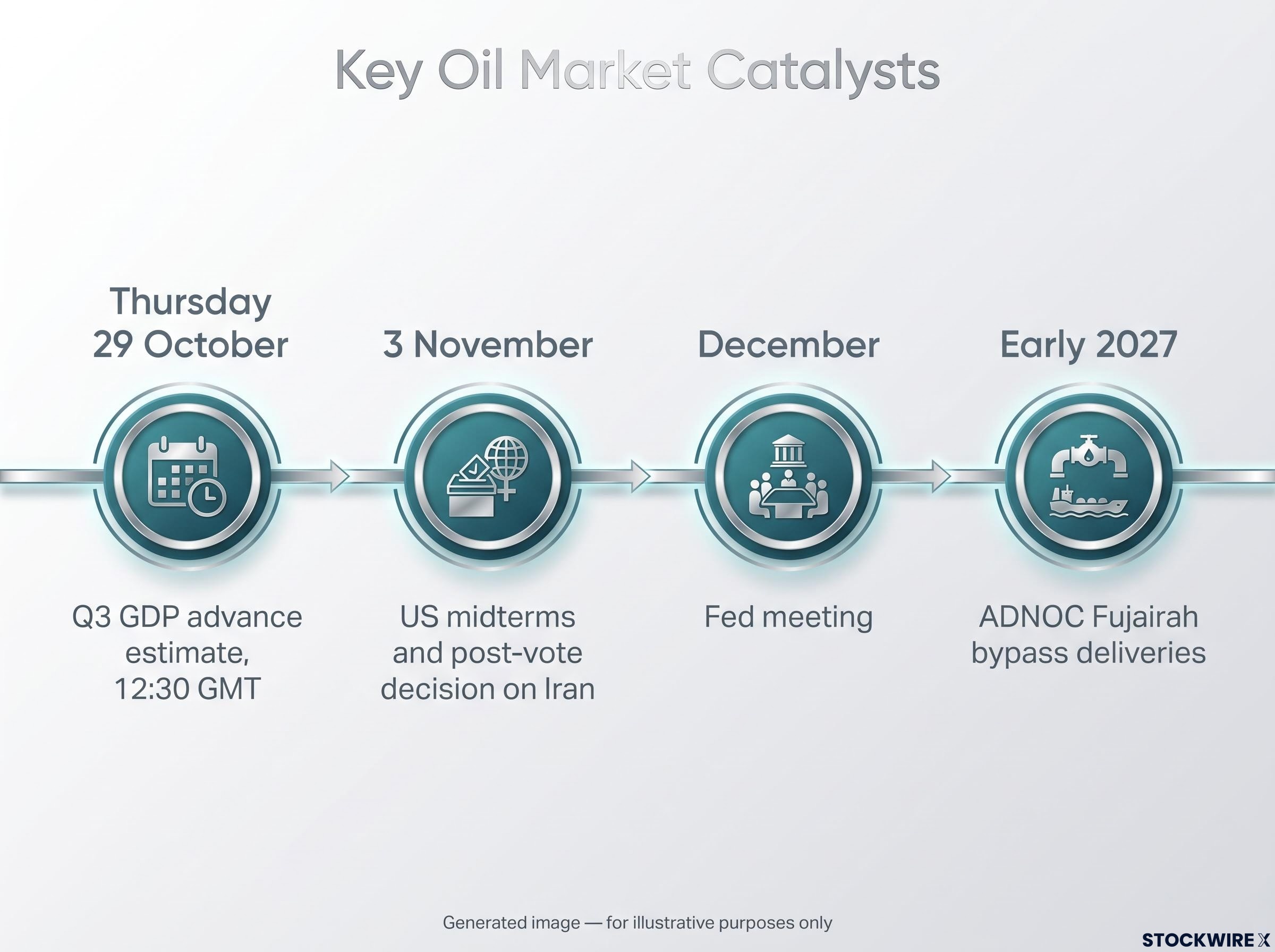
Catalysts to watch
- Thursday 29 October: Q3 GDP advance estimate, 12:30 GMT
- By the weekend: Iran’s reply to Qatar’s draft
- 3 November: US midterms and the post-vote decision on Iran
- December: Fed meeting, where hike odds hinge on whether Warsh links price pressure to energy
- Early 2027: ADNOC Fujairah bypass deliveries
A hike cannot fix a supply shock; it works only by weakening demand.
Past performance does not guarantee future results. Financial projections are subject to market conditions and various risk factors.
What Wednesday’s session settles, and what stays open
Wednesday confirmed the Fed hold as a footnote for crude. Iran’s reply, the post-midterm decision and the physical supply picture are setting direction. The market’s read of Warsh’s remarks, Thursday’s GDP figure and Tehran’s response are the next tests, though sources conflict and several figures above remain unverified.
The decision point is binary: a confirmed ceasefire with Hormuz reopening would pull the risk premium lower, while a renewed campaign would push it higher.
This article is for informational purposes only and should not be considered financial advice. Investors should conduct their own research and consult with financial professionals before making investment decisions.
—