The US dollar slid to just above 1.4000 Canadian dollars during Federal Reserve Chair Warsh’s press conference on Wednesday, erasing the range USD/CAD had held since the Bank of Canada raised rates by 25 basis points to 2.50% earlier in the day. The drop pulled the pair below a low set before the Canadian hike, complicating any near-term USD/CAD forecast.
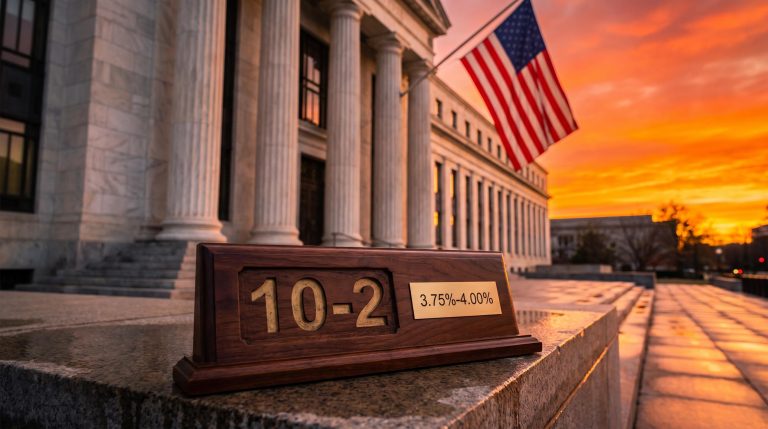
The Federal Reserve held its target range at 3.75%-4.00% in a 10-2 vote, with two members pushing for a hike. Despite that hawkish dissent, the dollar weakened. That tells you markets are trading the expected path of both central banks rather than the headline decisions.
Here is what the narrowing rate gap means for the pair, which data releases and dates are likely to decide the next move, and where major banks see USD/CAD heading into year-end.
What moved USD/CAD to 1.4000 after two central bank decisions?
The Bank of Canada’s hike produced little reaction. The overnight rate rose to 2.50%, with the Bank Rate at 2.75% and the deposit rate at 2.45%. Reuters reported the Canadian dollar firming only modestly to about C$1.4050 per US dollar, because markets had expected the move.
Governor Tiff Macklem kept his guidance deliberately measured.
Bank of Canada guidance “There could be a need to increase the policy rate further, but given uncertainties, we will proceed carefully,” said Tiff Macklem, Governor of the Bank of Canada.
The Fed then held, with a statement saying “Inflation remains elevated.” Through the early session, USD/CAD barely moved. According to intraday reporting from FXStreet, the session ran like this:
- Open: near 1.4050
- Peak: just under 1.4100, early in the session
- Session low: just above 1.4000, reached within four five-minute bars during Warsh’s remarks
The break came once Warsh began speaking. Questions centred on whether a December hike would widen the Fed’s rate lead over the Bank of Canada again. Warsh said nearly all colleagues think policy is starting to take effect and that incoming data will guide the stance.
Warsh has scrapped forward guidance entirely, which concentrates repricing risk into single speeches like Wednesday’s press conference and leaves incoming inflation data as the main driver of rate expectations.
That was enough. The pair fell below both its post-hike range and its pre-hike low, then stayed near the bottom.
A currency pair falling on a Fed hold with hawkish dissent shows traders reacting to signals about the path ahead, not the decision itself. For your purposes, central bank guidance deserves more attention than the headline rate.
How wide is the Fed-BoC rate gap, and why did the BoC hike while the Fed held?
The figure to hold onto is the gap. US rates now sit about 1.25-1.50 percentage points above Canada’s, or roughly 1.375 points using the Fed’s midpoint. Wednesday narrowed that gap, but only partly.
| Central bank | Policy rate | Latest decision | Stance | Key concern |
|---|---|---|---|---|
| Federal Reserve | 3.75%-4.00% | Hold, 10-2 vote | Waiting for more data | Elevated inflation against a stronger US economy |
| Bank of Canada | 2.50% | Hike of 25 bps | Insurance tightening, still below neutral | Energy prices spreading into broader inflation |
The two banks are responding to different risks. The Bank of Canada’s October Monetary Policy Report flagged higher gasoline and diesel prices feeding into transport and production costs. Reuters reported the bank raised its 2027 inflation forecast to 3.1%, up from 2.0% in July.
Canada’s rate remains below neutral, meaning the level at which policy neither stimulates nor restrains growth. The hike is insurance against an inflation shock, not an attempt to cool overheated demand. The Fed, facing stronger US activity, chose to wait for more information on its path back to its 2% inflation target across its eight meetings a year.
The hike targeted second-round risk rather than broad price damage, since core inflation stays below 2% even as energy-driven headline inflation runs well above it, with rising business and consumer expectations carrying the most weight.
Rate policy generally moves the dollar in predictable directions, though some tools are less reliable than others:
- Rate hikes tend to support the USD
- Rate cuts tend to weigh on it
- Quantitative easing (QE), where the Fed buys bonds, usually weakens it
- Quantitative tightening (QT), the reverse, usually supports it, though less reliably than rate moves
Lee Hardman at MUFG sees limited extra upside for the Canadian dollar because the hike was largely priced in. History adds caution: rate differentials work as a medium-term valuation and carry factor, and they broke down in 2008-09 and 2013-15, when oil and risk aversion took over.
A gap narrowing from a wide starting point still leaves US rates far higher. You should not treat the move to 1.4000 as a structural shift in Canadian dollar fortunes.
What could push USD/CAD next: the data, the December 9 decisions and strategist forecasts
This week’s data
The first tests arrive within days.
| Release | Consensus | Date and time |
|---|---|---|
| US Q3 GDP (advance) | 3.2% annualised (Continuum Economics 2.8%) | Thursday 29 October, 8:30 a.m. ET (12:30 GMT) |
| US September core PCE | +0.3% m/m | Thursday 29 October, 8:30 a.m. ET (12:30 GMT) |
| US September headline PCE | No authoritative consensus available | Thursday 29 October, 8:30 a.m. ET (12:30 GMT) |
| Canada August GDP | +0.2% m/m (RBC +0.1%) | Friday 30 October, 12:30 GMT |
Strong US figures would strengthen the case for a Fed hike. Soft Canadian growth would raise doubts about further Bank of Canada tightening.
December 9 and strategist views
Both central banks decide on 9 December. Markets price roughly 85%-86% odds of a 25 bp Fed hike, according to Reuters and Admiral Markets. No authoritative market odds for the Bank of Canada were available.
Fed rate hike odds have swung sharply in recent months, moving from near certainty to a coin flip within 48 hours in September, a volatility that explains why a 85%-86% December pricing remains conditional.
Strategists remain split:
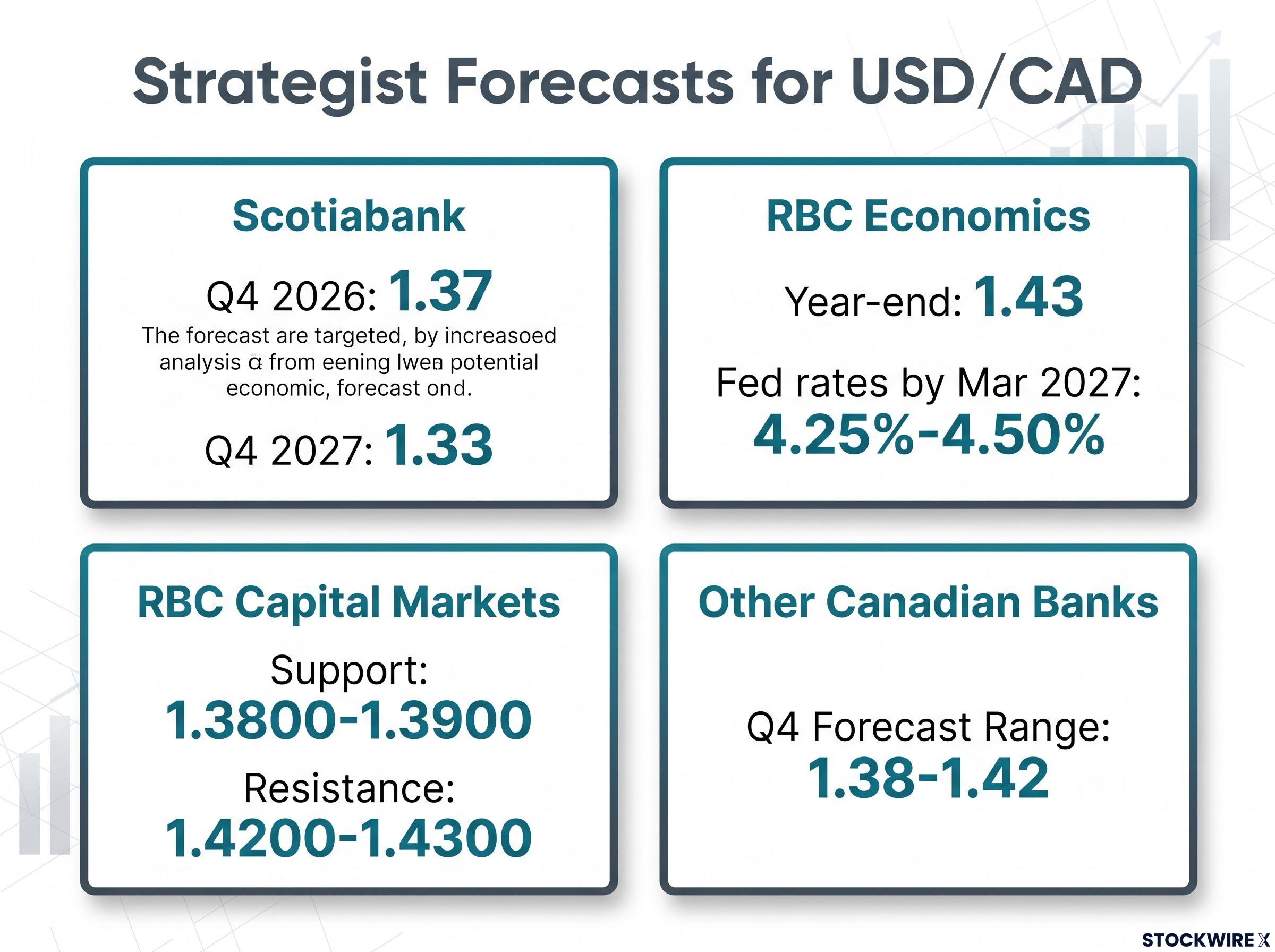
- Scotiabank: about 1.37 in Q4 2026 and 1.33 in Q4 2027, citing a weaker USD and further Canadian tightening
- RBC Economics: about 1.43 at year-end, expecting Fed hikes in December and March 2027 to 4.25%-4.50%
- RBC Capital Markets: support at 1.3800-1.3900, resistance at 1.4200-1.4300
- Other Canadian banks: Q4 forecasts of about 1.38-1.42
The risks cut both ways: a December Fed hike, oil swings, tariffs, weak Canadian growth and indebted Canadian households that may feel tightening more sharply. Forecasts spanning 1.37 to 1.43 for the same quarter show no consensus, so treat any single projection as conditional on the Fed’s December call. These projections are speculative and subject to change as market conditions evolve.
What the move to 1.4000 settles, and what December 9 will decide
The dip to 1.4000 reflects a rate gap that has narrowed only partly and a Fed that has not softened. It does not confirm a lasting Canadian dollar trend.
Thursday’s US GDP and PCE data and Friday’s Canadian GDP figure are the near-term tests, with the joint 9 December decisions as the real decision point. Watch for Fed signalling on a hike, whether the Bank of Canada follows through, the direction of oil and the resilience of Canadian growth.
This article is for informational purposes only and should not be considered financial advice. Investors should conduct their own research and consult with financial professionals before making investment decisions. Past performance does not guarantee future results. Financial projections are subject to market conditions and various risk factors.