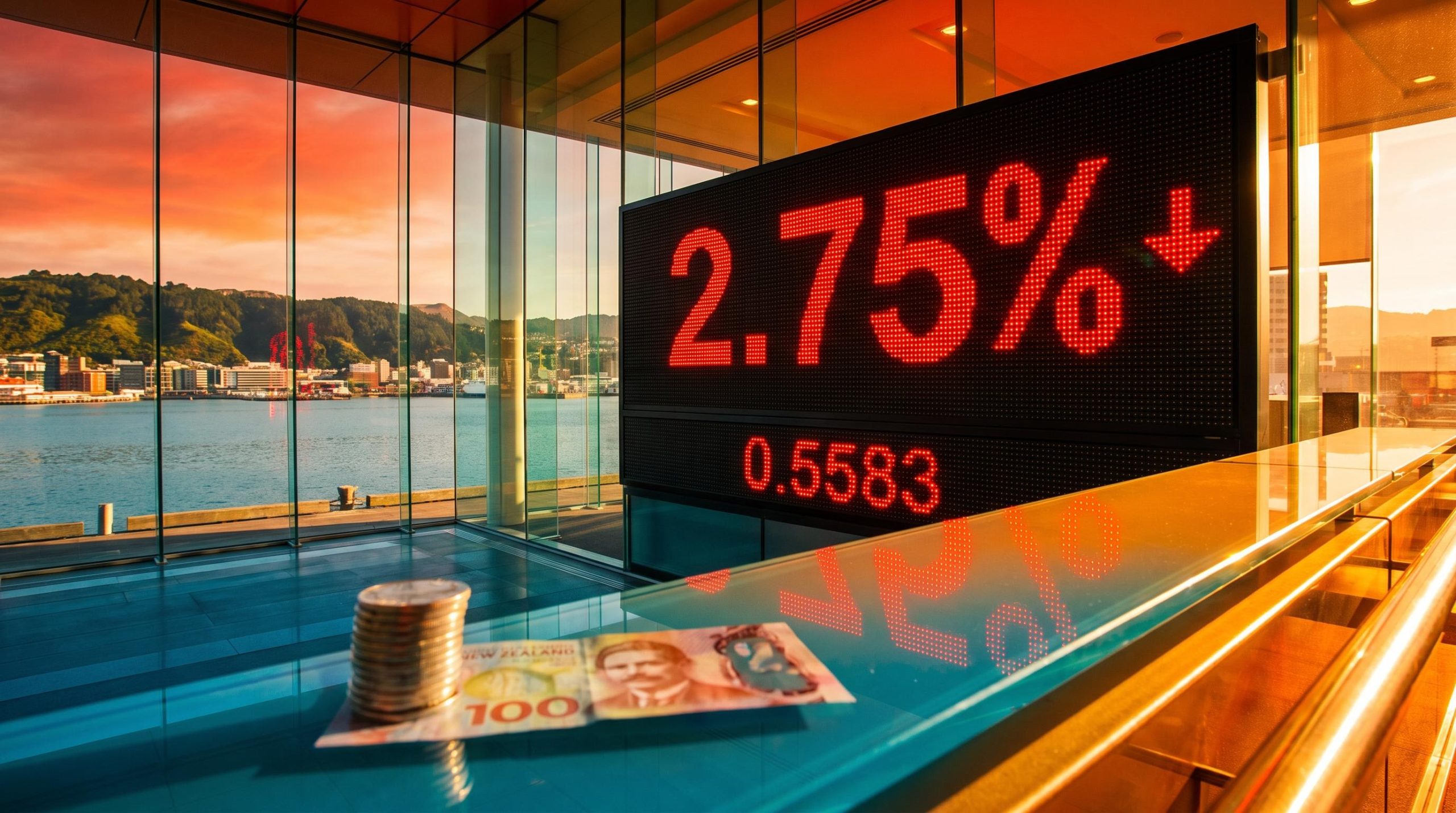
The Reserve Bank of New Zealand held the Official Cash Rate at 2.75% on Wednesday 28 October 2026, defying markets that had priced roughly a 90% chance of a hike. The New Zealand dollar fell from about 0.5678 against the US dollar to almost 0.5583 within the session.
The vote was split 4-3, with three members pushing for 3.00%. The bank still said tighter policy would probably be needed.
That leaves a hold that sounds hawkish, and a currency that sold off anyway.
This RBNZ rate decision shows how close the committee came to hiking, and what that means for the path of rates. It also shows why a surprise against heavy pricing can outweigh hawkish guidance in the currency.
Why did the NZD fall when the RBNZ still sounds hawkish?
The numbers explain the reaction. According to BusinessDesk, markets had assigned about a 90% probability to a 25 basis point hike before the announcement. A basis point is one hundredth of a percentage point, so 25bp equals 0.25%.
Every major domestic forecaster sat on the same side of the trade. ANZ, ASB, BNZ, Westpac and Kiwibank all expected a move to 3.00%, and ASB had pencilled in hikes in October, December and February to reach 3.50%.
When the hike failed to arrive, NZD/USD dropped about 1.6%-1.7% before the decline proved temporary. Traders were stripping out near-term policy premium, meaning the extra currency value built on the expectation of higher rates arriving soon.
Rate surprises are only one of the forces that move the Kiwi; Chinese activity data, dairy auction results and global risk sentiment can each override a central bank signal on a given day.
The bigger picture held steady. Markets still price about four 25bp hikes by September 2027, which reads as a delay rather than a smaller cycle.
When positioning is this crowded, the direction of a surprise can matter more for your currency exposure than the tone of the guidance attached to it.
A pattern of RBNZ surprises
The Kiwi has followed this script before.
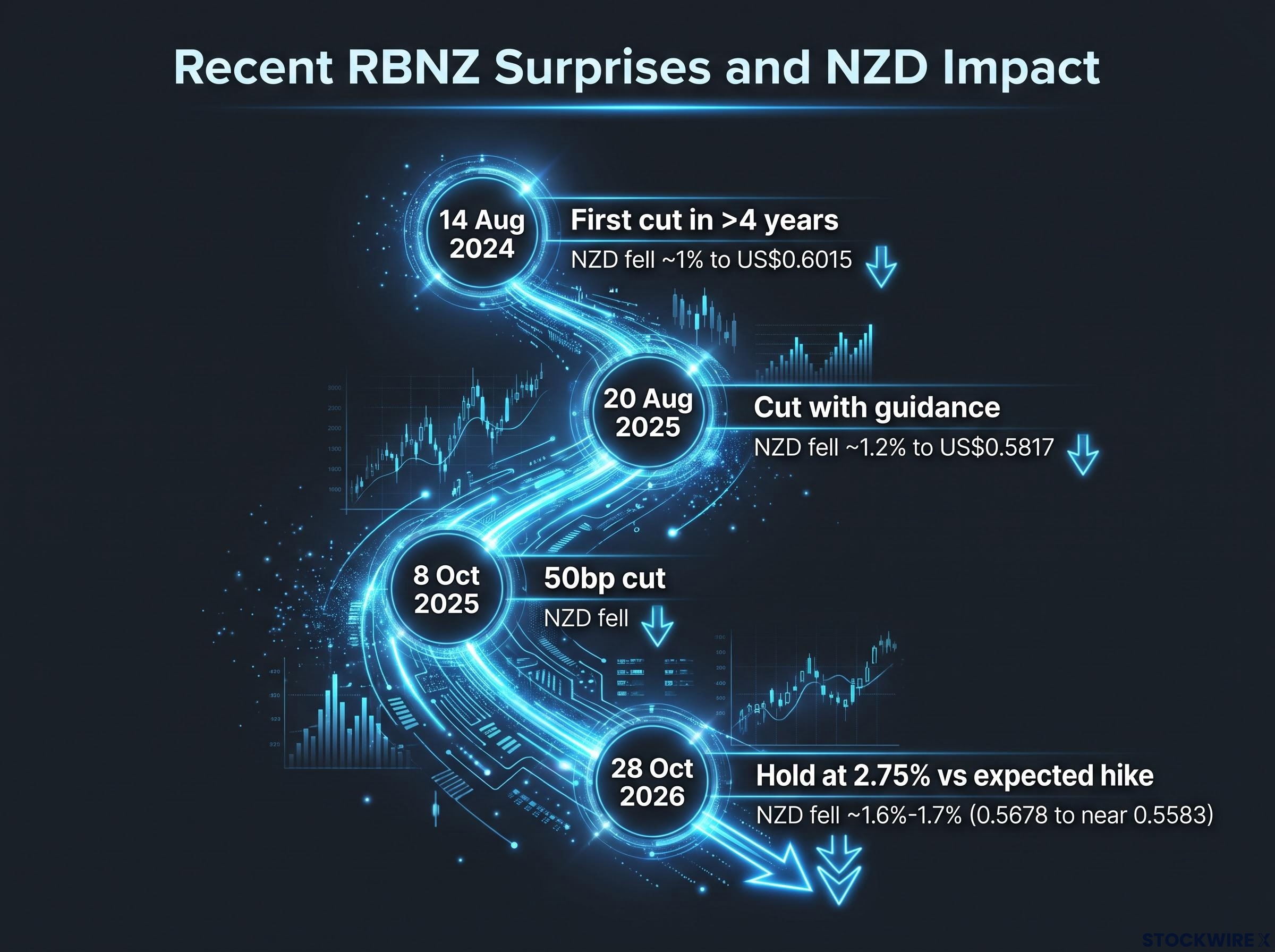
| Date | Event | Surprise direction | NZD move |
|---|---|---|---|
| 14 August 2024 | First cut in more than four years | Dovish | Fell about 1% to US$0.6015 |
| 20 August 2025 | Cut with guidance for more easing | Dovish | Fell about 1.2% to US$0.5817 |
| 8 October 2025 | 50bp cut, larger than expected | Dovish | Fell, alongside swap rates |
| 28 October 2026 | Hold at 2.75% versus expected hike | Missed hawkish pricing | Fell about 1.6%-1.7%, from 0.5678 to near 0.5583 |
The earlier episodes were outright dovish surprises. This one missed hawkish expectations, yet the logic matched: less tightening than priced, weaker Kiwi.
When big ASX news breaks, our subscribers know first
What the 4-3 split reveals about the committee’s thinking
One vote kept the rate where it was.
Governor Anna Breman sided with the majority alongside Carl Hansen, Prasanna Gai and Rebecca Williams. Paul Conway, Hayley Gourley and Karen Silk voted for 3.00%.
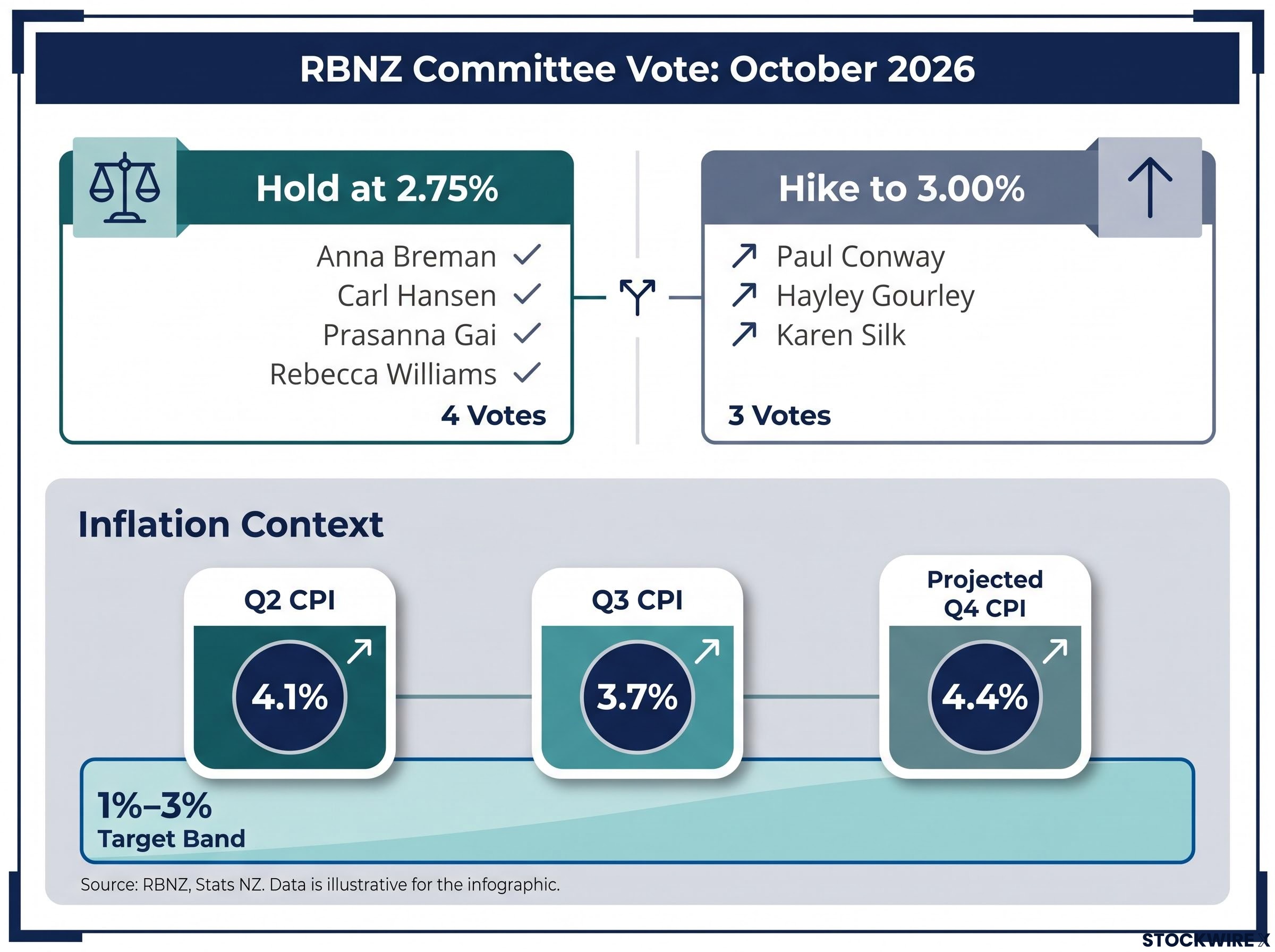
| Camp | Members | Core argument |
|---|---|---|
| Hold at 2.75% | Anna Breman (Governor), Carl Hansen, Prasanna Gai, Rebecca Williams | Inflation eased, demand is weak, wages are subdued and fuel pass-through may stay limited |
| Hike to 3.00% | Paul Conway, Hayley Gourley, Karen Silk | Fuel costs and a weaker NZD risk lifting inflation expectations and triggering second-round effects |
Both camps looked at the same inflation figures:
- Q2 CPI: 4.1% annual
- Q3 CPI: 3.7%, below expectations
- Projected Q4 CPI: 4.4%, driven largely by fuel futures prices
All three sit above the bank’s 1%-3% target band, which has a 2% midpoint. The majority treated much of the projected jump as a temporary imported shock. The minority worried about second-round effects, where higher fuel and import costs spread into wages, services and broader domestic pricing.
The fuel-driven inflation overshoot explains why the committee split: petrol and diesel accounted for roughly two-thirds of the June quarter CPI increase, and stripping out fuel brought annual inflation back inside the target band.
The RBNZ itself cited pricier fuel and a softer NZD, and said more tightening could follow if domestic pricing pressures fail to moderate or broaden. It published no numerical OCR path, only a conditional assessment.
Sunny Nguyen of Moody’s Analytics called the hold surprising given the oil rebound and weaker currency. With a one-vote margin, you should treat December as a genuinely live, data-dependent call rather than a promise.
Delay or fewer hikes: how analysts are reading the path ahead
The same hold supports two different stories.
Kiwibank’s Jarrod Kerr reads it as tightening delayed, not abandoned. Commerzbank also sees postponement, and Westpac’s base case agrees, though with a caveat attached.
Westpac’s call Chief economist Kelly Eckhold sees a December hike as the data-dependent base case, with the OCR peaking at 4.00% in September 2027.
Westpac also flags the other path. A weak recovery or global downturn could bring further pauses, or even eventual easing.
Underneath sits a debate about the nature of inflation. If fuel and currency effects work their way into expectations and services prices, the problem becomes structural and hikes come faster. If spare capacity and weak consumption absorb the shock, it fades and the cycle shrinks.
The variables that decide between those readings:
- Fuel prices, which drive most of the projected 4.4%
- Inflation expectations and the credibility of the 2% anchor
- Second-round pricing in wages and services
- Global growth, alongside weak household consumption and high household debt
A December hike is the central case, not a certainty. Fuel prices are the single input most likely to move it, in either direction.
Commerzbank’s view: limited NZD upside, with the Fed as a cushion
Commerzbank currency strategist Norman Liebke had cautiously foreseen the hold, which gives his outlook extra weight today. He still expects a December hike but thinks markets have gone too far.
Commerzbank’s assessment Pricing of about four 25bp hikes by September 2027 looks too hawkish, leaving limited medium-term upside for the NZD.
His reasoning works in two steps:
- As overly hawkish New Zealand rate expectations are scaled back, the Kiwi loses support and weakens.
- Commerzbank also views Federal Reserve expectations as too hawkish, so if those are pared back, the US dollar should fall and restrain how far the NZD drops.
That second step matters. A currency pair reflects two central banks, not one.
The Kiwi was already extended after a six-week slide driven by oil, inflation fears and a hawkish Fed, so the shift in RBNZ pricing landed on a currency with little cushion from US dollar softness.
For you, NZD/USD is exposed to two repricings at once. The upside looks capped, but a softer US dollar could cushion the downside.
What the RBNZ hold changes for the NZD, and what it does not
The hold postponed the tightening cycle rather than cancelling it. Markets still price roughly four hikes, and a single vote means December remains open.
What has changed is the timing premium in the currency, which the market removed within minutes.
Four signals will shape the next move:
- Fuel prices and their pass-through
- The next CPI print
- Inflation expectations
- Shifts in Fed pricing
If fuel stays elevated and expectations drift higher, the minority’s case strengthens. If demand stays weak, delay could turn into fewer hikes.
Investors tracing how the tightening bias began will find our detailed coverage of the May RBNZ hawkish pivot, including the oil and Strait of Hormuz inputs behind it.
Past performance does not guarantee future results. Financial projections are subject to market conditions and various risk factors. These statements are speculative and subject to change based on market developments.
This article is for informational purposes only and should not be considered financial advice. Investors should conduct their own research and consult with financial professionals before making investment decisions.