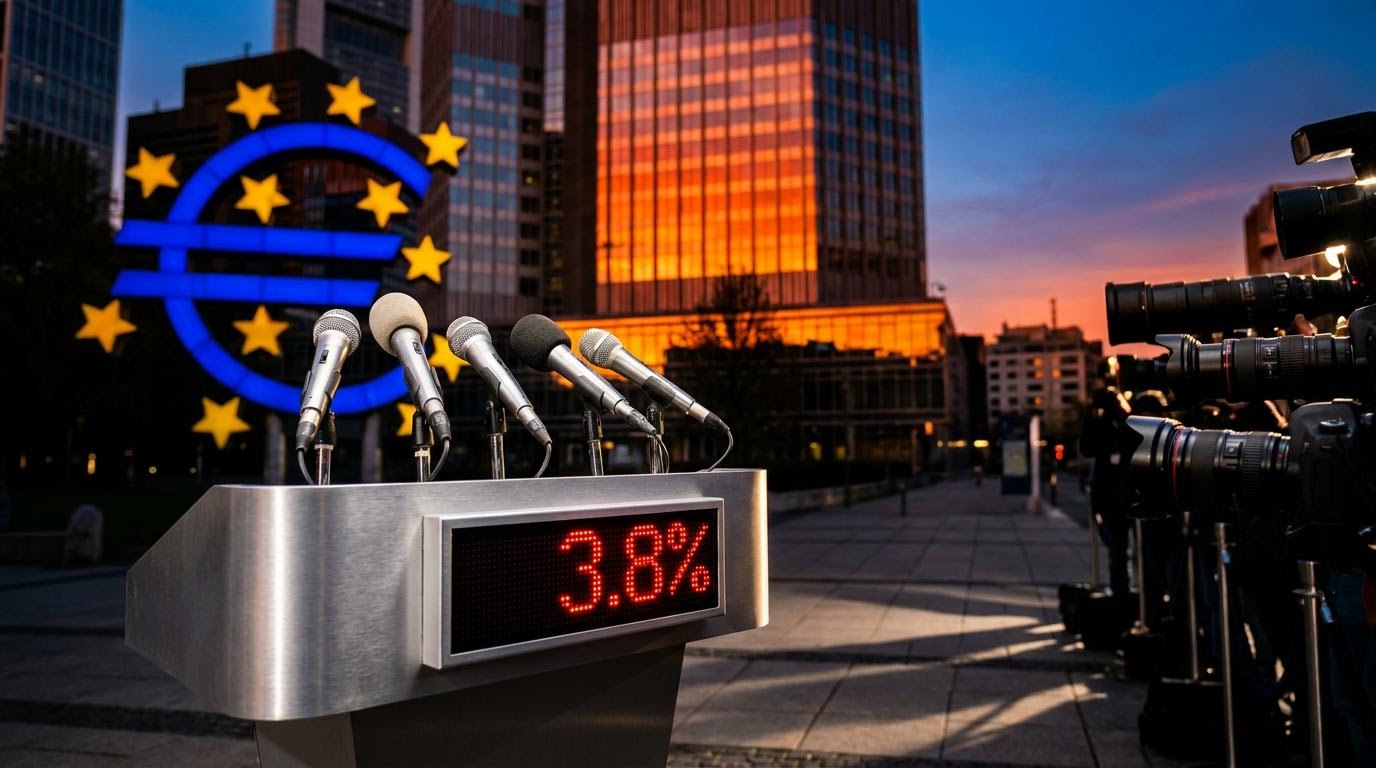
The European Central Bank (ECB) is almost certain to do nothing on 29 October. Even so, this meeting could shape the next two rate decisions. Headline inflation hit 3.8% in September, energy inflation reached 18.9%, and Brent crude traded above $112 a barrel this afternoon.
A hold rarely moves markets, but this one sits inside a tightening cycle that markets are pricing aggressively. Swaps imply roughly 75 basis points of further hikes by September 2027, and Nomura argues that is too much. A basis point is one hundredth of a percentage point, so 75bp equals three quarter-point hikes.
That gap between pricing and forecasts is why the press conference matters more than the decision itself.
This preview gives you a working framework for next Thursday: what the ECB is likely to do, what Christine Lagarde is likely to signal, where the major forecasters part ways, and which markets may move most when she speaks.
Why is the ECB expected to hold at 2.50% before moving again?
The baseline is a central bank that has already tightened twice this year. The deposit facility rate, the ECB’s main policy rate, rose from 2.00% to 2.25% on 17 June. It then rose to 2.50% from 16 September following the decision on 10 September.
Almost nobody expects a third move next week. A Reuters poll of 73 economists, taken 5-8 October, found all but three forecasting a hold. Swaps priced only about a 15.2% chance of an October hike as of 15 October.
The pause is deliberate rather than complacent.
Nomura analysts Andrzej Szczepaniak, George Buckley and Josie Anderson expect a unanimous hold, with guidance on quantitative tightening (the ECB’s gradual shrinking of its bond holdings) left untouched. In their view, the ECB is using the meeting to judge how the June and September hikes are filtering through the economy. With wages cooling, policymakers have room to wait.
The ECB’s approach to quantitative tightening is passive run-off rather than active bond sales, so the balance sheet shrinks steadily in the background; that is why guidance on it can stay untouched at a meeting like this one without implying any policy shift.
| Indicator | Reading | Source |
|---|---|---|
| October hold expectation | 70 of 73 economists | Reuters poll, 5-8 October |
| Probability of a hike by December | Nearly 78% | Swaps pricing |
| Negotiated wage growth | 2.2% in 2026 vs 3.2% in 2025 | ECB wage tracker |
The Banque de France tracker points the same way, showing 2.2% in Q3 2026. A pause paired with a hawkish bias is therefore consistent: wages give the ECB time, while energy keeps the door to further hikes open.
For you, the read is simple. A decision this widely expected carries almost no new information, so the signalling around it is where your attention belongs.
When big ASX news breaks, our subscribers know first
How does an energy shock turn into second-round inflation risk?
The reason the ECB keeps hinting at more hikes comes down to one concept: second-round effects. These are the wage and price increases that spread through the economy after an initial energy shock.
The pass-through mechanism
The chain typically runs in four steps:
- Energy prices rise. Fuel, electricity, heating and transport costs jump, lifting headline inflation directly.
- Firms pass costs on. Businesses raise prices for goods and services to cover higher energy and logistics bills.
- Workers seek compensation. Employees push for higher pay to recover lost purchasing power.
- Wages keep prices high. Negotiated pay rises sustain service-sector inflation long after the original shock fades.
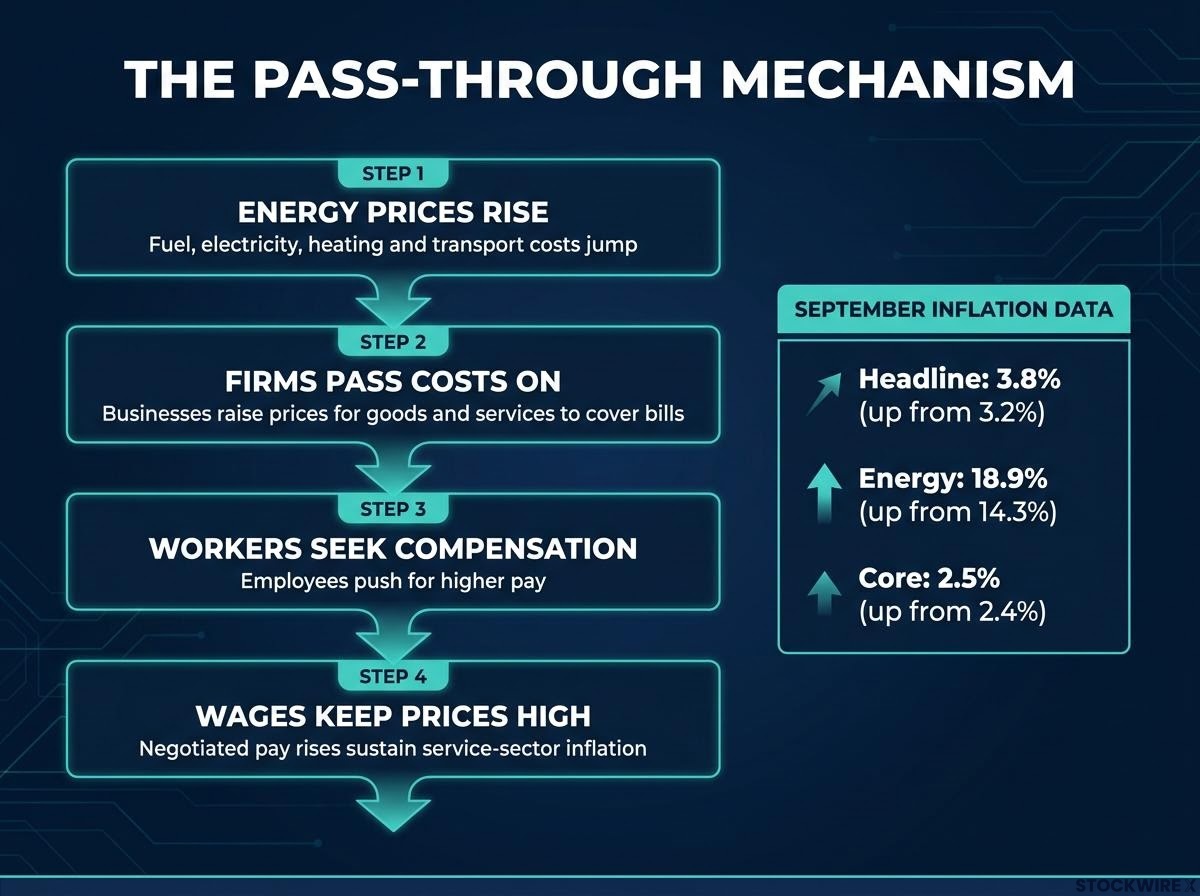
September’s data shows the first stage clearly. Eurostat’s Harmonised Index of Consumer Prices (HICP), the euro area’s official inflation measure, rose to 3.8% from 3.2% in August, with energy at 18.9%, up from 14.3%. Core inflation, which strips out energy and food, edged up to 2.5% from 2.4%.
That core uptick is the detail worth watching. It suggests the shock is starting to broaden, which is why the ECB is treating this as risk management rather than a reaction to an established spiral.
Monetary policy cannot fix a supply shock directly. Higher rates do not produce more oil. What they can do is stop a temporary shock from becoming embedded in wages, a risk that grows if conflict keeps prices high for longer.
Why 2022 and 2011 are both imperfect guides
At the September meeting, oil was around $97 and European gas around €73/MWh. Brent reached $112.01 on 22 October, according to Reuters. No comparable gas benchmark for today was available.
| Episode | Energy trigger | Wage backdrop | ECB response |
|---|---|---|---|
| 2011 | Commodity-price inflation | Not the main driver | Hiked, then faced a sharp slowdown and sovereign debt stress |
| 2022 | Geopolitical disruption to energy flows | Broad post-pandemic catch-up | Reacted to entrenched inflation |
| 2026 | Middle East conflict, Brent above $112 | Easing toward roughly 2-2.5% | Pre-emptive hikes |
This is not a rerun of 2022, because wages are far calmer. It is not a harmless blip either. The 2011 episode, when the ECB tightened into a weakening economy, stands as the warning critics keep raising.
Where Nomura’s 3.00% terminal rate sits against the rest of the Street
Nomura expects quarter-point hikes in December 2026 and March 2027, taking the terminal rate, or peak policy rate, to 3.00%. It calls December “virtually certain” and sees March as justified on risk-management grounds, given energy prices likely to stay high because of the Iran war.
| House | October call | December call | Terminal rate |
|---|---|---|---|
| Nomura | Hold | Hike | 3.00% |
| Nordea (Jan von Gerich) | Hold | Hike | 3.00% |
| Goldman Sachs | Hold | Hike to 2.75% | Unlikely above 3% |
| Deutsche Bank | Hold | Hike | 2.75%, upside to 3%+ |
| TD Securities | Hold | Hike | 2.75% |
| ING (Carsten Brzeski) | Hold | Possible hike | Leans cautious |
Barclays and Citi also expect a December hike. December is effectively consensus. The real disagreement sits in March and in whether the peak is 2.75% or 3.00%.
Nomura’s pricing view Markets price roughly 75bp of hikes by September 2027, which Nomura considers excessive for a two-hike path to 3.00%.
The ECB’s September account, published on 8 October, recorded 84bp priced by end-2027, up from 64bp at the July meeting. An independent overnight index swap (OIS) fixing for September 2027 was not located, so those two figures rely on different windows and sources.
The case against a March hike
ING’s Brzeski argues that the surge in German bond yields has already delivered roughly the tightening effect of another 25bp hike. Add weaker growth, demand destruction in energy-heavy industries, a potentially stronger euro and French fiscal strain on spreads, and March looks far less certain. The 2011 precedent sharpens that concern.
French bond stress has already removed part of a hike from market pricing, with the French-German spread at its widest since 2011; the ECB ignored similar strains in 2022 and 2023 but reversed course in 2011.
Nomura’s counter is credibility: an early, limited hike may lower second-round risk at a smaller eventual cost.
The read for you is that December is largely in the price. If markets are wrong anywhere, it is likely to be on March and the terminal rate.
What will Lagarde signal on 29 October, and how could markets react?
The press conference runs from 13:45 to 14:45 London time. Nomura expects Lagarde to decline to endorse market pricing while signalling December as firmly as she can, much as she did in April and July before the June and September hikes.
Nomura also expects the ECB to review Q4 2026 wage negotiations, which look benign. On that basis, it anticipates a slightly lower terminal rate priced by the close of the press conference and a modest market rally.
Watch for:
- Lagarde’s exact wording on December
- Whether she pushes back on market pricing
- Her commentary on wage settlements
- Her tone on growth and energy
| Asset | Hawkish December signal | Cautious, data-dependent message |
|---|---|---|
| EUR/USD | Supported, limited if already priced | Softer |
| Two-year Bund yields | Rise more sharply | Flatter expected path |
| Ten-year Bund yields | Rise less, or fall on growth fears | Ease |
| Periphery spreads | May widen, with France in focus | Less pressure |
No event-by-event dataset of past reactions to Lagarde signals was located, so these are directional expectations rather than historical averages.
The practical takeaway is that a firm December signal should move the front end and the euro more than long-dated yields. Two-year Bunds and periphery spreads will tell you more than the headline decision.
What the hold settles, and the questions it leaves open
The October decision is effectively settled, and a December hike is close to consensus. The live debate is whether March follows and whether the cycle peaks at 3.00%.
The split over the 2027 rate peak has made March the key fork, with some houses seeing a swift top at 2.75% and others pushing toward 3.00% if core inflation or wage settlements re-accelerate.
Three variables are likely to decide that outcome. The first is whether Brent holds near $112. The second is whether core inflation and wages keep drifting higher. The third is how far bond yields and the euro tighten conditions without further help from the ECB.
Next Thursday, treat Lagarde’s language on December as the signal and the terminal rate as the open question.
This article is for informational purposes only and should not be considered financial advice. Investors should conduct their own research and consult with financial professionals before making investment decisions. Past performance does not guarantee future results. Financial projections are subject to market conditions and various risk factors, and forward-looking statements are speculative and subject to change.