
Most Australians know Gumtree as the place they sold a couch or picked up a secondhand bike. Fewer know that Gumtree Australia Markets (ASX: GUM), the listed company behind the name, runs three brands that earn money in three different ways. The familiar brand is only one part of the business.
“Online classifieds” sounds like a single type of business. A general listings site, a car marketplace built around dealers and a car review publisher face different competitors and different pressures. That means you have to read a group like this one brand at a time, not as a single block.
Here is a framework you can apply to any multi-brand marketplace group, along with a clear view of where each brand inside Gumtree Australia Markets (ASX: GUM) faces its real test.
How online marketplaces earn their revenue: three distinct models
Picture “a classifieds site” and you probably imagine one thing: people post items, other people browse. In practice that picture covers at least three separate engines. Each one has its own paying customer and its own way of failing.
A horizontal classifieds site lists items across many categories, from furniture to jobs to pets. A vertical marketplace specialises in one high-value category, such as cars. A content-led platform builds an audience with reviews and editorial, then earns from advertising and from sending that audience to sellers.
The Australian Competition and Consumer Commission (ACCC) drew a related line in its Digital Platform Services Inquiry final report (dated March 2025). It separated online retail marketplaces, which handle checkout and payment, from classified-only services, where payment and delivery happen away from the platform. No independent academic framework for the three models was identified in research, so the ACCC distinction is the closest regulator-sourced reference.
| Model | How it earns | Who pays | Main exposure |
|---|---|---|---|
| Horizontal classifieds | Listing fees, promoted listings, advertising | Private sellers, businesses, advertisers | Free competitors and user trust |
| Vertical marketplace | Fees for reaching buyers in one category | Mostly businesses such as car dealers | Concentrated competition for business customers |
| Content-led platform | Advertising and referring audience to sellers | Advertisers and sellers | The advertising cycle |
Transactional features such as payments and shipping can sit on top of any of these models. For you, the takeaway is simple: a group revenue figure blends three different engines, so every number from Gumtree Australia Markets (ASX: GUM) invites one follow-up question. Which brand is driving this?
When big ASX news breaks, our subscribers know first
Gumtree’s shift from classified listings to paid transactions
The gap where scams happen
Traditional classifieds sites step aside at the exact moment money changes hands. The buyer and seller agree on a price, then pay by cash, bank transfer or PayID, outside the platform’s view. That handover is where many scams take place.
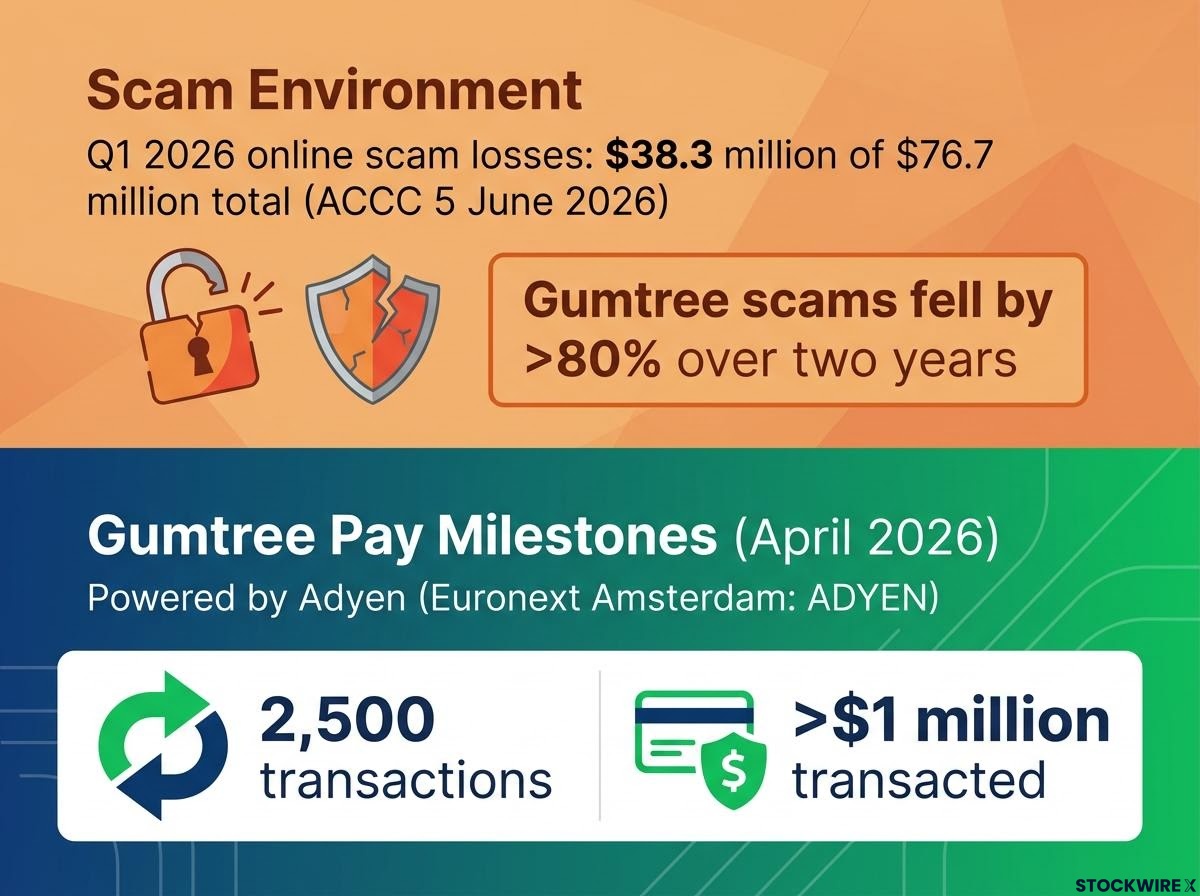
Scam losses by contact method Online contact methods, including fake websites, advertisements, social media and apps, accounted for about $38.3 million, roughly half of $76.7 million in reported Scamwatch losses in Q1 2026, according to the ACCC’s 5 June 2026 release.
Some classifieds sites are responding by becoming transactional marketplaces. The platform holds the payment, can arrange delivery and steps in if something goes wrong. Under the Scams Prevention Framework, classifieds are not among the first digital platform services designated, which currently cover social media, messaging services and paid search advertising.
What the Gumtree brand says it has done
The company states it has invested substantially in trust and safety over two years, and that scams and fraud on Gumtree fell by more than 80% over that two-year period. These are the company’s own figures and measures. Its company-stated milestones for Gumtree Pay, which is powered by payments provider Adyen (Euronext Amsterdam: ADYEN), are:
- 2,500 transactions reached in April 2026
- More than $1 million of goods transacted since launch (as at the April 2026 milestone)
- Shipping and buyer protection being rolled out, according to the company
The scam statistics explain why the model is changing. They do not prove the change will work. A fall in scams on one brand and a $1 million transaction base are early markers, and what you want to watch is whether users actually choose paid, protected transactions over free cash deals.
For readers wanting the full picture, our dedicated guide to why scams are reshaping online classifieds explains why platforms that sit outside the payment have so little power to intervene when money changes hands.
Two car brands, two models: editorial reach and dealer listings
The two car brands cover opposite ends of the same purchase. One meets you while you are still reading reviews, the other when you are ready to look at stock. They share buyers, yet they are tested in very different places.
CarsGuide: content as the front door
Cars are a high-value purchase, and buyers often research for weeks before they commit. A publisher that owns that research phase captures attention early. Content-led platforms turn that attention into revenue through advertising and by referring buyers to sellers.
CarsGuide is a car review and editorial site with dealer listings attached. That makes advertising its key revenue lever, and its main exposure. The company attributed part of its FY26 revenue decline to softer programmatic advertising, which is advertising bought and sold automatically through online auctions.
Brand-level audience figures for CarsGuide were not found in publicly accessible Ipsos iris summaries, so none are given here. What you can take from the company’s own explanation is that this brand moves with the advertising market.
Autotrader: the dealer marketplace
Vertical car marketplaces earn mostly from dealers paying to list stock and reach buyers. Autotrader covers cars, caravans and motorbikes. It competes for dealer spend against a long-established market leader in auto classifieds.
The most detailed regulator description of this market comes from the ACCC’s 2020 review of Gumtree’s acquisition of CarsGuide and Autotrader:
- In 2020, more than 90% of CarsGuide and Autotrader listings were dealer listings
- In 2020, CarsGuide and Autotrader dealer pricing combined subscription or tiered products with pay-per-view charges
- On that 2020 review’s market definition, CarsGuide and Autotrader held a combined share of about 23%, against 13% for Gumtree
The company says it is developing motors features, including Instant Cash Offer and Social Amplification tools, aimed at dealer and consumer engagement. These remain in development. For you, the point is that the two car brands can share an audience while carrying very different risks, so strength in CarsGuide’s reach would not on its own settle Autotrader’s competitive question.
Group logic and the cost story behind rising earnings on falling revenue
How the three fit together
The group’s case rests on a shared audience. Someone shopping for a car could start with a CarsGuide review, move to Autotrader to see what dealers have in stock, and then check Gumtree for a private seller. The company describes itself as an integrated marketplace ecosystem focused on cars, pets, jobs and real estate.
It became a pure online marketplace business after selling its capital markets division, HotCopper and Stockhouse, at the end of FY25 (company-stated). A commercial partnership with Australian Community Media extends its reach. Including that partnership, the company states a total online audience of 6.2 million Australians a month, a group-level figure drawn from Ipsos iris for August 2025 to January 2026, according to company investor material.
The cost structure
Online marketplaces carry largely fixed costs, mainly technology and staff. When those costs are cut, the savings flow quickly to earnings, even if revenue is falling. That is exactly the pattern in the company’s FY26 results, released on 28 August 2026.
| Measure | FY26 | FY25 comparison | Company-stated driver |
|---|---|---|---|
| Revenue | $69.6M | $74.4M (down 7%) | Softer programmatic advertising; lower listings volumes in some categories due to competition |
| EBITDA | $7.8M | $6.0M (up 29%) | Cost reductions, including head office savings |
| Profit before tax | $3.5M | $0.1M loss | Cost reductions against falling revenue |
EBITDA means earnings before interest, tax, depreciation and amortisation, a measure of operating profit. In August 2026 the company also began embedding AI across its operations, a project that affected 22 roles in its technology engineering group; management expects efficiencies, though no effects have been reported yet.
Rising earnings on falling revenue came from the cost side. That tells you the figure to follow next is revenue, not EBITDA.
Four open questions the reported numbers cannot answer
Each brand, and the group as a whole, now carries a test that the latest results cannot settle. Framed as questions, they are:
- Gumtree: Do users prefer paid transactions with buyer protection to free cash deals and free social media marketplaces, and how many make that choice?
- CarsGuide: How much does advertising revenue depend on the advertising cycle, and on shifts in how search engines and AI tools direct readers to publishers?
- Autotrader: How much dealer spend can a smaller vertical marketplace win against a long-established market leader?
- The group: Can revenue stabilise and grow once cost savings have run their course?
The group test Earnings growth from cost reduction cannot repeat indefinitely. The next test is whether revenue stabilises and grows, and the effects of the AI project have not yet been reported.
These four questions work as your checklist for reading any future announcement from Gumtree Australia Markets (ASX: GUM). None of them points to a predetermined answer.
Reading a multi-brand marketplace brand by brand
One familiar name sits on top of three businesses that earn in different ways, and each faces its own test. Reading them separately gives you a clearer picture than the group headline. For any multi-brand marketplace, ask:
- Which model does each brand follow, and what drives its revenue?
- Which brands share an audience, and do reported figures show it?
- Is earnings growth coming from revenue or costs, and which brand is most exposed to advertising versus transactions?
In upcoming ASX announcements from Gumtree Australia Markets (ASX: GUM), watch Gumtree Pay transaction volumes, the shipping and buyer protection rollout, audience trends across the three brands, progress on the motors features, and whether revenue stabilises.
This article is for informational purposes only and should not be considered financial advice. Investors should conduct their own research and consult with financial professionals before making investment decisions. Past performance does not guarantee future results.
General information only, not a recommendation.
—