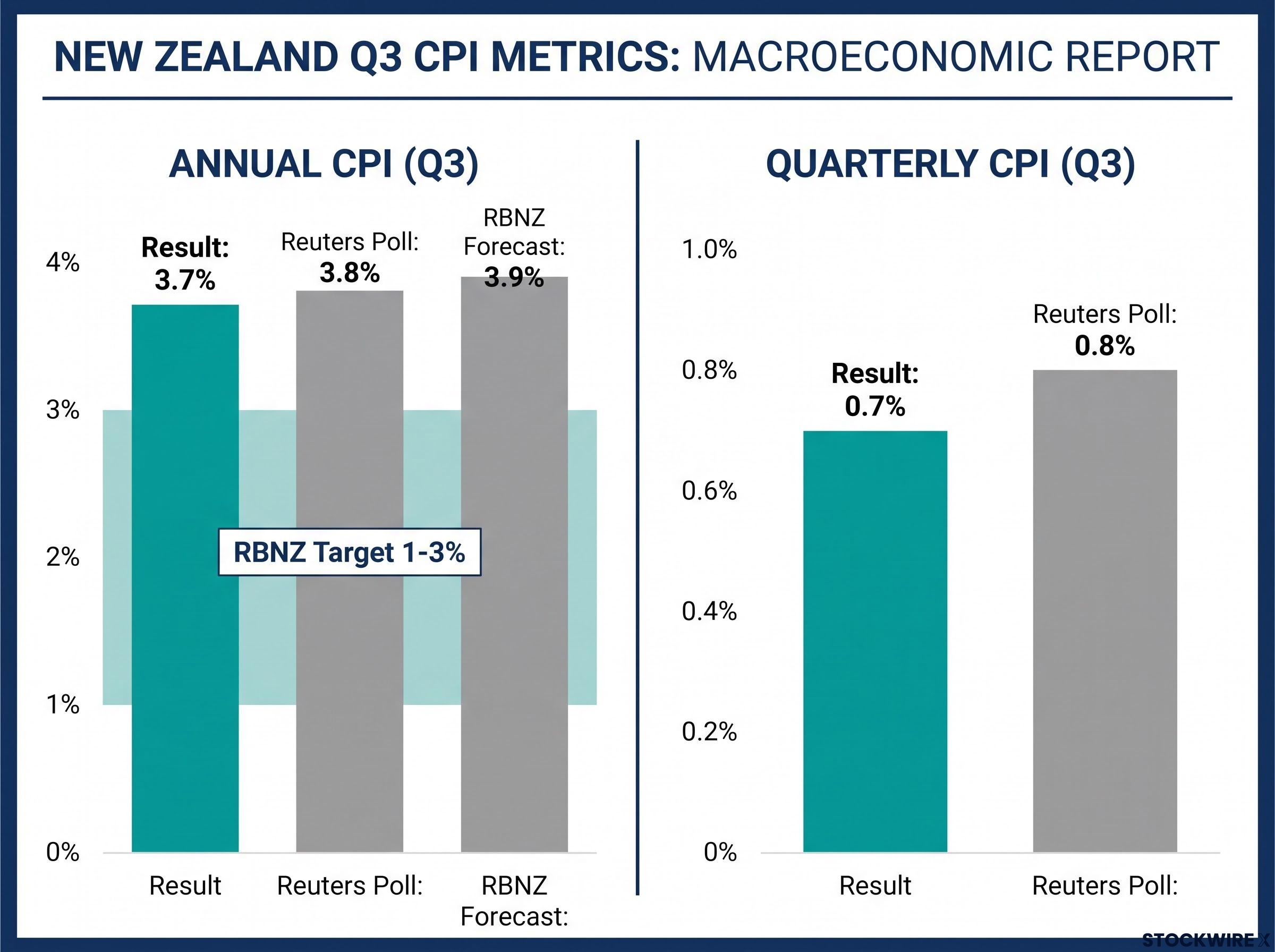
New Zealand’s annual inflation rate slowed to 3.7% in the third quarter, below the 3.8% consensus and under the Reserve Bank of New Zealand’s own 3.9% forecast. Yet markets still put the odds of a rate hike next week at roughly 98%. For anyone building an NZD/USD forecast, that gap is the puzzle: why did a miss leave the call almost untouched?
The currency gave its answer first. The Kiwi slipped to 0.5692 after the data and still trades below its 100-day simple moving average (SMA) of about 0.5775. The 100-day SMA is the average closing price over the past 100 trading days, and traders use it as a trend reference.
The live question is whether the Reserve Bank of New Zealand (RBNZ) decision on 28 October will move the currency or has already been priced in. The US Federal Reserve, now chaired by Kevin Warsh, meets the same week.
Here is what the market has priced, where ING sees the Kiwi at year-end, which forces move the currency, and the levels that would confirm or break the outlook.
Why a softer CPI print did not derail the RBNZ hike case
The first reaction looked like disappointment for anyone holding the Kiwi. Annual consumer price inflation (CPI) eased from 4.1% to 3.7%. The quarterly rise slowed from 1.5% to 0.7%, and the currency dipped.
| Measure | Result | Expectation |
|---|---|---|
| Annual CPI (Q3) | 3.7% | Reuters poll 3.8%; RBNZ forecast 3.9% |
| Quarterly CPI (Q3) | 0.7% | Reuters poll 0.8% |
The hike case survived because the miss was small and the number looks backwards. Inflation is still well above the RBNZ’s 1-3% target band. The bank has also become more worried about what comes next than about last quarter.
RBNZ Chief Economist Paul Conway set that out in comments reported by Bloomberg. He flagged upside risks to fourth-quarter inflation from oil prices and a weak New Zealand dollar.
Paul Conway, RBNZ Chief Economist The decision was “wide open” between a hold and a 25 basis point hike, but the cash rate was “most likely up.”
ING read those remarks as an attempt to lift market pricing, and it worked. According to ING, markets priced roughly 18-21 bp for the meeting afterwards. Reuters now shows a 100% probability of 50 bp of cumulative tightening by the end of February, which implies the Official Cash Rate (OCR) moves from 2.75% to 3.00% first. A basis point (bp) is one hundredth of a percentage point.
What this tells you is that the market is trading the RBNZ’s forward inflation worries, not the Q3 figure. A CPI miss alone is a weak reason to expect a softer rate decision or a stronger Kiwi.
What brokers expect after the miss
The following bank views come from reports that could not be fully verified, so treat them as indicative:
- ASB (Mark Smith): 25 bp hikes in October and December, with a 3.25% OCR peak.
- BNZ: leaning toward an October move, with the OCR reaching about 3.75%.
- Westpac (Darren Gibbs): the RBNZ is likely to look past the modest headline decline.
The reports on Westpac conflict. An earlier pause-then-December view predates the CPI release.
When big ASX news breaks, our subscribers know first
ING’s outlook and the Fed backdrop: what could hold the Kiwi above 0.570
ING makes the most clearly stated case for the Kiwi. Its view rests on value as much as on the rate path.
ING Think, 21 October 2026 ING expects a 25 bp RBNZ hike next week, barring a sharply lower CPI print, and sees NZD/USD holding above 0.570 into year-end.
The bank also argues the currency is cheap against its short-term fair-value model, an estimate of where the exchange rate “should” trade based on fundamentals. On that basis, ING expects the Kiwi to regain ground against the Australian dollar. In ING’s reading, the CPI undershoot was simply not large enough to overturn the hiking case.
That confidence has a weak point, and it sits in Washington rather than Wellington.
The Fed under Warsh: no pre-commitment
Speaking at an International Monetary Fund event in Bangkok on 16 October, Warsh declined to prejudge the coming meetings. According to Reuters, he said judgements would be made at the October and December meetings, without signalling whether further hikes were needed.
The current signals going into the 27-28 October meeting:
- Markets expect a hold, with CNBC reportedly citing a 15% hike probability (not independently verified).
- The median Fed official is reported to expect one more hike in 2026 (also unverified), which keeps December open.
- FXStreet’s Speechtracker scored Warsh’s remarks 5.6/10 against a 6.1/10 average, while its Fed Sentiment Index held at 127.51. Readings above 100 indicate a hawkish lean, meaning a bias toward higher rates.
Scotiabank’s Shaun Osborne said markets lack an overarching theme and probably will until the meeting. If the Fed surprises with a hike, the US rate advantage widens and offsets much of what the RBNZ delivers.
The read you should take: ING’s year-end view is a base case that depends on the Fed avoiding a hawkish surprise. The FOMC matters as much to your Kiwi exposure as the RBNZ does.
Warsh’s stance of no pre-commitment follows his removal of forward guidance after the September hike, which concentrates repricing risk into single speeches and data releases rather than spreading it gradually across meetings.
What actually moves the New Zealand dollar
This week’s moves, a dip on soft data alongside firm hike pricing, make more sense once you separate the forces behind the currency. Some change slowly over years. Others can flip within days.
Separating the forces behind the currency matters because RBNZ guidance, Chinese activity data, dairy auctions and risk sentiment each carry different weight, and the order of that hierarchy often decides which headline the Kiwi follows on a given day.
| Driver | Effect on NZD | Structural or cyclical | Link to today’s setup |
|---|---|---|---|
| NZ-US rate differential | Higher RBNZ rates support it; higher Fed rates weigh on it | Cyclical | RBNZ hike priced; Fed path open |
| RBNZ guidance | Hawkish wording supports it | Cyclical | Conway kept the hike priced |
| China demand | Weak Chinese activity hurts exports and the currency | Structural | China data can override technical levels |
| Dairy prices | High prices lift export income and the currency | Structural channel, cyclical prices | Background support or drag |
| Risk sentiment | Rises in calm markets, falls in turbulent ones | Cyclical | Lacks direction until the FOMC |
| Oil and NZD weakness | Raises imported inflation and the case for hikes | Cyclical | Conway’s main concern |
Structural drivers
China is New Zealand’s largest trading partner, and dairy is its main export. Those two channels tie the Kiwi to Chinese demand and global food prices regardless of what either central bank does.
Cyclical drivers
Interest rates matter most in the short run. When the RBNZ lifts rates, New Zealand assets pay higher yields and attract overseas money. When the Fed lifts rates, the pull runs the other way.
Oil adds a twist. Pricier oil and a weaker Kiwi make imports more expensive, which pushes inflation up and gives the RBNZ more reason to tighten. That loop explains why a soft CPI print could coexist with near-certain hike pricing.
Knowing which drivers are structural tells you what shapes the Kiwi over years. The cyclical ones can reverse within a single week of data and central-bank commentary, and this is one of those weeks.
Key NZD/USD technical levels and the risks to the forecast
Fundamentals explain why the currency moves. Price levels show where traders are likely to react. The current chart shows a negative bias below the 100-day SMA, a tentative base and momentum that is improving without being decisive.
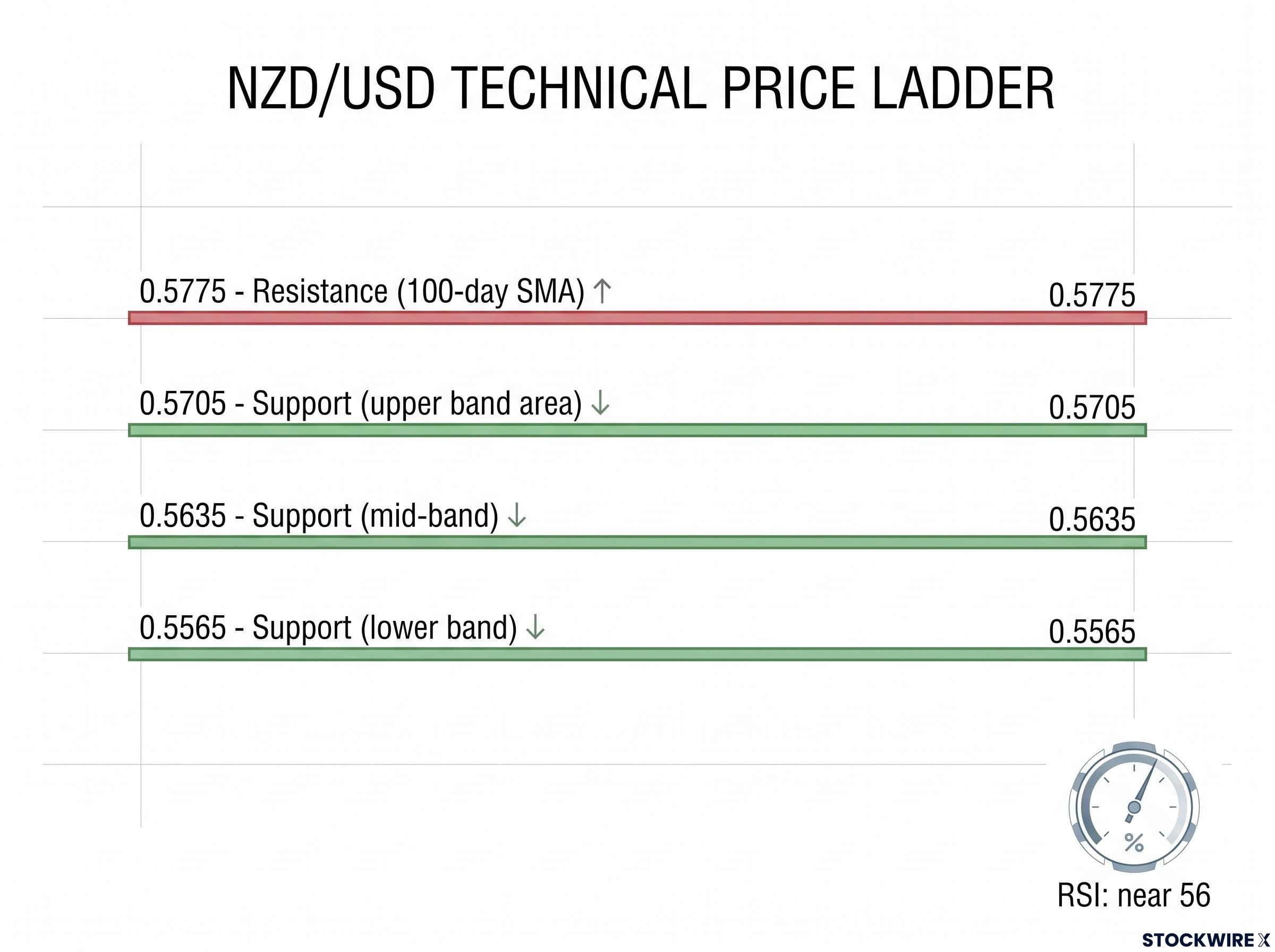
The Relative Strength Index (RSI), a 0-100 gauge of recent buying versus selling pressure, sits near 56, slightly on the buyers’ side. Price is above the middle of its Bollinger Bands, a volatility envelope drawn around a moving average, and well clear of the lower band.
| Level | Type | What it signals |
|---|---|---|
| 0.5775 | Resistance (100-day SMA) | A daily close above would open a stronger rebound |
| 0.5705 | Support (upper band area) | First test of the tentative base |
| 0.5635 | Support (mid-band) | Recovery momentum fading |
| 0.5565 | Support (lower band) | A break risks a deeper decline |
Treat 0.5775 as the level that would confirm a recovery and 0.5565 as the line that would signal deeper weakness. Fed expectations or Chinese data can override either one.
The Kiwi’s six-week slide to a fresh 2026 low near 0.5586 in early October was driven by oil, inflation fears and Fed hike odds rather than New Zealand’s economy, which frames how much the 0.5565 support line matters.
What could go wrong
- An RBNZ hold on 28 October. Conway kept that option open, and softer CPI gives the bank cover to wait. Reports of weak domestic activity, which remain unverified, add to that argument.
- A sell-the-fact reaction. With the move almost fully priced, a 25 bp hike without more hawkish guidance may not lift the Kiwi.
- A Fed upside surprise on 28 October or later. A hike or hawkish guidance would widen the US rate advantage into year-end.
No directly comparable case of a CPI miss followed by a hike was found in recent history. The dip to 0.5692 already shows that a miss does not automatically help the currency. The 100-day SMA is a reference point traders watch, not a fundamental barrier.
Past performance does not guarantee future results, and forecasts are subject to market conditions and various risk factors.
Reading the setup before the RBNZ decision, and what would change it
The CPI miss reduced the urgency for tightening but did not remove the case for it. ING’s year-end view of the Kiwi above 0.570 holds only if the Fed stays patient.
Three things decide whether that view survives:
- RBNZ tone: whether the guidance after a hike points to more tightening or a pause.
- The FOMC on 27-28 October: any hawkish shift from Warsh.
- Daily closes: above 0.5775 for confirmation, or below 0.5565 for warning.
This article is for informational purposes only and should not be considered financial advice. Investors should conduct their own research and consult with financial professionals before making investment decisions.