
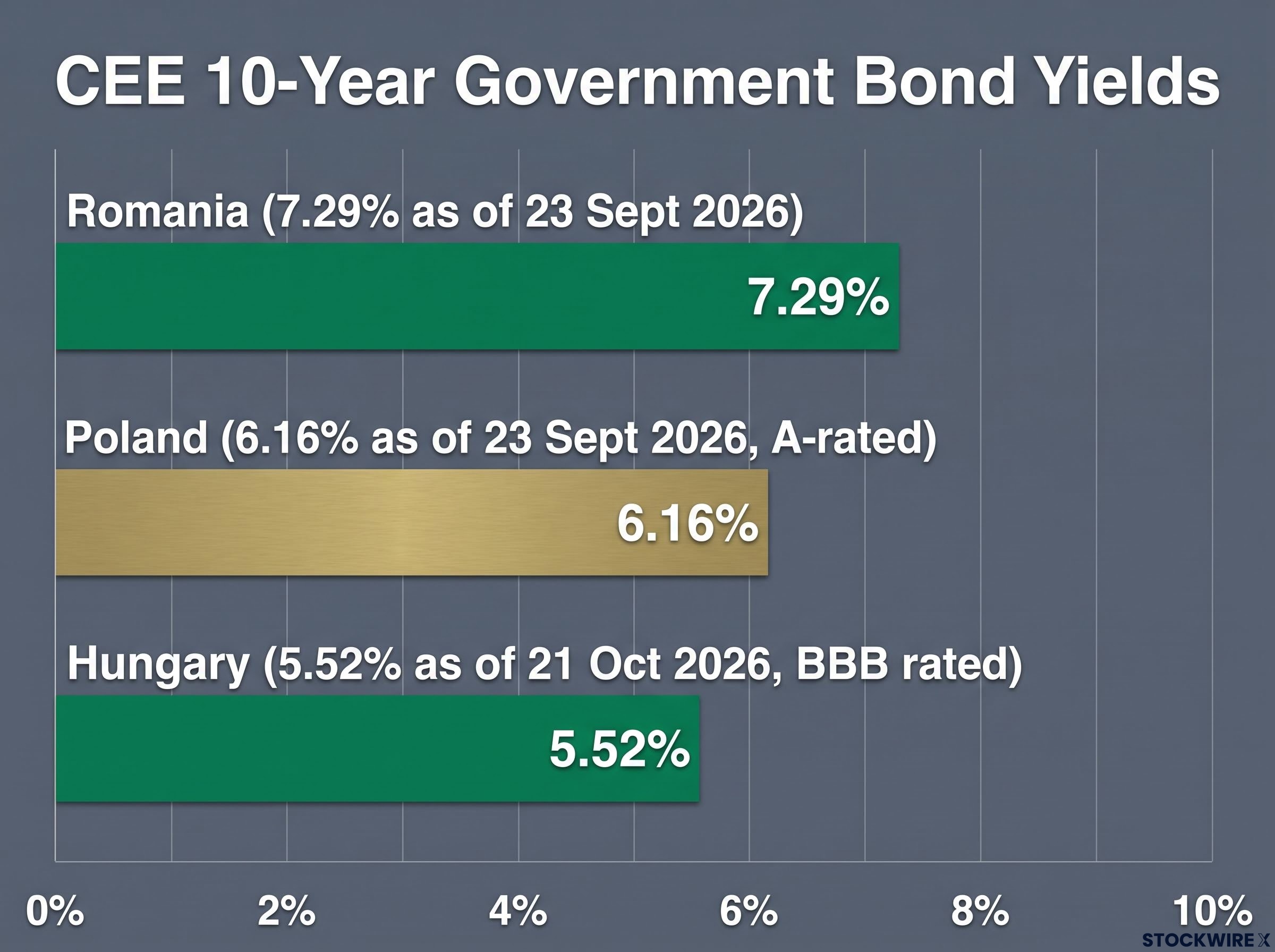
Hungary’s 10-year government bond yield has fallen roughly 170 basis points this year. It now sits below the yield on A-rated Poland’s debt, even though Hungary carries a lower BBB rating. The government behind that rally only published the budget meant to justify it this week, which puts its plan for euro adoption by 2030 at the centre of the trade: is the market paying for a result, or for a promise?
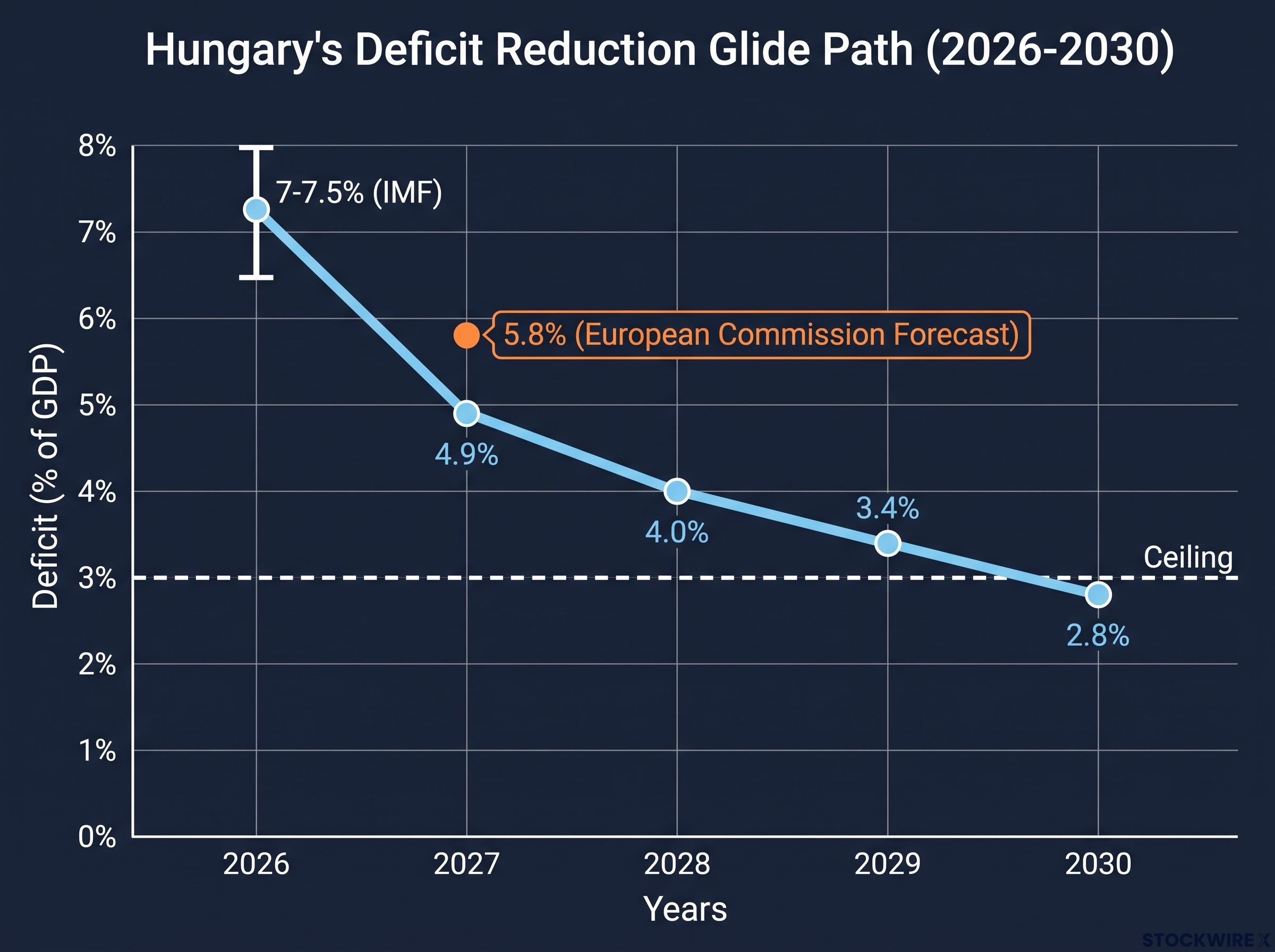
Prime Minister Peter Magyar‘s first budget, presented on 20 October 2026, targets a general-government deficit of 4.9% of GDP in 2027, down from an estimated 7.0-7.5% this year. Geoff Yu of BNY Mellon sees Hungary as a favourable fiscal outlier in Central and Eastern Europe (CEE), a region where few governments are tightening voluntarily.
Here is what the 2030 goal actually commits Hungary to, how much of the good news is already in the price of its longer-dated bonds, and whether a wider CEE re-rating is realistic or a Hungary-only story.
What does the 4.9% deficit target actually commit Hungary to?
Cutting a deficit by about 2.5 percentage points of GDP in a single year is a large move by any standard. The government’s glide path runs 4.9% in 2027, 4.0% in 2028, 3.4% in 2029 and 2.8% by 2030, starting from a 2026 base the International Monetary Fund (IMF) puts at 7-7.5%. Reuters reported the government’s own working estimate as 7.5%.
The IMF’s warning on euro plans reinforces the point that adoption is a medium-term reform anchor, not a shortcut, since its 7-7.5% deficit estimate sits more than double the Maastricht ceiling.
Yu did not soften the description.
BNY Mellon’s view Yu labelled the plan “austerity in all but name”, a step that Budapest has avoided for more than ten years and has never taken by choice.
Then the comparison points arrive, and they complicate the headline. The European Commission‘s Spring 2026 forecast had the 2027 deficit at 5.8%, although that figure predates the plan and assumes only previously known policies. S&P, which affirmed Hungary at BBB-/A-3 in May 2026, warned the deficit could exceed 6.5%.
| Item | Figure | Source | Date |
|---|---|---|---|
| 2027 deficit target | 4.9% of GDP | Government budget | 20 October 2026 |
| 2027 deficit forecast | 5.8% of GDP | European Commission | Spring 2026 |
| 2026 deficit forecast | 6.2% of GDP | European Commission | Spring 2026 |
| 2026 deficit estimate | 7-7.5% of GDP | IMF | 7 October 2026 |
| Public debt | 74.6% (2025), 75.1% (2026), 76.8% (2027) | European Commission | 10 July 2026 |
| 2027 debt objective | 77.2% of GDP | Finance Minister András Kármán | 20 October 2026 |
The debt line deserves attention. The deficit is the annual flow of new borrowing; debt is the accumulated stock, and on the Commission’s numbers it keeps rising through 2027 even as the deficit shrinks. The government’s 77.2% objective and the Commission’s 76.8% projection do not line up, and neither source reconciles them.
The gap between 4.9% and 5.8% tells you the market is pricing delivery before anyone has validated it. Treat the target as a claim still to be proved, not a baseline.
Why the political cost matters
The plan leans on higher taxes on wealthy households and large companies, plus spending savings. Both create opposition and execution risk, because every measure that bites is a measure someone will lobby to reverse.
There is also a growth drag. A fiscal squeeze of this size lands on an economy the IMF expects to grow only about 2% in 2026, with the possible release of roughly €16 billion in frozen EU funds acting as the main offset.
When big ASX news breaks, our subscribers know first
Does “euro by 2030” mean what the headline says?
Most coverage, including the original BNY framing, presents 2030 as Hungary’s euro date. Later reporting draws a sharper line. 2030 is the government’s deadline for meeting the Maastricht criteria, the EU’s entry tests for euro membership, not the year the forint disappears.
Finance Minister András Kármán expects a deficit below 3% in 2030 to make adoption possible in 2032, according to Reuters. No formal date has been set. The government plans to use 2027 to map the required steps and to set up a working group with the Magyar Nemzeti Bank (MNB), Hungary’s central bank.
The reason for the two-year gap is the Exchange Rate Mechanism II (ERM II). ERM II is a system in which a country links its currency to the euro and must keep it stable within agreed limits for at least two years before adopting the euro. Hungary has not entered it yet.
The sequence runs like this:
- Meet the fiscal criteria on deficit and debt.
- Enter ERM II.
- Spend at least two years inside it with a stable currency.
- Complete the legal and institutional steps.
- Adopt the euro.
The MNB’s own assessment adds sobering context: Hungary met none of the convergence requirements in 2024 or 2025. Officials have also discussed joining the EU Banking Union, the bloc’s shared bank supervision framework, voluntarily before ERM II.
Where Hungary stands on each criterion
Inflation is the standout improvement, while the fiscal tests remain the binding constraint.
| Criterion | Hungary’s position | Status | Note |
|---|---|---|---|
| Deficit | 7-7.5% (2026), 4.9% target (2027) | Not met | Ceiling is 3% |
| Debt | About 75-77% of GDP | Not met | Reference value 60%; a sufficiently declining trend can be considered |
| Inflation | 1.3% by August 2026 | Met at that point | MNB target cut from 3% to 2.5% from 2028 |
| Exchange rate | Outside ERM II | Not started | Two-year minimum period |
| Long-term rates | Below Poland and Romania | Improving | Test uses an average over the reference period |
For a bond investor holding for a “2030 euro”, this means underwriting a wait at least two years longer and a chain of institutional steps. Your holding-period assumptions should reflect that.
How much of the rally is already in the price?
The market has moved fast. Hungary’s 10-year yield stood at 5.64% on 23 September, below Poland’s 6.16% and Romania’s 7.29%, and reached 5.52% on 21 October, according to Trading Economics. The forint has gained about 6% against the euro in 2026, with EUR/HUF at 364.68 on 20 October.
The MNB has held its base rate at 5.50% since August, leaving the policy easing cycle paused.
| Indicator | Level | Comparison | Date |
|---|---|---|---|
| Hungary 10-year yield | 5.52% | About 170 bp lower year to date | 21 October 2026 |
| Hungary 10-year yield | 5.64% | Poland 6.16%, Romania 7.29% | 23 September 2026 |
| EUR/HUF | 364.68 | Forint about 6% stronger in 2026 | 20 October 2026 |
| MNB base rate | 5.50% | Unchanged since August | 20 October 2026 |
Credible tightening compresses yields through six channels:
- Lower supply: smaller deficits mean fewer new bonds to absorb.
- Lower risk premium: less chance of debt stress or rating pressure.
- Lower term premium: the extra yield demanded for long maturities shrinks as the future debt path clears.
- Currency support: a firmer forint reduces imported inflation.
- Monetary room: the MNB could cut without triggering a forint sell-off.
- Euro option: eventual adoption would remove exchange-rate risk entirely.
The debate now is how much of that remains. Debt agency chief Gábor Tardos sketched a scenario, explicitly not a forecast, of 4.0-4.5% by ERM II entry if the roadmap holds. ING’s Peter Virovacz sees 4.9% possible by year-end if consolidation is delivered. Commentators expect 15-, 20- and 30-year bonds to outperform, although current long-end yield data was not available.
BNY itself flagged the limits in late August.
BNY Mellon, 24 August 2026 Yu stayed bullish but warned that duration had become expensive and that fiscal slippage could undermine the trade.
The split matters. Structural drivers (ERM II, Banking Union entry, lower currency risk) could last; cyclical ones (sharp disinflation, easing expectations, global bond moves) can reverse. Hungary yielding less than higher-rated Poland tells you the market is already paying for euro convergence, so your return from here depends on execution rather than discovery.
The split between structural and cyclical drivers matters most where positioning is stretched: ING has flagged crowded forint and bond positioning in long-end Hungarian duration, so even confirmation of good fiscal news can prompt profit-taking.
Past performance does not guarantee future results. Yield scenarios are subject to market conditions and various risk factors.
Will Hungary’s bet lift CEE bonds, or only Hungary’s?
Yu’s broader argument is that if Budapest delivers, its regional peers may rethink their own budget rules, which would reprice duration across the whole region. Precedent supports part of that argument.
| Precedent | Timeline | Yield effect | Caveat |
|---|---|---|---|
| Croatia | ERM II July 2020; euro January 2023 | About 90 bp below a synthetic no-euro path in 2023 (Croatian National Bank) | Smaller, more euro-linked economy |
| Bulgaria | ERM II July 2020; euro January 2026 | Five-year yield 2.8% on 2 January 2026, from 3.5% in May 2025 (BNP Paribas) | Currency board eased exchange-rate convergence |
| Slovakia | ERM II November 2005; euro January 2009 | Specific bond data not found | Clear timetable aided credibility |
The Baltic states also priced much of their convergence before accession, but those were small markets with very strong institutional commitment. The pattern holds; the mechanics do not transfer cleanly to Hungary’s floating forint.
Selective, not broad: the regional case
Country by country, the read-through narrows. Poland’s spread over Hungary reflects a Hungary-specific euro premium, not regional repricing. Romania, at 7.29%, faces larger imbalances and political uncertainty that no neighbour’s example can fix. Czechia already enjoys stronger fiscal credibility, leaving less catch-up room.
A wider re-rating becomes plausible only if global rates stabilise, EU funds flow and Hungary proves its consolidation politically durable. The stronger case is a Hungary-led, selective move, so you should not assume owning Romanian or Czech duration gives you the same exposure.
The CEE currency outlook also depends on energy exposure and US yields, and Hungary’s heavy gas import dependency means a price spike could widen the current account gap and test the carry that supports regional duration.
What could unwind the trade
- Inflation reversal: the IMF sees inflation rising toward 3% in 2027; S&P projects 3.5% in 2026 and 4.25% in 2027.
- EU-fund delays: the €16 billion depends on governance and rule-of-law milestones.
- Forint volatility: a sharp move either way would disrupt carry and inflation.
- Credibility slippage: temporary or reversed measures would widen the Commission gap.
- ERM II delay: the total return case rests on entering the mechanism.
The signposts are concrete: the 2027 budget passing intact, EU-fund release, monthly inflation prints and a published ERM II timetable.
What the 4.9% target changes, and what it does not
Hungary now offers a genuine fiscal-convergence and euro-option trade. What it no longer offers is surprise. With the 10-year yield below Poland’s, investors are being paid for execution risk, not for spotting an overlooked story.
The 2030 milestone is a fiscal test; euro entry, on the finance minister’s own reckoning, is more likely around 2032, and the return case hinges on reaching ERM II. The signals worth tracking are budget passage, revisions to the Commission’s deficit forecasts, inflation and the MNB’s rate path, and EU-fund disbursement.
This is analysis of public data and published views, not personal investment advice.
This article is for informational purposes only and should not be considered financial advice. Investors should conduct their own research and consult with financial professionals before making investment decisions. Forward-looking statements are speculative and subject to change based on market developments and government policy.