
Imugene reports further complete and partial responses in azer-cel Phase 1b trial
Imugene Limited (ASX: IMU) today reported two further responses in its ongoing Phase 1b basket study of azer-cel (azercabtagene zapreleucel), announced on 19 October 2026. The update includes a new Complete Response (CR) in the CAR T-naïve Cohort 2 and a conversion to Partial Response (PR) in the Bruton Tyrosine Kinase inhibitor (BTKi) combination Cohort 3.
The patient with marginal zone lymphoma (MZL) achieved the CR at their Day 28 assessment. In Cohort 3, a patient with Richter’s Transformation, who had previously demonstrated stable disease (SD), converted to a PR.
Patient enrolment continues across ten US and five Australian sites. Each added response contributes to the dataset for azer-cel, the lead asset of the clinical-stage company.
When big ASX news breaks, our subscribers know first
Cohort response rates at a glance
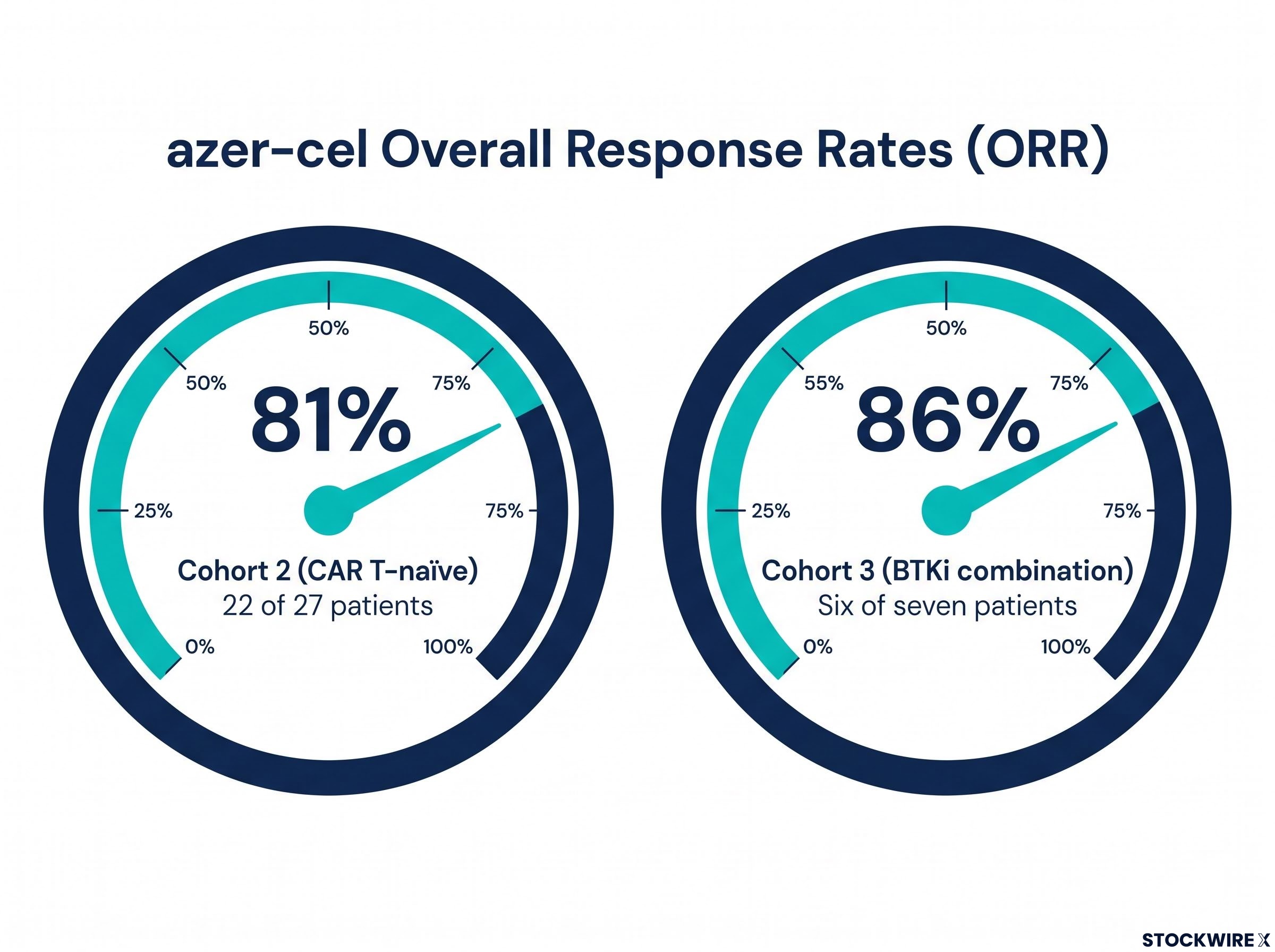
The announcement provided updated Overall Response Rates (ORR) for both cohorts. Cohort 3 is a small group of seven patients, so its figures reflect a limited sample.
Cohort 3 had previously posted a 71% overall response rate across seven evaluable patients, including a complete response in Mantle Cell Lymphoma, and the new conversion to PR lifts that figure.
| Cohort | Population | Responders | ORR |
|---|---|---|---|
| Cohort 2 | CAR T-naïve | 22 of 27 patients | 81% |
| Cohort 3 | BTKi combination | Six of seven patients | 86% |
Context for Cohort 3 from the announcement:
- All patients enrolled previously received and progressed on BTKi therapy.
- The cohort is described as a heavily pre-treated population with high unmet medical need and fewer remaining treatment options.
- Cohort 3 evaluates azer-cel in combination with a BTKi.
What is allogeneic CAR T and why does it matter?
CAR T therapy uses engineered immune cells designed to target cancer. An allogeneic therapy is an “off-the-shelf” product, in contrast to treatments made specifically for each patient. According to Imugene, azer-cel is an off-the-shelf (allogeneic) CAR T that targets CD19 to treat blood cancers.
The ongoing, open-label Phase 1b trial in the U.S. and Australia evaluates three patient populations: CAR T-relapsed patients, CAR T-naïve patients, and a BTKi combination cohort of patients with B-cell malignancies who previously progressed on BTKi therapy. For investors, responses across these settings point to the breadth of azer-cel’s potential.
Across a broad range of non-Hodgkin lymphomas (including FL, CLL/SLL, MZL, WM, and MCL), treatment with azer-cel, lymphodepletion, and IL-2 has yielded meaningful clinical activity, according to the company.
Earlier Phase 1b data had already shown a 100% response rate in CLL/SLL and 80% in MZL within the CAR T-naïve cohort, the first signal that azer-cel could be active across several B-cell malignancies.
What’s next for azer-cel
Imugene stated that further clinical updates will be reported as patient enrolment continues and data matures. No dates were given.
The company noted multiple complete responses in the BTKi cohort, with a manageable safety and tolerability profile. Imugene is focused on developing azer-cel for patients with B-cell cancers whose disease has progressed on existing treatments, including CAR T and BTK inhibitors.
Want to Explore Imugene’s Azer-Cel Phase 1b Trial Further?
Azer-cel, Imugene’s off-the-shelf CD19-targeting CAR T, has posted a new complete response in CAR T-naïve Cohort 2 and a conversion to partial response in BTKi combination Cohort 3. With enrolment continuing across ten US and five Australian sites, the dataset behind this lead asset keeps growing.
Investors seeking the full detail on the trial results and cohort response rates can visit the Imugene ASX announcements page. It is the place to track further clinical updates as patient data matures.