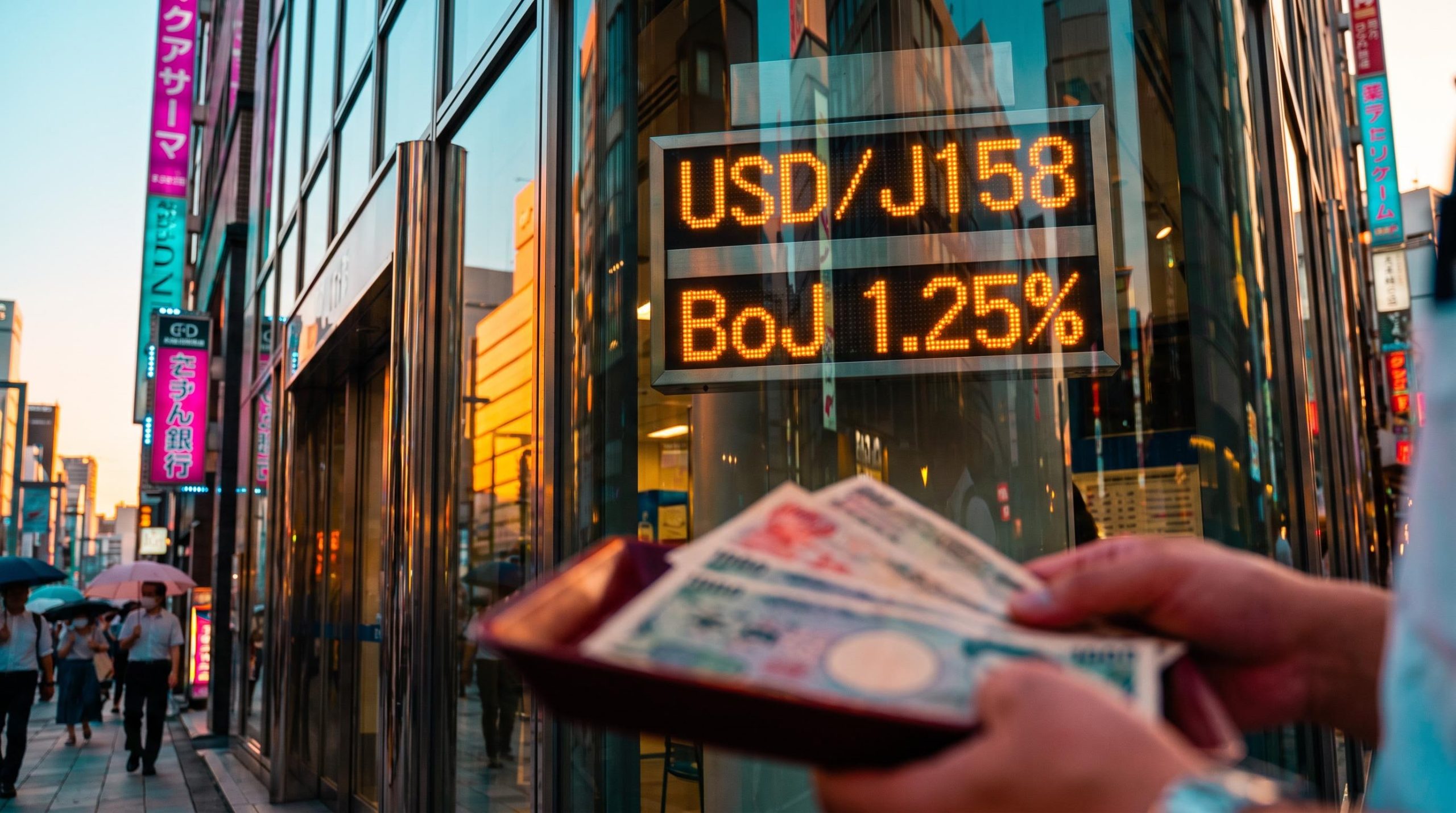
Bank of Japan Governor Kazuo Ueda said on Friday that the central bank will keep raising interest rates because underlying inflation is closing in on its 2% target. The yen barely moved. USD/JPY held near 158, as though the strongest hint yet of another BoJ rate hike had never been said.
The policy rate sits at 1.25% after a 7-2 vote on 18 September lifted it by 25 basis points (a basis point is one-hundredth of a percentage point). That is the highest level in 31 years. The next policy meeting runs 29-30 October.
Reading the signal correctly matters. A yen position, a Japanese equity holding or any exposure to yen-funded trades can swing sharply on a surprise, and the speech left plenty unanswered.
Here is what the market has already priced in, what would change that, and the indicators to watch over the next fortnight.
Why did the yen shrug off Ueda’s hawkish signal?
On paper, the speech was hawkish. Speaking around the IMF and World Bank meetings in Bangkok, Ueda said the BoJ cannot tolerate underlying inflation accelerating further, and that anchoring prices around target now matters more than before.
Kazuo Ueda, Governor, Bank of Japan The BoJ will continue raising rates, as underlying inflation approaches 2% while financial conditions remain accommodative.
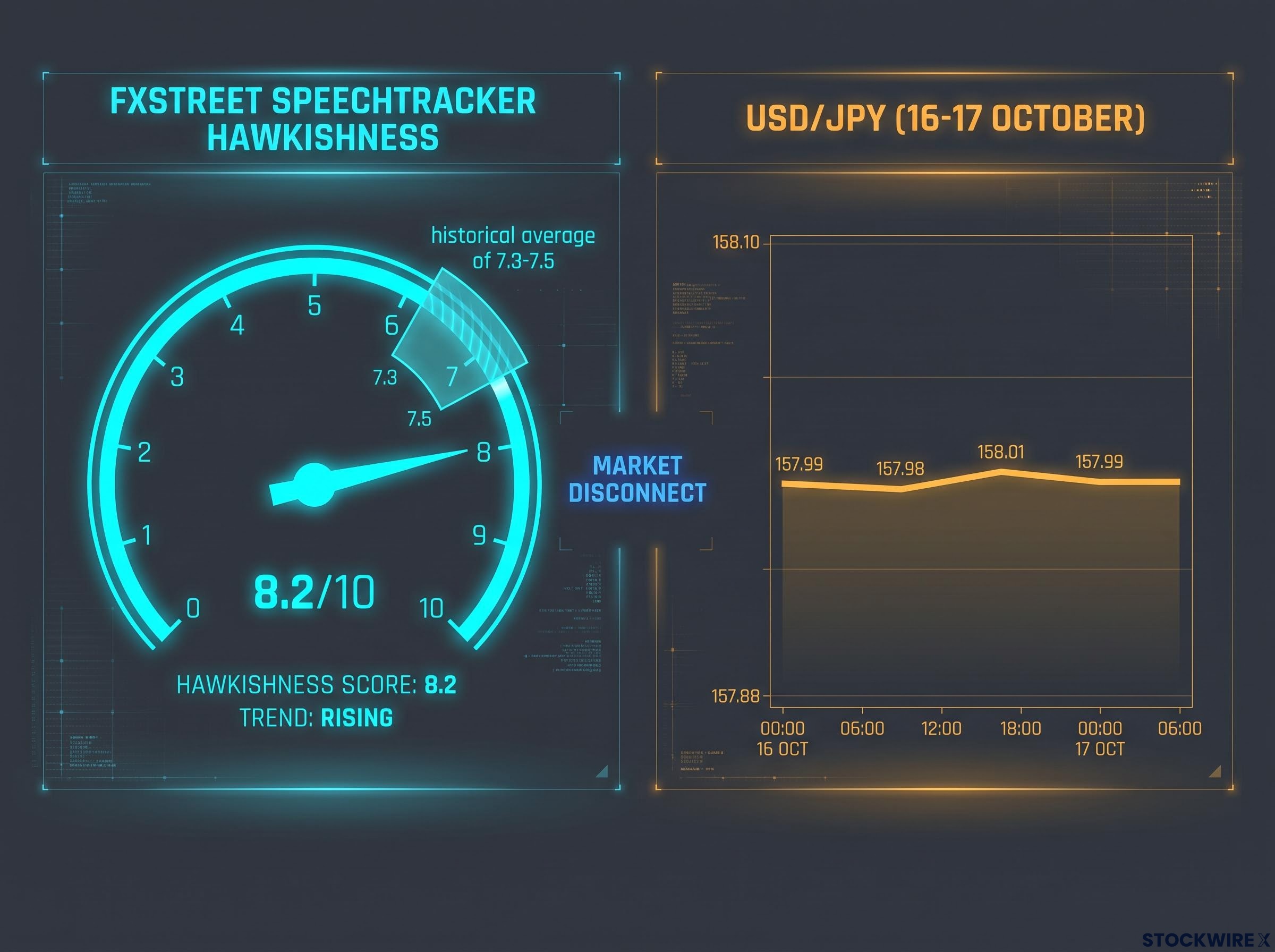
FXStreet’s Speechtracker scored the remarks 8.2/10 for hawkishness, well above Ueda’s historical average of about 7.3-7.5. Yet USD/JPY traded between roughly 157.88 and 158.10 across 16-17 October, little changed.
Borrowing yen to buy dollar assets remains attractive because the spread over US rates, still roughly 2.5%-2.75%, outweighs the cost of the BoJ’s incremental hikes.
The disconnect has clear causes:
- Wide rate gap: Japanese yields remain far below US yields, so borrowing yen to buy dollar assets still pays.
- Negative real rates: with inflation near 2%, a 1.25% policy rate is not yet restrictive once inflation is subtracted.
- Slow pace: traders hear a commitment to eventual hikes, not rapid tightening.
- US rate expectations: bets on higher US rates are supporting the dollar.
- Fiscal worries: the IMF’s Krishna Srinivasan said Japan needs a credible medium-term fiscal framework, and debt concerns can lift yields without lifting the yen.
- 160 as a ceiling: markets treat 160 as the zone where intervention becomes likely, which deters buying above it without forcing the yen higher.
Ueda also said he has had no contact with US Treasury Secretary Scott Bessent since their Asheville meeting. A hawkish tone without a timetable tells you the market is waiting for numbers and dates; the flat yen reflects patience, not indifference.
What Ueda said on AI, oil and the exchange rate
Ueda tied the pace of hikes to exchange rates, AI-related demand and Middle East developments. He saw little gap between the BoJ and global officials on AI-driven price pressure, though some participants were more bullish on AI demand than the BoJ, and the baseline outlook is unchanged.
Does the inflation data justify a BoJ rate hike in December?
The case for “near 2%” depends on which gauge you pick.
| Measure | Latest reading | Note |
|---|---|---|
| Nationwide core CPI, Aug 2026 | 1.7% | Official |
| Nationwide core CPI, Sept 2026 | 2.1% | Forecast (Reuters poll of 15 economists) |
| Tokyo core CPI, Sept 2026 | 2.7% | Official |
| Tokyo core-core CPI, Sept 2026 | 3.0% | Official, excludes fresh food and energy |
| BoJ ex-temporary factors, Aug 2026 | 2.6% | Official |
| BoJ trimmed mean, Aug 2026 | 2.2% | Official |
| BoJ weighted median, Aug 2026 | 1.5% | Official |
| BoJ mode, Aug 2026 | 1.3% | Official |
The 2.1% September figure is a forecast, not a published number. If confirmed, it would put core inflation above target for the first time since December.
Because the weighted median and mode sit well below the headline gauges, you should treat the “near 2%” claim as contested. That makes the October statement wording more important than the rate decision itself.
Consensus expects a hold at 1.25% on 29-30 October, with Reuters reporting that the BoJ is preparing hawkish guidance to keep December open. Markets price roughly 10-25% odds of an October move and 75-88% for December.
The October Outlook Report may matter more than the rate decision itself, since a large upward revision to inflation forecasts is the condition some former officials name for moving earlier than December.
Gradualists versus pre-emptive hikers
The BoJ’s reported neutral-rate range (the level that neither stimulates nor restrains the economy) is about 1.1%-2.5%, so 1.25% sits near the bottom.
- Gradualists: roughly one hike per quarter. A Reuters poll sees 1.50% by March 2027 and 1.75% in Q2 2027.
- Pre-emptive camp: faster moves if the yen slides or energy spikes. Yusuke Matsuo of Mizuho Securities expects faster-than-expected hikes, board member Junko Koeda sees neutral well above 1%, and former board member Makoto Sakurai sees about 2% by around June 2027.
Former policymaker Masayoshi Noguchi, who expects 1.50% in December, says the BoJ fears a yen slide past 160 could spark another wave of food inflation.
What could move USD/JPY before 29-30 October, and what history suggests
The yen-bullish case is simple: hikes narrow the yield gap and raise the risk that carry trades (borrowing cheaply in yen to invest in higher-yielding assets) unwind. The sceptical case holds that hikes are too small, already priced in, or swamped by rising US yields and fiscal risk.
2024 shows positioning can matter more than the rate change.
| Event | Market effect | Relevance to 2026 |
|---|---|---|
| March 2024 exit from negative rates | No lasting yen rally | Structural shifts alone do not close the gap |
| July 2024 intervention | About ¥5.53 trillion spent | Shows the Ministry of Finance will act |
| 31 July 2024 hike to about 0.25% | USD/JPY fell about 1.7% to 150.2, from above 161 earlier in July | Hike plus intervention moved the yen |
| 5 August 2024 carry unwind | Nikkei down about 12.4%, VIX above 60, per BIS | Crowded positions magnify small moves |
The September 2026 hike produced nothing comparable, because the yield gap still favours the dollar and markets expect gradual tightening. Households face a separate effect: higher costs for variable-rate borrowers.
Intervention near 160 is also bounded by IMF episode limits, which cap free-floating currencies at three operations per six-month window and narrow the Ministry of Finance’s room to act.
The BoJ’s path from ultra-loose settings to normalisation
The BoJ launched massive asset purchases in 2013, then added negative rates and 10-year yield control in 2016. That weakened the yen, which pushed up import and energy costs, so the bank reversed course in 2024 and reached 1.25% in September 2026.
You should read 160 as a risk marker, not a trigger. A larger hike or a long pause would matter more than the next 25 basis points. Watch, in order:
- The official September nationwide CPI release
- USD/JPY near 160 and any intervention talk
- US Treasury yields
- Oil prices and Middle East developments
- Signals on AI-driven demand
What the signal changes, and what it leaves open
The direction is now clear: more hikes are coming, and December is firmly in play. Timing and the yen’s response still depend on data and positioning.
Ueda named exchange rates, AI demand and Middle East events as the swing factors, and the numbers that test them are the September CPI print, the 160 level and US yields. The next decision point is the 29-30 October statement, particularly any shift in how officials assess underlying inflation.
Past performance does not guarantee future results. Financial projections are subject to market conditions and various risk factors, and forward-looking statements may change with market developments.
This article is for informational purposes only and should not be considered financial advice. Investors should conduct their own research and consult with financial professionals before making investment decisions.