A catalyst date is a deadline. It is not a probability, and treating it as one is how many small-cap biotech investors get caught out. Between now and year-end, four Food and Drug Administration (FDA) dates, three major medical conferences and several small-cap readouts will test that difference, and your biotech catalyst calendar needs to reflect it.
The difference is already showing. Savara’s decision date slipped three months, from 22 August to 22 November 2026, and the FDA gave no verdict on whether the drug works.
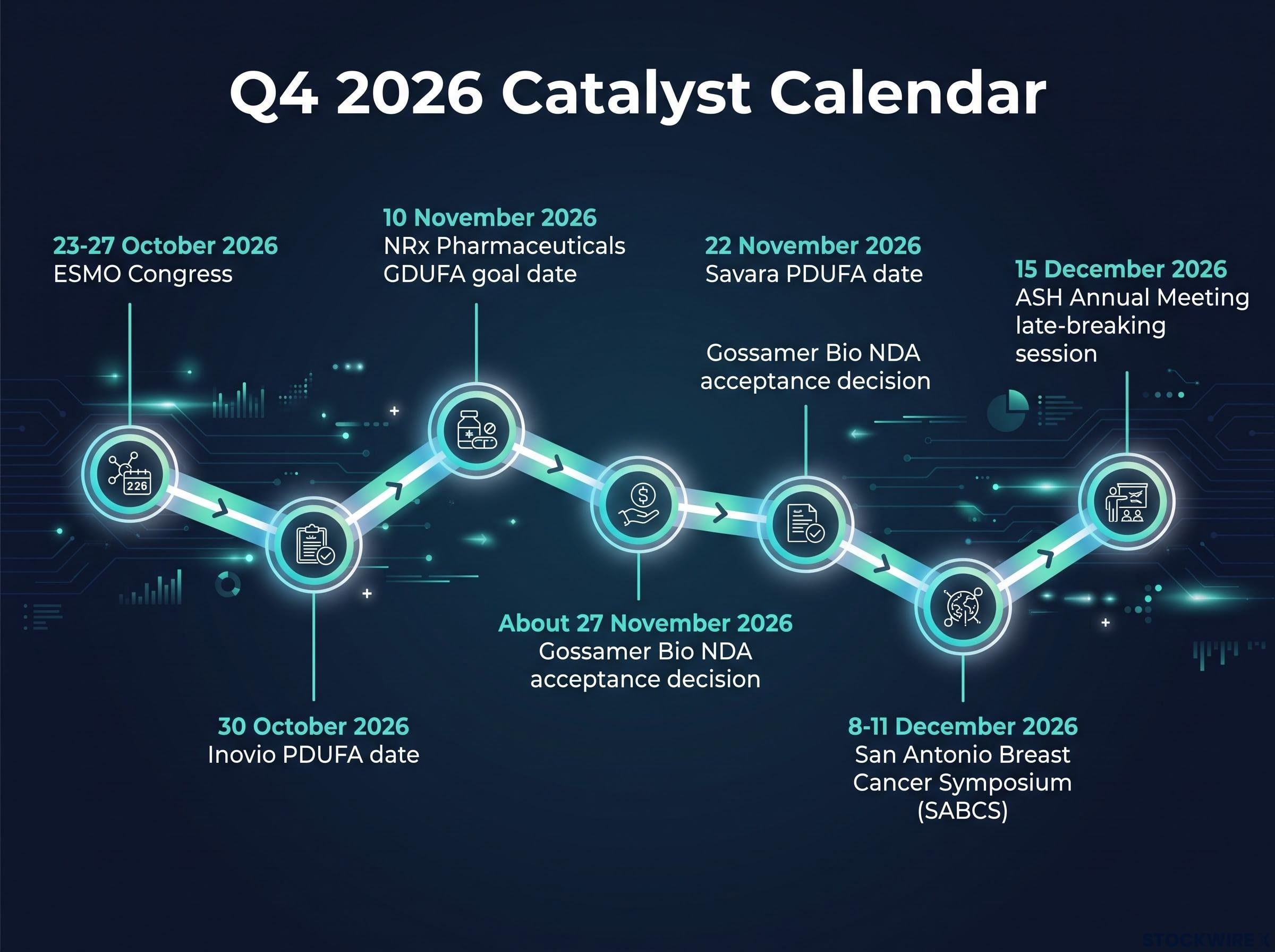
The ESMO Congress opens on 23 October, and December brings the San Antonio Breast Cancer Symposium and the American Society of Hematology (ASH) meeting. Many of the smaller companies on this calendar also carry financing triggers, reverse splits and Nasdaq listing problems that can move a share price as much as any trial result.
If you treat every date as a coin flip, you can lose money on events that were never about efficacy in the first place. This guide gives you a dated calendar for the next ten weeks and a method you can repeat to weigh risk and reward for each event.
What is on the calendar between now and year-end?
The regulatory dates come first. They cluster tightly, and they are not all the same kind of event.
Regulatory dates
Three terms appear in the table below. A PDUFA date is the FDA’s target deadline to act on a new drug or biologic application. A GDUFA goal date is the equivalent deadline for a generic drug application. An NDA acceptance decision is the earlier step where the FDA decides whether a new drug application is complete enough to review at all.
| Company or event | Date | Event type | Status | What to watch |
|---|---|---|---|---|
| Inovio INO-3107 (recurrent respiratory papillomatosis) | 30 October 2026 | PDUFA date (BLA, accelerated approval) | Standard 10-month review after priority review was denied; no advisory committee planned | Whether the FDA asks for more information to support accelerated approval |
| NRx Pharmaceuticals preservative-free ketamine | 10 November 2026 | GDUFA goal date (ANDA) | Date revised after the FDA reclassified an amendment from Major to Minor | Final action on labelling and the proposed proprietary name |
| Savara molgramostim | 22 November 2026 | PDUFA date (BLA, priority review) | Moved from 22 August after a major amendment | Whether the extended review resolves the open questions |
| Gossamer Bio seralutinib | About 27 November 2026 | NDA acceptance decision | NDA submitted 23 September; no PDUFA date yet | Acceptance or refusal to file |
Four events in under a month means November will do most of the work on this calendar.
Conference dates
- ESMO Congress, Madrid: 23-27 October 2026.
- San Antonio Breast Cancer Symposium (SABCS): 8-11 December 2026, with late-breaking titles due online on 30 October.
- ASH Annual Meeting: late-breaking submissions close on 28 October, and only six abstracts are scheduled for the late-breaking session on 15 December. The full meeting dates could not be confirmed.
When a date moves or a letter arrives, that news tells you where a file sits in the process. Log each event by its type rather than reading all of them as approval signals, because the risk attached to each type is different.
When big ASX news breaks, our subscribers know first
How to read a PDUFA, GDUFA or filing date
The most common misreading is simple: the date arrives, so a verdict must arrive with it. Sometimes that is true. Often the date only marks a point in a process that can bend, pause or restart.
Here is what each term actually means:
- PDUFA date: the FDA’s target date to act on a new drug or biologic. Action can mean approval, a complete response letter or a delay.
- GDUFA goal date: the same idea for generic drug applications.
- Priority review: a faster review, about six months instead of the standard ten.
- Accelerated approval: a conditional approval based on early evidence. The company must confirm the benefit later, and the approval can be withdrawn if that evidence falls short.
- Major amendment: a substantial new submission during review, which can extend the deadline, usually by three months.
- Complete response letter (CRL): the FDA’s formal notice that it cannot approve an application in its current form.
Key point A PDUFA date is an FDA action deadline, not an approval probability.
Savara shows how this works. Its responses to FDA information requests were classified as a major amendment, so the deadline moved three months. That extension is neither an approval signal nor automatic evidence of an efficacy problem.
The FDA review clock sets a standard 10-month target and a 6-month priority target, and a major amendment can add three months, so you should treat any shift in a goal date as a procedural change rather than a verdict on the drug.
NRx is a similar case. On 7 August, the FDA raised questions about the possible fragility of the container’s snap closure and classified them as minor. A later letter asked for sample labelling with the proposed brand name, which is a good procedural sign. It is still not an approval.
Inovio is the one to watch most closely. The FDA denied its request for priority review and warned that more information could be needed to support accelerated approval. The late-cycle review and facility inspections were reportedly completed, so manufacturing problems look less likely.
Failures are not always about efficacy. According to research that could not be independently verified, the FDA said in October 2025 that it would publish CRLs. A reported 2026 CRL entry for Eagle Pharmaceuticals cited labelling, packaging and facility inspection themes. If accurate, that is a useful reminder that manufacturing and paperwork can sink an application.
When a podcast host or analyst says a drug is “well positioned” for its date, treat that as opinion, not evidence. The hosts of the podcast behind much of this research, John Galliano and Chef, rated INO-3107 that way, and one of them disclosed that he owns Inovio shares.
Financing triggers, reverse splits and Nasdaq compliance: the risks beyond the data
A clinical win and a good result for shareholders are separate outcomes. The financing structure decides who gets paid when an event happens, and that can matter as much as the event itself.
Financing tied to acceptance
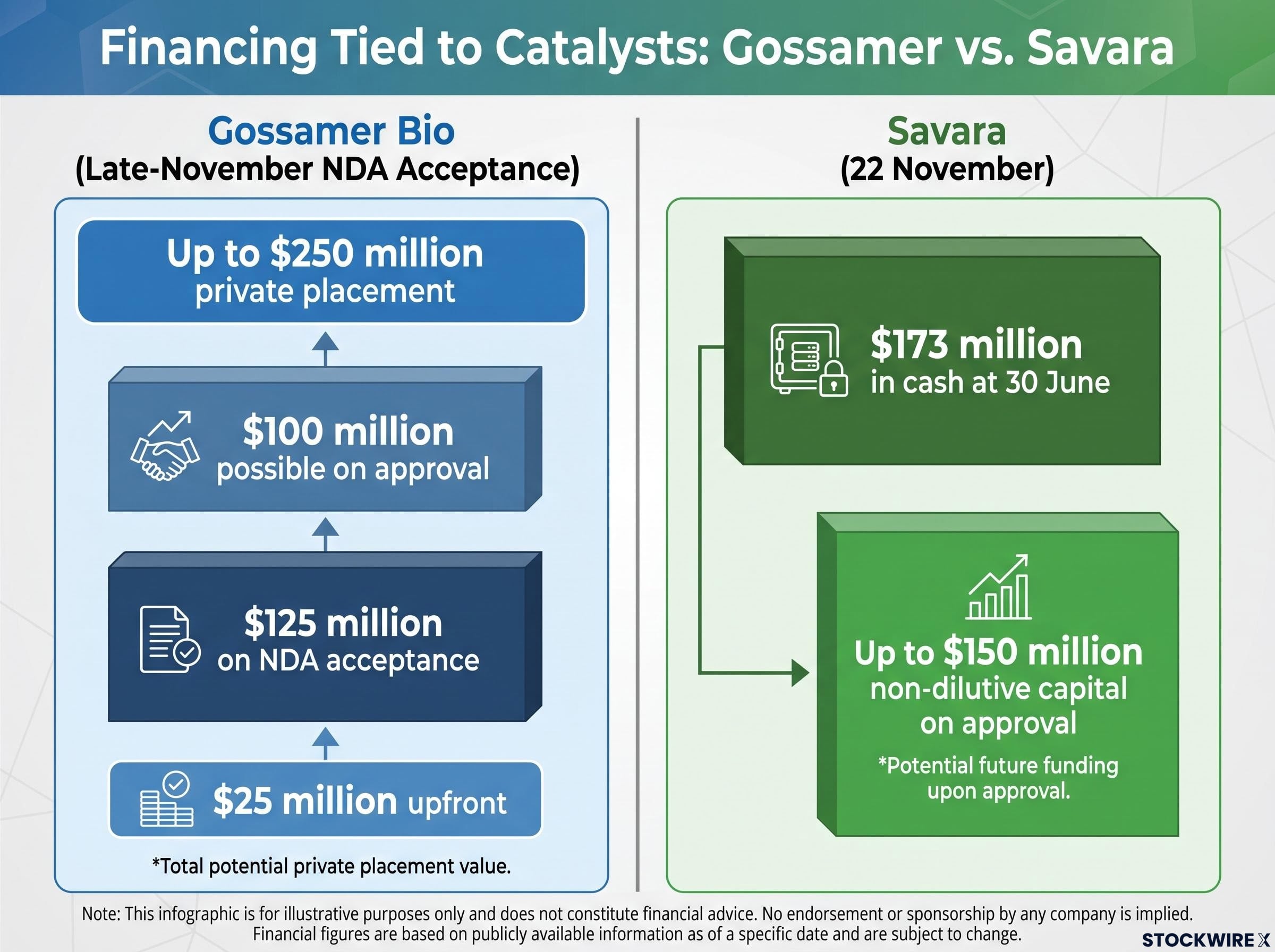
Gossamer’s August deal is the clearest example. It arranged a structured private placement of up to $250 million, with $150 million committed. Only $25 million came upfront. A further $125 million arrives on NDA acceptance, and another $100 million is possible on approval.
That makes the late-November filing decision a financing event, not just a regulatory one. The risk is real. Gossamer’s Phase 3 PROSERA trial missed its prespecified threshold. FDA meeting minutes reclassified two likely refuse-to-file objections as review matters, but that is not acceptance, and it is certainly not endorsement.
Savara offers the contrast. It held $173 million in cash at 30 June and has access to up to $150 million in non-dilutive capital, meaning money that does not create new shares, on approval. A delay hurts, but it is less likely to force a raise at a depressed price.
Reverse splits and Nasdaq notices
Nasdaq requires a minimum bid price of $1.00. A company that falls below it gets a deficiency notice and a 180-day period to recover. If it does not, it must choose between a reverse split, which combines shares to lift the price, and an extension request.
Fractyl Health chose the split. With shares near $0.60-0.70, it carried out a 1-for-12 reverse split effective 2 October, and split-adjusted trading began on 5 October. Pasithea (KTTA) took the other route: Nasdaq granted a 180-day extension from 16 September to 16 February, so no near-term split is needed.
A reverse split changes the share count and price. It does not change enterprise value, efficacy or cash runway, which is why the market often reads it as a warning sign. Gossamer’s own split took its shares from about $0.20-0.25 to about $9, and nothing in the underlying business changed.
Before you size a position around any catalyst, run four checks:
- Cash runway: how long can the company operate without raising money?
- Financing triggers: which tranches depend on which events, and do they arrive before or after the binary outcome?
- Listing status: is there an open Nasdaq notice, and how much time remains?
- Dilution history: how often has the company raised money, and at what prices?
Raising into strength still dilutes your holding. A delay can force a raise at the worst possible moment.
Before you size a position around any catalyst, remember that adverse trial results land as overnight gaps, so position sizing is the only risk lever you fully control; capping each catalyst bet well below your total risk capital limits the damage from a single failure.
Small-cap setups to watch: Fractyl, OS Therapies, Vivani, ProQR and others
Each setup below has something confirmed and something unresolved. The useful habit is to separate the two before you decide anything.
Fractyl: a catalyst already delivered
Fractyl reported results today, 16 October. When the source podcast was recorded two days earlier, the readout was still described as imminent.
The REMAIN-1 pivotal cohort met its co-primary endpoint, which is the main health outcome a trial is designed to measure. In a 315-patient randomised, sham-controlled cohort, Revita patients retained about 80% of their GLP-1-driven weight loss, compared with 67% for sham. Weight regain was 5.1% against 8.2% (p=0.0023). The company has targeted a De Novo submission to the FDA in late Q4 2026.
That is a clean result. It covers weight maintenance after GLP-1 treatment, though, and it says nothing yet about approval, reimbursement or how many doctors will adopt the procedure.
Setups still ahead
| Company | Catalyst | Expected timing | Key risk |
|---|---|---|---|
| OS Therapies (OSTX) | OST-HER2 accelerated approval BLA in osteosarcoma; possible PRV | Rolling review; no approval date confirmed | No approval or PRV award found |
| Vivani Medical (VANI) | NPM-139 Phase 1 topline | November 2026 | Novo Nordisk option status unknown |
| ProQR (PRQR) | AX-0810 Cohort 3 and 12-week data | By year-end 2026 | Lilly milestone status unknown |
OS Therapies needs the biggest correction. The source expected accelerated approval in December, but later research points to a pre-BLA process and a rolling review following an FDA statistical-methods meeting. The thesis rests on a Rare Pediatric Disease priority review voucher (PRV), a transferable voucher that speeds up a future FDA review. The company and the hosts cite sale prices of $200-250 million against a $35-40 million market cap, and one host owns the stock.
Vivani’s implant aims at weight maintenance for GLP-1 users. Novo Nordisk holds an option to partner, and director Greg Williams bought 1.6 million shares at $1.26 in June. ProQR’s Lilly collaboration includes possible milestone payments if AX-0810 succeeds.
Three quick hits round out the list:
- Pasithea: PAS-0004 Phase 1 data at ESMO on 23 October.
- KYNB: Phase 2 prostate cancer data in Q4, with a $31 million market cap.
- OID: OV329 epilepsy readout at year-end, backed by $170 million in cash.
Treat an option or a PRV as potential value that may expire, be renegotiated or never turn into cash. It is not money in the bank.
Building your own catalyst checklist for ESMO and beyond
Conferences act as both data events and deal events, because they put efficacy and safety results in front of large drugmakers. A partnership headline is not an acquisition, though, and it is not upfront cash or guaranteed funding.
Conference catalysts can disappoint even with positive data A late-breaking slot or good results may already be priced in. The market reaction depends on the size of the effect versus expectations, the safety profile and the commercial path.
A late-breaking slot is also not a result. ASH has only six of them, and no small-cap late-breakers have been identified at SABCS. Smaller or single-arm datasets also leave room for doubt over durability, missing data and safety exposure.
Conference slots, designations and meeting outcomes are different clinical milestone signals, and each reflects a different evaluating body; a competitive presentation slot is peer endorsement, not regulatory approval.
The FDA’s move toward publishing CRLs divides opinion. Optimists say transparency reduces uncertainty. Sceptics point to Savara: a strong package can still be delayed by a late major amendment.
Run every binary event through these six steps:
- Date type: is it a PDUFA date, a GDUFA goal or a filing decision?
- Regulatory history: have there been denied priority reviews, amendments or warnings?
- Financing trigger: what money arrives, and on which event?
- Listing status: is there an open Nasdaq notice or a recent split?
- Partner or PRV assumptions: is the value confirmed or only claimed?
- Post-event scenarios: what happens to the stock and the cash position on approval, delay or rejection?
Your edge comes from knowing what is verified and what is not. The research could not confirm the ASH meeting dates, the status of the Novo and Lilly options, or any small-cap conference presentations beyond Pasithea. Write those gaps down for each position instead of assuming them away.
This article is for informational purposes only and should not be considered financial advice. Investors should conduct their own research and consult with financial professionals before making investment decisions. Forward-looking statements are speculative and subject to change based on market developments and company performance.
What the calendar can and cannot tell you before the first date arrives
The dates give you structure, and the risk framework gives you context. Neither predicts an outcome.
The first checkpoints are close. ESMO opens on 23 October, Inovio’s PDUFA date follows on 30 October, and NRx’s GDUFA goal lands on 10 November. Savara on 22 November and Gossamer’s filing decision around 27 November come next.
As each event resolves, update your tracker. Record what happened, whether it was procedural or a verdict, and what remains unknown. That record is more useful to you than any forecast made before the date.