
GBP/JPY traded near 209.80 in Asian hours on Friday, 16 October 2026, its second straight daily gain. The lift came after UK GDP unexpectedly grew in August, while a Bank of Japan (BoJ) board member said the central bank should not become overly cautious about raising rates.
Two forces are now pulling on the same currency pair. The Pound is being lifted by expectations of a November rate hike from the Bank of England (BoE). The Yen, meanwhile, has a central bank that is talking tougher, which could limit how far it weakens from here.
That tension has kept the cross in a range between roughly 208.20 and 210.31 in recent sessions.
If you are forming a GBP/JPY forecast of your own, the useful question is not simply “up or down.” It is which signals are doing the lifting, which ones could cap the move, and which price levels will show you that the balance has shifted.
Why is the Pound holding firm near 209.80?
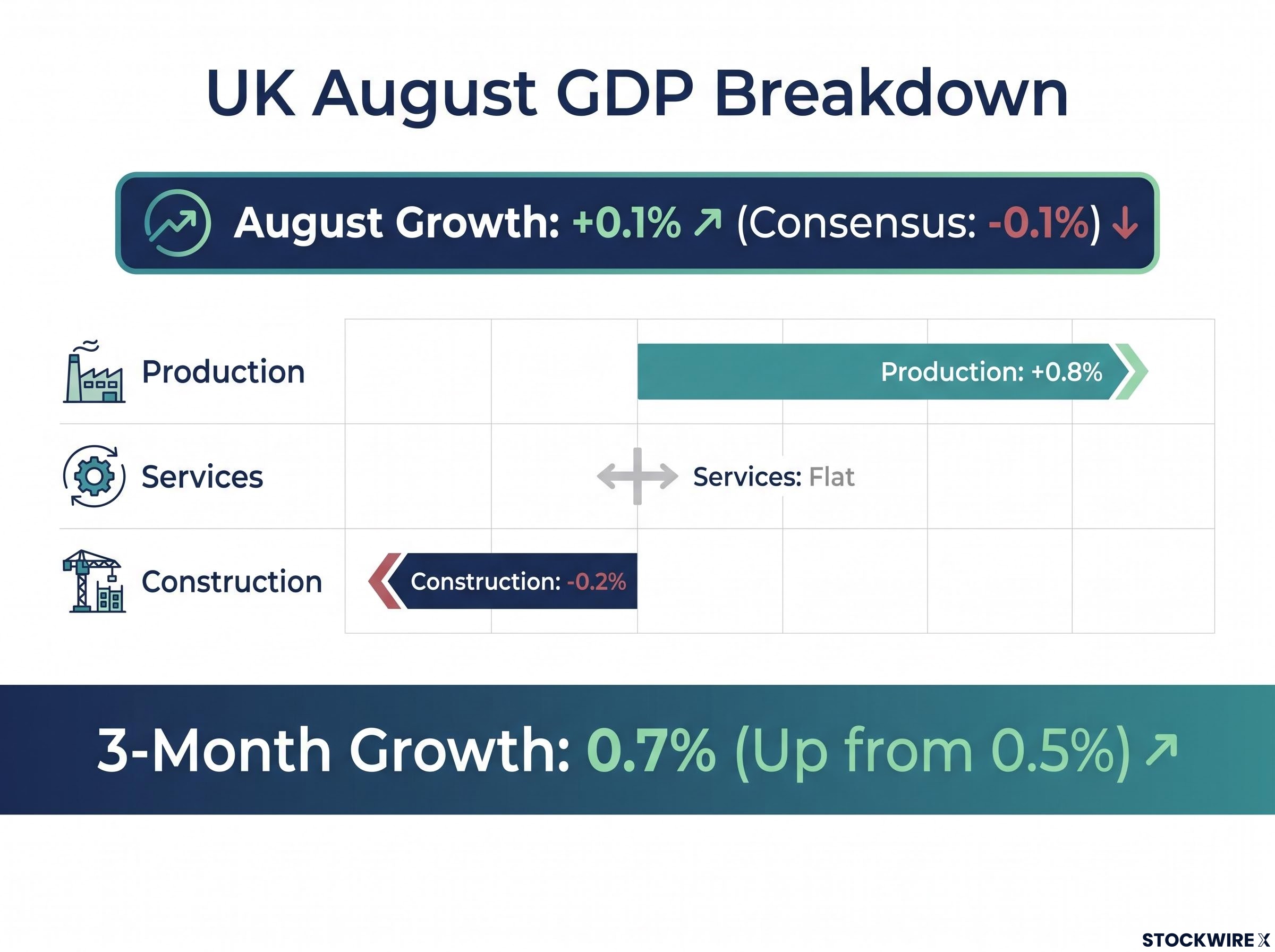
The number that moved the Pound arrived on Thursday. UK GDP rose 0.1% month-on-month in August, according to the Office for National Statistics (ONS). A Reuters poll had expected a 0.1% contraction.
The GDP surprise August growth: +0.1% month-on-month, against a -0.1% consensus forecast
The detail behind it was mixed. Production grew 0.8%, services were flat and construction fell 0.2%. Still, July’s 0.4% gain held unrevised, and growth over the three months to August reached 0.7%, up from 0.5%.
That beat weakened the argument that the economy was too fragile to cope with another hike.
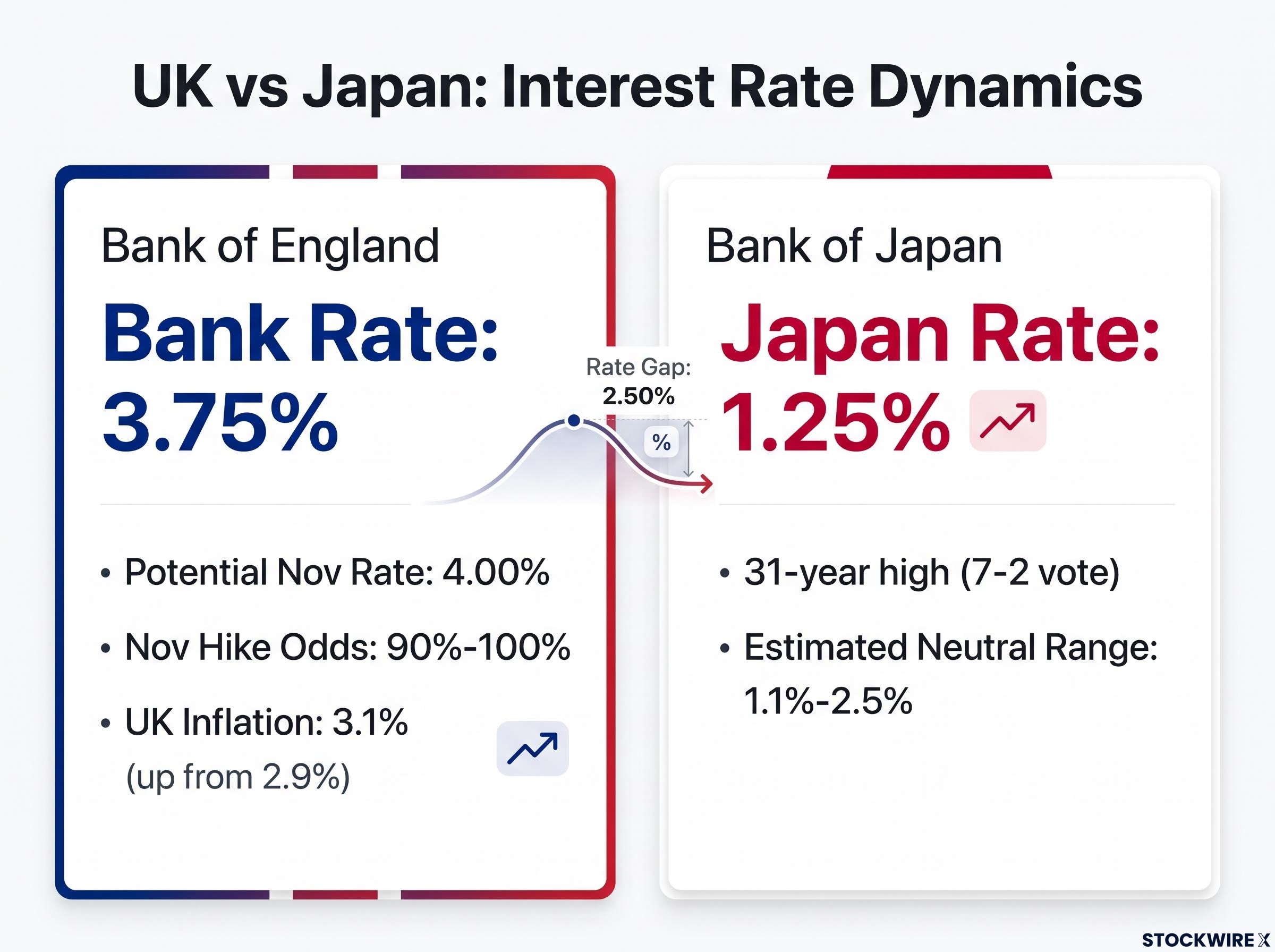
Bank Rate sits at 3.75%. A 25 basis point move (a quarter of a percentage point) would take it to 4.00%. Markets priced the odds of a November hike at roughly 90% in one assessment and close to 100% in another. Reuters found 54 of 63 economists expecting the move, with UK inflation running at 3.1%, up from 2.9%.
Governor Andrew Bailey, speaking in Bangkok, said the economy had proved sturdier than expected but that growth was still inadequate. He added that it was too early to judge second-round inflation effects, meaning the risk of higher prices feeding through into wages and services costs. Kenneth Broux at Societe Generale said the GDP beat strengthens the hike case, and Commerzbank judged a hike more likely than not.
The split between money markets and surveyed economists makes November hike pricing unusually contested, with traders treating headline CPI as a trigger while many forecasters point to stable core inflation as a reason to wait.
For you, the takeaway is that a hike is largely already in the price. Any further upside for the Pound depends on what the BoE signals about rates beyond November.
How BoE rates, QE and QT move Sterling
The BoE affects the Pound through three main channels:
- Interest rates: Hikes raise expected returns on UK assets and improve carry appeal, which tends to support Sterling. A carry trade means borrowing in a low-yielding currency to invest in a higher-yielding one.
- Quantitative easing (QE): The central bank creates money to buy bonds, which lowers yields and usually weakens the Pound.
- Quantitative tightening (QT): The central bank shrinks its bond holdings, which usually supports Sterling if done in an orderly way.
| Channel | Typical Sterling effect | Condition that flips it | October 2026 relevance |
|---|---|---|---|
| Rates | Supportive on hikes | Dovish hold or one-off signal | November hike priced near 90%-100% |
| QE | Weakens the Pound | Seen as preventing a severe recession | Not in play |
| QT | Supportive if orderly | Disorderly gilt selling | £488 billion of gilts left to unwind |
The BoE’s latest reported plan lets about £222 billion of those gilts mature and sells £146 billion, at roughly £20 billion a year. The Bank estimates QT has lifted gilt yields by about 0.25 percentage points. This week, though, the rate channel is the one at work.
Can the BoJ’s hawkish tilt cap the cross?
On the Yen side, the signals turned firmer. In a speech in Kumamoto on 15 October, BoJ board member Junko Koeda said the bank should adjust rates “in a timely manner” and described the neutral rate as “considerably above 1%.” The neutral rate is the interest rate that neither stimulates nor restrains the economy.
Junko Koeda, BoJ board member The BoJ “should not become overly cautious” about raising rates.
That lands on top of September’s hike to about 1.25%, a 31-year high, passed on a reported 7-2 vote. Reuters cites the BoJ’s estimated neutral range at about 1.1%-2.5%, leaving room to go higher. Markets are watching December, with an October move possible but not the main expectation.
Markets had largely priced the September hike itself, so the forward guidance that accompanied it mattered more for the Yen than the 25 basis point move.
Yet the Yen has not rallied decisively. Several reasons stand out:
- The rate gap is still wide. Japan’s 1.25% sits well below UK and US rates, so carry trades have little reason to unwind fast.
- No committed pace. Koeda gave no timetable.
- Rhetoric is not action. Reuters reported the BoJ might pause in October.
- The neutral-rate path implies gradualism. The range allows slow, cautious steps.
- Global yields and dollar demand. USD/JPY held near 158.10 despite the hawkish talk.
FXStreet’s Speechtracker scored the speech 8.2/10, exactly her historical average. In other words, the message was firm but not new.
What this means for you: hawkish BoJ talk limits Yen weakness at the margin, but on its own it does not reverse the carry advantage that favours GBP/JPY.
What could break the rally, and which levels matter?
The move already looks less secure than the headline suggests. After touching 210.31, the cross slipped back to about 208.89 before recovering.
The biggest open question is whether November brings one hike or the start of a cycle. BNP Paribas Wealth Management frames it as a single “insurance” move, and BoE Chief Economist Huw Pill has warned against reading a hike as the first of a long series. MPC member Megan Greene has been reported as favouring prompt action, which points the other way.
Beyond central banks, the risks pile up. One October assessment called the gilt market the Pound’s main vulnerability ahead of the budget. Japan has bought Yen to support it before, and GBP/JPY is a high-beta pair, meaning it swings harder than most when risk appetite changes. An equity or geopolitical shock can trigger rapid Yen buying.
Thin liquidity tends to amplify carry reversals rather than dampen them, and past blowups in August 2007, 2015 and 2024 show how fast a calm market can turn.
| Factor | Direction for GBP/JPY | Trigger to watch | Level or event |
|---|---|---|---|
| BoE guidance | Up if hawkish, down if one-off | Forward guidance tone | November BoE meeting |
| Gilt stress | Down | Rising long-term yields | UK budget |
| BoJ hike | Down | Timing signals | December meeting |
| Risk-off / intervention | Down | Rapid Yen buying | Equity or geopolitical shock |
A gilt wobble or risk shock can erase the carry story quickly. For you, that makes position sizing and stop placement more important than conviction about the BoE.
Key levels
- 210.31: recent high and first resistance
- 208.89: recent pullback level
- 208.50: first support
- 208.20: the 8 October low
- 208.00: round-number support
A clean break above 210.31 would suggest the hike story is still gaining ground. Failure to hold 208.50 would expose 208.20 and 208.00. With GBP/USD sitting near its 1.32 pivot, the Pound’s broader tone is worth checking too.
These statements are speculative and subject to change based on market developments. Past performance does not guarantee future results.
What to watch after Friday’s move, and what stays uncertain
The Pound has genuine support from firmer growth, sticky inflation and near-certain November hike pricing. The Yen has a central bank leaning hawkish, and a one-off BoE hike could cap the upside quickly.
That leaves you with three things to track:
- The November BoE decision and guidance: a single insurance hike or the start of a cycle.
- The BoJ’s December signals: whether talk turns into action.
- Gilt-market and risk sentiment: the fastest route to a sharp reversal.
Watch how these line up against the levels above before you commit to a direction.
This article is for informational purposes only and should not be considered financial advice. Investors should conduct their own research and consult with financial professionals before making investment decisions.