Carbonxt Group has lifted its FY27 revenue growth outlook to at least 40%, up from more than 33%, after Reworld added four more US waste-to-energy plants to its powdered activated carbon supply deal. The upgrade comes from a contract that was already running, which makes the detail behind the headline worth a closer look.
Alongside the contract news, the ASX-listed company is spending about $1.1 million from cash flow on a second mill at its Black Birch plant in Georgia, which is expected to double capacity. The upgraded outlook excludes the company’s Kentucky site. The announcements were dated 13 October 2026 and 14 October 2026.
All figures are in Australian dollars unless marked US$. Carbonxt’s operations are in the United States, but it reports in Australian dollars.
This piece covers how much of the 40% is already contracted, what the mill spend does and does not de-risk, and which variables will decide whether the guidance holds.
What actually sits behind the 40% growth outlook?
Forty per cent sounds like a step change. On FY26 revenue of $15.7 million (about US$10.6 million), the latest Reworld volumes add only a small part of that.
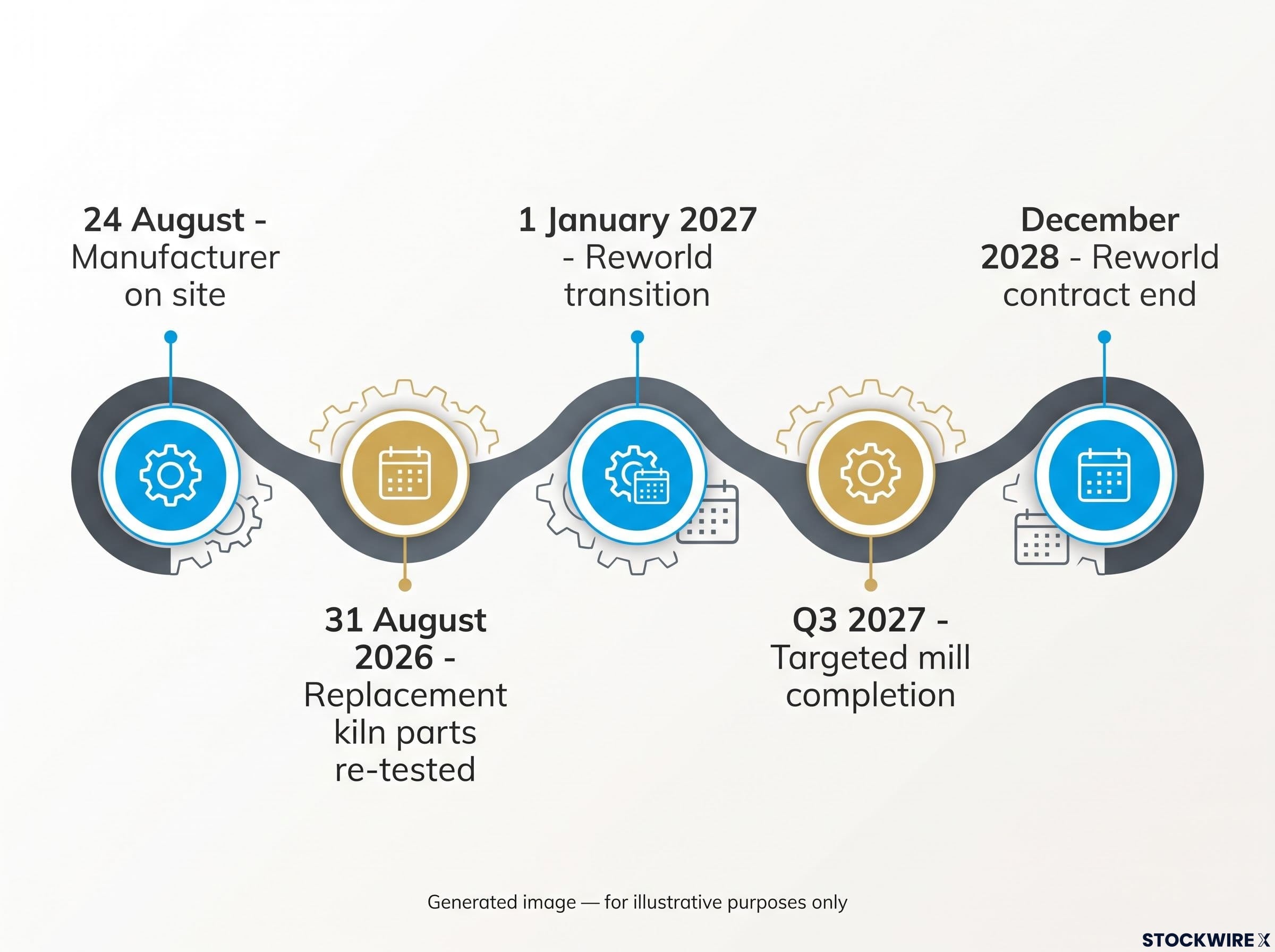
The four plants will switch to Carbonxt’s powdered activated carbon (PAC) on 1 January 2027. PAC is a fine carbon powder injected into exhaust gas to trap pollutants, and Reworld uses it to capture mercury, dioxins and furans. The switch lifts annual deliveries to Reworld by about 25%. Because Carbonxt’s financial year ends on 30 June, only January to June 2027 deliveries count towards FY27. That works out to roughly $1.0 million of revenue.
The larger drivers were already in place before this week:
| Driver | Size or effect | Timing | Status |
|---|---|---|---|
| Wisconsin Public Service pellet order | At least 25% of FY26 revenue | Reported 15 September 2026 | Supported earlier 33%+ outlook |
| Principal ACP customer extension | Contract revenue up more than 30% a year | Three-year term | Higher pricing secured |
| Reworld four-plant expansion | About $1.0M in FY27 | From 1 January 2027 to December 2028 | Contracted, not yet delivering |
TipRanks reported the Wisconsin Public Service order. The extension with the principal ACP customer came with the FY26 results. ACP refers to the company’s activated carbon pellet products. These sit on top of a Reworld relationship first extended in 2024 in a deal worth about $24 million, or roughly $6 million a year.
Management on the outlook Carbonxt says the projected growth comes solely from current operations, with no contribution from the Kentucky site.
For you, the takeaway is that the Reworld expansion confirms the relationship and extends visibility. It is not the main engine of growth. The 40% depends on several customers delivering, not on one headline contract.
Can a $1.1 million mill and a thin cash balance carry the growth?
The capacity project
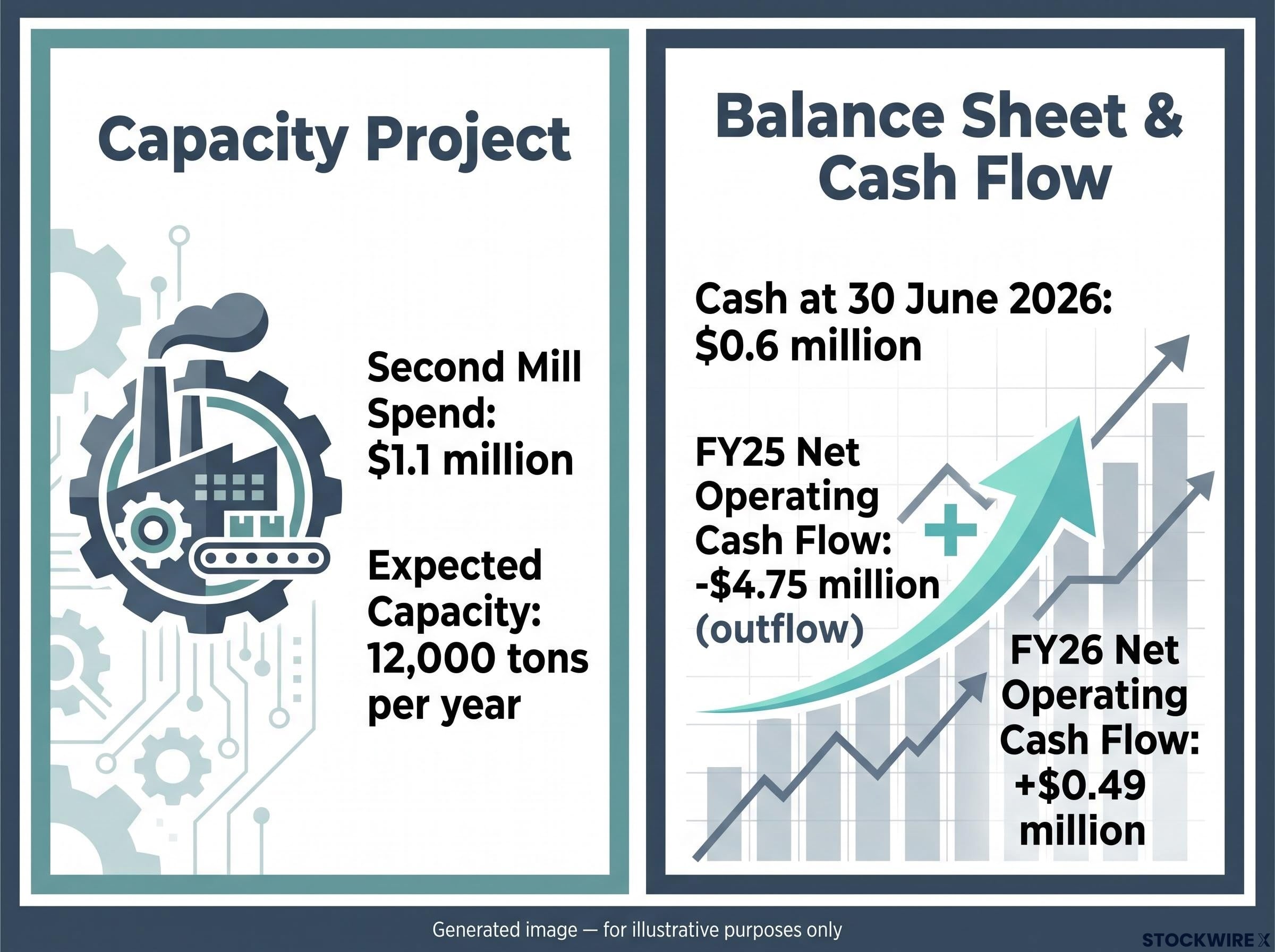
The second Black Birch mill, in Swainsboro, Georgia, is a modest spend for a large result. It is expected to double capacity to about 12,000 tons per year and give the plant a backup if one mill goes down.
Timing is less clear. The company announcement, as reproduced by ShareCafe, pointed to roughly two to three months for installation. Green Review cited completion targeted for Q3 2027. Until the company clarifies, treat the schedule as unsettled.
Warren Murphy, Managing Director Murphy described the expansion as evidence of customer trust. He said the mill provides capacity for the new volumes, adds redundancy and prepares the company for further demand.
This sequence suits a small industrial company: secure the contracted volume first, then fund a modest capacity step from operations. The alternative is a speculative build or an equity raise, which dilutes existing shareholders. For scale, Calgon Carbon is spending about US$100 million on roughly 12,300 tons per year of capacity in Ohio.
Another small-cap path runs through industrial partnerships, where a sorbent supplier such as Dotz Nano is trying to move up the value chain by teaming with a larger filtration group, a different route to scaling from the one Carbonxt is taking.
The balance sheet
The FY26 numbers show an improving business:
- Gross margin of $7.4 million, or 47.3%
- Q4 FY26 gross margin of 52.4%
- Net operating cash flow of positive $0.49 million, against a $4.75 million outflow in FY25
- Cash of $0.6 million at 30 June 2026
The last figure matters most. A $1.1 million mill is large next to $0.6 million of cash, although Carbonxt also reported a funding restructure after year-end.
The mill suggests management expects demand to be real and lasting. It also means any delay in installation would hit a balance sheet with little cash to absorb it.
Which risks and milestones decide whether guidance holds?
Customer concentration is the first risk. In February 2026, a slowdown at the largest PAC customer cut quarterly receipts and PAC sales. Volumes recovered in the June quarter, but the episode showed how quickly one account can move results. The Reworld deal adds to that concentration, and delays in commissioning or qualifying the four plants could push revenue back.
Kentucky is upside, not base case. As of 31 August 2026, replacement kiln parts were being individually re-tested, and the manufacturer had been on site since 24 August. Carbonxt has flagged an initial revenue milestone of about US$1 million, but it depends on testing, certification and customer approval.
Margins also deserve attention. The FY26 gross margin of 47.3% fell short of FY25’s 52.4%, so higher costs could absorb gains from extra volume.
Demand is more secure. US rules limit mercury and dioxin emissions from waste combustors, and PAC is used up continuously, so plants have to keep buying it.
No independent broker target prices or valuation models were found. Most of the commentary comes from the company. Limited trading in small ASX stocks can also exaggerate share price moves around news.
Milestones to track:
- Black Birch mill installation and commissioning
- Reworld transition on 1 January 2027
- Kentucky kiln testing outcome
- Half-year FY27 results
- Reworld contract end in December 2028
Guidance looks credible on contracted volumes but fragile on timing. The January transition and the mill start-up are the checkpoints that matter.
What the Reworld deal changes, and what it leaves open
The expanded contract extends revenue visibility to December 2028, and the new mill removes an obvious capacity limit. Neither guarantees the 40%. The outlook still depends on the mill being installed on time, the four plants switching over smoothly, and customers beyond Reworld keeping their volumes.
At the next update, check three things: whether the mill is running, whether Reworld deliveries started on schedule, and how the cash balance has held up through the spend. Those answers will show whether the upgrade holds.
This article is for informational purposes only and should not be considered financial advice. Investors should conduct their own research and consult with financial professionals before making investment decisions. Financial projections are subject to market conditions and various risk factors, and forward-looking statements may change based on company performance.