
On Monday, 12 October 2026, three well-known stocks moved before the opening bell. Stellantis rose, Micron Technology fell about 2.1% and GoDaddy slipped roughly 1%. Today’s stock market news grouped them together, but the three moves had almost nothing in common.
One came from a trade deal negotiated in Beijing. One came from a union demand in Taiwan and a rising Chinese chipmaker. The third came from a single broker changing its opinion.
Each of those catalysts reprices a company through a different mechanism and on a different timeline. Read them as one stream of red and green numbers and you risk reacting to all of them in the same way.
Here is a way to sort each headline into macro, operational or analyst-driven before you decide whether it deserves your attention, using today’s three moves as worked examples.
Why the EU-China hybrid understanding gives Stellantis breathing room, not a permanent shield
The relief arrived from Beijing. After two days of talks, EU Trade Commissioner Maros Sefcovic announced an understanding that would moderate Chinese exports of hybrids and plug-in hybrids to Europe, and Stellantis shares rose. The available reporting did not quantify the percentage move.
The deal closes a gap. Higher EU tariffs already applied to Chinese battery-electric vehicles, but hybrids had slipped past them, becoming the main route for low-priced Chinese cars into European showrooms. Sefcovic did not explain how the understanding would be implemented.
Then the arithmetic starts to matter. According to reporting from investinglive.com, Bloomberg and Reuters, the reported terms are:
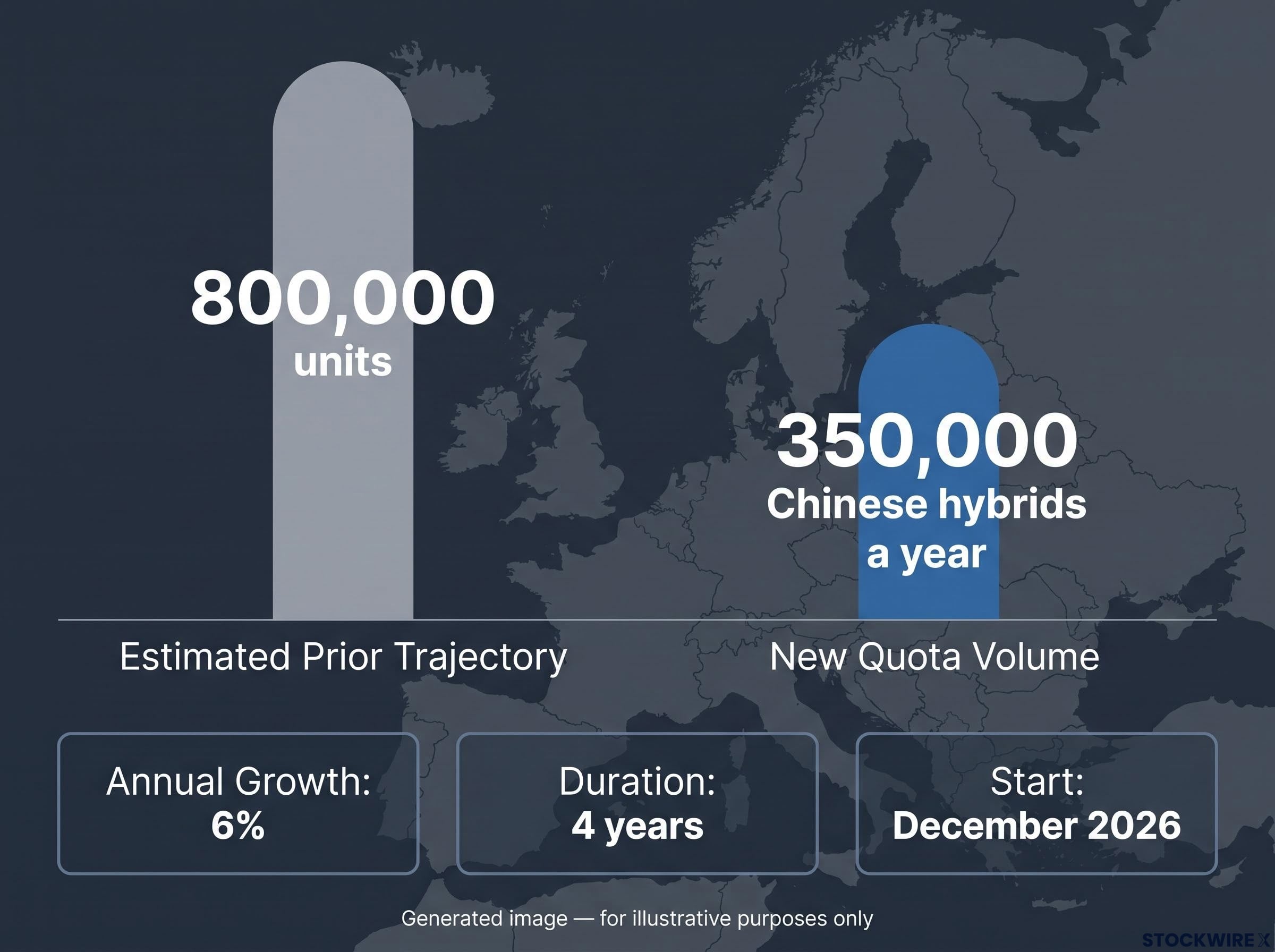
- Volume: about 350,000 Chinese hybrids a year
- Growth: rising about 6% annually
- Duration: four years
- Start date: possibly as early as December 2026
- Coverage: plug-in and non-plug-in hybrids across the EU, EFTA and the UK, including joint-venture brands such as Stellantis-Leapmotor (Dataforce figures via briefs.co)
Against an estimated prior trajectory of about 800,000 units, exports could fall by more than half. That is meaningful. It is also a cap that grows every year.
What the quota does and does not protect
A tariff is a tax on imports that changes relative pricing. A quota is a hard limit on how many units can enter. This deal layers a quota on top of existing tariffs, which makes it more complicated to enforce and easier to dispute.
“Buys time” briefs.co characterised the concession as averting a trade clash and buying time while the EU prepares safeguard measures, a stop-gap rather than a settlement.
The risks are enforcement, retaliation and creep toward broader trade barriers. If export reductions disappoint, the EU could fall back on unilateral safeguards.
What this tells you is that the rise was not really a Stellantis story. The market repriced industry economics for Volkswagen, Renault and Stellantis together, so the useful question is how long the relief lasts, not whether one carmaker won.
When big ASX news breaks, our subscribers know first
Micron’s two-front problem: a Taiwan profit-share dispute and CXMT’s rise in DRAM
The louder headline came from Taiwan. The quieter one, from China, may matter more.
The labour dispute
Unions at Micron’s Taoyuan and Taichung plants want 15% of operating profit paid to employees quarterly, through a permanent, verifiable system. Micron has declined to formalise it.
The company’s answer was its largest bonus payout ever. Taiwan staff who joined before 29 August 2025 receive a T$1 million (about US$31,500) cash bonus, equal to 35-68 months of pay for direct-labour employees, as part of fiscal-2026 rewards for more than 60,000 employees globally. The unions rejected it because it happens once.
That distinction is the point. A one-off bonus is a cost; a permanent profit share is a structural cost, and investors typically treat that as lasting compression of margins and free cash flow.
A strike-authorisation vote passed at one plant in early October, and mediation continues. Sources conflict on the workforce involved, with figures of roughly 12,000 and roughly 15,000 both reported. Taiwan is a key production centre for Micron’s DRAM and high-bandwidth memory (HBM), the stacked memory chips used in AI servers, so a prolonged outage would carry real supply risk.
The competitive threat
ChangXin Memory Technologies (CXMT) has been gaining ground steadily, according to Counterpoint Research and TrendForce data:
- About 4% of global DRAM revenue a year earlier
- About 8% in Q1 2026
- About 10% in Q2 2026, ranking fourth behind Samsung, SK hynix and Micron
The gains have come mainly in commodity and mobile DRAM, and CXMT has also announced advances on its newest chip architecture, which may allow more data to be packed into each device.
The same-day reaction across Seoul and Shanghai shows how the market is pricing the CXMT 4F2 DRAM design as a signal of future competition, even though no product has shipped and no specifications have been published.
| Risk | Nature | Time horizon | Escalation trigger |
|---|---|---|---|
| Taiwan labour dispute | Negotiable cost and execution risk | Medium term | Strike, outage or a permanent 15% profit share |
| CXMT share gains | Structural competitive pressure | Ongoing | Further share gains, price pressure in commodity DRAM |
Commentators tend to weigh CXMT as the more structural valuation risk. The read for you is that a labour dispute only becomes a valuation problem if it escalates or locks in permanent cost, while a rival’s share gains erode pricing power whether or not anyone walks out.
What an RBC downgrade tells you about GoDaddy, and what it may already have priced in
A 1% slip looks underwhelming for a downgrade. The muted reaction is the informative part.
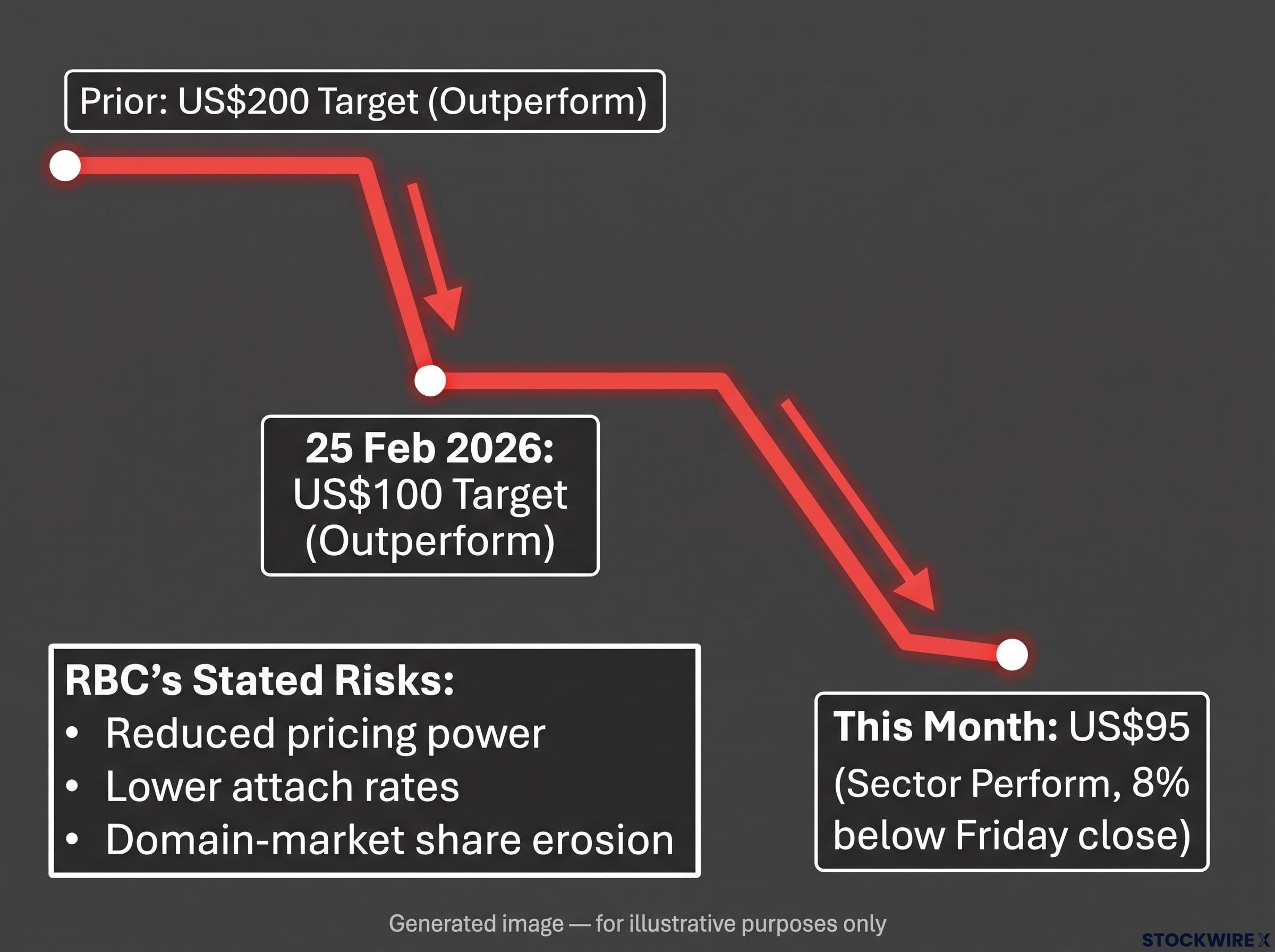
RBC Capital Markets cut GoDaddy (NYSE: GDDY) from Outperform to Sector Perform with a US$95 price target, about 8% below Friday’s close. The sequence matters:
- Earlier, RBC held a US$200 target.
- On 25 February 2026, it cut the target to US$100 while keeping its rating, citing weak bookings and AI concerns.
- This month, it downgraded the rating and trimmed the target to US$95.
RBC’s three stated risks Reduced pricing power; lower application and commerce attach rates; domain-market share erosion as the AI-driven web transition accelerates.
An attach rate is the share of customers who buy an additional product alongside their core purchase, such as a website builder sold with a domain.
Price target cuts and rating downgrades are not the same signal: the first often reflects changed model inputs, while the second expresses a stronger directional view, which is why the sequence of RBC’s moves matters.
Academic research on analyst recommendations has generally found that downgrades are followed by negative abnormal returns, strongest on announcement day. That is a broad finding, not one verified for this case. Here, the big cut came eight months ago, so much of RBC’s caution may already sit in the price.
Caveats apply. Pre-market moves can reverse once liquidity deepens, and price targets rest on model assumptions that can lag fast shifts.
Because RBC cited a secular AI threat rather than valuation alone, the downgrade is a statement about the business model. Watch whether other analysts revise their models, not one morning’s price.
A framework for sorting stock market news: macro, operational and analyst catalysts
You have now seen all three types in action. The categories are simple once named.
A macro or policy catalyst changes the rules an entire industry operates under. The hybrid quota touched every European carmaker, and trade terms rarely reverse quickly.
An operational or competitive catalyst hits one company’s costs, supply or market position. Micron’s dispute could settle quickly or drag into disruption, while CXMT’s gains build quietly.
An analyst-driven catalyst changes expectations rather than the business itself. Its weight depends on how far it departs from consensus and whether fundamentals confirm it.
| Catalyst type | Example | Breadth | Reversibility | What to check next |
|---|---|---|---|---|
| Macro/policy | EU-China hybrid quota (Stellantis) | Several companies | Slow to reverse | Implementation and enforcement |
| Operational/competitive | Taiwan dispute and CXMT (Micron) | Single company, sector spillover | Negotiable; competitive shifts persist | Mediation outcome, DRAM share data |
| Analyst-driven | RBC downgrade (GoDaddy) | Single company | Depends on fundamentals | Other analysts, company results |
Each pre-market move is only the first reaction. Stellantis still faces long-term EV and hybrid competition. Micron’s lasting impact depends on its cost structure and whether CXMT’s gains hold, and GoDaddy will be reassessed as the company reports.
Before acting on any headline, run it through four questions:
- Is the cause macro, operational or analyst-driven?
- Does it affect one company or the whole sector?
- Is it a one-off, or does it change costs or competition permanently?
- What new information does it contain that the market did not already have?
Treat a pre-market move as a prompt to investigate the cause, not as a standalone reason to change a long-term position.
What the three moves change, and what they leave open
Today delivered one policy catalyst, one operational and competitive catalyst and one opinion catalyst, each with a different shelf life.
The open variables are specific. Watch whether the hybrid quota is implemented in December 2026 and properly enforced. Track the outcome of Micron’s mediation alongside CXMT’s next DRAM share readings, and see whether other analysts follow RBC on GoDaddy.
Sort the catalyst first. Only then decide whether the move deserves any response from you.
Readers interested in how sector exposure shapes portfolio outcomes can use our detailed coverage of cyclical and defensive allocation, which sets out how weightings shift across the economic cycle.
Past performance does not guarantee future results. Forward-looking statements are speculative and subject to change based on market developments and company performance.
This article is for informational purposes only and should not be considered financial advice. Investors should conduct their own research and consult with financial professionals before making investment decisions.