
Most investors assume a company worth about $4.3 trillion cannot offer a margin of safety, the cushion between what you pay and what a business is worth. One Rule One analyst argues otherwise. On his numbers, Google Services alone, with Google Cloud valued at zero, could still return about 8% a year at today’s price.
That claim matters because Berkshire Hathaway has made Alphabet roughly its third-largest holding. Its Q2 2026 13F filing, released in August 2026, shows about 106 million shares worth around $37 billion at 30 June 2026. Some critics read the purchase as a sign of decline.
Two mistakes are possible here: dismissing a well-priced franchise, or overpaying for one. The analysis below draws on Alphabet’s Q2 2026 results, reported on 22 July 2026. Every valuation figure is one presenter’s Rule One estimate, not an independent forecast.
You will come away with a worked method you can stress-test yourself, and a clear list of the risks that could break it.
What Berkshire actually owns, and what Alphabet just reported
The confirmed facts come from the 13F filing, a quarterly disclosure of US equity holdings. Investopedia’s summary puts the stake at about 106 million Class A and Class C shares, worth around $37 billion. International Business Times broke down the Q2 buying as 24.5 million Class A shares (about $7.9 billion) and 23.6 million Class C shares (about $7.6 billion). That adds up to roughly 48.1 million shares and $15.5 billion added in a single quarter.
Berkshire’s Q2 purchases ended a 14-quarter net-selling streak and spanned nine companies, which places the Alphabet addition within a wider capital allocation shift rather than a single isolated bet.
The details get less certain beyond that.
- Confirmed by 13F coverage: about 106 million shares, about $37 billion, roughly third-largest holding, about $15.5 billion bought in Q2
- Not confirmed: a 9-10% portfolio weight and a discrete $10 billion tranche in June (both reported by Motley Fool)
- Likely misread: a BingX flash note’s “$17 billion stake,” which appears to describe the purchases, not the full position
- Missing entirely: any on-the-record explanation from Warren Buffett or Greg Abel
The business results are on firmer ground.
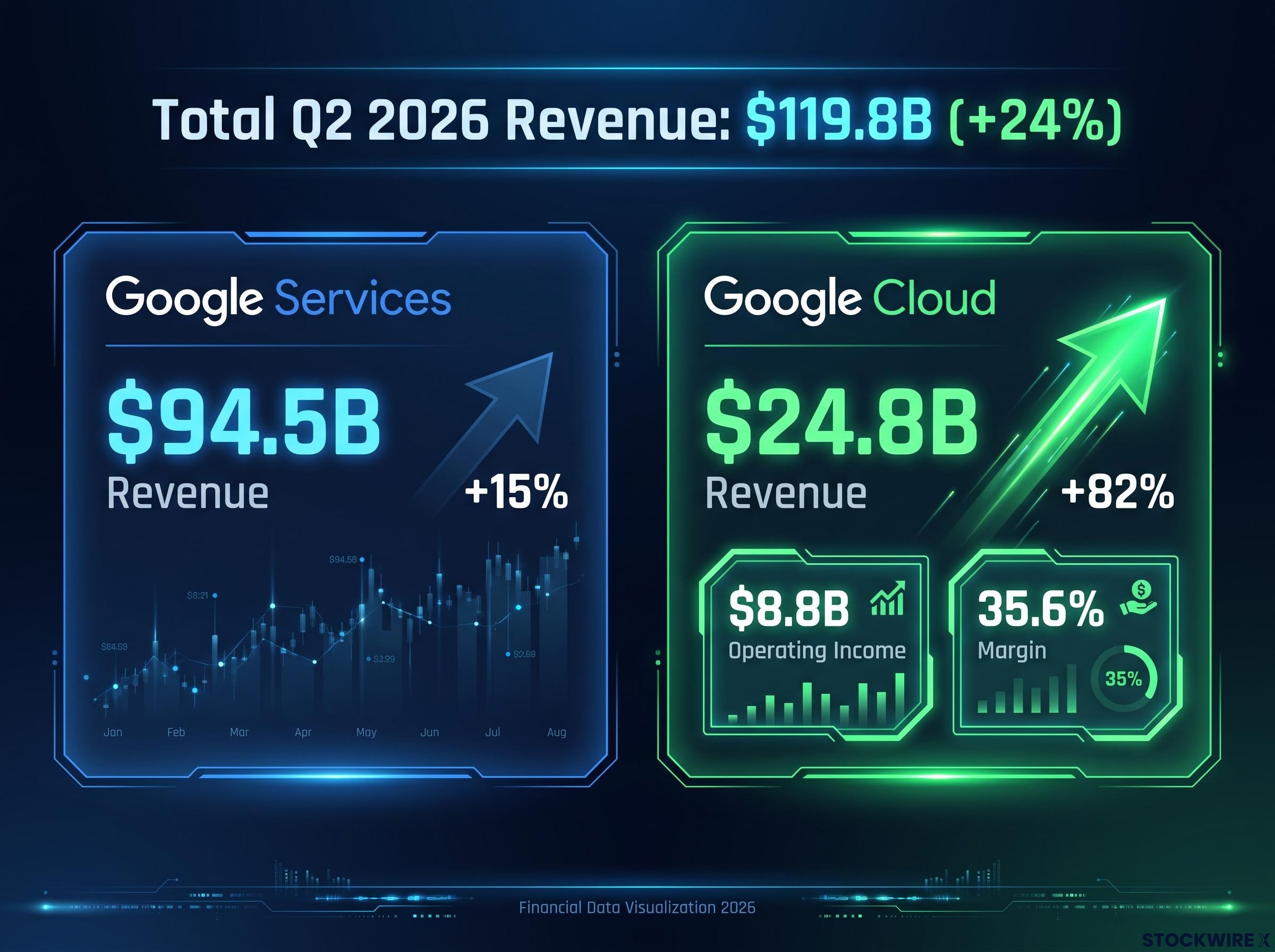
| Segment | Q2 2026 revenue | Growth | Operating income | Note |
|---|---|---|---|---|
| Google Services | $94.5B | +15% | Not separately disclosed | Search +17%, YouTube ads +13%, subscriptions +15% |
| Google Cloud | $24.8B | +82% | $8.8B (from $2.8B) | Margin 20.7% to 35.6%; backlog $514B |
| Total | $119.8B | +24% | $40.7B (+30%) | Price about $352; trailing P/E 17.45, forward 22.83 |
Cloud’s margin jump is the figure to watch. Alphabet now runs two profitable engines, so the share price no longer has to be justified by advertising alone.
When big ASX news breaks, our subscribers know first
How does a conservative margin of safety work?
Valuing a stock can feel like guesswork. The Rule One method, associated with Phil Town, narrows that by making each assumption deliberately cautious. It focuses on free cash flow and demands a large margin of safety.
The chain has four links:
- Estimate owner earnings, meaning the profit a business really generates for its shareholders.
- Apply a growth rate below the company’s own history.
- Set a reasonable future price-to-earnings (P/E) ratio, which is the share price divided by earnings per share.
- Work back to the annual return that today’s price implies.
This reframes the question. You stop asking “what is the fair price?” and start asking “what is my return if the cautious scenario is simply what happens?”
The benchmark According to the presenter, Buffett reportedly said the Google investment should very likely return more than a Treasury bill. This is relayed second-hand, not a confirmed Buffett quote.
Benjamin Graham’s older approach demands a clear discount to conservative intrinsic value. Fast-growing mega-caps strain that test because so much of their value sits years out. Rule One also requires a strong moat (a durable competitive advantage) and capable management, and the presenter considers both satisfied here.
The horizon is ten years, to 2037, not the volatile next one to two years. The presenter first bought in late 2022, when advertising alone justified the price. He now holds nothing and wants a lower entry than Buffett paid.
The output is a hurdle, not a price prediction. You compare it with what a Treasury bill pays.
The worst-case maths: Google Services alone, then Cloud on top
The presenter starts with Services and gives Cloud no value at all. He annualises Services operating income at about $158 billion, built on a Q2 figure of $39.5 billion (about +20%). Alphabet’s public materials do not separately disclose that number, so treat it as presenter-sourced. Losses at ventures such as Waymo explain why segment profits can exceed the group total.
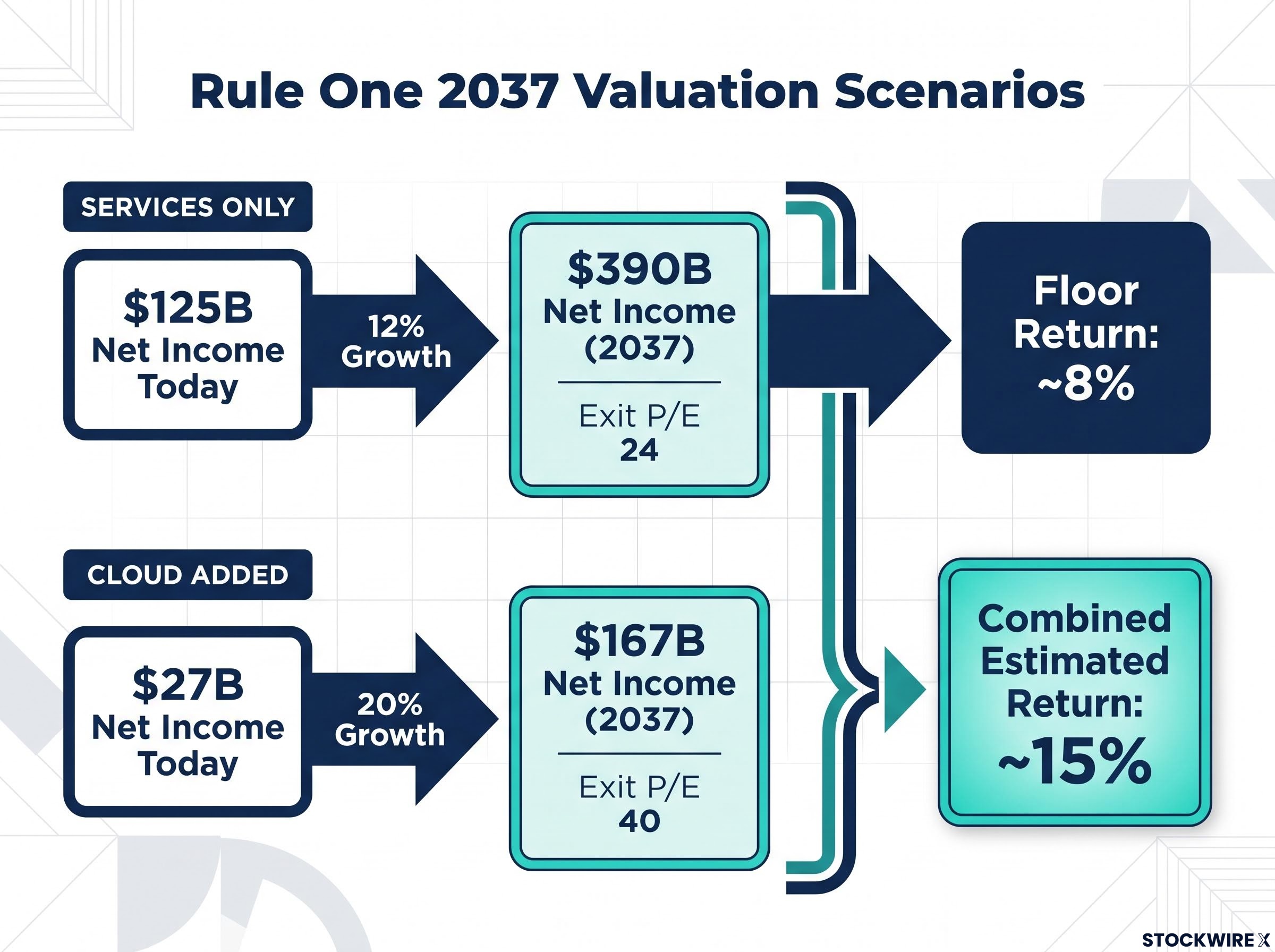
After a 21% tax rate, that leaves about $125 billion in net income. At 12% annual growth, which the presenter calls conservative against historical growth above 20%, net income reaches about $390 billion by 2037. A 24 P/E puts the segment at about $9.3 trillion, against a current market cap of about $4.25 trillion.
That gap works out to roughly 8% a year, and it assumes everything outside Services is worthless.
Cloud then sits on top. The presenter takes forward operating income of over $35 billion (about $27 billion net) and assumes 20% growth, rejecting both the recent 200% pace and a 12% rate. That produces about $167 billion by 2037, worth about $7 trillion at a 40 P/E.
The unresolved question for Cloud is margin durability: the gap between a 25% and a 35% operating margin at scale is worth tens of billions in annual income, and new hyperscaler supply arrives in 2027-2028.
| Scenario | Net income today | Growth rate | 2037 net income | Exit P/E |
|---|---|---|---|---|
| Services only | $125B | 12% | $390B | 24 |
| Cloud added | $27B | 20% | $167B | 40 |
Combined, the presenter estimates a return near 15% a year and a market cap of about $16 trillion in ten years. Waymo, other AI initiatives and Tensor Processing Units (TPUs, Google’s in-house AI chips) are counted only as upside.
Stress-testing the inputs
- Lower Services growth: the 2037 earnings base shrinks, pulling the return below 8%
- Lower Services multiple: the exit value falls, cutting the return in the same way
- Slower Cloud growth or a lower Cloud P/E: the combined figure moves back towards the Services floor
- Lower entry price: every scenario improves, lifting the return above 8%
The step from 8% to 15% rests on Cloud. A 20% growth rate held for a decade and a 40 multiple are the softest inputs in the model, and that is where your own judgement counts most.
Past performance does not guarantee future results. These projections are speculative and depend on market conditions and company performance.
Is the critics’ case against Buffett’s Alphabet stake fair?
The sceptics have real points. A forward P/E of 22.83 sits well above traditional value stocks, and that is hard to square with Graham-style discipline.
- Critics: they see a decline narrative, possibly Buffett’s last major buy, concentration risk, and an AI spending cycle that could turn
- Counterpoints: Berkshire started buying Apple in 2016 and built it into its largest holding on brand, ecosystem, recurring cash and buybacks; value investors have also often underestimated how durable platform moats can be
The dividing line: Apple buyers paid a fair price for growth that arrived. Dot-com buyers paid extreme prices for growth that never did.
The presenter adds that Buffett has been called irrational before and has historically been proven right. Even so, much of this stake was built under Greg Abel, who took over as CEO at the start of 2026. Berkshire has not explained its reasoning publicly.
Treat Berkshire’s buy as one data point. Because its rationale is inferred rather than stated, it cannot replace your own margin-of-safety check.
What could break the case in the next two years?
The maths looks comfortable until you name the threats. Alphabet raised its 2026 capital expenditure guidance to $195-205 billion, up from $180-190 billion, and the shares came under pressure despite the Q2 beat. The presenter lists an AI infrastructure bubble as a risk over the next one to two years.
Other risks come from broader commentary rather than the Q2 sources. These include antitrust remedies and the possibility that chatbots take queries away from Search. The presenter also flags recession risk tied to the Iran conflict and oil-driven inflation, and Alphabet’s high fixed costs make its earnings sensitive to any revenue shortfall.
| Risk | Time horizon | Hits price or earnings power | What to watch |
|---|---|---|---|
| AI capex overshoot | 1-2 years | Price first; earnings if returns disappoint | Cloud margin against capex growth |
| Recession and inflation | 1-2 years | Mostly price | Advertising and cloud spending trends |
| Antitrust remedies | Multi-year | Earnings power | Limits on self-preferencing or AI integration |
| AI replacing Search | Long term | Earnings power | Search revenue growth |
A falling price on its own lifts the return for new buyers. A fall in earnings power is different, because it breaks the model. Decide now which events you would treat as a chance to buy and which as a reason to sell.
Investors exploring the capex risk further can read our deep-dive into AI capex versus monetisation, which shows why hyperscaler spending now absorbs roughly 93-94% of operating cash flow.
Applying the framework to your own margin-of-safety call
The method works on any company. For Alphabet, use the presenter’s assumptions as starting points to adjust, not as recommendations.
- Pick segment earnings, such as Services net income of about $125 billion.
- Choose a growth rate below the company’s history (the presenter uses 12% for Services and 20% for Cloud).
- Set an exit multiple (24 and 40 in his model).
- Calculate the annual return from today’s price of about $352.
- Compare that return with the risk-free rate.
Hold unprovable bets such as Waymo and TPUs outside the base case. Treat them as a free option, upside you are not paying for.
Where to adjust for your own risk tolerance
Set your own required return before you look at the result. If it sits above the worst-case 8%, your entry price has to be below today’s.
Your hurdle decides whether this price offers enough safety for you, not Buffett’s and not the presenter’s. This is educational analysis, not personal financial advice.
Why the margin of safety, not the headline name, should drive your decision
The presenter’s maths gives a Services-only floor near 8% and a Cloud-inclusive estimate near 15%. Both depend on his assumptions, not on independent forecasts.
Before the next earnings cycle, watch three variables:
- whether the capex surge earns its return
- whether Cloud can hold its growth and margins
- how regulatory remedies take shape
The decision comes down to your required return set against the price on offer, not to Berkshire’s name on the register.
This article is for informational purposes only and should not be considered financial advice. Investors should conduct their own research and consult with financial professionals before making investment decisions.