The International Monetary Fund (IMF) now projects Hungary’s 2026 budget deficit at 7-7.5% of GDP, more than double the 3% Maastricht ceiling for euro entry. It has also told Budapest that euro plans will not close that gap, a message that sharpens the Hungary forint outlook. The warning came in the IMF’s Article IV concluding statement, published on 7-8 October 2026 after a staff mission that ran from 23 September to 6 October.
An Article IV review is the IMF’s regular check-up on a member country’s economy and policies.
The timing matters for anyone holding forint assets or Hungarian government bonds. Two kinds of credibility are being tested at once. The government’s is on the line over the budget, and the Magyar Nemzeti Bank’s (MNB) is on the line over inflation, with a rate pause and a new, lower inflation target both in play.
The forint’s risks are easiest to judge from two sides. First, ask whether Budapest has a believable plan to shrink the deficit. Second, ask whether the central bank’s actions match its words.
Why the IMF says the euro is an anchor, not a shortcut
The IMF was blunt about the euro. It said the currency union could give reform efforts something to aim for, yet it cannot do the reforming itself, and Hungary should see adoption as a goal for the medium term, not a quick remedy for its economic or exchange-rate troubles.
The arithmetic explains the bluntness. If policies stay as they are, the IMF expects budget shortfalls to remain beyond the Maastricht limits over the medium term, with public debt continuing to climb. Its answer is sizeable consolidation, meaning a sustained cut to the deficit through spending restraint, higher revenue or both.
The Fund set three tests for that effort: it should be credible, growth-friendly and early. The levers it named were lower subsidies, lower administrative spending and tax reform. The statement gave no quantified path and no detailed list of measures. The coverage also confirms no official euro adoption timetable.
What Maastricht actually requires
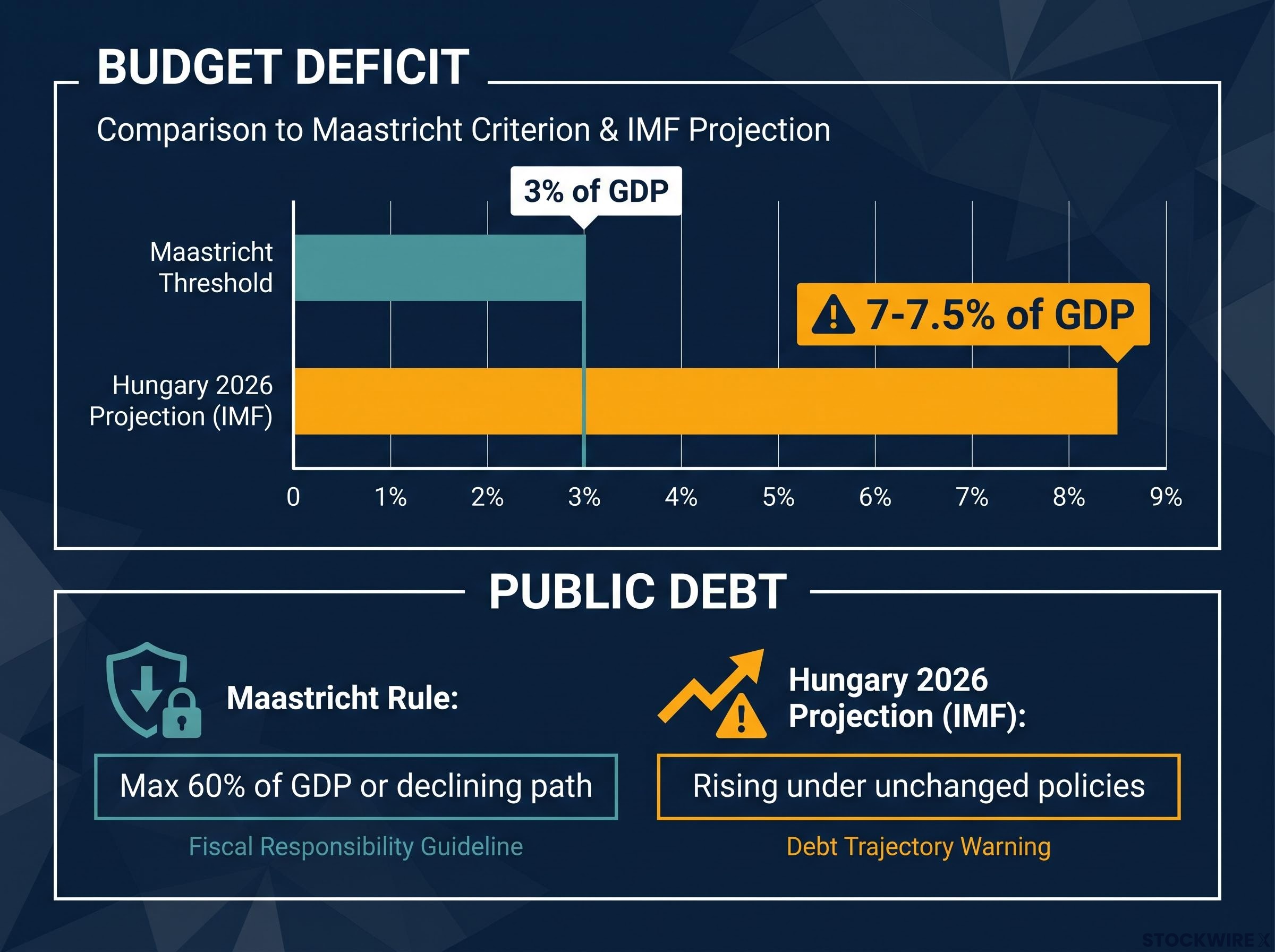
The Maastricht criteria are the entry tests a country must pass before adopting the euro. Two of them are fiscal, and they force budget repair before entry. Other convergence criteria also apply.
| Metric | Maastricht threshold | Hungary position | Source |
|---|---|---|---|
| Budget deficit | Below 3% of GDP | 7-7.5% of GDP projected for 2026 | IMF, October 2026 |
| Public debt | No higher than 60% of GDP, or on a declining path | Ratio projected to keep rising under unchanged policies | IMF, October 2026 |
Commerzbank’s view Tatha Ghose of Commerzbank, writing via FXStreet, argues that euro adoption plans on their own will not lift the forint’s value in any lasting way.
A deficit more than twice the entry ceiling tells you euro membership is a long way off. Any forint rally built on euro hopes therefore has no fiscal foundation beneath it.
Rate pause, new 2.5% target: is the MNB sending the right signal?
The central bank’s side of the story looks calmer at first glance. On 22 September 2026, the MNB’s Monetary Council held its base rate at 5.50% for a third consecutive meeting:
- Base rate: 5.50%
- Overnight deposit rate: 4.50%
- Overnight lending rate: 6.50% (effective 23 September 2026)
- New inflation target: 2.5% CPI from 1 January 2028, keeping the plus or minus 1 percentage point tolerance band
The hold followed the most recent 25 basis point cut. Sources disagree on when that cut happened: Tradingpedia’s account points to July, while The Budapest Times places it in August. The MNB said the decision ensures its inflation target is met sustainably over its policy horizon.
Where analysts disagree on policy
The tension sits in the new target. A goal of 2.5% brings Hungary closer to the European Central Bank’s 2% and in line with regional peers. The IMF welcomed the rate pause but noted the lower target calls for a more hawkish stance, meaning a greater readiness to keep rates high or raise them.
No such signal has arrived. Ghose sees a contradiction between the MNB’s projections, its lower target and the absence of any tightening hint. He points to sharply accelerating month-on-month inflation and argues the forint will not recover meaningfully until the MNB turns substantially more hawkish.
Erste Bank offers the counterweight. It treats a strong forint as disinflationary and cut its average 2026 inflation forecast to 2.8%, though that is a forecast, not an official reading.
A lower target without tighter policy is a promise with nothing behind it yet. You should read forint weakness as a credibility discount, and watch for the MNB’s language to change before its rate does.
What the Hungary forint outlook looks like from here
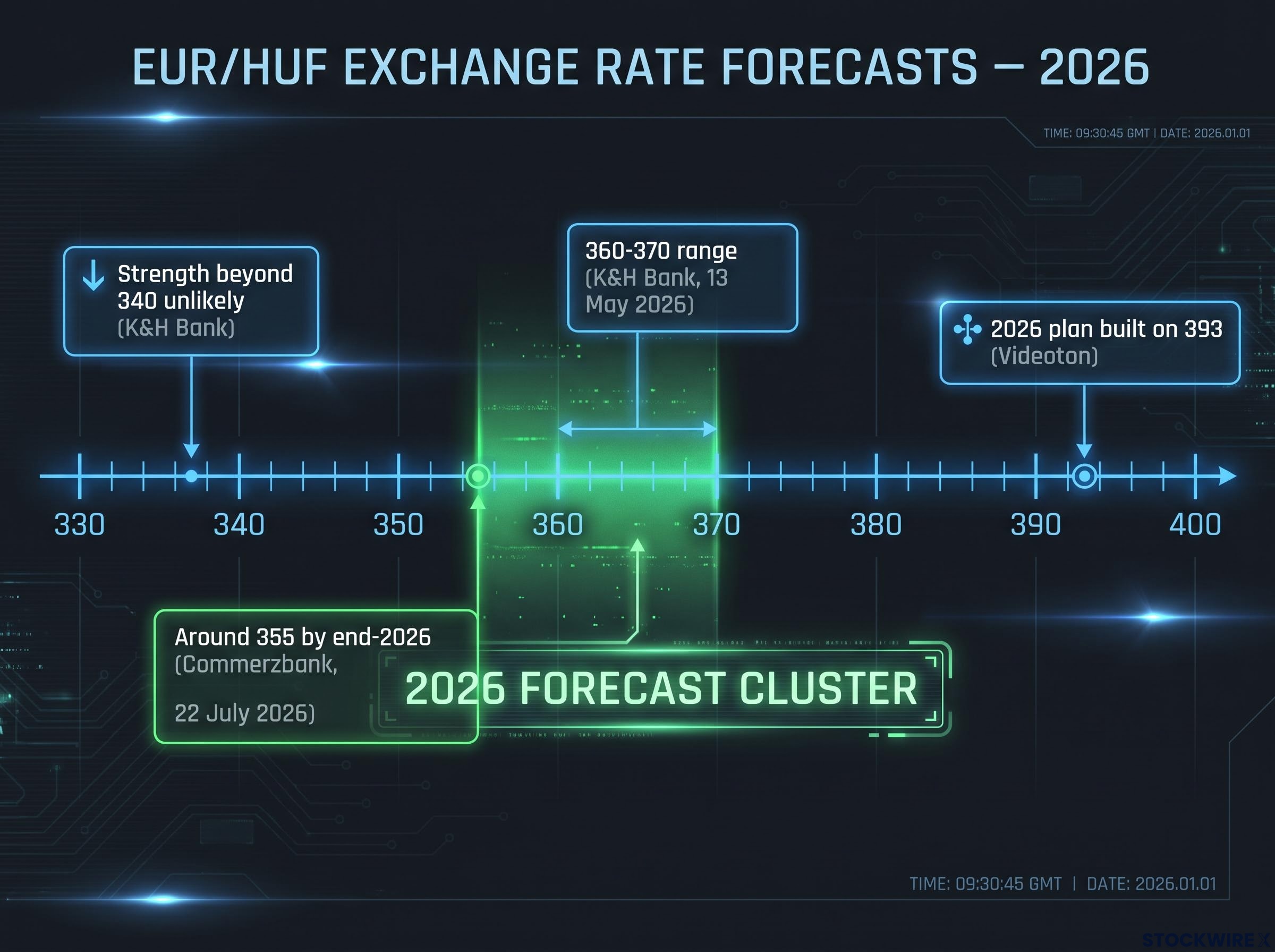
Forecasts for 2026 cluster in a 355-370 range against the euro, though no precise early October spot level was found in the coverage.
| Source | Date | EUR/HUF view | Key driver |
|---|---|---|---|
| K&H Bank (Dávid Németh) | 13 May 2026 | 360-370 range; strength beyond 340 unlikely | Economy can cope with 360; growth 2.6-3% |
| Commerzbank (via Tradingpedia) | 22 July 2026 | Around 355 by end-2026 | Oil prices, 2027 budget details |
| ING | March 2026 | Forint in market favour | Weak dollar, Ukraine peace hopes, EU funds |
The IMF’s deficit figure puts ING’s earlier warning in a harsher light. In March, ING estimated the deficit at 5.2-5.5% of GDP for 2026-27 and cautioned that missing EU funds would raise financing needs. The IMF’s number now sits well above that estimate, which implies more bond issuance and more pressure on the currency.
Exporters have their own stake in the outcome. Videoton built its 2026 plan on a rate of 393 and warned that a stronger forint would hurt exporters.
That leaves two camps. One sees a strong forint driving disinflation, while the other sees inconsistent signals and fiscal risk keeping the currency under pressure. Three signposts will show which camp is right:
- Any fiscal consolidation announcement with concrete measures
- The details of the 2027 budget
- A shift in MNB tone towards tightening
With no consensus among forecasters, your exposure depends on which story you believe will dominate.
What to watch before the forint’s fiscal test arrives
The IMF has pulled the euro story apart from the fiscal story. The MNB’s new target has done the same to its own words and actions. Both gaps now sit in the price of the forint.
The markers ahead are concrete. The 2027 budget will show whether consolidation is real. Any spending or tax package will test the IMF’s three conditions. A tougher tone from the MNB would signal that its target carries weight. If both gaps narrow, the case for forint resilience strengthens; if neither does, the pressure described here is likely to persist.
This article is for informational purposes only and should not be considered financial advice. Investors should conduct their own research and consult with financial professionals before making investment decisions. Past performance does not guarantee future results. Financial projections are subject to market conditions and various risk factors.