
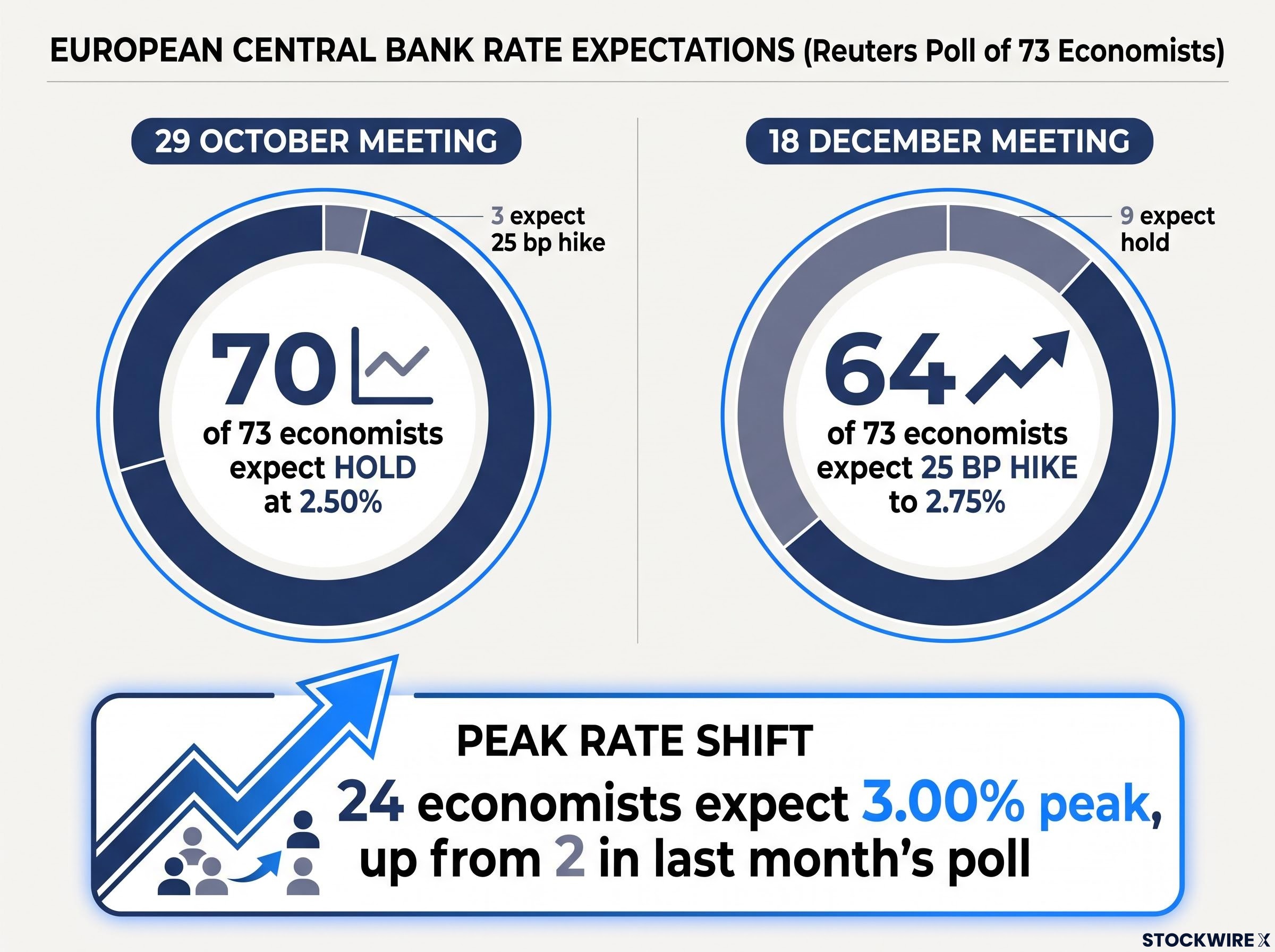
Seventy of 73 economists polled by Reuters expect the European Central Bank (ECB) to sit still on 29 October. Yet 64 of those same economists expect a 25 basis point hike on 18 December. The obvious question is why the ECB would wait two meetings when inflation is running at almost double its target.
The poll ran from 5-8 October 2026 and was published today. It lands as euro area inflation hit 3.8% in September and Brent crude pushed above $100 a barrel on Middle East supply fears.
The ECB has already raised rates twice this year. The debate is no longer about whether tightening is under way. It is about where the peak sits.
Here is what is driving the expected December move, what could push it off course, and how the ECB’s rate and balance sheet decisions feed through to the euro.
Why economists want to wait until December, then hike
Start with the lopsided part. According to the Reuters poll, reported by FXStreet‘s Vishal Chaturvedi, 70 of 73 economists expect the deposit rate to stay at 2.50% in October.
December looks very different. 64 of 73, about 88%, expect a 25 bp rise. A basis point is one hundredth of a percentage point, so the move would lift the deposit rate to 2.75%.
The split points to a patient sequence. The ECB has hiked twice in 2026 and held at its 9-10 September meeting, so the consensus expects one more pause to absorb the data before acting again.
| Meeting or question | Consensus outcome | Number of economists | Change versus prior poll |
|---|---|---|---|
| 29 October meeting | Hold at 2.50% | 70 of 73 | Not reported |
| 18 December meeting | Hike 25 bp | 64 of 73 (about 88%) | Not reported |
| Peak at 2.75% | Majority view | 58% | Not reported |
| Peak at 3.00% | Growing minority | 24 | Up from 2 |
The December call is the headline. The peak-rate shift is the real story.
The quiet shift 24 economists now see the deposit rate peaking at 3.00%, up from just two in last month’s poll.
That jump tells you the debate has moved from “one more hike” towards “a longer tightening cycle”. If you hold euro-denominated bonds or currency exposure, a higher expected peak shapes pricing well beyond December.
The gap between the 2.75% and 3.00% peak camps reflects the wider neutral rate debate, since a deposit rate near 2.50% sits inside model estimates that range from mildly restrictive to still accommodative.
Keep the limits in view. This is 73 economists surveyed over four days, and available reporting names none of them, nor quotes any ECB official on this path.
When big ASX news breaks, our subscribers know first
How oil, inflation and growth data build the case
The hike case did not appear overnight. It has accumulated, print by print, from the oil market outward.
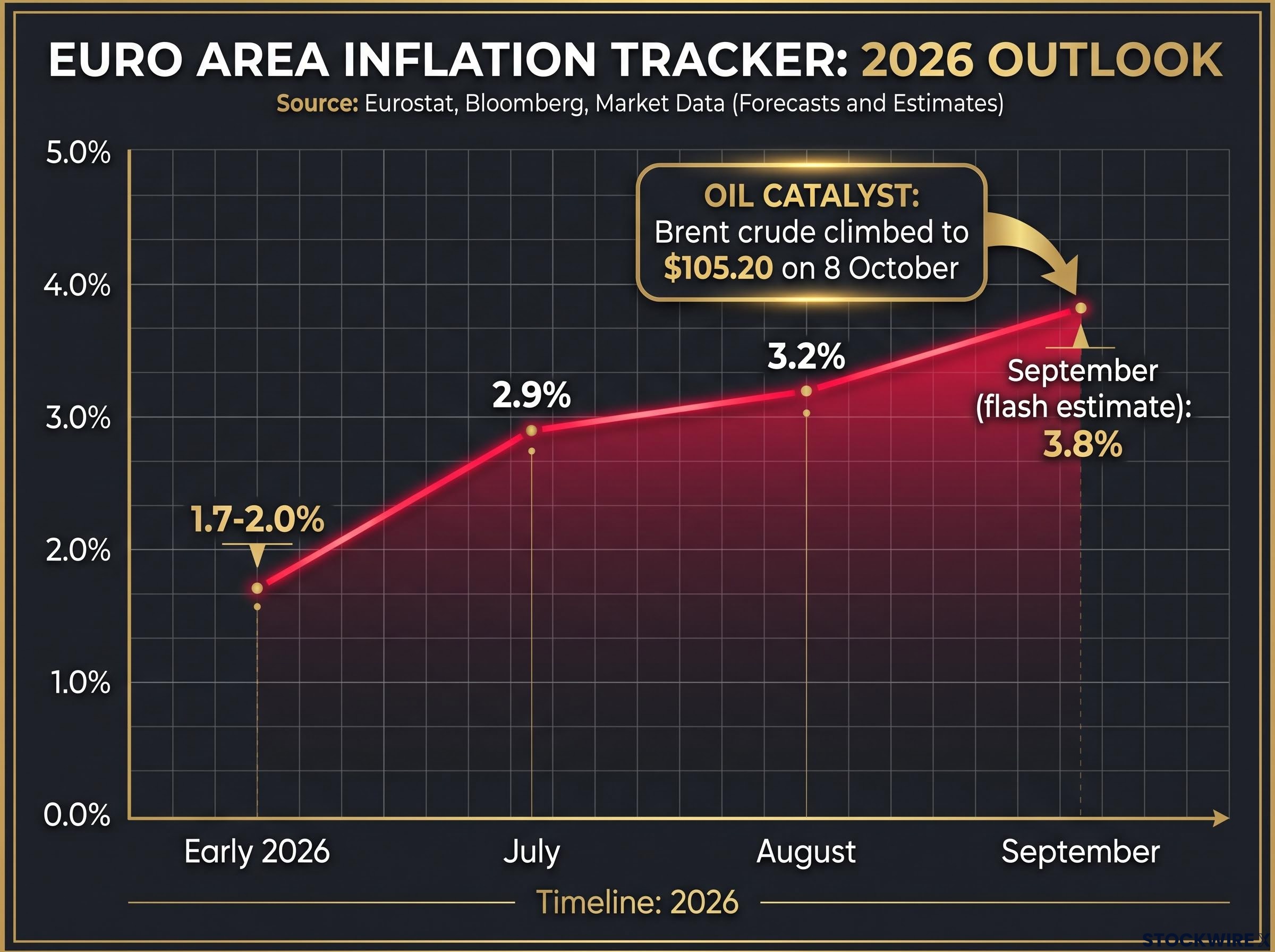
Brent climbed to about $105.20 on 8 October, its highest since 29 September, as attacks on Gulf and Strait of Hormuz shipping intensified, according to Reuters. The conflict is in its eighth month and affects routes that once carried roughly 20% of global oil and fuel shipments.
Euro area inflation, measured by the Harmonised Index of Consumer Prices (HICP), tracked that pressure. It sat around 1.7-2.0% earlier in 2026, rose to 2.9% in July and 3.2% in August (Eurostat final data), then jumped to 3.8% in September’s flash estimate on 2 October.
The path from oil to policy runs in four steps:
- Energy costs: fuel, heating and transport prices rise directly.
- Pass-through: firms lift non-energy prices and workers push for higher wages.
- Expectations: a long overshoot risks unanchoring what households and businesses expect inflation to be.
- Policy response: the ECB tightens to defend credibility, even against a supply shock.
Forecasters agree prices will stay hot. Note that the poll and ECB staff are separate forecasters.
| Metric | Reuters poll | ECB staff (September) | Previous (poll / staff) |
|---|---|---|---|
| Inflation 2026 | 3.0% | 3.0% | 2.9% / unchanged |
| Inflation 2027 | 2.6% | 2.5% | 2.3% / 2.3% |
| Growth 2026 | 1.0% | 0.9% | 0.8% / 0.8% |
| Growth 2027 | 1.2% | 1.4% | Not reported / 1.2% |
The poll also sees Q4 inflation averaging 3.7%, up from 3.3% in Q3, and growth of 1.3% in 2028. Growth is upgraded but still modest, and that is the uncomfortable tension.
The latest ECB staff projections lift 2027 headline inflation to 2.5% and keep core above 2% through 2028, which suggests underlying pressure is not confined to the energy component.
Inflation near 3.8% alongside a firmer growth outlook strips away the usual “too weak to hike” argument. That is why you should read December as a credibility move, not a reluctant one.
Transitory shock or lasting pressure?
One camp argues oil-driven inflation fades once shipping normalises, which favours caution. The other sees lasting changes in routes, security premia or sanctions keeping pressure elevated and the peak rate higher.
The poll’s tilt towards a December hike and a higher peak suggests many economists lean structural. An easing of the conflict would change that picture quickly.
How the ECB’s rate, QE and QT tools move the euro
All of this comes back to one number on your screen, and two balance sheet tools behind it.
The deposit rate
The deposit facility rate is the interest the ECB pays banks on overnight deposits. It is the ECB’s main policy rate. The Frankfurt-based bank, led by President Christine Lagarde, sets it at Governing Council meetings held eight times a year.
A 25 bp rise takes the rate from 2.50% to 2.75%. Higher rates generally draw capital into euro assets, which tends to support the currency.
The deposit facility rate is the true policy signal because it reprices the overnight cost of money for every bank in the system, which is why economists anchor their December call on a move from 2.50% to 2.75%.
QE versus QT
Quantitative easing (QE) means the ECB creates euros to buy bonds. Quantitative tightening (QT) reverses that by halting reinvestment of maturing bonds or selling them.
| Tool | What it does | Typical euro effect | Example |
|---|---|---|---|
| Rate hike | Raises the deposit rate | Supportive | Two hikes in 2026 |
| QE | Creates euros to buy government or corporate bonds | Usually negative | 2009-11, 2015 (APP), pandemic (PEPP) |
| QT | Stops reinvesting or sells bonds, draining liquidity | Usually supportive | Current reduction of asset holdings |
QT also pushes up term premia, the extra yield investors demand to hold longer-dated bonds. That can lift borrowing costs for governments and companies and add bond market volatility.
The ECB has been shrinking its holdings. For you, the practical point is that a December hike and continued QT push the euro the same way, so read them as one story.
What could derail a December hike, and what the euro might do
The 88% consensus looks solid. History offers a reason to test it.
Lessons from 2011 and 2022-23
In 2011, the ECB lifted its main refinancing rate from 1.0% to 1.25% in April and to 1.50% in July on energy and food inflation. As the sovereign debt crisis deepened, the moves were widely criticised and later reversed.
The 2022-23 cycle cut the other way. Facing broad-based inflation after the pandemic and the Russia-Ukraine war, the ECB raised rates rapidly from negative territory.
Two precedents 2011: tightening into a supply shock that reversed proved costly. 2022-23: forceful action against broad inflation restored credibility. Today’s 3.00% peak debate sits between them.
The live risks are:
- Growth damage: ECB staff see growth of only 0.9% in 2026 and 1.4% in 2027.
- Fed divergence: a Federal Reserve pause or cuts could narrow rate gaps and move EUR/USD.
- Council divisions: doves stress transitory energy effects; hawks stress expectations.
- Oil reversal: a fall in crude could weaken the inflation case fast.
The euro’s response is two-sided. A hike read as credible would support it; a hike seen as growth-damaging may lead investors to price earlier cuts, capping gains.
Treat the December call as a base case resting on elevated oil, not a promise. These scenarios are speculative and subject to change as data arrives.
Investors exploring why hikes may not lift the currency will find our deep-dive into the euro’s rate gap with the Fed, which quantifies the 125-150 basis point policy differential.
Reading the ECB’s path: signals to watch between now and 18 December
The poll describes a patient hold followed by a hike, built on oil-driven inflation that most economists do not see as clearly temporary.
Three signals will tell you whether that holds:
- The 29 October meeting tone: any hint of December intent, or hesitation.
- The next HICP release: another print near 3.8% strengthens the hawkish case.
- Brent’s direction: sustained prices above $100 keep pressure on; a retreat weakens it.
If you have euro exposure, watch the gap between the 2.75% and 3.00% peak camps. That spread will likely matter more than December itself.
This article is for informational purposes only and should not be considered financial advice. Investors should conduct their own research and consult with financial professionals before making investment decisions. Past performance does not guarantee future results. Financial projections are subject to market conditions and various risk factors.