
Most traders reading a falling EUR/GBP see a sterling story. ING‘s Chris Turner sees something else: a euro story, too. In a note dated 8 October 2026, he pointed to “quite a sharp drop in EUR/GBP over the last couple of weeks” and named 0.8455/0.8465 as the support zone now in play. That framing shapes any EUR/GBP forecast from here.
Two forces are pushing at once. France’s fiscal and political strain is adding a premium to the euro, while markets debate whether the Bank of England (BoE) could hike as soon as November.
The UK bond market made the noise louder. On 1 October, the 30-year gilt yield passed 6% for the first time since 1998.
This piece sets out the levels that matter, the two drivers behind them, and the developments that could send the pair the other way. Information is current as of 8 October 2026. The exact spot rate was not available in the research, so check live pricing before acting on any level discussed here.
Why is EUR/GBP testing its yearly low near 0.8455?
The chart shows the pressure building in stages. According to FXStreet‘s technical analysis on 7 October, the cross recently failed at 0.8500. That rejection left the yearly low at 0.8455 exposed, a sign that sellers had taken control.
Each failed rally turns a former level into a ceiling. Above 0.8500, FXStreet places resistance at 0.8527 and then 0.8550, and treats moves toward those levels as chances to sell. That view has not been independently confirmed, but it fits the direction of travel.
Below sits the floor ING is watching.
Strong support ING’s Chris Turner describes 0.8455/0.8465 as “strong support”, a zone likely to be tested if a November BoE hike starts to look probable.
Turner also flags an outside risk of 0.8400. His logic is conditional: that level comes into view only if markets price in a November hike while France’s budget is still unresolved. Without both conditions, he sees a deeper break as the lesser risk.
| Level | Type | Source | What it signals |
|---|---|---|---|
| 0.8550 | Resistance | FXStreet (technical) | Upper ceiling; rallies here seen as selling opportunities |
| 0.8527 | Resistance | FXStreet (technical) | First hurdle for any rebound |
| 0.8500 | Rejected level | FXStreet (technical) | Recent failure that opened the move lower |
| 0.8455/0.8465 | Strong support | ING (Turner) | Yearly low zone; test likely if a November hike looks probable |
| 0.8400 | Outside risk | ING (Turner) | Possible if a hike is priced in and France’s budget stays unresolved |
Sterling is already at its strongest against the euro since June 2025. The clustering of levels tells you the bias is lower, but 0.8455/0.8465 is where the bearish case has to prove itself. A clean break there is a genuine signal; a hold suggests the selling has run its course for now.
When big ASX news breaks, our subscribers know first
How much of the fall is a French risk premium?
The surprise is that sterling may not be doing most of the work. Turner argued that “big declines” in both EUR/GBP and EUR/CHF point to a larger risk premium priced into the euro, a comment relayed by Yahoo Finance on 5 October (not independently confirmed). When the euro falls against two different currencies at once, the common factor is the euro itself.
France is the main source of that premium. The stress runs through three channels:
- Deficit: Euronews reports the 2026 deficit is expected at about 5.4% of GDP, with a 5% target for 2027, still well above the EU’s 3% ceiling (figures not independently confirmed).
- Politics: Prime Minister Sébastien Lecornu is reportedly preparing a €54 billion austerity budget, according to TechTimes, which must pass a fragmented parliament ahead of next spring’s presidential race.
- Spreads: The gap between French and German 10-year yields has widened toward levels last seen in the euro crisis.
That gap is the OAT-Bund spread: the extra yield investors demand to hold French government bonds instead of German ones. A wider spread means markets see France as a bigger credit risk.
France’s debt crisis rests on a debt-to-GDP ratio near 118% and a minority government that struggles to pass budgets, which is why analysts increasingly see a rollover as likelier than intact passage.
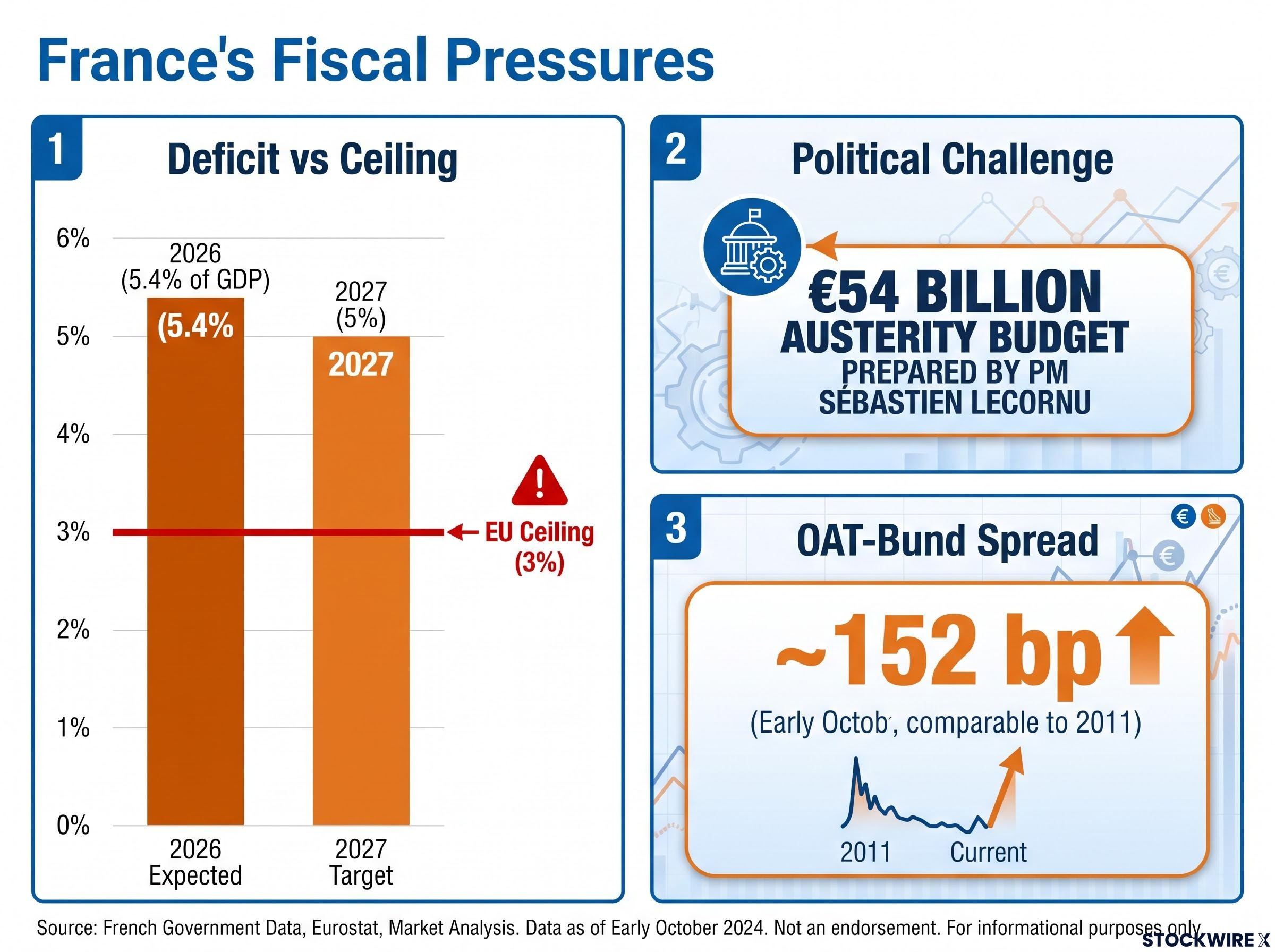
Echoes of the euro crisis Euronews references a spread of about 152 basis points (bp), comparable to 2011 levels. Reuters put it at about 104 bp on 18 September, the highest since 2012.
Turner reportedly called a jump to around 127 bp “quite an alarming move”, arguing it could constrain European Central Bank (ECB) tightening (not independently confirmed).
Why the spread figures differ
The readings conflict mainly because they were taken at different times. Reuters’ 104 bp reading dates from mid-September, while Politico and Euronews cite roughly 145-152 bp in early October, so the later figures are more recent.
Politico’s mid-September starting point of about 0.55 percentage points also differs from Reuters’ figure for the same period. Treat any exact basis-point level as indicative, and focus on the direction: wider.
No 2026 rating actions on France tied to the budget talks were found. The calendar remains the worry. Reuters warns that a government collapse without a budget, or a run-off between Jean-Luc Mélenchon and Marine Le Pen, could push spreads wider. For you, that means this part of the EUR/GBP move can extend or reverse on Paris headlines alone, whatever the BoE decides.
Can the Bank of England turn a hawkish hope into a November hike?
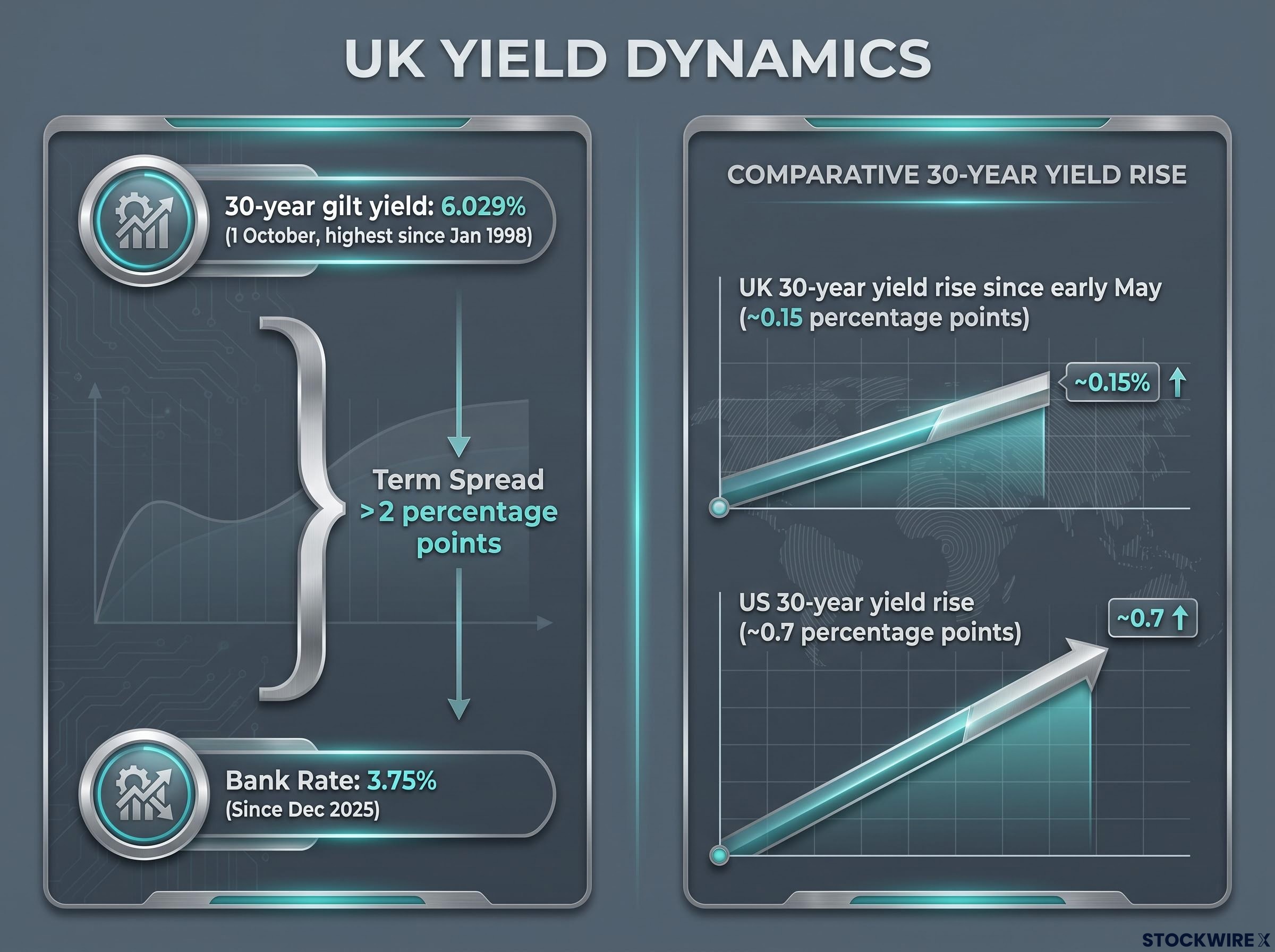
If Paris supplies half the story, London supplies the other half, and the gilt market is shouting. Reuters reports the 30-year yield reached 6.029% on 1 October, the highest since January 1998, using LSEG data. Bank Rate has sat at 3.75% since December 2025, leaving a term spread of more than 2 percentage points.
A term spread is the gap between short-term and long-term interest rates. A steep one can support a currency by improving carry, the return earned from holding higher-yielding assets.
The headline flatters the UK, though. Since early May, the UK 30-year yield has risen about 0.15 percentage points, against roughly 0.7 for the US 30-year. The gilt move is described as largely driven by external factors, so it says more about global bonds than about British strength.
The chain from bond market to currency runs like this:
- A global bond rout lifts long-dated yields across developed markets.
- Higher gilt yields follow.
- Markets begin pricing a possible BoE hike.
- Centrist Monetary Policy Committee (MPC) members decide whether that hike has majority support.
- Sterling reacts to the signal.
Step four is where the case gets thin. The hawks have already spoken, so attention has moved to Governor Andrew Bailey and Deputy Governor Claire Lombardelli. Any sign that both would back a hike could push EUR/GBP lower on the day and align the BoE with other central banks that are tightening.
Earlier in 2026, ING observed up to 60 bp of tightening priced into UK money markets, a view that has since been superseded (not independently confirmed). What remains unknown is significant:
- The latest MPC vote breakdown
- The date of the next MPC decision
- A precise market-implied probability of a November hike
That gap matters for your read of the pair. The gilt rout is not, on its own, a reason to back sterling. Only a clear signal from Bailey and Lombardelli turns it into a rate-differential argument for further EUR/GBP downside.
For readers weighing the November hike case, our full explainer on the BoE’s September hold unpacks the 6-3 vote and the upgraded inflation forecast.
What could reverse the EUR/GBP slide?
With both drivers pointing the same way, the obvious question is what breaks the trade.
A quick primer: risk premium and rate differentials
A risk premium is the extra return investors demand for holding an asset they see as riskier. If France’s budget fails, investors may ask more to hold euro assets, which weakens the euro.
A rate differential is the gap between interest rates in two economies. If the BoE hikes while the ECB holds, sterling assets pay relatively more, drawing money into the pound. Right now, both forces lean against the euro, which explains why this pair is moving.
The core euro valuation drivers, namely ECB policy, rate differentials and sovereign fragmentation risk, explain why a rate differential argument can turn quickly when political risk flares.
The same logic works in reverse. FXStreet raises a sharper question about whether very high long-term yields are good or bad for the pound, noting markets may eventually read them as a sign of UK fiscal stress rather than attractive carry.
| Scenario | Trigger | Likely EUR/GBP effect | Watch for |
|---|---|---|---|
| BoE disappoints | No hike or dovish guidance | Higher, as priced-in tightening unwinds | Bailey and Lombardelli commentary |
| Gilts read as a credibility problem | Focus shifts to UK debt dynamics | Higher, as sterling loses its carry appeal | Rating agency or major investor warnings |
| French consolidation | €54 billion package passes and is implemented | Higher, as the euro risk premium eases | Budget votes and spread direction |
| Hawkish ECB surprise | ECB firmer than markets expect | Higher, limiting downside despite wide spreads | ECB guidance and euro area inflation data |
History supports caution. The 2011-2012 euro crisis and sterling’s sharp fall after the 2016 Brexit vote both show political shocks can move currencies hard, and that those moves can reverse. Turner has also reportedly argued that credible EU-UK re-engagement would likely support sterling (not independently confirmed).
Views shift fast. ING’s own earlier projection had EUR/GBP heading toward 0.87 in Q4 2026, a call now superseded. No major bank calls for sustained upside from current levels were found.
That lopsided consensus is a risk in itself. When nearly everyone is positioned for a lower EUR/GBP, a French stabilisation or a UK fiscal scare could make any reversal sharper and more painful for those on the same side.
Three signals to watch before 0.8455 gives way
The two forces reinforce each other. French risk weakens the euro while the prospect of BoE tightening lifts sterling, and both converge on the 0.8455/0.8465 zone.
Your decision points come down to three signals:
- Whether Bailey and Lombardelli back a November hike.
- Whether France’s budget passes and spreads narrow or widen.
- Whether gilt markets keep reading high yields as carry or start treating them as a fiscal warning.
The spot level, hike probability and MPC date were not confirmed, so check live data first. If a priced-in hike meets an unresolved French budget, ING’s 0.8400 outside risk comes into view. A failure on either front reopens a rebound toward 0.8527/0.8550.
Forecasts and projections cited here are speculative and subject to change with market conditions. Past performance does not guarantee future results.
This article is for informational purposes only and should not be considered financial advice. Investors should conduct their own research and consult with financial professionals before making investment decisions.